Best AI Copywriting Tools in 2026: 8 Tools Compared
Compare the best AI copywriting tools for 2026, from Jasper and Copy.ai to budget and SEO options, with pricing, free plans, and the best fit for each writer.
- Editor's choice
 Jasper
Brand voice for marketing teams
Starts at$69 per monthVisit jasper.aiFull review - Great alternative
 Copy.ai
Short-form and sales copy
Starts at$29 per monthVisit copy.aiFull review - Also consider
 Writesonic
SEO articles and visibility
Starts at$79 per monthVisit writesonic.comFull review
TL;DR:
- Jasper is the strongest pick for marketing teams that need consistent brand voice across long campaigns, while Copy.ai suits short-form and sales workflows.
- Rytr is the cheapest usable paid option for solo writers, and general chat tools such as Claude cover many drafting jobs for a lower price.
- SEO tools such as Surfer and Frase add research and scoring that a general writer does not provide, which matters for search-facing articles.
- AI copy still needs human editing for facts, tone, and claims, so budget editing time alongside any subscription.
Quick comparison
| Tool | Best for | Starts at | Free plan? | |
|---|---|---|---|---|
| Jasper | Brand voice for marketing teams | $69 per month | No | Visit |
| Copy.ai | Short-form and sales copy | $29 per month | Yes | Visit |
| Writesonic | SEO articles and visibility | $79 per month | No | Visit |
 Rytr | Budget solo drafting | $9 per month | Yes | Visit |
 Anyword | Performance-scored ad copy | $49 per month | No | Visit |
 Surfer | SEO content optimization | $49 per month | No | Visit |
 Frase | Research-led content briefs | $49 per month | No | Visit |
 Claude | Natural long-form drafting | $20 per month | Yes | Visit |
The best AI copywriting tools
We compared official feature pages and pricing pages for tools that write marketing copy, not only chatbots that answer questions. The list below covers brand voice, short-form copy, SEO content, and budget drafting, because copywriting is several jobs at once. A tool that writes a great ad may be a poor fit for a long article, and the reverse is also true.
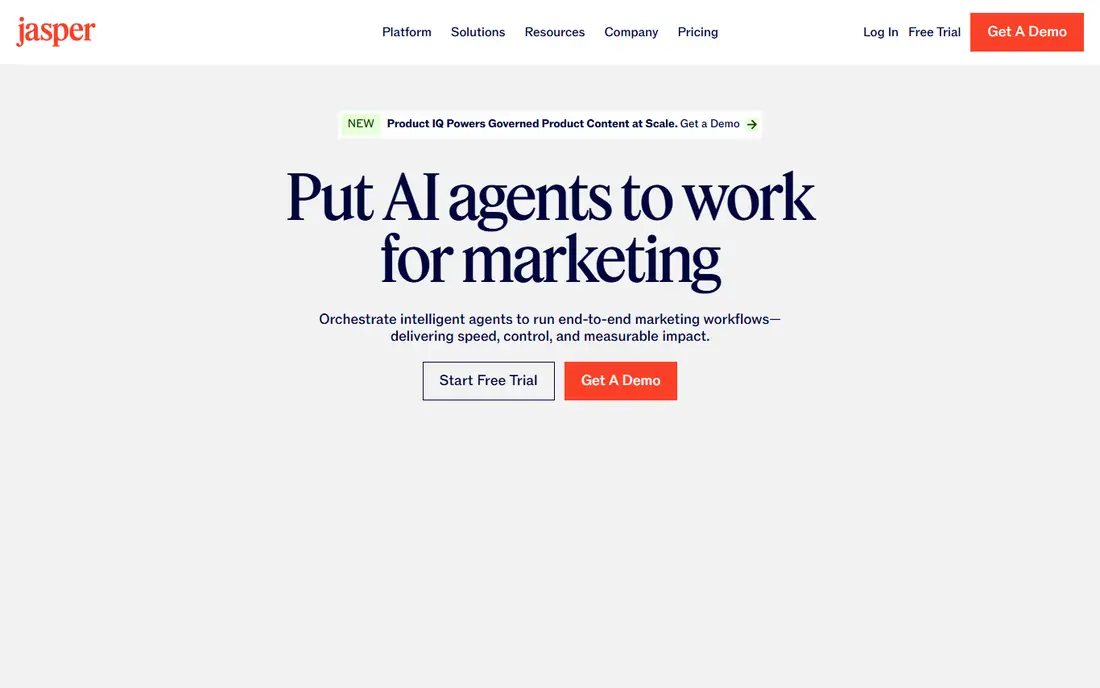
Jasper is aimed at marketing teams that need many writers, or one AI tool, to sound like the same brand every time. You can train brand voice from samples, store knowledge about products and style, and build campaign workflows that move from brief to draft to review. That structure helps a team that publishes often and cannot afford a different tone on every page.
The main drawback is price. At $69 per month for one seat on the monthly plan, Jasper costs far more than a solo writer's budget tool, and each extra teammate adds another seat. There is no free plan, only a trial, so you should test brand voice on your own samples before committing. For a team that values consistency and volume, the cost can be justified. For a solo writer, cheaper tools below cover most of the same drafting work.
- Strong brand voice controls
- Campaign workflows and knowledge assets
- Team collaboration
- High per-seat price
- No free plan, only a trial

Copy.ai has shifted toward go-to-market workflows, but it remains a strong tool for short marketing copy, email sequences, social posts, and product descriptions. The entry plan covers five seats, which makes it unusually affordable for a small team, and workflow tools help repeat the same research and drafting steps for many prospects or products. For sales and marketing operations, that repeatability matters more than literary polish.
The catch is the jump to the next tier, which is far more expensive, and the fact that long-form articles often need heavier editing than Jasper or Claude produce. If your main job is short copy and repeatable workflows, Copy.ai is good value. If your main job is long, nuanced articles, test a long draft on the trial or free plan before you rely on it for client work.
- Affordable team seats
- Workflows for sales and marketing
- Many short-form templates
- Long-form output needs more editing
- Higher workflow tier is much more expensive
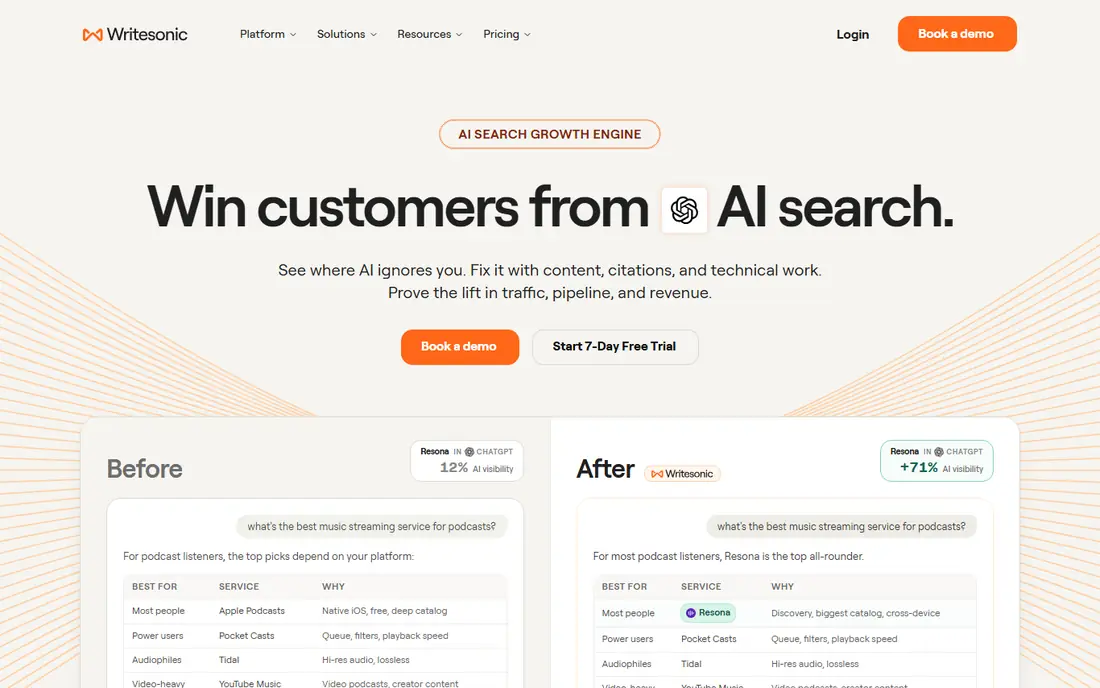
Writesonic suits content teams that publish search-facing articles at volume and want to track how those articles appear in AI search results as well as classic search. Its article workflows combine research, drafting, and optimization steps, and its visibility tools help a team see which pages are being cited or summarized. That combination is useful for a brand that depends on search traffic and wants a single workflow from brief to published draft.
The drawback is price and the need for human review. At $79 per month on annual billing for the starter plan, Writesonic is not a casual purchase, and its articles still need fact-checking, source checks, and editing for tone. For a content operation that publishes many articles per month, the workflow savings can justify the cost. For a solo blogger, a cheaper writer plus a separate SEO tool may cost less overall.
- SEO article packs
- AI-search visibility tracking
- Bulk content workflows
- Higher starting price
- Article output still needs fact-checking
Rytr is the tool we would suggest first to a solo writer on a tight budget. The free plan covers 10,000 characters per month, and the unlimited paid plan costs $9 per month, or less on annual billing. You can pick a use case, such as a blog outline, ad, email, or product description, choose a tone, and get a draft in seconds. For short copy and first drafts, that is enough to beat a blank page.
The limit is depth. Rytr's output tends to be simpler and more generic than Jasper or Claude, and long articles need more outlining and editing from you. It also lacks the brand governance and SEO scoring of the premium tools above. As a budget drafting aid, however, it is excellent value, and the free plan lets you test it on real work before paying anything.
- Very low price
- Permanent free plan
- Many use cases and tones
- Output is simpler than premium tools
- Long-form structure needs more guidance
Anyword is built for performance marketers who need to choose between many versions of an ad, headline, or landing page before spending on traffic. It scores copy against performance data and helps you generate variants for different audiences and channels. That scoring step can save testing budget, because you start with the strongest candidates rather than guessing which headline to run first.
The honest limit is that a score is a prediction, not a promise. Real results still depend on offer, audience, creative, and landing page, so you should treat Anyword scores as a shortlist, not a verdict. Anyword is also less suited to long editorial writing than Jasper or Claude. For ad and landing page work where small wording changes affect results, it earns its place on this list.
- Predictive scores for ad and landing page copy
- Brand voice controls
- Data-driven variants
- Scoring is a prediction, not a guarantee
- Less suited to long editorial articles
Surfer is less a writer and more a guide for writers. Its content editor scores a draft against pages that already rank for a topic, suggests terms, headings, and structure, and flags gaps that may hold a page back. That makes it a strong companion to any AI writer, because it turns vague SEO advice into a concrete checklist while you draft or edit.
The drawback is that Surfer does not write a finished article on its own, and a high score does not guarantee good writing or accurate facts. You still need a writer or AI tool to produce the draft, and you still need to edit for clarity and truth. For a content team that already writes well but wants search performance, Surfer is a practical addition. For a solo writer on a budget, it may be more than you need at first.
- Scores drafts against ranking pages
- Content editor with keyword guidance
- Audit tools
- No free plan
- Writing quality depends on the writer, not only the score
Frase starts before drafting, by researching the pages that rank for a topic and turning them into a brief with headings, questions, and key points. That research step helps a writer cover what readers actually ask, rather than guessing at structure. You can then draft inside Frase, using the brief as a guide, and check the draft against the same research.
The limit is learning time and publishing volume. Frase rewards a team that publishes regularly and follows a brief process, while a casual writer may not use enough of it to justify $49 per month. It also needs human judgment, because ranking pages can contain errors or outdated claims that should not be copied. For a content operation that values research-led briefs, Frase is a strong tool.
- Builds briefs from ranking pages
- Outlines and question research
- AI drafting inside the brief
- Interface takes time to learn
- Best value comes with a regular publishing schedule
Claude is a general AI assistant, not a dedicated copywriting platform, but it belongs on this list because many writers now use it as their main drafting tool. Its long-form prose tends to read naturally, and it is strong at editing, restructuring, and summarizing research. The free tier covers light use, and the paid plan costs $20 per month, which is far less than Jasper for a solo writer.
The trade-off is specialization. Claude lacks the brand voice governance, workflow automation, and SEO scoring of the dedicated tools above, so a marketing team may still need one of those for scale. For a solo writer, freelancer, or small team that mainly needs good drafts and sharp editing, Claude is often the best value, and it pairs well with Surfer or Frase when SEO scoring matters.
- Natural long-form prose
- Strong editing and research help
- Free tier for light use
- Not a dedicated marketing platform
- Lacks brand governance and SEO scoring
How we picked these
We compared official feature pages and pricing pages, and we favored tools that are available in October 2026 for the copy jobs named in the list, from ads to long articles. We looked for a clear drafting or optimization job, usable free or trial options where offered, and honest limits on output quality. We also weighed price per seat, because a tool that looks affordable for one user can become expensive for a team.
What to check before you subscribe
Start with the copy you actually produce each week, such as ads, emails, product descriptions, or articles, and match the tool to that job. Test each finalist on the same brief, using your own brand samples and facts, and compare the editing time each draft needs. A tool that produces a fast draft but needs an hour of fixes is not faster than a tool that produces a cleaner draft more slowly.
Next, check the pricing details that affect teams, including seats, word or credit limits, and the cost of the next tier. Finally, set an editing rule for every AI draft, covering facts, claims, prices, and tone, and keep a human review step for anything that reaches customers. AI copy saves time on first drafts, but accuracy and brand trust still depend on the person who approves the final version.
FAQ
What is the best AI copywriting tool for small businesses?
Copy.ai and Rytr are strong choices for small businesses, because Copy.ai covers team seats affordably and Rytr covers solo drafting at a very low price. Jasper suits a larger marketing team that needs brand consistency, while Claude is a good all-round drafting tool for a solo owner. Pick based on whether your main job is short copy, long articles, or ads.
Can AI copywriting tools replace a human copywriter?
No, not for finished work that affects customers, search rankings, or brand trust. AI tools are excellent for first drafts, outlines, variants, and editing help, but they can invent facts, miss nuance, and repeat generic phrasing. A human should check facts, claims, and tone, and shape the final copy for the audience and goal.
Which AI copywriting tool is best for SEO content?
Writesonic, Surfer, and Frase are the strongest SEO-focused options on this list, because they combine research, drafting, and scoring for search-facing content. Surfer and Frase work best as guides for a writer or AI draft, while Writesonic bundles article workflows with visibility tracking. For best results, pair an AI draft with human editing and a Surfer or Frase check.
Is there a free AI copywriting tool worth using?
Yes, Rytr has a permanent free plan, Copy.ai offers a free tier in some plans, and Claude has a free tier for light use. Free plans usually limit words, features, or seats, so they suit testing and occasional drafting better than high-volume publishing. Try a free plan on real briefs before paying, and check the current limits on the vendor site.
How much does AI copywriting software cost?
Prices on this list range from free plans and $9 per month for Rytr to $69 per month per seat for Jasper and $79 per month for Writesonic, with several tools at $49 per month. Team costs depend on seats, credits, and the next tier, so check the pricing page for your team size. Always test editing time as well as price, because a cheap draft that needs heavy fixes can cost more in hours.
What is the best AI tool for copywriting ads?
Anyword is the strongest dedicated choice for ads, because it scores variants against performance data before you spend on traffic. Copy.ai is also strong for short ad and email copy at a lower price, while Jasper suits brand-consistent campaigns. Whichever tool you choose, test real ads with real audiences, because a predicted score is not a substitute for measured results.