Best AWS Glue Alternatives in 2026: 10 Data Integration Tools Compared
Searching for aws glue alternatives for ETL, ELT, and data pipelines at scale? We compare 10 tools on connectors, pricing, and team fit. - 2026 guide.
- Editor's choice
 Fivetran
Managed ELT connectors
Starts atSee websiteVisit fivetran.comFull review - Great alternative
 Airbyte
Open source flexibility
Starts atSee websiteVisit airbyte.comFull review - Also consider
 Stitch
Simple row based ELT
Starts at$100 per monthVisit stitchdata.comFull review
TL;DR:
- AWS Glue is a serverless ETL and data integration service inside AWS, so replacements range from managed ELT tools to code first transformation platforms, depending on how much coding your team wants to do.
- Fivetran and Airbyte suit teams that want managed connectors with little code, while dbt Cloud suits teams that want SQL based transformation in their warehouse.
- Azure Data Factory and Google Cloud Dataflow suit teams already committed to Azure or Google Cloud, with native integration as the main advantage.
- Usage based pricing can be hard to forecast, so model rows, events, or compute hours at real volume before choosing.
- Glue is a code heavy engine, not a connector product, so a managed ELT tool will feel very different in day to day use.
Quick comparison
| Tool | Best for | Starts at | Free plan? | |
|---|---|---|---|---|
| Fivetran | Managed ELT connectors | See website | Yes | Visit |
| Airbyte | Open source flexibility | See website | Yes | Visit |
| Stitch | Simple row based ELT | $100 per month | Free trial | Visit |
 Hevo Data | No code mid market ELT | See website | Yes | Visit |
 Talend | Enterprise data integration | See website | Free trial | Visit |
 Informatica | Enterprise governance | See website | Free trial | Visit |
 Azure Data Factory | Azure native pipelines | See website | Free trial | Visit |
 Google Cloud Dataflow | Google Cloud streaming and batch | See website | Free trial | Visit |
 dbt Cloud | SQL transformation in warehouse | See website | Yes | Visit |
 Matillion | Warehouse native transformation | See website | Free trial | Visit |
The best AWS Glue alternatives
AWS Glue helps teams discover, clean, and move data into AWS analytics services, with Spark based jobs, a data catalog, and crawlers that infer schemas. It is powerful inside AWS, but it needs code, and it does not offer the large managed connector library of a modern ELT tool. The tools below cover that wider ground. Note that this list has 10 products, matching the title number, because the ETL field splits clearly between managed connectors, enterprise suites, and warehouse transformation.
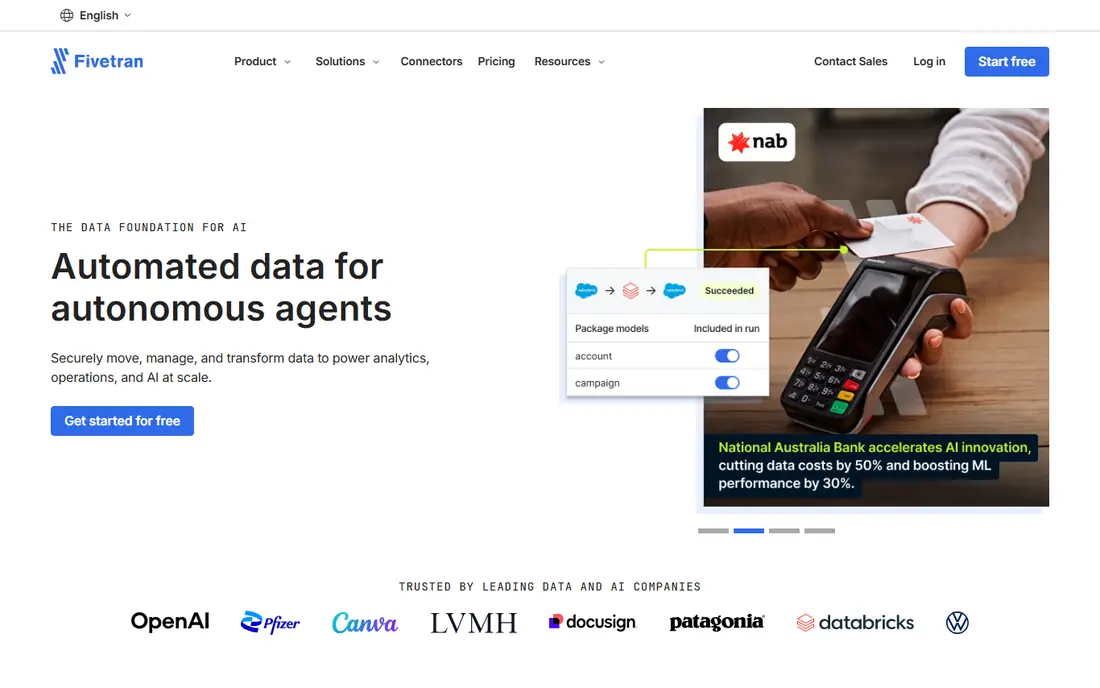
Fivetran is the leading managed ELT choice for teams that want data moved with little code. It offers hundreds of managed connectors, handles schema changes automatically, and loads data into warehouses such as Snowflake, BigQuery, and Databricks. Once a connector is set, it runs on schedule without a pipeline team babysitting each job.
The main cost risk is monthly active rows, billed per connector in recent pricing. High churn tables, frequent full refreshes, and many connectors can push the bill up quickly. For teams that value reliability and connector depth over code control, Fivetran is a strong Glue replacement, but budget it with real row numbers, not a demo estimate.
- Large managed connector library
- Automated schema changes
- Strong reliability
- Usage based pricing by monthly active rows
- Costs rise with churn
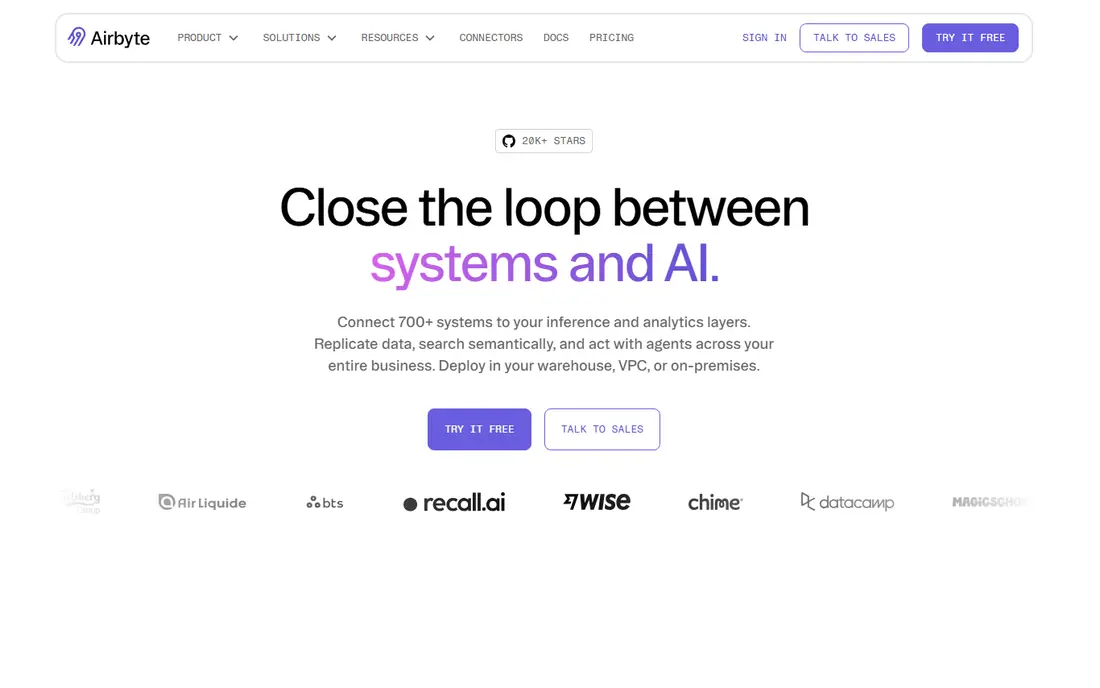
Airbyte gives teams a choice that Glue does not: run it open source yourself, or use Airbyte Cloud and pay by credits. The connector catalog is large, with community and partner connectors alongside official ones, and it supports common warehouses and lakes. That flexibility suits teams that want to avoid vendor lock in or that need a connector not offered elsewhere.
Self hosting is free in software terms but costly in engineering time, since you manage upgrades, scaling, and monitoring. Cloud pricing is credit based, so high volume syncs can add up. For a team that wants open source control with a managed path when ready, Airbyte is a practical pick.
- Open source option
- Large connector catalog
- Cloud and self hosted choices
- Cloud pricing is credit based
- Self hosting needs engineering time
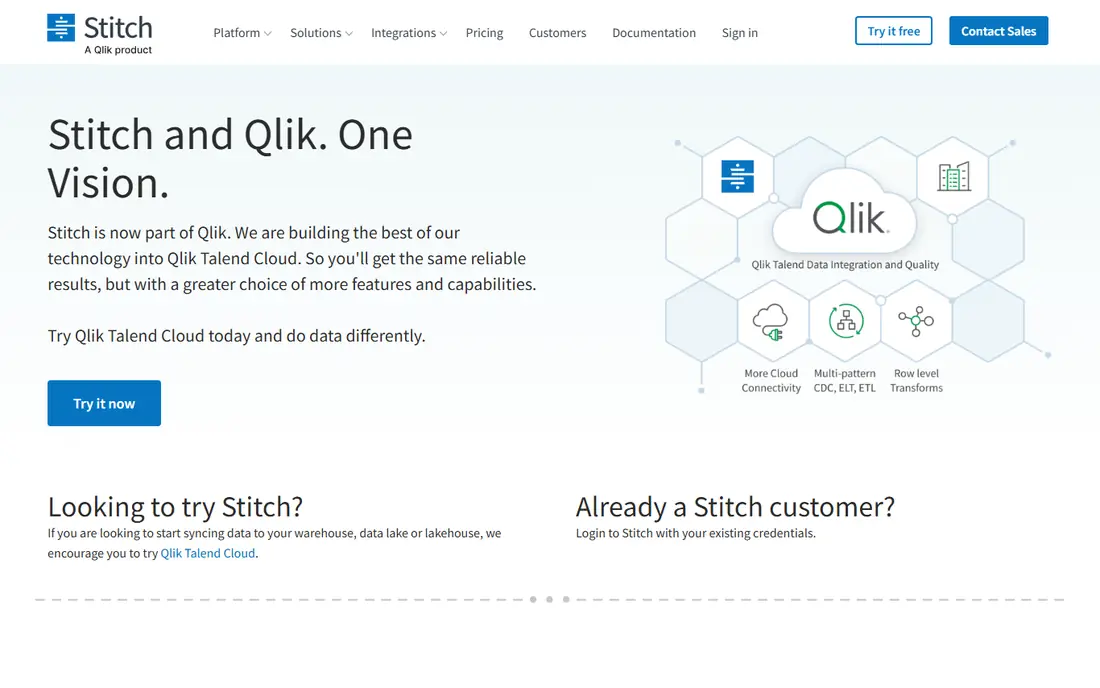
Stitch, now part of Talend, offers simple ELT with row based tiers, starting at $100 per month for a set row volume. Setup is straightforward: connect a source, pick a destination, and let replication run. That simplicity suits small to mid sized teams that need reliable replication without a data engineering team.
Governance, transformation, and advanced monitoring are lighter than in Fivetran or Informatica, and the product future is tied to Talend Cloud. For a team that wants predictable, simple replication at a clear price, Stitch remains a useful Glue alternative, especially for common SaaS and database sources.
- Simple row tier pricing
- Easy setup
- Good for small to mid sized teams
- Fewer governance features than enterprise tools
- Product direction tied to Talend
Hevo Data is a no code ELT platform with a visual pipeline builder, more than 150 sources, and destinations including major warehouses. It suits mid sized teams that want to build pipelines without writing Spark code, and its free tier helps with testing. Transformations can be done in the pipeline or in the warehouse, depending on team preference.
Pricing is event based, so tables that update often will generate many events and raise costs, much like Fivetran row billing. Check how your source tables change before committing, and use selective sync to avoid replicating tables you do not need. For no code teams, Hevo is a strong, approachable Glue replacement.
- No code pipelines
- Event based tiers
- Good support for mid sized teams
- Every update counts as an event
- High frequency tables raise costs
Talend is an enterprise data integration suite with visual job design, data quality, governance, and a large connector set. It suits large orgs that need complex transformations, compliance controls, and integration across on premise and cloud systems. Talend Cloud brings Stitch style replication together with broader integration tools.
Pricing is enterprise and quote based, and the platform takes time to learn, especially for teams used to simple ELT. Small teams will likely find it more than necessary. For a large company replacing Glue as part of a wider integration program, Talend offers depth that simpler ELT tools do not.
- Broad integration and governance
- Visual job design
- Strong data quality tools
- Enterprise pricing
- Learning curve for new teams
Informatica is a long running enterprise data management vendor, now focused on cloud data integration, governance, and catalog. It offers data integration, quality, master data, and governance in one platform, which helps regulated orgs track lineage, ownership, and compliance. That governance depth is a key reason large enterprises choose it over a simple ELT tool.
Cost and complexity are the trade offs. Pricing is quote based, implementation needs skilled staff, and small teams will find the platform heavy. For an enterprise that needs governance alongside integration, Informatica is a credible Glue alternative, especially where audit and lineage matter.
- Strong governance and catalog
- Broad enterprise connectors
- Cloud data management
- Quote based pricing
- Complex for small teams
Azure Data Factory is Microsoft cloud native data integration service, with visual pipelines, copy activities, and data flows for batch and streaming work. It integrates with Azure Synapse, Databricks, Blob Storage, and Microsoft 365 sources, making it natural for teams already on Azure. Pricing is based on operations and compute units, so small jobs can be cheap while large pipelines need careful modeling.
It is Azure focused, so multi cloud teams should look at Fivetran, Airbyte, or Talend instead. For an Azure shop that wants a Glue equivalent without leaving Microsoft, Data Factory is the most direct replacement, with a visual builder that lowers the code barrier compared with Glue Spark jobs.
- Native Azure integration
- Visual pipelines
- Serverless and managed options
- Azure focused
- Costs depend on operations and compute
Google Cloud Dataflow is a managed service for batch and streaming pipelines built on Apache Beam. It autoscales workers, handles streaming with low latency, and integrates tightly with BigQuery, Pub Sub, and other Google services. That makes it a strong pick for real time analytics and event processing inside Google Cloud.
Dataflow needs Beam knowledge, so teams without Beam experience face a learning curve, and it is Google Cloud focused. For a Google Cloud team that wants a managed pipeline engine with streaming strength, Dataflow is a powerful Glue alternative. For a team that wants no code connectors, Fivetran or Hevo will be faster to adopt.
- Unified batch and streaming
- Autoscaling
- BigQuery integration
- Needs Apache Beam knowledge
- Google Cloud focused
dbt Cloud is not a direct Glue replacement on its own, because it transforms data already in a warehouse rather than loading it from sources. That distinction matters, and it is why many teams pair dbt with Fivetran or Airbyte. dbt lets analysts write SQL models, test them, document them, and version them in Git, turning warehouse data into clean, trusted tables.
The strength is analytics engineering workflow: testing, docs, and collaboration that Glue Spark jobs do not offer in the same way. The limit is that you still need a loader for sources. For a team that has moved to ELT and wants transformation owned by analysts in SQL, dbt Cloud is an essential part of the Glue replacement stack.
- SQL based transformation
- Version control and testing
- Strong analytics engineering community
- Not a connector tool
- Needs a loader such as Fivetran or Airbyte
Matillion is a warehouse native ETL and ELT platform with a visual builder for transformations that run inside Snowflake, Databricks, and other warehouses. It suits teams that want orchestration, transformation, and pipeline management close to the warehouse, without writing Spark code for every job. Prebuilt components speed up common patterns such as joins, filters, and aggregations.
Pricing is credit based, tied to compute use, so long or complex jobs raise costs. Connector depth for SaaS sources is less than Fivetran, so many teams pair Matillion with a loader. For warehouse centered teams that want visual transformation and orchestration, Matillion is a strong Glue alternative.
- Visual transformation inside warehouse
- Strong Snowflake and Databricks support
- Orchestration
- Credit based pricing
- Less connector depth than Fivetran
How we picked these
We started with the Glue job: move, clean, and prepare data for analytics, with a catalog and scheduled jobs. We compared official feature pages, pricing pages, and public docs, and we kept tools that cover managed connectors, enterprise integration, cloud native pipelines, or warehouse transformation. That mix reflects how teams actually replace Glue, since no single tool covers every Glue feature in the same way.
We did not claim hands-on testing, and we did not include simple CSV import tools that lack scheduling, connectors, or transformation. A Glue replacement needs to run reliably on schedule, handle schema changes, and scale with data volume, or it will fail in production.
What to check before you switch
Load versus transform split
Decide whether you need a loader, a transformer, or both. Managed ELT tools load data, dbt and Matillion transform it, and enterprise suites do both. Many teams use two tools together, such as Fivetran plus dbt, and that stack often works better than searching for one tool that does everything poorly.
Cost model at real volume
Model the billing unit for each tool: rows, events, credits, compute hours, or operations. A tool that looks cheap on a demo can become costly with high churn tables, long retention, or frequent full refreshes. Run a pilot on real tables for a month, and compare the actual bill with the estimate before migrating all pipelines.
Governance and lineage
Check lineage, data quality checks, access controls, and audit logs, especially for regulated data. Glue catalog and IAM controls set a baseline that a simple ELT tool may not match. If lineage and governance matter, prioritize Talend, Informatica, or a dbt plus warehouse governance stack over a basic loader alone.
FAQ
What is AWS Glue?
AWS Glue is a serverless data integration service from Amazon Web Services that helps teams discover, prepare, and move data for analytics. It uses Spark based jobs, a data catalog, and crawlers to infer schemas from sources. It is often used with Amazon S3, Redshift, and Athena inside AWS.
Are aws glue alternatives cheaper?
It depends on volume and team skills. Managed ELT tools can be cheaper in engineering time but costly in usage fees at high volume, while Glue can be cheap in license terms but costly in engineering time. Model both the vendor bill and the staff time needed to build and maintain pipelines before comparing prices.
Do I need coding skills for these tools?
Managed tools such as Fivetran, Stitch, and Hevo need little code for standard sources, while Glue, Dataflow, and dbt need SQL, Python, or Beam skills. Choose a tool that matches your team: no code tools for small teams, code based tools for data engineering teams that want control.
Can I replace Glue with Fivetran alone?
Often yes, if your main need is loading SaaS and database sources into a warehouse. Fivetran handles loading and schema changes, but transformation still needs dbt, Matillion, or warehouse SQL. For complex transformations, pair Fivetran with a transformation tool rather than expecting one tool to do everything.
What is the difference between ETL and ELT?
ETL transforms data before loading it into a warehouse, while ELT loads raw data first and transforms it inside the warehouse. Modern cloud warehouses favor ELT, since they can handle transformation at scale and analysts can work in SQL. Glue supports both patterns, while many newer tools are built mainly for ELT.
Which tool is best for a small team?
Airbyte Cloud, Stitch, or Hevo are strong starting points for small teams, since they offer simple setup and lower entry prices. Pair one with dbt Cloud free tier for transformation, and you have a workable modern stack without a large data engineering team. Start with a few key sources, and expand only when the pipeline proves reliable.