Best AWS Alternatives in 2026: 8 Clouds Compared
Looking for aws alternatives? We compare 8 alternatives to aws, from Google Cloud and Azure to DigitalOcean, Linode, Vultr, and Heroku pricing in this guide.
- Editor's choice
 Google Cloud
Full AWS replacement with AI
Starts atSee websiteVisit cloud.google.comFull review - Great alternative
 Microsoft Azure
Microsoft shops and enterprise
Starts atSee websiteVisit azure.microsoft.comFull review - Also consider
 DigitalOcean
Simple cloud for developers
Starts at$6 per monthVisit digitalocean.comFull review
TL;DR:
- Google Cloud and Microsoft Azure are the closest full replacements for AWS, with a similar breadth of compute, storage, databases, and AI services.
- DigitalOcean, Linode, and Vultr are the best simpler alternatives for developers and small teams that want predictable VPS pricing.
- Hetzner Cloud offers the lowest cost per unit of RAM in this list for many workloads, while Oracle Cloud suits teams already using Oracle software.
- Egress fees, not compute prices, often decide the real bill, so compare outbound traffic costs before you migrate a data-heavy app.
Quick comparison
| Tool | Best for | Starts at | Free plan? | |
|---|---|---|---|---|
| Google Cloud | Full AWS replacement with AI | See website | Free trial | Visit |
| Microsoft Azure | Microsoft shops and enterprise | See website | Free trial | Visit |
| DigitalOcean | Simple cloud for developers | $6 per month | Free trial | Visit |
 Linode | Reliable VPS with support | $5 per month | Free trial | Visit |
 Vultr | Many locations and fast VPS | $5 per month | Free trial | Visit |
 Hetzner Cloud | Lowest cost per RAM | See website | Free trial | Visit |
 Oracle Cloud | Oracle workloads and free tier | Free | Yes | Visit |
 Heroku | Easiest app deployment | Free trial | Free trial | Visit |
The best aws alternatives
We compare full clouds and simpler VPS clouds, since the best alternative to AWS for an enterprise is not the same as the best for a side project.

Google Cloud Platform is the closest full alternative to AWS for most teams. It offers compute, storage, databases, networking, AI, and data tools at a similar breadth, plus managed Kubernetes through GKE, BigQuery for analytics, and Vertex AI for model work. Teams that already use Google Workspace, Android, or BigQuery often find integration smoother on Google Cloud than on AWS, and the global network is strong for low-latency apps.
Pricing complexity is the main drawback. Like AWS, Google Cloud bills per service, per region, and per gigabyte of egress, so a small instance can look cheap while the total bill grows with traffic, storage, and API use. A free trial with credits lets you test a real workload before committing, and the pricing calculator helps estimate a full stack. For teams that need a full cloud with strong AI and data tools, Google Cloud is the most direct AWS replacement in this list.
- Broad service range similar to AWS
- Strong AI, data, and Kubernetes tools
- Global network
- Pricing is complex
- Egress fees can be high for data-heavy apps
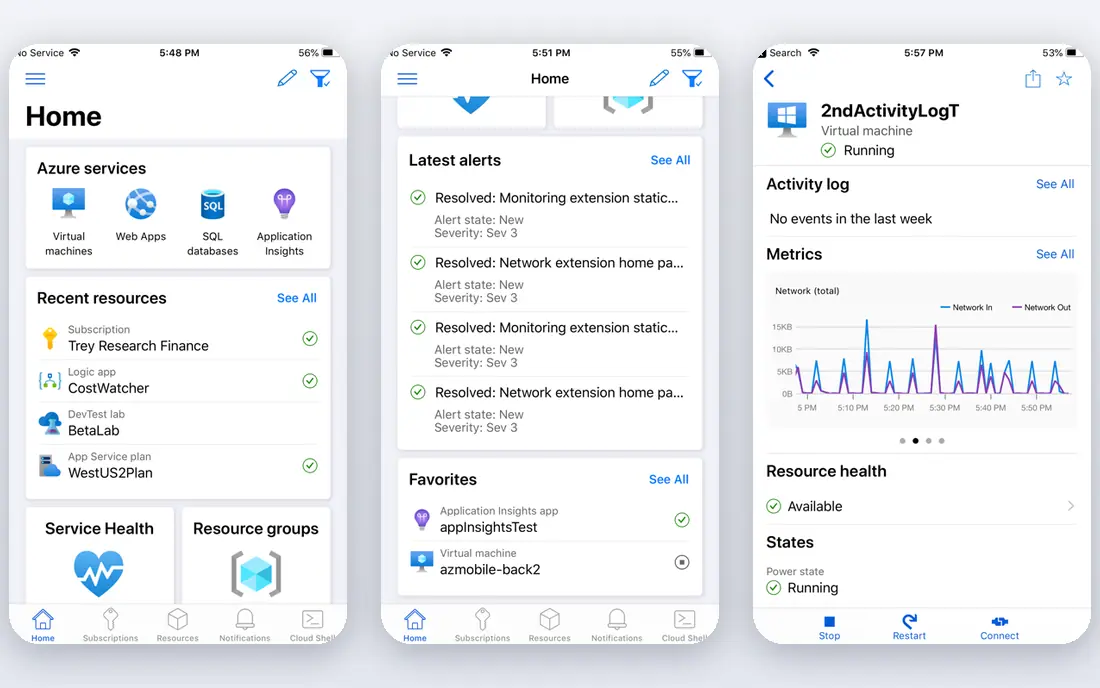
Microsoft Azure suits companies already running Windows, Active Directory, Microsoft 365, or SQL Server. Integration with those tools is tighter on Azure than on AWS or Google Cloud, and hybrid tools let you run workloads on premises and in the cloud under one management plane. Azure also offers a broad service range, from virtual machines and databases to AI, IoT, and DevOps tools, with strong compliance options for regulated industries.
Small teams may find Azure heavy. The portal packs many services into one view, pricing varies by region and service, and egress fees apply as on other full clouds. A free trial with credits helps test, but budget for learning time if your team is new to Azure. For Microsoft-centric enterprises, Azure is often the natural AWS alternative, and for others it is still a strong full-cloud choice.
- Deep Microsoft 365 and Windows integration
- Strong enterprise and compliance options
- Hybrid cloud tools
- Pricing is complex
- Portal can feel busy for small teams

DigitalOcean is our pick for developers and small teams that want cloud hosting without AWS complexity. Droplets, which are virtual servers, start at $6 per month for a basic 1 vCPU and 1 GB plan, with larger sizes up to high-memory and CPU-optimized types. One-click marketplace apps, managed databases, App Platform for simple deployments, and managed Kubernetes cover most small-team needs without learning dozens of services.
The trade-off is breadth and price per unit. DigitalOcean offers fewer managed services than AWS, Google Cloud, or Azure, and its cost per gigabyte of RAM is higher than Hetzner Cloud. For a blog, SaaS app, or API with predictable traffic, that simplicity is worth the premium, since setup takes minutes and billing is easy to predict. For large, complex enterprise workloads, a full cloud fits better.
- Simple dashboard and Droplets
- One-click apps
- Managed databases and Kubernetes
- Higher cost per RAM than Hetzner
- Fewer services than AWS
Linode, now part of Akamai, offers reliable VPS hosting with a low entry price and strong support. Shared plans start at $5 per month for a 1 GB Nanode, with larger shared, dedicated, and high-memory types for growing apps. Pricing is predictable, bandwidth allowances are clear, and support from real engineers is a noted strength in reviews. Linode also offers managed databases, Kubernetes, object storage, and load balancers for teams that need more than a single server.
Linode is not a full AWS replacement. Managed AI, data warehousing, and the long tail of AWS services are absent or thinner here, so teams with complex needs will miss them. For developers, agencies, and small SaaS teams that want a solid VPS with good support and a low bill, Linode is one of the best AWS alternatives, especially when paired with object storage and a managed database.
- Low entry price
- Strong human support
- Predictable VPS pricing
- Now part of Akamai
- Fewer managed services than full clouds
- Dashboard is plainer than DigitalOcean
Vultr suits teams that need servers in many locations with fast performance. Regular cloud compute starts at $5 per month for a 1 vCPU and 1 GB plan, with high-frequency plans for workloads that need faster single-core speed. Vultr operates in more than 30 locations, which helps apps serving users in several regions, and billing is hourly with a monthly cap, so short tests cost little. Bare metal, managed Kubernetes, and object storage cover larger needs.
Support and managed services are thinner than on full clouds, and Vultr expects more hands-on server management than DigitalOcean App Platform or Heroku. That suits developers comfortable with Linux, firewalls, and backups, but not teams that want a fully managed platform. For global VPS hosting with many locations and clear pricing, Vultr is a strong pick.
- Many global locations
- Fast high-frequency plans
- Simple hourly and monthly billing
- Support is more ticket-based than Linode
- Managed services are thinner than full clouds
Hetzner Cloud offers the best value per unit of RAM in this list for many workloads. Shared plans in Europe and the US start at a few euros per month for several gigabytes of RAM, with 20 TB of traffic included on many plans, which dwarfs the allowances on DigitalOcean, Linode, and Vultr. NVMe storage is fast, and dedicated vCPU plans suit steady, CPU-heavy work. For self-hosting, staging, and small production apps, Hetzner is hard to beat on price.
The limits are locations and managed services. Hetzner has fewer US locations than Vultr or DigitalOcean, with Ashburn and Hillsboro as main US sites, and its managed database and Kubernetes options are thinner than full clouds. Support is solid but less hand-holding than Linode for beginners. For cost-sensitive teams in Europe or the US that can manage their own servers, Hetzner Cloud is our value pick.
- Very low cost per RAM
- Generous traffic allowance
- Fast NVMe storage
- Fewer US locations than rivals
- Support and managed services are thinner
Oracle Cloud Infrastructure suits teams already running Oracle Database, Java, or Oracle business apps, since integration and licensing are smoother there than on other clouds. The Always Free tier is also generous, with free compute instances, storage, and databases for small projects, which makes Oracle Cloud a useful free starting point for learning or hosting a side project. Egress allowances are also generous in some cases, with the first 10 TB free per month, which helps data-heavy apps.
The drawback is experience. The console and docs feel enterprise-heavy, community tutorials are fewer than for AWS or DigitalOcean, and some services are less polished for small teams. Oracle Cloud is not the simplest AWS alternative for a beginner, but for Oracle workloads and for free-tier hosting, it deserves a close look. Test the free tier with a real workload before moving production traffic.
- Generous Always Free tier
- Strong for Oracle Database and Java workloads
- 10 TB free egress in some cases
- Interface and docs feel enterprise-heavy
- Smaller community than AWS or Google Cloud
Heroku is the easiest AWS alternative for deploying an app quickly. Push code with git, and Heroku builds, runs, and scales it, with managed Postgres, Redis, and a marketplace of add-ons for logging, monitoring, and queues. That simplicity suits prototypes, student projects, startups validating an idea, and small teams without DevOps staff. A free trial and low-cost dynos let you test before scaling.
Costs rise quickly as traffic and dyno size grow, and Heroku gives less control over servers, networking, and storage than DigitalOcean or Linode. Teams that outgrow Heroku often move to a VPS cloud or a full cloud for lower cost and more control. Use Heroku when speed to launch matters most, and plan a migration path if your app grows to steady, high traffic.
- Easiest git-push deployment
- Managed runtime, databases, and add-ons
- Great for prototypes
- Costs rise quickly at scale
- Less control than VPS clouds
- No free tier for production
How we picked these
We compared official pricing pages, service catalogs, free tiers, and trial terms for full clouds and VPS clouds. We checked entry VPS prices, traffic allowances, managed services, and platform fit, and we favored providers with a live US presence, clear pricing, and a track record in 2026. Where a price is pay-as-you-go and varies by region and usage, we wrote See website rather than stating a single monthly number that would mislead readers with different workloads.
How to migrate from AWS without a surprise bill
Migration starts with an inventory, not a new account. List your AWS services, regions, storage, databases, and traffic, and note which services have no direct equivalent on the target cloud. A simple web app with a database and object storage migrates easily to DigitalOcean or Linode, while a stack using many AWS-specific services, such as Lambda, DynamoDB, and Step Functions, needs more rework on Google Cloud or Azure, and even more on a VPS cloud.
Next, test costs with a real workload, not just a calculator estimate. Run a staging copy on the new cloud for two weeks, measure compute, storage, and egress, and compare the bill with AWS for the same traffic. Egress is the usual surprise, since moving data out of a cloud costs money on full clouds, while VPS clouds include larger allowances. Finally, migrate in stages: move staging first, then a low-traffic service, then production, with backups and a rollback plan at each step. That staged move avoids downtime and gives you time to fix performance or cost issues before they affect users.
FAQ
What is the best alternative to AWS?
Google Cloud and Microsoft Azure are the best full alternatives to AWS, with a similar breadth of services. DigitalOcean is best for simple developer hosting, Linode is best for reliable VPS hosting with support, and Hetzner Cloud is best for low cost per RAM. The right pick depends on whether you need a full cloud or a simpler VPS.
Is DigitalOcean cheaper than AWS?
For a simple VPS workload, DigitalOcean is usually cheaper and easier to predict than AWS, since pricing is flat per Droplet with a clear traffic allowance. For complex workloads with many managed services, autoscaling, and global traffic, AWS pricing can be competitive, and egress fees matter on both clouds. Compare a real workload bill, not just instance prices.
Can I migrate from AWS to DigitalOcean or Linode easily?
Yes, for standard apps using virtual servers, databases, and object storage, migration is straightforward with standard tools. Apps that rely heavily on AWS-specific services, such as Lambda, DynamoDB, or managed AI tools, need more rework. Start with staging, test performance and cost, and migrate production in stages.
What is the cheapest AWS alternative?
Hetzner Cloud is often cheapest per unit of RAM for VPS workloads, while Oracle Cloud Always Free tier is cheapest for small projects that fit its free limits. DigitalOcean, Linode, and Vultr start at $5 to $6 per month for a small VPS. Cheapest depends on RAM, traffic, and whether you need managed services, so compare total bills for your workload.
Does Heroku still offer a free tier?
Heroku no longer offers a general free tier for production apps as it once did, and current plans start with a free trial and low-cost dynos. Check the official Heroku pricing page for current trial terms and dyno prices, since they change. For a truly free small project, Oracle Cloud Always Free or a low-cost VPS is a better fit.