Best Appium Alternatives in 2026: 9 Tools Compared
Compare the best Appium alternatives in 2026 for mobile test automation, from cloud device farms to low-code tools and framework-based testing options.
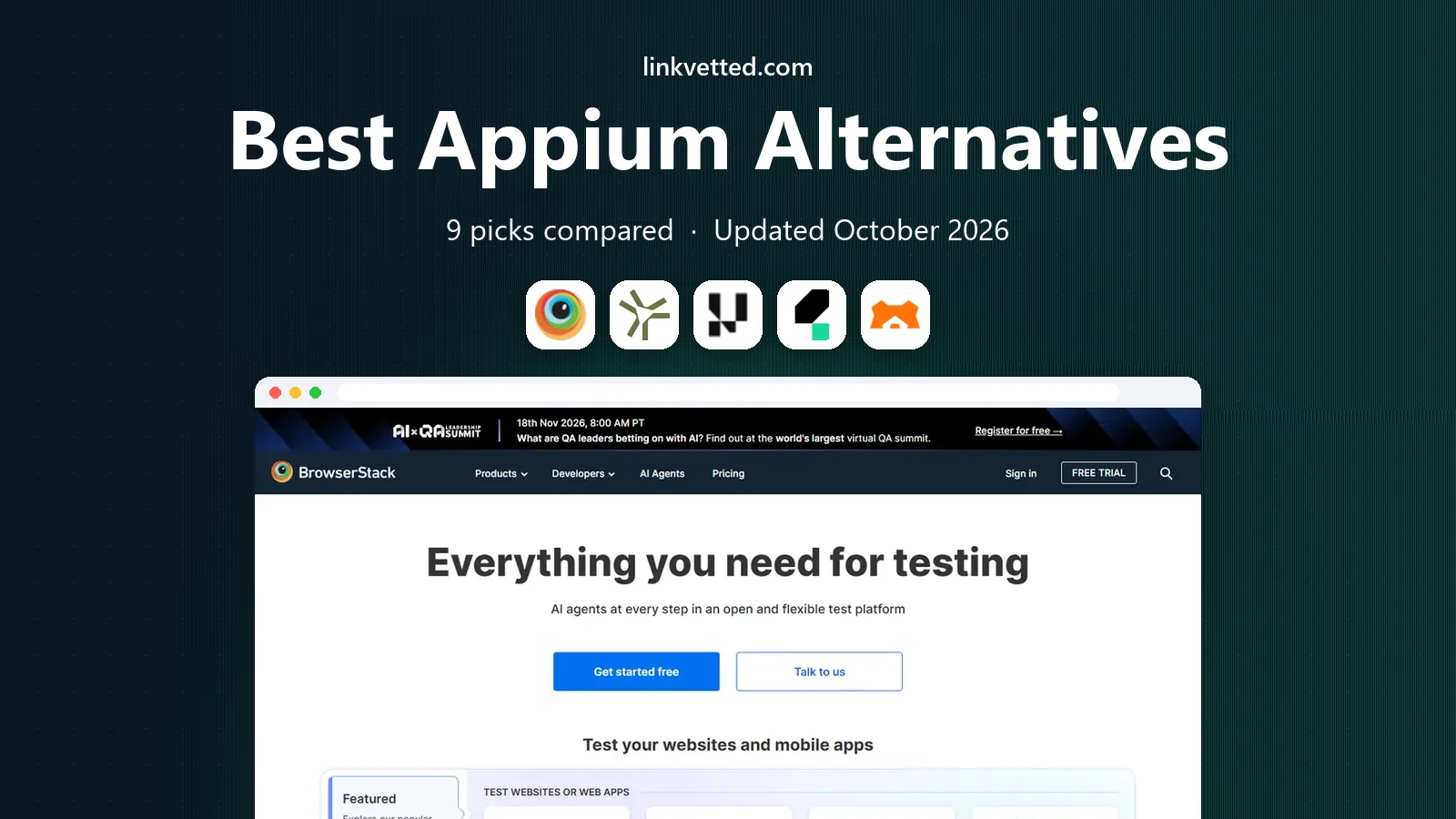
- Editor's choice
 BrowserStack App Automate
Cloud real devices
Starts atSee websiteVisit browserstack.comFull review - Great alternative
 Sauce Labs
Cloud mobile testing
Starts atSee websiteVisit saucelabs.comFull review - Also consider
 LambdaTest
Affordable cloud devices
Starts atSee websiteVisit lambdatest.comFull review
TL;DR:
- BrowserStack, Sauce Labs, LambdaTest, and Kobiton replace Appium's device coverage with cloud device farms.
- Katalon Studio and TestComplete suit teams that want lower-code test creation and desktop plus mobile coverage.
- Maestro and Detox fit developers who prefer code-first, framework-based mobile testing.
- Perfecto suits enterprises that need large-scale, governed mobile testing.
- The right pick depends on real devices versus emulators, team coding skill, and parallel test volume.
Quick comparison
| Tool | Best for | Starts at | Free plan? | |
|---|---|---|---|---|
| BrowserStack App Automate | Cloud real devices | See website | Free trial | Visit |
| Sauce Labs | Cloud mobile testing | See website | Free trial | Visit |
| LambdaTest | Affordable cloud devices | See website | Free trial | Visit |
 Katalon Studio | Low-code mobile testing | Free | Yes | Visit |
 TestComplete | Desktop plus mobile tests | See website | Free trial | Visit |
 Maestro | Code-first mobile flows | Free | Yes | Visit |
 Detox | React Native gray-box tests | Free | Yes | Visit |
 Kobiton | Real device cloud | See website | Free trial | Visit |
 Perfecto | Enterprise mobile testing | See website | Free trial | Visit |
The best Appium alternatives
Appium is an open source framework for automating native, hybrid, and mobile web apps. Alternatives differ in how much code they need, whether they run on real devices or emulators, and how they scale. We cover cloud farms, low-code tools, and developer frameworks.

BrowserStack App Automate is our pick for teams that want Appium tests on real devices without buying hardware. You can run existing Appium scripts on a large cloud of Android and iOS devices, run tests in parallel, and integrate with common CI tools. That combination helps teams that already use Appium but lack device coverage.
Costs rise with parallel sessions and device minutes, so model your test volume before choosing a plan. Teams that run tests only on release days may need less capacity than teams that test every pull request. For broad device coverage, BrowserStack is a strong default.
- Large real device cloud
- Appium test support
- Parallel testing and integrations
- Pricing is plan based and can rise with parallel sessions
- Setup needs test config work
Sauce Labs suits teams that test web and mobile together. It offers real devices, emulators, and simulators, supports Appium and other frameworks, and connects to CI pipelines for automated runs. That breadth helps teams that maintain both a website and apps.
Pricing for larger plans is often quoted, so budget planning takes a sales step. New users may also need time to learn reporting and device selection. If your team already runs web tests on Sauce Labs, adding mobile tests there keeps reporting in one place.
- Real devices and emulators
- Appium and other frameworks supported
- CI integrations
- Pricing is quote based for many plans
- Dashboard learning curve for new users

LambdaTest is a good value pick for teams that want cloud devices without enterprise pricing. It supports Appium tests on real devices, offers emulators and simulators, and integrates with CI tools. Small and mid-size teams often find the entry plans easier to justify than larger rivals.
Device availability and parallel capacity vary by plan, so check the devices your users actually own. Teams that need rare or very new devices should confirm availability in a trial. For common Android and iOS coverage at a lower cost, LambdaTest fits well.
- Real device cloud
- Competitive entry pricing
- Appium support and integrations
- Device availability varies by plan
- Advanced features need higher tiers
Katalon Studio suits testers who want to build mobile tests with less code. Record and playback, built-in keywords, and object handling help manual testers move to automation faster. It also covers web and API testing, so one tool can handle more than mobile alone.
Paid plans add features for teams, reporting, and scale, so check what the free version covers for your project size. Larger teams should set naming and object rules early, or test suites can grow messy. For teams new to automation, Katalon is a friendly start.
- Low-code test creation
- Mobile, web, and API testing
- Free version to start
- Advanced features need paid plans
- Larger projects need governance
TestComplete, from SmartBear, fits teams that test desktop, web, and mobile apps together. It offers record and script options, strong object recognition, and support for many languages and frameworks. Teams that maintain Windows desktop apps alongside mobile apps often value that single-tool coverage.
The tooling is Windows focused, which matters for Mac-based mobile teams. Licensing is per user, so team costs should be modeled for all testers, not just one seat. For mixed desktop and mobile estates, TestComplete is a practical choice.
- Script and record options
- Desktop, web, and mobile coverage
- Strong object recognition
- Windows-focused tooling
- Pricing is per license and can add up for teams
Maestro is a developer-friendly, open source option for testing mobile flows. Tests are written in simple YAML, runs are fast locally, and setup is lighter than a full Appium grid. Developers who want quick feedback on user flows, such as signup, checkout, or navigation, often like its simplicity.
It is not a full enterprise test platform, so reporting, device cloud, and governance features are thinner. Teams that need large-scale cloud runs should pair Maestro with a device farm or choose a cloud tool. For fast, code-first flow tests, Maestro is a clean alternative.
- Simple YAML flows
- Fast local runs
- Open source
- Less suited to complex enterprise reporting
- Smaller ecosystem than Appium
Detox suits React Native teams that want stable, gray-box tests. Because it runs inside the app, it can wait for animations and network activity more reliably than black-box tools, which reduces flaky tests. It integrates with Jest and CI pipelines, and it is free and open source.
It is mainly for React Native, so native iOS, Android, or Flutter teams should look elsewhere. Setup also needs developer time, especially for CI and device configuration. For React Native apps, Detox is one of the strongest Appium alternatives.
- Gray-box testing for React Native
- Fast and stable runs
- Open source
- Mainly for React Native
- Setup needs developer skill
Kobiton fits teams that want both manual and automated testing on real devices. Testers can explore an app by hand on a cloud device, then automate the same flows with Appium scripts. That mix helps teams that still do exploratory testing alongside automation.
The device pool is smaller than BrowserStack or Sauce Labs, so check coverage for your key devices. Pricing varies by plan and parallel capacity, so model test volume first. For teams that value manual plus automated device access, Kobiton is a solid pick.
- Real device cloud
- Manual and automated testing
- Appium support
- Pricing is plan based
- Device pool is smaller than the largest clouds
Perfecto, from Perforce, suits large enterprises that need governed, large-scale mobile testing. It offers real devices, cloud and on-prem options, and reporting that helps teams track quality across releases. Regulated firms often value its controls and audit features.
Pricing and setup reflect that enterprise focus, so smaller teams may find it heavy. Teams should trial it with a real release pipeline, not a demo app, to judge speed and reporting. For large, regulated mobile estates, Perfecto is a credible enterprise choice.
- Large enterprise device cloud
- Governed testing
- Analytics and reporting
- Enterprise pricing
- Heavier setup than developer tools
How we picked these
We compared official feature and pricing pages for tools that automate mobile apps on real devices, emulators, or frameworks. We kept only tools that exist and work today, with current homepages and clear trial or open source paths. We favored a mix of cloud farms, low-code tools, and developer frameworks, and we left out web-only test tools that lack mobile app support.
What to check before you switch
Start with your app type. React Native teams should trial Detox and Maestro first, while native teams should trial cloud farms with existing Appium scripts. Check device coverage for your top ten user devices, not just the latest flagships, since older devices often cause the most field issues.
Next, test flakiness and speed. Run the same suite three times in a trial and count failures that are not real bugs. Check CI integration, parallel capacity, and reporting, since those decide daily usability. Finally, price by parallel sessions and device minutes, not by seats alone, since test volume drives cloud costs.
Real devices versus emulators
Emulators are fast and cheap for early checks, but real devices catch issues with sensors, permissions, and performance that emulators miss. Use emulators for fast feedback during development, and real devices for release checks and key user flows. A mix usually gives the best coverage per dollar.
FAQ
Is BrowserStack a good Appium alternative?
Yes, especially if you already use Appium. BrowserStack App Automate runs Appium tests on real cloud devices, adds parallel testing, and removes the need to buy and maintain hardware. Price parallel capacity for your actual test volume.
What is the best free Appium alternative?
Maestro and Detox are strong free, open source options for developer teams, and Katalon Studio offers a free version for low-code testing. The best free pick depends on your app type: Detox for React Native, Maestro for simple flows, Katalon for low-code teams.
Can I run Appium tests on a cloud device farm?
Yes. BrowserStack, Sauce Labs, LambdaTest, and Kobiton all support Appium tests on cloud devices. You can often reuse existing scripts with config changes for device selection and credentials, then run them in parallel.
Is Katalon Studio good for beginners?
Yes, Katalon Studio is one of the friendliest starts for testers new to automation. Record and playback plus built-in keywords reduce coding, while web and API testing add breadth. Larger teams should plan object and naming rules early.
What is the difference between Detox and Appium?
Detox is a gray-box framework mainly for React Native that runs inside the app for more stable waits, while Appium is a black-box framework for native, hybrid, and mobile web apps across platforms. Detox suits React Native teams; Appium suits cross-platform native teams.
How do I choose between real devices and emulators?
Use emulators for fast, cheap feedback during development, and real devices for release checks, performance, and hardware features. Check your analytics for the top devices your users own, and cover those on real hardware first.