Best Alternatives to Rust in 2026: 9 Languages Compared
Looking for alternatives to Rust? We compare 9 programming languages for systems work, speed, safety, and ease of learning in 2026 for developers.
- Editor's choice
 Go
Servers and cloud tools
Starts atFreeVisit go.devFull review - Great alternative
 C++
Raw performance
Starts atFreeVisit isocpp.orgFull review - Also consider
 Zig
Modern systems work
Starts atFreeVisit ziglang.orgFull review
TL;DR:
- Go is our pick for most developers leaving Rust, because it is fast, simple, and strong for servers and cloud tools.
- C++ remains the closest match for raw performance and hardware control, but it gives you manual memory management and a larger set of pitfalls.
- Zig offers a modern take on C-style systems work with clear error handling and no hidden runtime, though its ecosystem is still young.
- Swift, C#, and Kotlin suit app developers who want memory safety with a larger library of ready-made tools for mobile and desktop apps.
- No language copies Rust exactly, so pick based on the job: systems work, web services, mobile apps, or scripting, rather than on syntax alone.
Quick comparison
| Tool | Best for | Starts at | Free plan? | |
|---|---|---|---|---|
| Go | Servers and cloud tools | Free | Yes | Visit |
| C++ | Raw performance | Free | Yes | Visit |
| Zig | Modern systems work | Free | Yes | Visit |
 Swift | Apple platforms | Free | Yes | Visit |
| C# | Windows and web apps | Free | Yes | Visit |
 Kotlin | Android and backend | Free | Yes | Visit |
 Python | Fast scripting | Free | Yes | Visit |
 D | Systems with GC option | Free | Yes | Visit |
 Nim | Small fast programs | Free | Yes | Visit |
The best alternatives to Rust
Rust is known for memory safety without a garbage collector, strong performance, and a strict compiler that catches many bugs early. Those strengths come with a learning curve, slow compile times on large projects, and a smaller hiring pool than older languages. The languages below each trade some of that safety or speed for simplicity, a larger ecosystem, or a better fit for a specific platform.
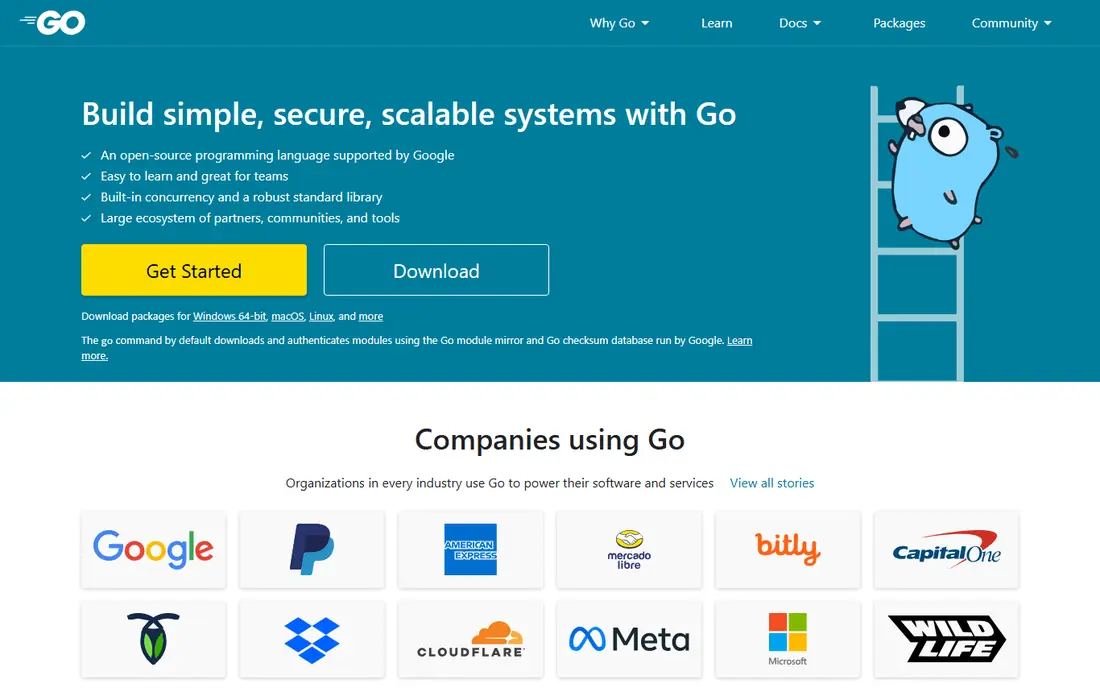
Go, also called Golang, is the most practical Rust alternative for backend work. It compiles fast, runs fast enough for most services, and includes built-in support for concurrency through goroutines. A developer can learn the core language in days, and the standard library covers HTTP servers, JSON, and networking without a pile of dependencies.
Go trades Rust-style memory safety for a garbage collector. That means you do not manage memory by hand, but you also give up the precise control Rust offers, and you accept occasional garbage collection pauses. For web APIs, cloud tools, and command-line programs, that trade is usually worth it.
The ecosystem is large, with strong tooling, testing support, and a huge library of packages. If your Rust project is a service, a tool, or a cloud component, Go is the first language to try.
- Simple syntax
- Fast builds
- Strong standard library for networking
- No generics until recent versions, and they are limited
- Garbage collector adds pauses
C++ is the language Rust most directly competes with for systems work. It gives you direct control over memory, hardware, and performance, and it runs everywhere from game engines to browsers to embedded devices. Decades of libraries mean you rarely start from zero, and modern C++ adds smart pointers, move semantics, and other tools that reduce some old risks.
The catch is that safety is opt-in. You can still write buffer overflows, use-after-free bugs, and data races if you are careless, and the compiler will not stop you the way Rust does. Large C++ codebases need discipline, code review, and sanitizers to stay safe.
Choose C++ when raw speed, existing libraries, or a specific platform demands it, and when your team already knows how to write it carefully. For a new systems project where safety is the top goal, Rust or Zig may be a better fit.
- Full hardware control
- Huge ecosystem
- Used in games, browsers, and operating systems
- Manual memory management risks
- Long learning curve
- Unsafe defaults
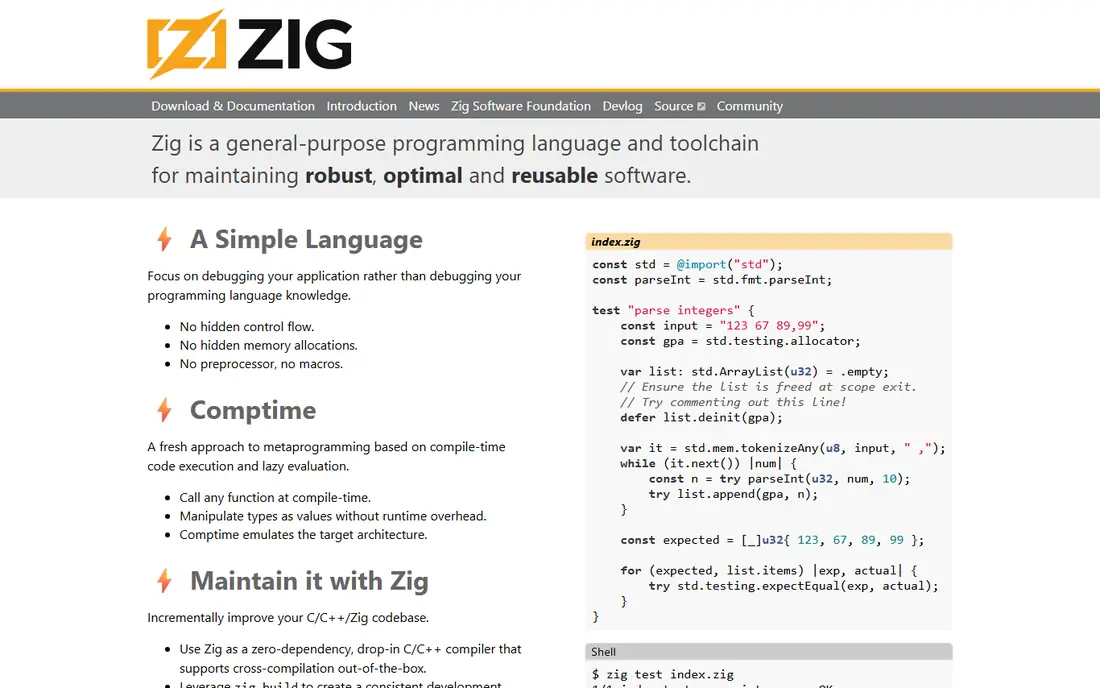
Zig is a newer systems language that aims for simplicity and explicit control. There is no hidden allocation, no garbage collector, and error handling is explicit through error unions. Allocators are passed around openly, so you can see where memory comes from and where it goes. That clarity appeals to developers who like Rust's control but want a simpler language.
Zig also works well with C code, and it can compile C programs with its own toolchain. That makes it useful for embedded work, tooling, and projects that need to talk to existing C libraries. Cross-compilation is a strength too, since Zig can target many platforms from one machine.
The ecosystem is still small compared with Go, C++, or Python, and the language has changed across versions. Zig suits adventurous systems developers and tool builders, not teams that need a large library for every task today.
- No hidden control flow
- Explicit memory allocation
- C interoperability is excellent
- Young ecosystem
- Language still evolving
- Fewer libraries than Go or C++
Swift is the natural Rust alternative if you build for iPhone, iPad, Mac, Apple Watch, or Apple TV. It is memory safe, uses automatic reference counting instead of a garbage collector, and has a modern syntax with optionals that force you to handle missing values. Apple ships it as the main language for its platforms, so documentation and tooling are strong there.
Swift also runs on Linux and Windows, and it has a growing server-side community. That side is still smaller than Go or Python, so backend developers may find fewer ready-made libraries. For app work, though, Swift is a clear pick: native performance, a large UI framework in SwiftUI, and a direct path to the App Store.
If your Rust project is a mobile or desktop app for Apple users, Swift will feel more productive than fighting a cross-platform toolkit. If you need Windows or Linux first, look at C# or Kotlin instead.
- Memory safe by default
- Modern syntax
- First-class support on Apple platforms
- Best on Apple systems
- Server ecosystem is smaller than Go or Python
C# is a strong general-purpose alternative, especially for Windows apps, web APIs with ASP.NET Core, and games with Unity. The language is modern, with pattern matching, nullable reference types, and async support built in. The .NET runtime gives you a large library, good performance for most business apps, and cross-platform support on Windows, macOS, and Linux.
C# uses a garbage collector, so you do not manage memory by hand. That makes development faster and safer for most app work, at the cost of less precise control over allocation and latency. For games and high-frequency trading, that trade may matter. For web apps, desktop tools, and internal systems, it rarely does.
Tooling is a real advantage. Visual Studio and Visual Studio Code offer strong debugging, refactoring, and testing support. If you want a productive, well-supported language for app and web work, C# is a dependable choice.
- Strong tooling in Visual Studio
- Large .NET library
- Good for web, desktop, and games
- Garbage collector
- Less direct hardware control than Rust or C++
Kotlin is the official language for Android development, and it also works well for backend services on the JVM. Its syntax is concise, null safety is built into the type system, and coroutines make async code easier to read than callback chains. Developers coming from Rust will appreciate that Kotlin pushes many null errors to compile time.
The JVM is both a strength and a limit. You get a huge library ecosystem, mature tooling, and easy deployment on servers, but you also get JVM startup time and memory overhead. Kotlin Native can compile to native code, but it is less widely used than JVM Kotlin.
Choose Kotlin for Android apps, for backend services where the JVM is already in use, or for multiplatform projects that share code between Android and iOS. For bare-metal systems work, Zig or C++ will fit better.
- Concise syntax
- Null safety built in
- Official language for Android
- Runs on the JVM by default, so startup and memory use are higher
- Native support is less common
Python is not a systems language, but it is a practical Rust alternative when speed of development matters more than raw speed. Its syntax is readable, its library ecosystem covers data analysis, web work, automation, and AI, and a prototype that takes a week in Rust may take a day in Python.
Performance is the obvious gap. Python is interpreted and much slower than Rust for tight loops and heavy computation, though libraries like NumPy and tools that call compiled code can close much of that gap. Type hints and tools like mypy help catch errors, but Python will not enforce memory safety the way Rust does.
Use Python for scripts, data tools, internal tools, and prototypes. If a Python prototype proves a concept, you can later rewrite the hot parts in Rust, Go, or C++ while keeping Python for the rest.
- Easiest to learn on this list
- Huge library ecosystem
- Great for data, scripting, and AI work
- Much slower than Rust for CPU-heavy work
- Runtime errors are common without type checks
D is a systems language that combines C-style performance with modern features like ranges, contracts, and built-in unit testing. It has a garbage collector, but you can write code that avoids it, which gives you a middle path between Rust's strict ownership and C's manual management. D also interoperates well with C, so existing libraries are easy to call.
The community is smaller than Go, Rust, or C++, and the job market reflects that. Libraries exist for many tasks, but you may need to write more yourself. Documentation and tooling are solid, and the language itself is stable and pleasant to write.
D suits developers who want systems performance with a more forgiving language than Rust, and who are comfortable working in a smaller ecosystem. It is a thoughtful pick for tools, compilers, and native apps.
- C-like speed with modern features
- Garbage collector can be disabled
- Good C interoperability
- Smaller community
- Fewer jobs and libraries than Go or C++
Nim looks like Python but compiles to C, C++, or JavaScript, which gives you native speed with readable code. It has a garbage collector with options for manual control, macros for metaprogramming, and a syntax that many developers find easy to read. For small tools, games, and utilities, Nim can feel like a shortcut to fast code.
The ecosystem is the limit. Libraries are fewer than Python or Go, and learning resources are thinner. Nim is also less common in hiring, so a team that picks Nim should be ready to build some pieces themselves.
Choose Nim for personal tools, experiments, and small native programs where readability matters. For a large team project, Go or C# will give you more libraries and more developers to hire.
- Python-like syntax that compiles to C
- Fast binaries
- Small and readable code
- Small ecosystem
- Fewer learning resources
- Tooling is less mature
How we picked these
We compared official language pages, documentation, and public guidance on performance, safety, and ecosystem size. We favored languages that are still maintained in 2026, have real production use, and offer a clear reason to pick them over Rust for a specific job. We left out niche research languages and languages that are no longer actively developed.
We also weighed the trade between safety and simplicity honestly. Rust's ownership model is unique, and no language on this list copies it exactly. That is why we group picks by job, rather than pretending one language is Rust with a different name.
How to choose a Rust alternative
Start with the platform and the job. Apple apps point to Swift, Android apps point to Kotlin, Windows and web apps point to C#, and servers point to Go. Systems work points to C++ or Zig, and scripting points to Python. A language that fits the platform will save you more time than a language that merely looks similar to Rust.
Next, weigh safety against control. If memory safety is non-negotiable, Swift, Kotlin, and C# give you managed safety with good tooling. If you need bare-metal control, C++ and Zig give it to you, with more responsibility. Go sits in the middle for server work, with a collector and simple code.
Finally, consider hiring and libraries. A language with a large ecosystem will get you to a finished product faster, even if it is not the fastest on paper. Prototype in the language you are considering, measure the parts that matter, and let that test decide.
When to stay with Rust
Stay with Rust if you need memory safety without a garbage collector, if you build browsers, operating systems, or embedded firmware, or if your team already knows Rust well. The learning curve pays off most when safety and performance are both critical and the project will live for years.
Moving a Rust project gradually
You do not need to rewrite everything at once. Keep Rust for the performance-critical core, and build new services, tools, or front ends in Go, Python, or another language. Use clear APIs between parts, and migrate piece by piece as you learn what the new language handles well.
FAQ
What is the closest language to Rust?
Zig is closest in spirit for systems work, with explicit control and no garbage collector, while C++ is closest in terms of performance and hardware access. Neither copies Rust's ownership model, so expect a different approach to memory safety in both.
Is Go faster than Rust?
For most services, Go is fast enough, but Rust is usually faster for CPU-heavy work because it has no garbage collector and gives finer control over memory. Go wins on build speed and simplicity, while Rust wins on raw performance and predictable latency.
Should I learn Go or C++ after Rust?
Learn Go if you want backend, cloud, or tooling work with a gentler learning curve. Learn C++ if you want games, browsers, operating systems, or embedded work where existing libraries and hardware control matter most.
Can Python replace Rust?
Python can replace Rust for scripting, data work, prototypes, and internal tools, but not for high-performance systems work. Many teams use both: Python for speed of development and Rust or Go for the parts where performance matters.
Is Swift only for Apple devices?
Swift is best on Apple platforms, but it also runs on Linux and Windows. Server-side Swift exists, though its ecosystem is smaller than Go, Python, or C#. For Apple app work, Swift is the clear choice.
Which Rust alternative is easiest to learn?
Python is easiest to learn, followed by Go. Both have simple syntax and large tutorial libraries. Zig and C++ take longer, but they reward that time with deeper control over performance and hardware.