Best Alternatives to Animal Testing Software in 2026: 8 Platforms Compared
Compare the best alternatives to animal testing software, from organ-on-chip systems to in silico models, and find the right non-animal testing platform.
- Editor's choice
 Emulate
Human organ-chip studies
Starts atSee websiteVisit emulatebio.comFull review - Great alternative
 Mimetas
High-throughput tissue screening
Starts atSee websiteVisit mimetas.comFull review - Also consider
 Insilico Medicine
AI drug design and prediction
Starts atSee websiteVisit insilico.comFull review
TL;DR:
- Non-animal methods now cover distinct jobs, from early toxicity screening to human tissue modeling, and no single platform covers every endpoint.
- Organ-on-chip systems give the closest view of human tissue behavior, while in silico tools screen far more compounds at lower cost per run.
- Regulatory acceptance depends on the specific use case and validation data, so teams should check the endpoint first, not the marketing claim.
- Cost, throughput, and lab skill requirements differ sharply, and the cheapest screen is not always the best first step for a safety decision.
Quick comparison
| Tool | Best for | Starts at | Free plan? | |
|---|---|---|---|---|
| Emulate | Human organ-chip studies | See website | No | Visit |
| Mimetas | High-throughput tissue screening | See website | No | Visit |
| Insilico Medicine | AI drug design and prediction | See website | No | Visit |
 Certara Simcyp | Drug interaction modeling | See website | No | Visit |
 Simulations Plus GastroPlus | Absorption and dosing simulation | See website | No | Visit |
 CN Bio | Multi-organ chip systems | See website | No | Visit |
 MatTek EpiDerm | Skin and eye testing models | See website | No | Visit |
 Hesperos | Human-on-a-chip disease models | See website | No | Visit |
The best alternatives to animal testing software
These platforms replace or reduce animal work in different ways, and the right choice depends on the question being asked, the tissue involved, and the evidence a regulator will accept.
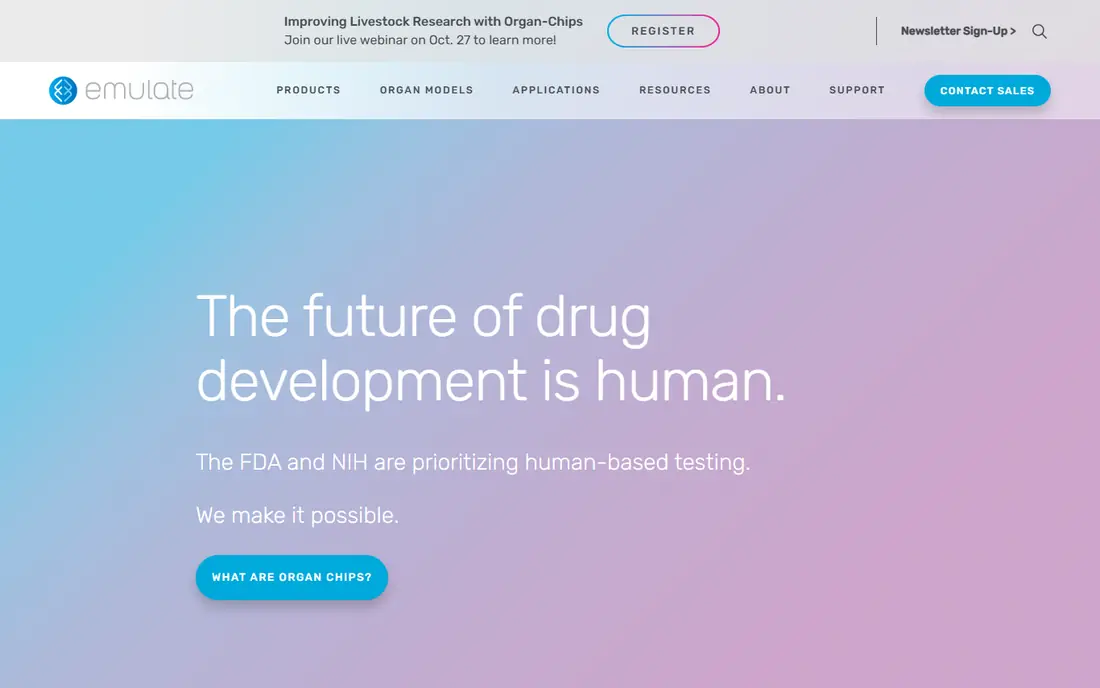
Emulate builds its Human Emulation System around chips lined with living human cells, with fluid flow and stretching forces that mimic breathing or gut movement. That design is useful when a team needs to see how human lung, liver, intestine, or kidney tissue responds, rather than relying on a static dish. The platform pairs chips with instruments and software, so experiments are run as a system instead of as separate parts.
The trade-off is practical. Organ-chip work takes training, careful cell handling, and time, and it will not screen thousands of compounds in a week. Teams with a focused safety question, such as liver toxicity for a small set of candidates, get more value than teams looking for a fast first pass across a large library.
- Human cells under flow and mechanical forces
- Multiple organ models
- Software for experiment control and analysis
- Needs skilled lab staff
- Lower throughput than computer models
- Hardware and consumable costs add up
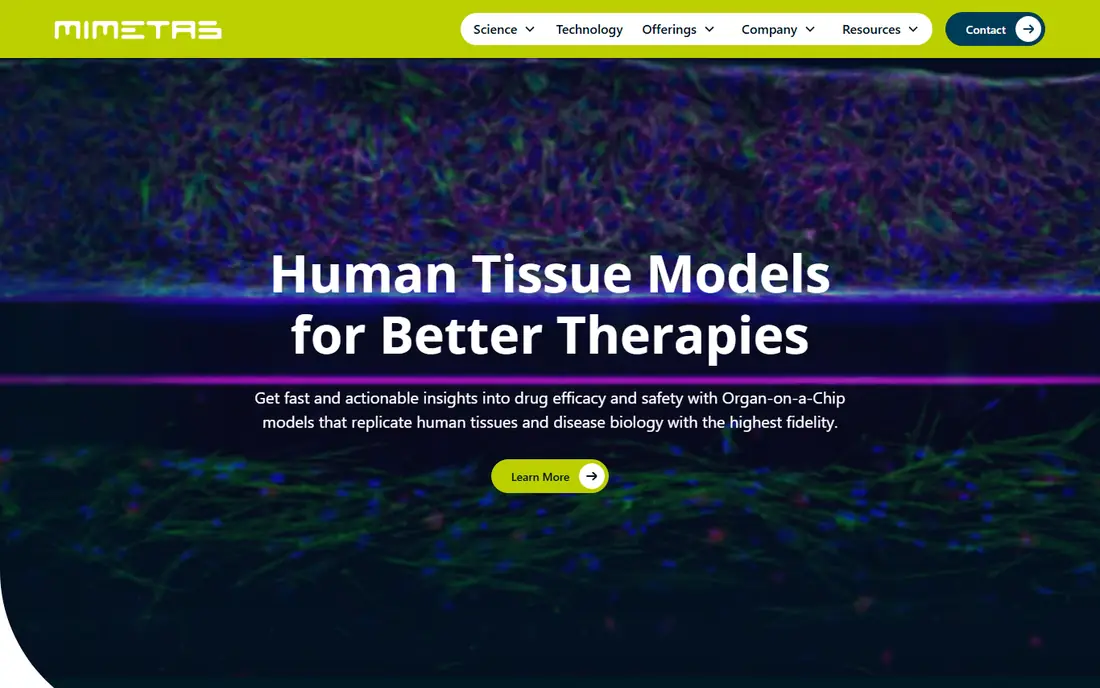
Mimetas takes a different route to scale. Its OrganoPlate platform grows three-dimensional tissues in a plate format that fits automated imaging and liquid handling, which makes it easier to run larger screens than a single-chip setup allows. Researchers use it for disease modeling, toxicity checks, and barrier models such as gut and blood-brain barrier work.
That plate format is the main draw for screening teams. It gives more data points per run, but it does not reproduce every mechanical cue found in a perfused chip. For early ranking of compounds, that balance often makes sense, with more detailed chip work reserved for the strongest candidates.
- OrganoPlate format supports many parallel cultures
- 3D tissue structure
- Compatible with standard lab automation
- Less mechanical stimulation than some chip systems
- Model setup still needs cell expertise
- Pricing is quote based
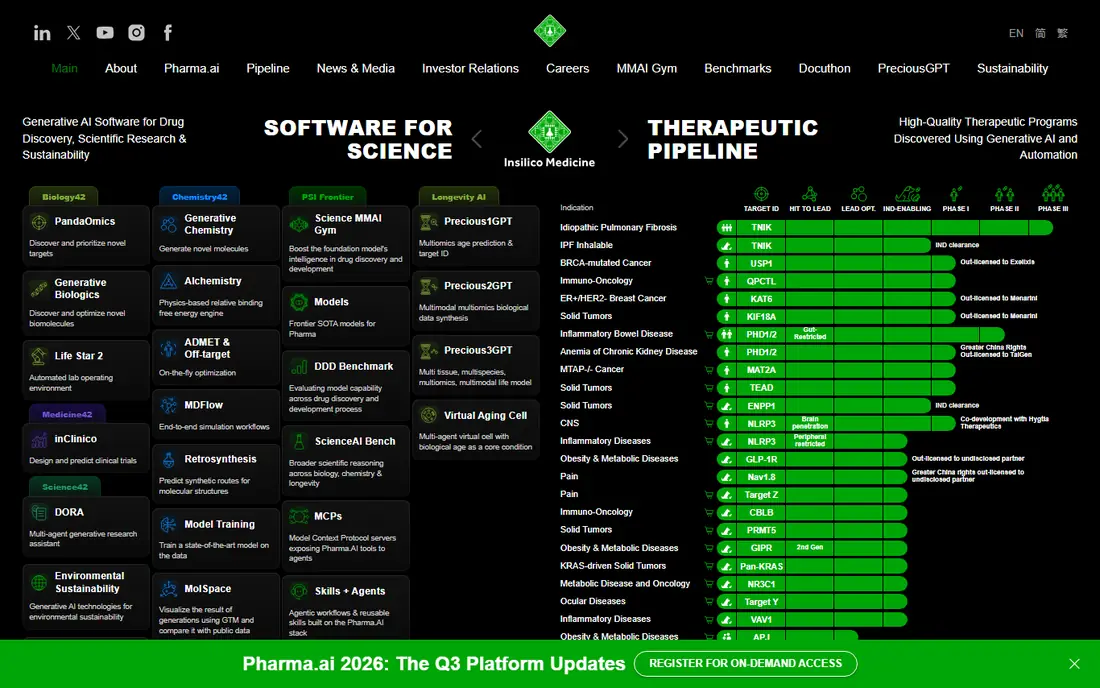
Insilico Medicine focuses on the computer side of the problem. Its platform uses machine learning to propose targets, design molecules, and predict properties before any wet-lab work begins. That approach can narrow a huge chemical space to a short list worth testing in cells or chips, which saves time and animal use downstream.
The honest limit is that a prediction is not proof. Teams still need cell or tissue data to confirm safety and activity, especially for new biology where training data are thin. Used as a triage and design tool, rather than a final verdict, it fits well at the start of a program.
- AI models for target discovery and molecule design
- Large-scale screening without lab work
- Used in real drug programs
- Predictions need lab confirmation
- Model quality depends on training data
- Enterprise pricing is not public
Certara Simcyp is a physiologically based pharmacokinetic modeling platform. It simulates how a drug moves through the human body, how it interacts with other drugs, and how dosing might differ across patient groups. Regulators have seen this kind of modeling for years, which helps when the question is about human exposure rather than a new tissue effect.
Modeling skill matters here. A team needs good compound data and an understanding of the model assumptions, or the output can look precise while resting on weak inputs. For pharmacokinetics and interaction questions, though, it is one of the most established non-animal routes available.
- Physiologically based modeling for human populations
- Drug interaction and dosing predictions
- Long regulatory track record
- Requires modeling expertise
- Input data quality drives results
- License costs suit larger teams
Simulations Plus GastroPlus simulates drug absorption and disposition in humans and animals, with tools for formulation design and dosing. A team can test how a change in formulation might affect exposure without running a new animal study for each variant. That makes it useful during formulation and early development, when many options are still open.
The platform works best when it is fed with measured solubility, permeability, and metabolism data. Without those inputs, the simulation is only as good as its assumptions. Teams that already run those lab assays will get the most from it, since the model then turns existing data into dosing insight.
- Absorption, distribution, and metabolism simulation
- Formulation and dosing support
- Widely used in pharma
- Learning curve for new modelers
- Needs quality lab measurements
- Pricing is quote based
CN Bio builds microphysiological systems that link organ models, so a team can study how a drug affects the liver and gut together, rather than in isolation. That linked view matters for questions about metabolism, where one organ changes a compound before another organ sees it. The PhysioMimix system provides perfusion, control, and sampling in one workflow.
Complexity is the catch. Multi-organ work needs planning around cell sourcing, media, and sampling times, and it is not a quick screen. For teams studying cross-organ effects or longer exposures, the added realism can justify the effort, while simpler questions may be answered faster elsewhere.
- Linked multi-organ models
- Perfusion and control systems
- Liver and gut models for toxicity work
- Complex setup for small labs
- Throughput is modest
- Costs are quote based
MatTek makes reconstructed human tissues, including EpiDerm skin models, that labs use for irritation, corrosion, and related safety tests. These models are among the most accepted non-animal options for certain skin and eye endpoints, and they fit into standard lab routines more easily than a chip system. A lab orders tissues, applies a test substance, and measures a defined outcome.
Scope is the limit. A skin model cannot answer a question about liver toxicity or whole-body exposure, and it is not meant to. For cosmetics, chemicals, and topical products where skin or eye safety is the question, it is a direct and well-understood replacement.
- Reconstructed human skin and eye tissues
- Validated for irritation and corrosion endpoints
- No live animals in the model
- Covers specific endpoints only
- Tissue shelf life is limited
- Batch ordering needs planning
Hesperos offers human-on-a-chip systems that combine multiple organ models to study disease and drug response. Its strength is in building linked systems for a specific disease question, such as how a compound behaves across connected tissues. Teams without their own chip lab can also work with Hesperos as a service provider, which lowers the barrier to trying the approach.
The service route has a trade-off. It removes the need to buy hardware and train staff, but the team has less direct control over day-to-day experiment choices. For a pilot study or a complex disease model, that trade can be worth it, and it lets a team judge the data before investing in-house.
- Multi-organ human systems
- Disease modeling focus
- Contract research option for teams without a chip lab
- Service model may limit in-house control
- Timelines depend on model build
- Pricing is quote based
How we picked these
We compared official product pages, published use cases, and public regulatory context for each platform, and we focused on tools with a clear non-animal method, a defined endpoint, and current availability in October 2026. We left out general lab software with no specific non-animal testing role, and we did not rank a platform higher for marketing claims alone. Where pricing was not published, we wrote See website rather than guessing a figure.
What to check before you choose
A platform can be excellent and still be wrong for a given study. Start with the endpoint, then match the method, then confirm cost and capacity.
Match the method to the question
Toxicity screening, absorption prediction, skin irritation, and disease modeling are different jobs. A computer model suits large-scale ranking, a tissue model suits a defined safety endpoint, and a chip system suits human tissue behavior under flow. Writing down the decision the data must support helps avoid buying a powerful tool for the wrong job.
Ask about validation and acceptance
Ask vendors for validation data for your exact endpoint, and for examples where regulators accepted that data. Published papers and guidance documents carry more weight than a general claim of regulatory readiness. If the endpoint is new, plan for a bridging study that compares the new method with existing data.
Budget for people and time, not just the tool
Chip and tissue work needs trained staff, cell sourcing, and quality control, while modeling needs data and expertise. A quote for hardware or software is only part of the total cost. Teams should also budget for pilot runs, failed batches, and analysis time, especially in the first year.
FAQ
Are alternatives to animal testing software accepted by regulators?
Acceptance depends on the endpoint and the validation behind it. Some reconstructed tissue tests and modeling approaches are accepted for defined uses, while newer chip methods are often accepted as supporting data first. Check current guidance for your product type and endpoint before relying on a single method.
What is the difference between in silico and organ-on-chip tools?
In silico tools use computer models to predict behavior from chemical and biological data, so they scale well but need confirmation. Organ-on-chip tools use living human cells in a controlled device, so they give direct tissue data but at lower throughput and higher lab cost. Many programs use both in sequence.
Can these platforms fully replace animal testing today?
Not for every question. They can replace animal work for specific endpoints and reduce it for others, but whole-body, long-term, and complex immune questions may still need animal data in some programs. A hybrid plan, with non-animal methods used first, is the common pattern in 2026.
How much do these platforms cost?
Most vendors price by quote, since cost depends on models, consumables, and support. Computer modeling licenses and tissue orders are often easier to budget than full chip systems. Ask for a pilot quote that includes consumables, training, and analysis, not just the headline license or hardware price.
Which option should a small lab try first?
A small lab often starts with a defined tissue test or a modeling tool, since both fit standard workflows better than a full chip system. If the question needs human tissue behavior under flow, a service-based chip pilot can test the value before any hardware purchase. Start small, measure the result, and expand only if the data change decisions.