Best WhitePress Alternatives for 2026 (6 Compared)
A practical look at WhitePress alternatives for buying and selling sponsored posts, based on vendor documentation and public sources, with limits and fit.
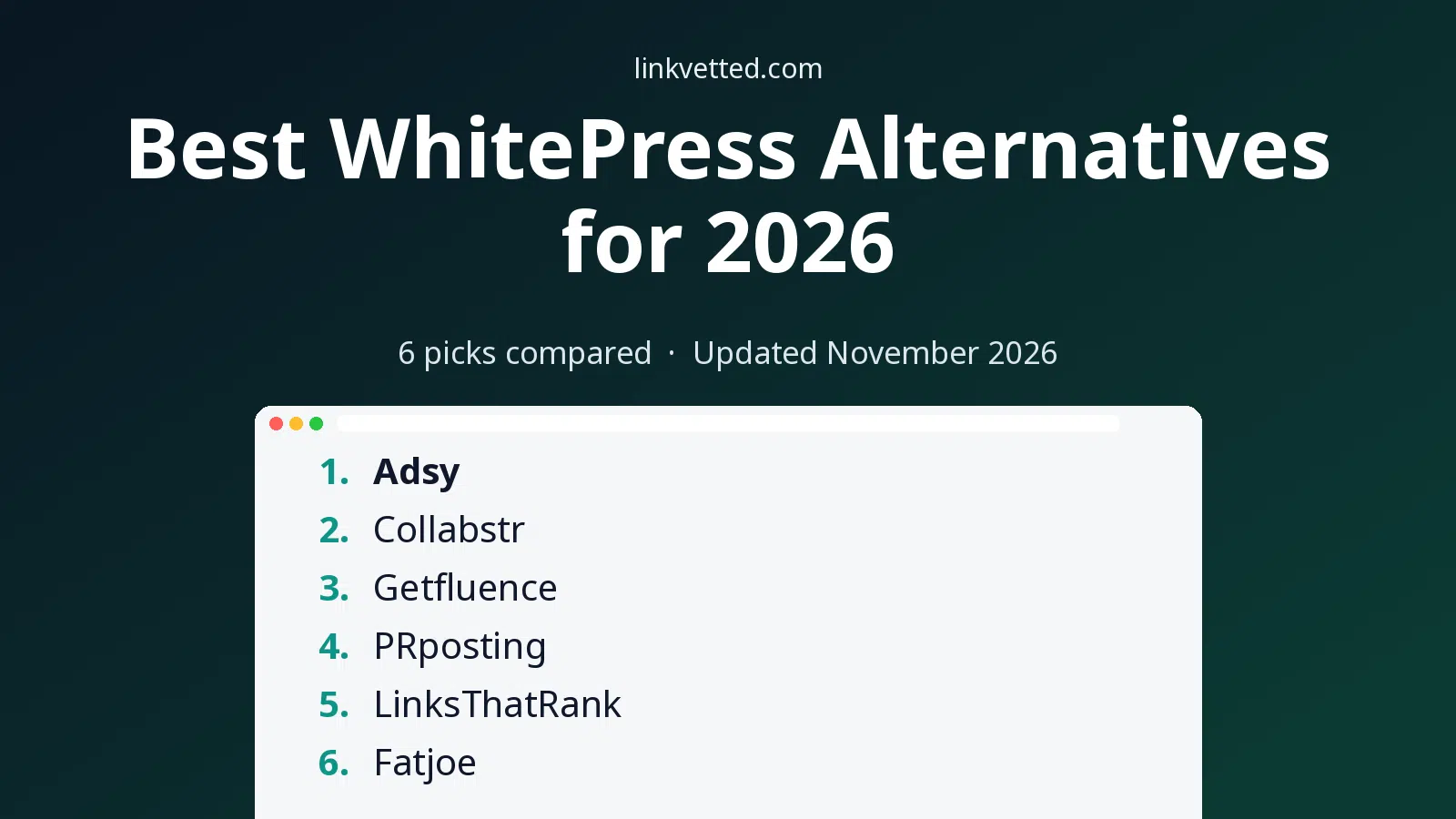
- Editor's choiceAdsy
Marketplace plus content ordering
Starts atSee websiteVisit adsy.comFull review - Great alternative
 Collabstr
Creator and influencer collaborations
Starts atSee websiteVisit collabstr.comFull review - Also considerGetfluence
Premium media brand placements
Starts atSee websiteVisit getfluence.comFull review
Direct answer
My first pick is Adsy, because it combines a publisher marketplace with campaign and content ordering in one dashboard, which suits agencies running repeat placements. For a large publisher inventory with a familiar self-serve flow, Collabstr and Getfluence are the next two I would look at, depending on whether you want creator-style placements or premium media brands. People look for WhitePress alternatives when they want different publisher pools, different workflow controls, or a marketplace that fits how their team already buys links.
TL;DR:
- WhitePress alternatives usually differ most in publisher inventory, vetting rules and how much workflow control you get.
- Adsy suits teams that want marketplace placements plus content ordering in one place.
- Collabstr leans toward creator and influencer-style collaborations rather than pure article placements.
- Getfluence focuses on premium media brands, which changes both the buying process and the budget conversation.
- Always confirm a marketplace's link policies and disclosure rules before you commit to a campaign.
Last checked November 2026. Plan prices are not quoted in this guide because they change often; see each vendor's own pricing page for current figures before you buy.
Quick comparison
| Tool | Best for | Starts at | Free plan? | |
|---|---|---|---|---|
| Adsy | Marketplace plus content ordering | See website | Not stated | Visit |
| Collabstr | Creator and influencer collaborations | See website | Not stated | Visit |
| Getfluence | Premium media brand placements | See website | Not stated | Visit |
| PRposting | Straightforward sponsored article buys | See website | Not stated | Visit |
| LinksThatRank | Managed-style marketplace buys | See website | Not stated | Visit |
 Fatjoe | Simple fixed-scope link packages | See website | Not stated | Visit |
The best WhitePress alternatives compared
I compared these options from vendor documentation and public sources rather than running hands-on tests. That means I looked at what each marketplace says it offers, how the buying workflow is described, and where the limits sit. I did not place live orders or measure results, so treat this as a starting point for your own checks before you spend.
Adsy
Best for: Marketplace plus content ordering
Adsy is a marketplace where advertisers browse publisher sites and place sponsored articles, and it also offers content creation and ordering in the same workflow. It fits agencies and in-house teams that run repeat campaigns and want the buying and writing steps close together. If your main need is a steady stream of placements across several client niches, the combined approach saves moving between tools.
In practice, you filter publishers by topic and site metrics, review the listing details, then order the placement. The dashboard keeps campaign activity in one view, which helps when several people touch the same account. For a WhitePress alternative, the appeal is that content and placement sit in one place instead of two separate vendor relationships.
The limit is that publisher quality is not uniform, so you still need to review each site yourself. Skip it if you only want a handful of one-off placements and do not need content ordering.
- Combines publisher marketplace with content ordering
- Campaign dashboard for tracking placements
- Filters for niche and site metrics
- Publisher quality varies by niche
- Some features depend on account type
Collabstr is a marketplace built around connecting brands with creators and influencers for collaborations. It is a different shape from a sponsored-post marketplace, so it fits brands that want creator-led content and mentions rather than only article placements on publisher sites. If your link plan includes creator content, it is worth a look.
The workflow is profile browsing and direct collaboration rather than buying a slot on a media site. That changes what you get: more control over the creator and the content, less control over the host site's editorial context. For some campaigns that trade-off is fine, and it can broaden where your brand appears.
The limit is clear: it is not a direct replacement for a publisher marketplace, and traditional article slots are fewer. Skip it if you specifically need editorial placements on established media sites.
- Large creator-style marketplace
- Brands can browse profiles and pitches
- Built around collaboration workflows
- Not a pure article-placement marketplace
- Fewer traditional publisher slots
Getfluence
Best for: Premium media brand placements
Getfluence is a marketplace focused on placements with premium media brands. It fits agencies and brands that want editorial context on recognisable outlets and are prepared for a more structured buying process. If a client cares about where a mention appears as much as the link itself, this is the kind of platform to evaluate.
The process tends to be more managed than a pure self-serve marketplace: you review available brands, agree on the placement, and the platform coordinates the campaign. That structure helps when several stakeholders need to approve placements, and it reduces the guesswork of dealing directly with individual sites.
The trade-off is budget and speed. Premium inventory costs more and moves slower than browsing a large self-serve list. Skip it if you need many low-cost placements quickly.
- Focus on premium media brands
- Structured campaign process
- Suits brand-conscious clients
- Premium inventory means higher budgets
- Slower process than self-serve marketplaces
PRposting
Best for: Straightforward sponsored article buys
PRposting is a sponsored article marketplace where you browse publisher listings and order placements directly. It fits smaller teams and freelancers who want a straightforward buy without a long onboarding process. The model will feel familiar to anyone who has used a publisher marketplace before.
You review site listings, check the details shown, and place an order for the article. Because the flow is simple, it suits one-off or occasional campaigns more than complex multi-client operations. For a WhitePress alternative, the main question is whether the publisher pool covers your niches.
The limit is inventory depth and workflow features. Skip it if you manage many clients at once and need detailed campaign tracking across accounts.
- Simple marketplace model
- Publisher listings with site details
- Direct ordering flow
- Smaller inventory than the largest marketplaces
- Less workflow depth for big teams
LinksThatRank
Best for: Managed-style marketplace buys
LinksThatRank is a link marketplace that presents itself around managed placements and topic-relevant sites. It fits teams that want help through the buying process rather than a fully self-serve list. Because it is less well known than the biggest names, I would check its current documentation and sample sites carefully before committing.
The workflow is closer to a managed service: you describe what you need, review proposed placements, and proceed from there. That can save time for teams without a dedicated link buyer, and it puts more of the site selection in the vendor's hands.
The limit is transparency and scale. With a smaller name, you should ask more questions about how sites are vetted and what happens if a placement changes. Skip it if you insist on browsing the full inventory yourself.
- Marketplace with a managed feel
- Placements organised by topic
- Support through the buying process
- Less well known, so vetting matters
- Inventory details vary by niche
Fatjoe sells link placements in packages, with content included in the order. It fits businesses that want a simple brief-to-delivery process and do not want to hand-pick every site. If your priority is speed and a clear scope rather than granular control, the package model is easy to understand.
You choose a package, brief the campaign, and the provider handles content and placement. For a WhitePress alternative, this is the most hands-off option on the list, which helps teams without a dedicated link builder. It also means less visibility into exactly which sites you get.
The limit is control. If you need to approve each domain, a package model will frustrate you. Skip it when site-level selection is a hard requirement.
- Package-based ordering
- Content and placement bundled
- Simple brief-to-delivery flow
- Less granular control over individual sites
- Package model suits simple campaigns only
How I chose
I picked these tools by reading vendor documentation and public sources, then comparing how each one describes its marketplace, workflow and limits. I did not run hands-on tests, place orders or measure outcomes, so this is a fit-based comparison rather than a performance review. Where a vendor's public information was thin, I said so and treated that as a reason to check further before buying.
The second filter was usefulness as a WhitePress alternative. That means the tool had to offer a realistic way to buy or arrange placements, not just a directory of sites. I also weighed workflow: whether a team can track campaigns, approve placements and keep content and placement together. Finally, I noted the obvious drawback for each option, because every marketplace makes a trade-off between inventory size, price level, control and speed. Your own checks should focus on the niches you actually work in.
What to check before you buy
- Confirm the marketplace's current policy on sponsored links and disclosure, and make sure your use fits it.
- Ask how publishers are vetted and whether you can see the actual site before you pay.
- Check whether content is included or billed separately, and who owns the article afterwards.
- Ask what happens if a placement is removed or a link changes after publication.
- Review the inventory in your specific niches, not just the total site count.
- Confirm reporting: can you export placement URLs and dates for client reporting?
FAQ
What is the best WhitePress alternative overall?
Adsy is my first pick for most agency use because it combines a publisher marketplace with content ordering and campaign tracking. That said, "best" depends on your need: Collabstr for creator-style work, Getfluence for premium media brands, and PRposting for simple one-off buys. Compare inventory in your own niches before deciding.
Are these marketplaces a direct replacement for WhitePress?
Not exactly. Each has a different publisher pool, vetting process and workflow, so placements and pricing structures will differ. Treat any alternative as a new vendor relationship that needs its own checks. The buying model may look similar, but the sites you can access and the support you get will vary.
Can I sell placements on these platforms as a publisher?
Several of these marketplaces let site owners list inventory, but the terms differ and some focus mainly on advertisers. Check each platform's publisher documentation for eligibility, vetting and payment terms. Do not assume that because a marketplace is open to advertisers, it is also open to your site.
How do I judge publisher quality on a marketplace?
Look at the site's topic relevance, editorial activity and how often it publishes. Check that the page you are buying sits in a relevant section and that the site discloses sponsored content. Ask the marketplace how it vets sites and whether you can reject proposed placements before publication.
Do these tools guarantee rankings or traffic?
No. Buying a placement does not guarantee rankings, traffic or any specific outcome, and I would be cautious of anyone who says otherwise. Placements are one input among many. Judge a marketplace on inventory fit, transparency and workflow, and keep your expectations tied to what you can actually verify.
Sources
- https://adsy.com
- https://collabstr.com
- https://getfluence.com
- https://prposting.com
- https://linksthatrank.com
- https://fatjoe.com