Website Traffic Estimators for Link Vetting in 2026: The 6 Best Options Side by Side
A practical look at website traffic estimators for link vetting in 2026, with six tools compared on documentation, fit and limits.
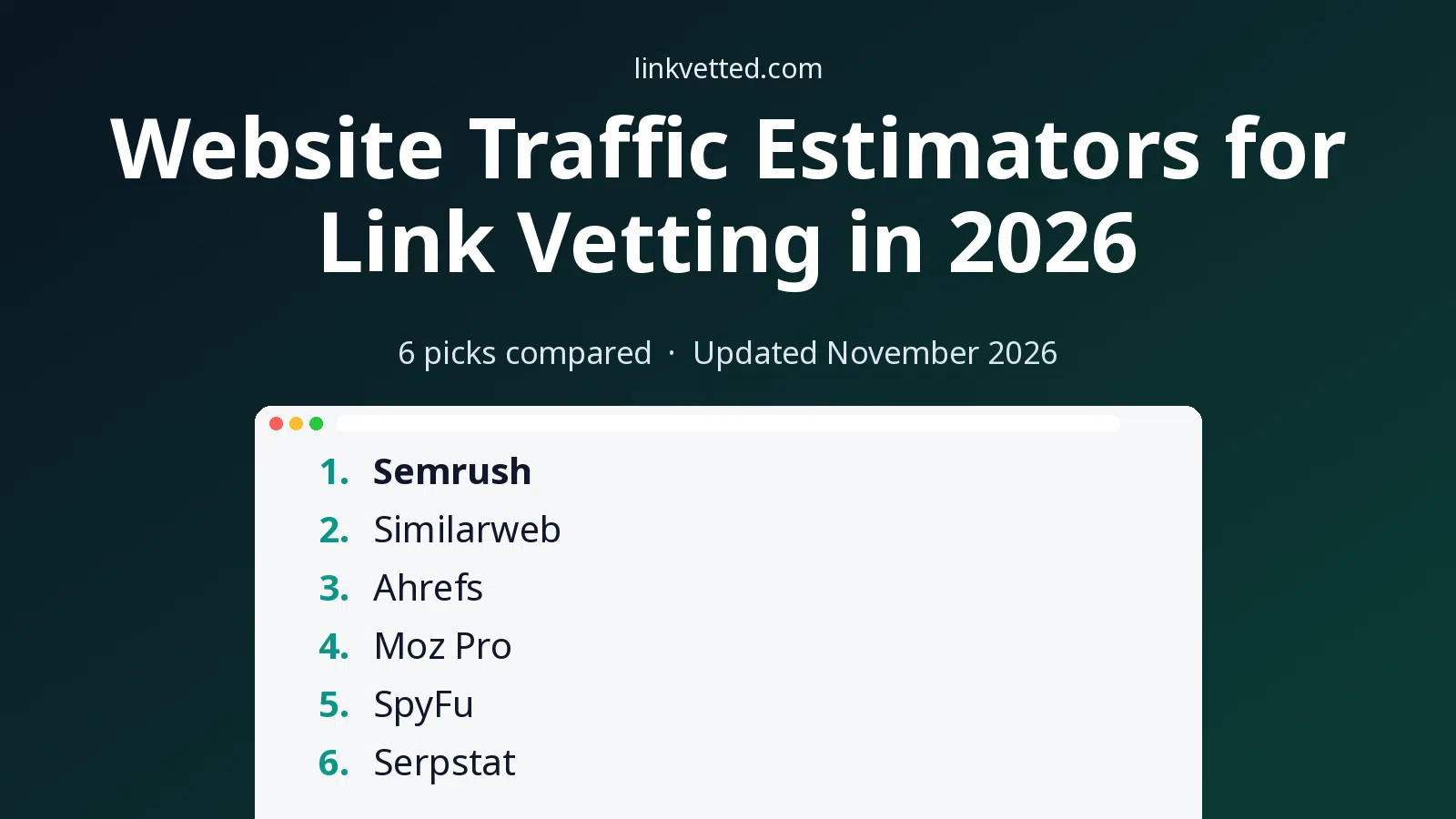
- Editor's choice
 Semrush
Traffic and backlink checks in one place
Starts atSee websiteVisit semrush.comFull review - Great alternative
 Similarweb
Fast audience and traffic mix checks
Starts atSee websiteVisit similarweb.comFull review - Also consider
 Ahrefs
Link vetting inside a backlink toolkit
Starts atSee websiteVisit ahrefs.comFull review
Direct answer
Semrush is my first pick for checking whether a site is worth a link, because its domain overview and traffic analytics views sit next to its backlink data. Similarweb suits quick market-level traffic checks, and Ahrefs fits teams that vet links inside a broader backlink workflow. All three are compared here from vendor documentation and public sources, not hands-on tests.
TL;DR:
- A traffic estimator only gives an estimate, so treat it as one signal in link vetting rather than a verdict.
- Semrush combines traffic estimates with backlink and authority data, which reduces tab-switching during outreach.
- Similarweb is useful when you want a fast read on a site's audience and traffic mix before you reply to a pitch.
- Ahrefs works well if your link vetting already happens inside its backlink and site explorer tools.
- No estimator replaces a manual look at the page, its topic and how it links out.
Last checked November 2026. Plan prices are not quoted in this guide because they change often; see each vendor's own pricing page for current figures before you buy.
Quick comparison
| Tool | Best for | Starts at | Free plan? | |
|---|---|---|---|---|
| Semrush | Traffic and backlink checks in one place | See website | Free plan | Visit |
| Similarweb | Fast audience and traffic mix checks | See website | Free plan | Visit |
| Ahrefs | Link vetting inside a backlink toolkit | See website | No free plan | Visit |
 Moz Pro | Link vetting with a domain authority focus | See website | Free trial | Visit |
 SpyFu | Checking sites in competitive niches | See website | No free plan | Visit |
 Serpstat | Budget-conscious agencies vetting links | See website | Free plan | Visit |
The best website traffic estimators for link vetting compared
I put this list together by reading vendor documentation and public sources for each tool, then matching what each one says it does against the job of vetting a link opportunity. I did not run hands-on tests, so treat the notes below as a starting point for your own trial. The order reflects how well each tool fits a link vetting workflow, not a score.
Semrush is an SEO platform with a traffic analytics module and a backlink analytics module. For link vetting, the value is that you can look at a site's estimated traffic and its referring domains in the same session. It fits agencies and in-house teams that already pay for an SEO suite and want one login for outreach research.
In a link vetting workflow, I would open the domain overview, check estimated visits and traffic sources, then move to the backlink profile to see whether the site links out to unrelated topics. Vendor documentation describes traffic estimates as modelled data, so I use them to spot obvious gaps, such as a site claiming high traffic with almost no organic footprint.
The limits are practical: the interface takes time to learn, and small or new sites may show thin data. If you only need a rough traffic number once a month, a lighter tool may be enough.
- Traffic analytics alongside backlink data
- domain overview gives a fast site summary
- broad toolset for outreach research
- Dense interface for occasional users
- estimates vary by market size
Similarweb is a digital intelligence platform known for website traffic estimates and audience data. It suits outreach teams that want a quick read on where a site's visitors come from and whether the audience matches the topic. It is often the first stop when a publisher pitches a guest post.
For link vetting, I use the traffic source split as a sanity check. A site with most visits from search and a clear topical focus looks different from one with traffic mostly from social or referrals. Vendor documentation frames the numbers as estimates, so I compare them with other signals rather than treating them as exact.
The drawback is that estimates can drift from what a site owner sees in their own analytics, and some detail requires a paid plan. Skip it if you need deep backlink analysis in the same view.
- Clear traffic source breakdowns
- useful competitor and audience context
- browser extension for quick lookups
- Estimates can differ from a site's own analytics
- deeper data sits in paid plans
Ahrefs is an SEO toolset built around backlinks and site research. Teams that already use it for link prospecting can check estimated organic traffic in the same place they review a site's link profile. It fits agencies with an established backlink workflow.
The workflow is straightforward: pull up a domain in site explorer, review estimated organic traffic and top pages, then check the backlink profile for signs of link schemes or irrelevant link neighbourhoods. Because the traffic and link data sit together, I can make a faster call on whether a site is worth pursuing.
The main limit is cost and commitment: there is no free plan, and the traffic figures are estimates. If you only need traffic numbers, a dedicated estimator may be simpler.
- Strong backlink index
- site explorer combines traffic and link data
- useful for checking link neighbourhoods
- No free plan
- traffic estimates are one part of a larger toolset
Moz Pro is an SEO platform known for its link metrics and site research tools. For link vetting, it fits teams that already use domain authority as part of their screening and want traffic context alongside it. It is common in agencies that have used Moz for years.
In practice, I would use Moz to check a site's link metrics and then look at traffic estimates as a secondary signal. Vendor documentation covers what each metric means, which helps when explaining a vetting decision to a client. The traffic side is not the main selling point, so I would not pick Moz only for traffic estimates.
The free trial is useful for a short evaluation, but ongoing use needs a paid plan. Skip it if traffic estimation is your primary need.
- Familiar link metrics for outreach
- combines site research with link data
- established documentation
- Traffic estimates are secondary to link metrics
- free access is limited to a trial
SpyFu is a competitor research tool that includes website traffic and search data. It fits link builders who work in competitive niches and want to see how a prospective link partner compares with others in the same space. It is less of a general traffic estimator and more of a research companion.
For link vetting, I would use it to compare a site against its competitors and see whether its estimated traffic is plausible for the niche. That context helps when a site claims a large audience. Vendor documentation explains the data sources, which is worth reading before you rely on any single number.
The limit is scope: it is built for competitor research, so it may be more than you need for a simple traffic check. Skip it if you want a lightweight estimator.
- Competitor research focus
- useful for niche traffic context
- combines search and site data
- No free plan
- built mainly around competitor research
Serpstat is an SEO platform with keyword, backlink and traffic research modules. It fits small agencies and freelancers who want several data types in one subscription without moving between tools. The free plan is useful for occasional checks.
In a link vetting workflow, I would check estimated traffic, then review the backlink profile and the site's keyword footprint to see whether the topic matches. Having those views together helps me decide quickly whether to reply to an outreach email. Vendor documentation describes the data as estimates, so I keep that in mind.
The limit is data depth: smaller sites and less common markets may show gaps. Skip it if you need the largest possible dataset.
- Combines traffic, keyword and backlink data
- free plan for light use
- useful for small agency workflows
- Smaller data footprint than larger rivals
- interface takes some learning
How I chose
I chose these tools by reading their official documentation and public descriptions, then matching each one to the specific job of checking a website's traffic before you agree to a link. I looked for tools that publish traffic estimates, explain where their data comes from, and fit into an outreach workflow without adding a lot of steps. I did not run hands-on tests, so my notes describe what the vendors say and how that maps to link vetting, not measured accuracy.
I also weighed limits: whether a free plan exists, how much of the traffic data sits behind a paid tier, and whether the tool is built mainly for traffic estimation or for something else. That is why the list includes platforms where traffic is one module among several. If your workflow is simple, a lighter tool may serve you better; if you already pay for an SEO suite, adding another subscription rarely makes sense.
What to check before you buy
- Confirm the tool covers the countries and languages of the sites you vet, since estimates vary by market.
- Check whether traffic estimates sit next to backlink data, so you can review both without switching tools.
- Read how the vendor describes its data sources and update frequency.
- Look for a free plan or trial long enough to test your own list of sites.
- Check export options if you need to share vetting notes with clients or teammates.
- Decide whether you need a dedicated estimator or can use a module inside a suite you already pay for.
FAQ
Are website traffic estimators accurate enough for link vetting?
They are estimates, not analytics data, so treat them as one signal. Vendor documentation generally describes modelled figures. I use them to spot obvious mismatches, such as a site claiming large traffic with little organic footprint, and then confirm with a manual look at the site and its link profile.
Can I vet links without a paid traffic tool?
Yes. Free plans and trials on some tools cover light checks, and a manual review of the site's topic, recent posts and outbound links tells you a lot. A paid tool helps when you vet many sites and need consistent data, but it is not a requirement for every outreach decision.
Should I use traffic estimates alone to reject a link?
No. A site with modest estimated traffic can still be a good link partner if its audience and topic fit. I combine traffic estimates with backlink profile checks, topical relevance and a look at how the site links out before deciding.
Which tool is best for a small agency?
It depends on what you already pay for. If you need traffic and backlink data together, Semrush or Ahrefs fit. If budget is tight, Serpstat's free plan is worth a look. I would trial two options against your own list of sites before committing.
Do these tools show traffic for small or new websites?
Often the data is thin for small or new sites, because estimators rely on modelled data. In that case I rely more on manual review and on the site's own claims, checked against its content and link profile. Do not assume a blank traffic figure means zero visitors.
Sources
- https://www.semrush.com
- https://www.similarweb.com
- https://ahrefs.com
- https://moz.com
- https://www.spyfu.com
- https://serpstat.com
Related guides
- How to Check Website Traffic for Any Site (Before You Buy a Link)
- Best Chaos Engineering Tools for High-Traffic Sites in 2026: Prices, Free Plans and 6 Picks
- Best Network Traffic Monitoring Tools (2026): 5 Picks Checked on Vendor Pages
- Best Services for High API Traffic Frontend Cloud in 2026: 8 Platforms Compared