Subscription Software for E-Commerce in 2026: The 5 Best Options Side by Side
Need the best subscription software for E-Commerce? We compare 5 tools on cost, free access and who each suits. Short verdicts, no fluff. Choose faster.
- Editor's choice
 Mailchimp
Straightforward email and SMS marketing
Starts at$13 per monthVisit mailchimp.comFull review - Great alternative
 Klaviyo
Retention marketing for online keeps
Starts at$20 a monthVisit klaviyo.comFull review - Also consider
 Shopify
All-in-one commerce for most merchants
Starts at$19 per monthVisit shopify.comFull review
Direct answer
Mailchimp leads the list, best for straightforward email and SMS marketing. Listed starting prices: Mailchimp from $13 per month, Klaviyo from $20 a month and Shopify from $19 per month. Klaviyo is better for retention marketing for online keeps, and Shopify is better for all-in-one commerce for most merchants. Details, prices and limits for the rest of the 5 tools are below.
TL;DR:
- Mailchimp takes the first slot, best suited to straightforward email and SMS marketing.
- Mailchimp is the lowest-priced starter here at $13 per month.
- 2 of 5 tools offer a free plan: Mailchimp, Klaviyo.
- Adobe Commerce fits enterprise B2B and B2C experiences.
Last checked November 2026. Prices and plan details were read from the vendors' own pages in November 2026; vendors change plans often, so confirm the current price on the vendor site before you buy.
Quick comparison
| Tool | Best for | Starts at | Free plan? | |
|---|---|---|---|---|
| Mailchimp | Straightforward email and SMS marketing | $13 per month | Yes | Visit |
| Klaviyo | Retention marketing for online keeps | $20 a month | Yes | Visit |
| Shopify | All-in-one commerce for most merchants | $19 per month | Free trial | Visit |
 BigCommerce | Scaling brands selling across channels | See website | Not stated | Visit |
 Adobe Commerce | Enterprise B2B and B2C experiences | See website | Not stated | Visit |
Every option for subscription software for E-Commerce explained
Short on time? The summary and table above give the quick view of 5 tools for subscription software for E-Commerce, and the profiles that follow give the detail behind each entry.
Mailchimp is built with straightforward email and SMS marketing in mind. Mailchimp centres on marketing instead of running a store, so it does not replace a commerce product.
Where it is weaker: Advanced needs may outgrow it.
More specifically, keeps with complicated, data-heavy retention programs may want a more specialized tool. On cost, Mailchimp starts like this: $13 per month. Free access exists with Mailchimp.
- Straightforward for smaller teams
- Live behavior data
- Marketing only, not commerce hosting
In short, Klaviyo is for retention marketing for online keeps. Pick it when retention marketing is the priority and your storefront already exists. In daily use, Klaviyo brings together AI-powered email marketing and SMS to drive growth, retention and measurable results, with personalized omnichannel experiences across channels including WhatsApp and ecommerce.
Downsides: Not a storefront system.
What Klaviyo does well: Extends to messaging channels.
It complements instead of replaces a commerce product. Klaviyo is a marketing tool, not a place to build or host a store, so it works alongside a separate commerce system. As for the details, results rely on how well customer and order data flows into it. Klaviyo cost at the entry level: $20 per month. Klaviyo offers a free plan.
- Brings together email and SMS marketing
- AI-powered personalization
- Value relies on data quality

Shopify works best for all-in-one commerce for most merchants. Since Shopify is a hosted system, deep customization depends on its app ecosystem and theme choices instead of direct control of the core.
Price to start with Shopify: $19 per month. Free access: Free trial.
What to check first: Recurring cost scales with extras.
- Handles plenty of parts of a business
- AI-assisted building and growth tools
- Less control over core code
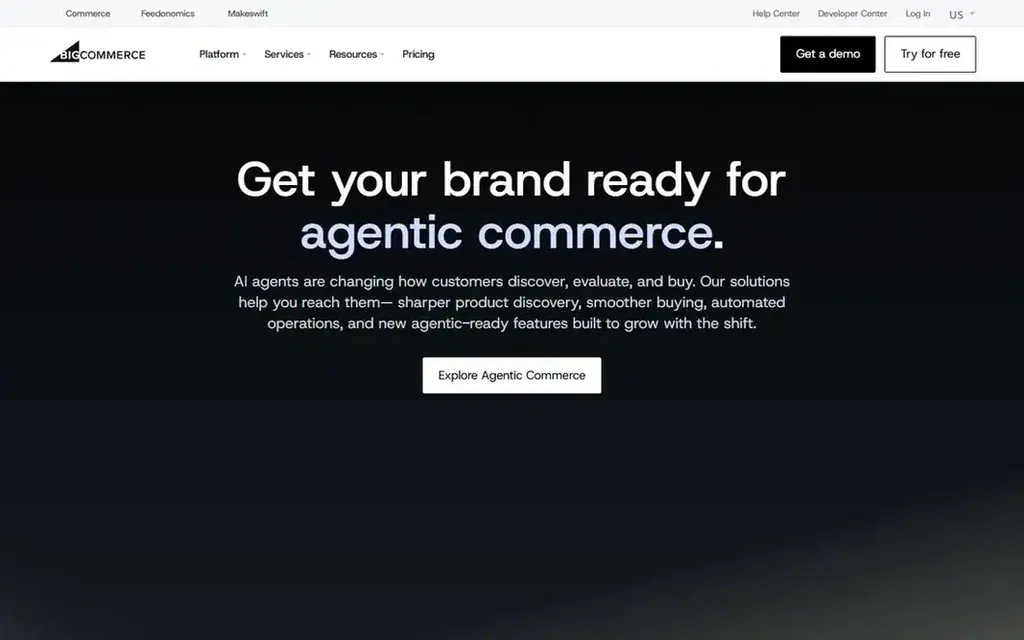
Pick BigCommerce if this describes you: scaling brands selling across channels. BigCommerce describes commerce built for momentum, powering buying experiences across brands, regions and channels from a single scalable foundation. It is a reasonable fit for brands planning expansion across regions rather than a single straightforward shop.
What to check first: Setup can feel complicated for small shops.
On top of that, some advanced capabilities depend on integrations with other services. Consider a more straightforward hosted choice if you sell in one place and want minimal configuration. Check the vendor site for BigCommerce pricing; none is listed in this comparison. Free plan details: Not stated.
- Supports regional brand experiences
- Single scalable foundation
- Some capabilities rely on integrations
For enterprise B2B and B2C experiences, Adobe Commerce is a natural candidate. Adobe Commerce, also known as Magento, is positioned as an AI-powered composable ecommerce system for B2B and B2C firms delivering personalized experiences at global scale.
It fits bigger organizations with complicated catalogs, several brands or international operations that require a composable architecture. Check the vendor site for Adobe Commerce pricing; none is listed in this comparison. Trial and free access: Not stated.
Drawbacks to consider: Geared toward large organizations.
- Designed for B2B and B2C
- AI-powered composable system
- Implementation demands specialist resources
How the list was put together
For each of the 5 tools we noted price, free plan or trial, fit for subscription software for E-Commerce and the main limit, using vendor pages and documentation. Where a price is missing, the vendor does not list one publicly or ties it to a quote. Always confirm before budgeting. Order on the page follows fit for the typical buyer first, then price transparency and free access. Your own requirements should decide the final pick.
What to check before you buy
- Confirm the entry price on the vendor page. For BigCommerce and Adobe Commerce that means a quote rather than a fixed price.
- Read the fine print on the free plans from Mailchimp and Klaviyo; seat, project and feature caps differ.
- Take the trial from Shopify and push a live task through it before you pay.
- Read the limits listed for Mailchimp first: marketing only, not commerce hosting.
- Check the support hours and onboarding help Mailchimp offers; smaller vendors vary a lot here.
- Before rolling out BigCommerce, verify the integrations your workflow depends on.
FAQ
Which options for subscription software for E-Commerce have a free plan?
On this list, Mailchimp and Klaviyo include a free plan. Caps on seats, usage or features are common, so test the free plan against your real workload. One other tool offers a trial instead.
What is the cheapest option for subscription software for E-Commerce in this list?
On published monthly entry prices, Mailchimp is the lowest here at $13 per month. Entry price is only part of the cost, because seats, add-ons and billing terms can change the total. Each of the 5 options in this subscription software for E-Commerce guide has its own card above with the price, free plan and limits.
Do these tools publish their prices?
Not all of them. BigCommerce and Adobe Commerce publish no starting price, so expect a quote request for those. The rest, Mailchimp included, show a starting price, though seats and billing terms still change the final cost.
How are the tools for subscription software for E-Commerce ordered?
The order follows typical fit for subscription software for E-Commerce, with Mailchimp first and Adobe Commerce last, then price clarity and free access. It is editorial judgement, not a score, so another team could rank the tools differently.
Sources
- https://mailchimp.com
- https://www.klaviyo.com
- https://www.shopify.com
- https://www.bigcommerce.com
- https://business.adobe.com/products/magento/magento-commerce.html