Choosing Platforms for Lakehouse Architecture in 2026: 6 Options Compared
Best platforms for Lakehouse architecture in 2026: 6 contenders with entry costs and free tiers. Plus the drawbacks of each tool. Last reviewed November 2026.
- Editor's choice
 Microsoft Fabric
Unified Microsoft analytics and data lakes
Starts atSee websiteVisit microsoft.comFull review - Great alternativeAmazon Athena
Serverless interactive SQL queries
Starts atSee websiteVisit aws.amazon.comFull review - Also consider
 Amazon EMR
Large-scale distributed data processing
Starts atSee websiteVisit aws.amazon.comFull review
Direct answer
Microsoft Fabric leads the list, best for unified Microsoft analytics and data lakes. Listed starting prices: Cloudera Data Platform from $0.04 per CCU per hour. If your case is different, Amazon Athena suits serverless interactive SQL queries and Amazon EMR suits large-scale distributed data processing. The remaining 3 options are covered below with prices and limits.
TL;DR:
- Microsoft Fabric takes the first slot, best suited to unified Microsoft analytics and data lakes.
- Only Amazon EMR offers a free plan among these 6 tools.
- Check the limits for Databricks Lakehouse Platform before you commit: wide scope may need careful setup.
- Expect to ask for a quote from Microsoft Fabric, Amazon Athena, Amazon EMR and others; the other tools show a starting price.
- Azure Databricks suits managed lakehouse on Azure.
Last checked November 2026. Prices and plan details were read from the vendors' own pages in November 2026; vendors change plans often, so confirm the current price on the vendor site before you buy.
Quick comparison
| Tool | Best for | Starts at | Free plan? | |
|---|---|---|---|---|
| Microsoft Fabric | Unified Microsoft analytics and data lakes | See website | Free trial | Visit |
| Amazon Athena | Serverless interactive SQL queries | See website | Not stated | Visit |
| Amazon EMR | Large-scale distributed data processing | See website | Yes | Visit |
| Databricks Lakehouse Platform | Unified data, analytics, and AI | See website | Not stated | Visit |
| Cloudera Data Platform | Hybrid data and AI anywhere | $0.04 per CCU per hour | Not stated | Visit |
| Azure Databricks | Managed lakehouse on Azure | See website | Free trial | Visit |
The full platforms for Lakehouse architecture list
Short on time? The summary and table above give the quick view of 6 tools for platforms for Lakehouse architecture, and the profiles that follow give the detail behind each entry.
Choose Microsoft Fabric for unified Microsoft analytics and data lakes. As with any wide system, governance and workspace design need early attention to keep data manageable.
Where it is weaker: Wide surface area to learn and govern.
What users get: AI-powered analytics system. Microsoft Fabric does not show a starting price in this comparison, so check the vendor site for current pricing. As for free access: Free trial.
- Data science, analytics
- Unites data lakes
- Most natural for Microsoft-centric organizations
Amazon Athena
Best for: Serverless interactive SQL queries
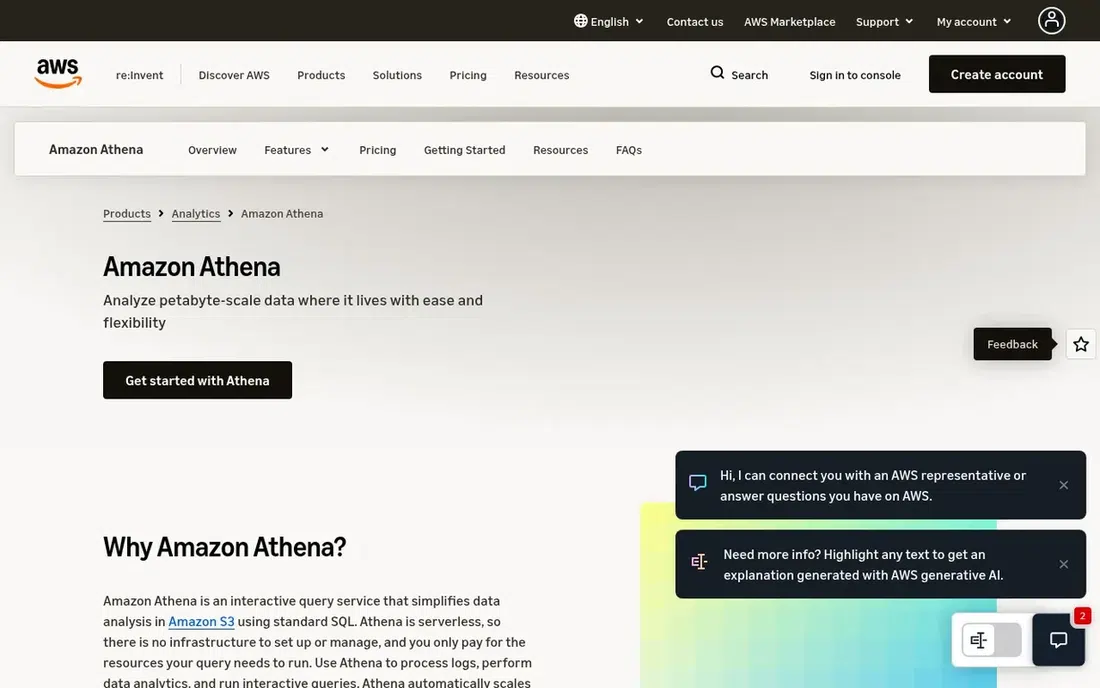
Amazon Athena makes the most sense for serverless interactive SQL queries. Amazon Athena is a serverless, interactive analytics service that offers a simplified and adaptable way to analyze large datasets where they live.
Athena is a query service, not a complete lakehouse system. So teams needing orchestration, governance, and data science tooling will pair it with other services. Amazon Athena shows no starting price here, so confirm the cost on the vendor site. Free access: Not stated.
The main drawbacks: Query-focused instead of a full platform.
- No infrastructure to run
- Takes care of large-scale datasets
- Best within the AWS ecosystem
Amazon EMR makes the most sense for large-scale distributed data processing. EMR expects teams to manage frameworks and cluster configuration, which layers on operational work compared to completely managed or serverless choices.
Pricing for Amazon EMR is not stated here, so ask the vendor for current figures. Free access exists with Amazon EMR.
Strengths: machine learning.
Where it is weaker: Operational overhead compared with serverless.
- Supports batch, SQL
- Cloud big data product for scale
- Needs cluster and framework expertise
Databricks Lakehouse Platform
Best for: Unified data, analytics, and AI
Databricks Lakehouse Platform serves unified data, analytics, and AI. Databricks Lakehouse Platform is a unified product for data, analytics, and AI, built around a data-centric approach.
Downsides: Best fit for teams aligned on its ecosystem.
On top of that, organizations with heavy investment in a single cloud vendor's native analytics stack may prefer that vendor's managed lakehouse service. Databricks is strongest when a unified, open lakehouse is the priority. Pricing for Databricks Lakehouse Platform is not stated here, so ask the vendor for current figures. Free access: Not stated.
- Single product for several data teams
- Merges ETL, warehousing, governance, AI
- Wide scope may need careful setup
Cloudera Data Platform
Best for: Hybrid data and AI anywhere
Cloudera Data Platform is built with hybrid data and AI anywhere in mind. Cloudera Data Platform is described as a hybrid data and AI system that brings AI to data anywhere: in clouds, in data centers, and at the edge.
Limits to weigh: Hybrid complexity requires planning.
In daily use, organizations committed to a single public cloud may find that cloud's native lakehouse services more straightforward to adopt. Hybrid systems carry integration and operational complexity, so teams should assess skills and governance needs. Price to start with Cloudera Data Platform: $0.04 per CCU per hour. On free options: Not stated.
- Fits on-premises and hybrid estates
- Brings AI to data at the edge
- Overlap with cloud-native lakehouse services
Azure Databricks
Best for: Managed lakehouse on Azure
Pick Azure Databricks if this describes you: managed lakehouse on Azure. It fits organizations that want Databricks capabilities whereas staying within Azure's cloud services, combining open lakehouse storage with managed compute and collaboration.
Check the vendor site for Azure Databricks pricing; none is listed in this comparison. Free plan details: Free trial.
Limits to weigh: Needs Databricks system knowledge.
- Managed service for open data lakehouses
- Supports analytics and AI strategy
- Azure-specific deployment
How these tools were picked
Before you commit
- Get a written quote from Microsoft Fabric, Amazon Athena, Amazon EMR and others; the list shows no starting price for them.
- Look at the free plan from Amazon EMR closely: its caps decide whether it is usable for real work.
- Use real work to test the free trial from Microsoft Fabric and Azure Databricks, rather than a demo project.
- Before choosing Microsoft Fabric, weigh its main limit: most natural for Microsoft-centric organizations.
- See whether Amazon Athena offers onboarding or training, and whether it is included in the price.
- Before rolling out Amazon EMR, verify the integrations your workflow depends on.
FAQ
Can I try these tools before paying?
Often, yes. Amazon EMR has a free plan and Microsoft Fabric and Azure Databricks offer a free trial. Use your own data and a real task during the test, and check what the free tier or trial limits before you rely on it.
Which options for platforms for Lakehouse architecture have a free plan?
Amazon EMR is the only tool in this list with a free plan. Free plans usually cap users, projects or features, so check the limits on the vendor page. Several others offer a trial instead.
Do these tools publish their prices?
Not all of them. Microsoft Fabric, Amazon Athena, Amazon EMR and others publish no starting price, so expect a quote request for those. The rest, Cloudera Data Platform included, show a starting price, though seats and billing terms still change the final cost.
Which platform is a good match for an open Iceberg lakehouse?
For most readers this guide would start with Microsoft Fabric, built for unified Microsoft analytics and data lakes. Amazon Athena is the alternative for serverless interactive SQL queries, and Amazon EMR for large-scale distributed data processing. The right answer depends on budget and workflow.
Is Microsoft Fabric the right pick for everyone comparing platforms for Lakehouse architecture?
No single tool suits every team. Microsoft Fabric comes first because it fits unified Microsoft analytics and data lakes, while Amazon Athena suits serverless interactive SQL queries and Amazon EMR suits large-scale distributed data processing. Match the tool to your own size, budget and workflow before deciding.
Sources
- https://www.microsoft.com/en-us/microsoft-fabric
- https://aws.amazon.com/athena
- https://aws.amazon.com/emr
- https://www.databricks.com
- https://www.cloudera.com
- https://azure.microsoft.com/en-us/products/databricks