6 Strong Marketing Intelligence Software Options in 2026
Best marketing intelligence software in 2026: 6 tools with starting prices, free plans and limits. Short verdicts, no fluff. Last reviewed November 2026.

- Editor's choice
 Klue
Product marketers building a competitive enablement program for sales
Starts atSee website (custom quote)Visit klue.comFull review - Great alternative
 Similarweb
Marketers and analysts benchmarking competitor website traffic and audience behavior
Starts atSee website (Starter widely reported around $199/month)Visit similarweb.comFull review - Also consider
 Crayon
Enterprises that want automatic competitor tracking feeding sales battlecards
Starts atSee website (custom quote)Visit crayon.coFull review
Direct answer
If you need product marketers building a competitive enablement program for sales, Klue is the first tool to look at here. Similarweb fits Marketers and analysts benchmarking competitor website traffic and audience behavior; Crayon fits enterprises that want automatic competitor tracking feeding sales battlecards. The full list of 6 tools follows, with prices and free plan facts.
TL;DR:
- Klue takes the first slot, best suited to product marketers building a competitive enablement program for sales.
- Check the limits for Similarweb before you commit: no published pricing beyond the self-serve level, so costs escalate through sales calls.
- Free plans exist at 3 of 6 tools (Similarweb, Semrush, Adbeat).
- Adbeat fits media buyers and agencies spying on competitor display and native ad creatives.
- Semrush is the lowest-priced starter here at $139.95/month.
Quick comparison
| Tool | Best for | Starts at | Free plan? | |
|---|---|---|---|---|
| Klue | Product marketers building a competitive enablement program for sales | See website (custom quote) | No | Visit |
| Similarweb | Marketers and analysts benchmarking competitor website traffic and audience behavior | See website (Starter widely reported around $199/month) | Yes | Visit |
| Crayon | Enterprises that want automatic competitor tracking feeding sales battlecards | See website (custom quote) | No | Visit |
 BuiltWith | Sales and marketing teams building prospect lists from website technology data | $295/month (Basic plan) | No | Visit |
 Semrush | Marketing teams that want competitor SEO, PPC and traffic data in one subscription | $139.95/month (Pro plan) | Yes | Visit |
 Adbeat | Media buyers and agencies spying on competitor display and native ad creatives | $249/month (Standard plan) | Yes | Visit |
Marketing Intelligence Software profiles
LinkVetted compared 6 tools for marketing intelligence software. The goal is a practical shortlist: published prices, free plan facts, best-fit use cases and honest limits for every entry.
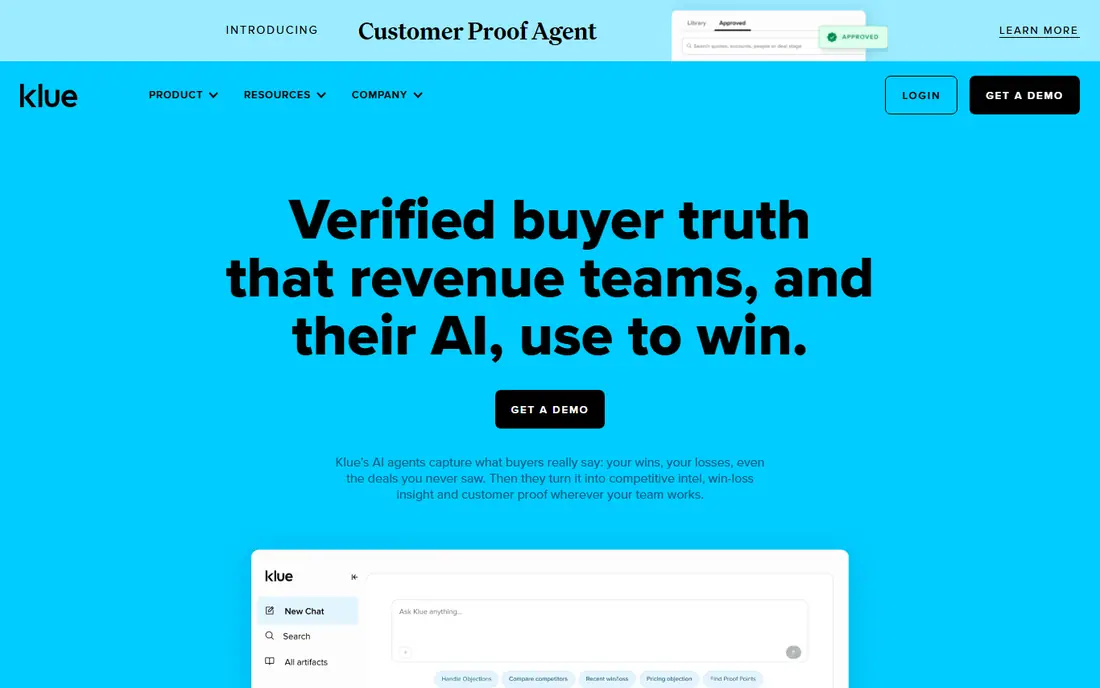
Klue serves product marketers building a competitive enablement program for sales. Klue is Crayon's closest rival and the choice of product marketers who think in programs, not dashboards. Beyond that, the system merges automatic competitor monitoring with a structured workflow for building, distributing and measuring battlecards, tying competitive content to CRM stages and win rates.
The honest catch is the same as Crayon's: custom quotes, annual contracts, and a product whose ROI lives or dies on seller adoption. Buying Klue without a plan to drive usage is buying a pricey library nobody opens. Klue shows no starting price here, so confirm the cost on the vendor site. Klue has no free plan.
Downsides: Custom pricing with no self-serve choice.
- Solid adoption playbooks for competitive programs
- Curated intel from analyst-curated sources plus your own field input
- Value relies on sales team adoption, which needs internal change management
Similarweb
Best for: Marketers and analysts benchmarking competitor website traffic and audience behavior

Pick Similarweb if this describes you: Marketers and analysts benchmarking competitor website traffic and audience behavior. Similarweb is what analysts mean when they say "competitive traffic data." Its panel-based estimates include traffic sources, audience geography, engagement and app rankings at a depth no SEO tool matches. In practice, small firms should start with the free level and Semrush, and only talk to Similarweb sales when the business case is concrete.
More specifically, for agencies and enterprises doing market sizing, it is the reference dataset. Beyond that, the free level hands real numbers for widely used sites, which makes it useful even before you pay. As for the details, the Starter level is the only self-serve choice. Everything above it (Team, Business, Enterprise) is custom-quoted and runs into five and six figures annually, with add-on modules for AI traffic and market research sold separately. This comparison lists no price for Similarweb; ask the vendor. A free plan is available with Similarweb.
The main drawbacks: Upper levels run $14,000-plus a year, which prices out small teams.
- Deepest website traffic and audience dataset in the category
- Genuinely usable free level for fast checks on major sites
- No published pricing beyond the self-serve level, so costs escalate through sales calls
Crayon
Best for: Enterprises that want automatic competitor tracking feeding sales battlecards
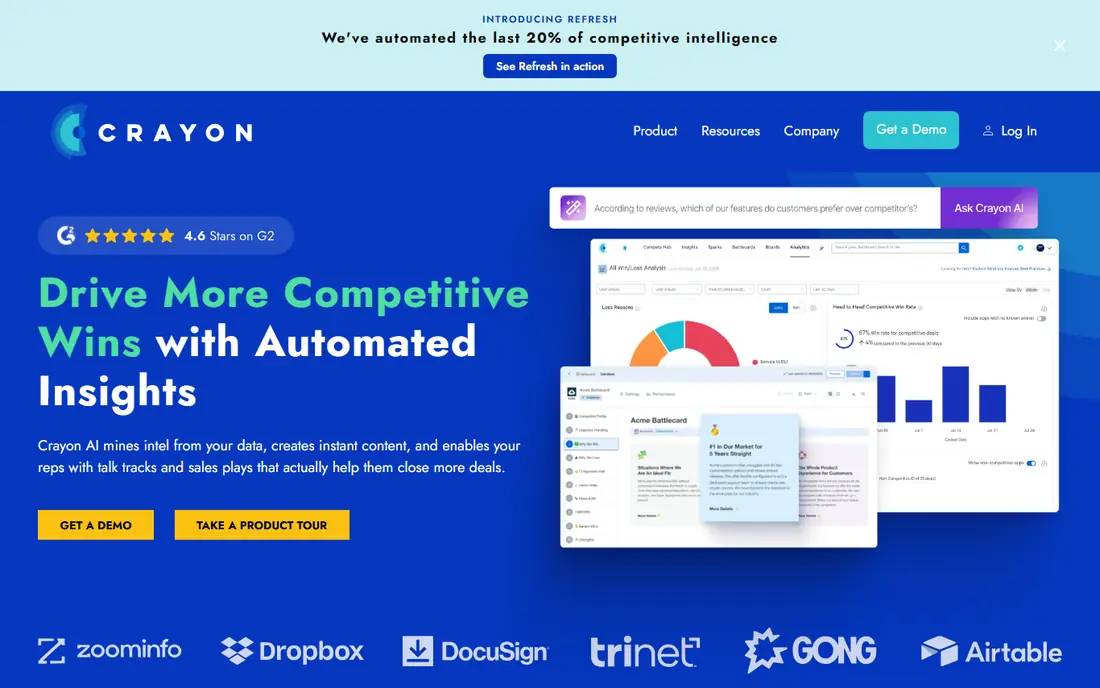
Choose Crayon for enterprises that want automatic competitor tracking feeding sales battlecards. There is no self-serve level and no published price; you talk to sales and sign an annual contract. The honest catch is the commercial model.
For everyday use, for product marketing teams supporting a sales org, that automation replaces hours of manual monitoring every week. If your team is five marketers doing their own research, Crayon is the wrong shape. This comparison lists no price for Crayon; ask the vendor. No free plan comes with Crayon.
Limits to weigh: Custom pricing means a sales process and annual contract.
- Automated capture of competitor website
- Pricing and messaging changes with human-curated insight
- Overkill and overpriced for teams that just need ad or keyword data
BuiltWith
Best for: Sales and marketing teams building prospect lists from website technology data
BuiltWith is a good fit for sales and marketing teams building prospect lists from website technology data. BuiltWith answers "which firms use this technology," which makes it a prospecting tool disguised as an intelligence tool. As for the details, for technographic market sizing and "who uses our competitor's stack" questions, nothing else matches its history.
Eighteen years of historical data also makes it the best source for technology adoption trends. The vendor's own knowledge base publishes these prices plainly, a rarity in this category. On cost, BuiltWith starts like this: $295/month. BuiltWith has no free plan.
Honest limits: list building needs contact data from elsewhere.
What works well: Largest technology profile database.
- Historical trend data presents technology adoption over time
- Tracking over 100,000 technologies across hundreds of millions of domains
- No free trial
Semrush
Best for: Marketing teams that want competitor SEO, PPC and traffic data in one subscription
Semrush is a good fit for marketing teams that want competitor SEO, PPC and traffic data in one subscription. At $139.95 a month with a restricted free account to test, it is the cheapest way to get credible competitor data across channels. On top of that, the honest catch is precision.
Where it shines: Published transparent pricing with monthly billing.
Beyond that, heavy users also hit Pro's project limits quick. In daily use, traffic Analytics estimates competitor visits and sources, Advertising Research displays their ad copies and budgets, and Keyword Gap finds the terms they rank for that you do not. For everyday use, Semrush models traffic from panels and crawls, so numbers for smaller sites can swing. Use it for direction and share, not for exact visitor counts. On cost, Semrush starts like this: $139.95/month. Free access exists with Semrush.
Points against: Pro project and keyword limits push active teams toward Guru rapidly.
- Traffic analytics and inbound link gaps in one login
- Broadest data set per dollar: keyword gaps
- Traffic estimates are modeled, not measured, so treat small-site numbers as directional
Adbeat
Best for: Media buyers and agencies spying on competitor display and native ad creatives
Where Adbeat fits: media buyers and agencies spying on competitor display and native ad creatives. Adbeat is the tool media buyers open when they have to see what competitors are actually running: the creatives, the landing pages, the publishers, the networks.
Where it falls short: Interface feels dated and takes time to learn.
Beyond that, standard at $249 a month handles display and native ads across 30-plus countries with 90 days of history; Advanced at $399 brings per year of data and competitor alerts. Adbeat cost at the entry level: $249/month. Adbeat has a free plan.
- Landing pages and publisher placements
- Best display
- $249 a month is steep if you only run search ads
How these tools were picked
For each of the 6 tools we noted price, free plan or trial, fit for marketing intelligence software and the main limit, using vendor pages and documentation. Prices and plan limits come from vendor pages and can change, so confirm them on the vendor site before you buy. Position on the page reflects fit for a typical buyer first, with price clarity and free access breaking ties. Treat it as a guide, not a ruling.
Before you commit
- Get a written quote from Klue, Similarweb and Crayon; the list shows no starting price for them.
- Read the fine print on the free plans from Similarweb, Semrush and Adbeat; seat, project and feature caps differ.
- Read the limits listed for Klue first: custom pricing with no self-serve choice.
- Total up the real monthly cost of Semrush, including add-ons, extra users and usage-based fees.
- Look at the renewal terms for Klue: auto-renewal, notice periods and price changes can matter more than the first-year price.
FAQ
Is Klue the right pick for everyone comparing marketing intelligence software?
No single tool suits every team. Klue comes first because it fits product marketers building a competitive enablement program for sales, while Similarweb suits Marketers and analysts benchmarking competitor website traffic and audience behavior and Crayon suits enterprises that want automated competitor tracking feeding sales battlecards. Match the tool to your own size, budget and workflow before deciding.
How are the tools for marketing intelligence software ordered?
The order follows typical fit for marketing intelligence software, with Klue first and Adbeat last, then price clarity and free access. It is editorial judgement, not a score, so another team could rank the tools differently.
Can I try these options before paying?
Often, yes. Similarweb, Semrush and Adbeat have a free plan. Use your own data and a real task during the test, and check what the free tier or trial limits before you rely on it.
What is the cheapest option for marketing intelligence software in this list?
On published monthly entry prices, Semrush is the lowest here at $139.95/month. Entry price is only part of the cost, because seats, add-ons and billing terms can change the total.
Which marketing intelligence tool is a good match for small companies?
This list starts with Klue, which fits product marketers building a competitive enablement program for sales. For other needs, Similarweb is aimed at Marketers and analysts benchmarking competitor website traffic and audience behavior, and Crayon at enterprises that want automatic competitor tracking feeding sales battlecards. Check each tool's price and main limit first.
Is Similarweb worth the price?
For enterprises doing traffic benchmarking and market sizing, yes: its dataset is the category reference. For small teams, the value is harder to justify once you pass the Starter level into custom-quoted plans at $14,000-plus a year.