Best Link Building Services for Insurance Websites for 2026: Our 6 Vetted Picks
A practical guide to link building services for insurance websites in 2026, compared from vendor documentation and public sources with limits and fit noted.
- Editor's choice
 FATJOE
Managed blogger outreach and editorial links
Starts atSee websiteVisit fatjoe.comFull review - Great alternative
 Pitchbox
In-house outreach campaign management
Starts atSee websiteVisit pitchbox.comFull review - Also consider
 BuzzStream
Digital PR and media relationships
Starts atSee websiteVisit buzzstream.comFull review
Direct answer
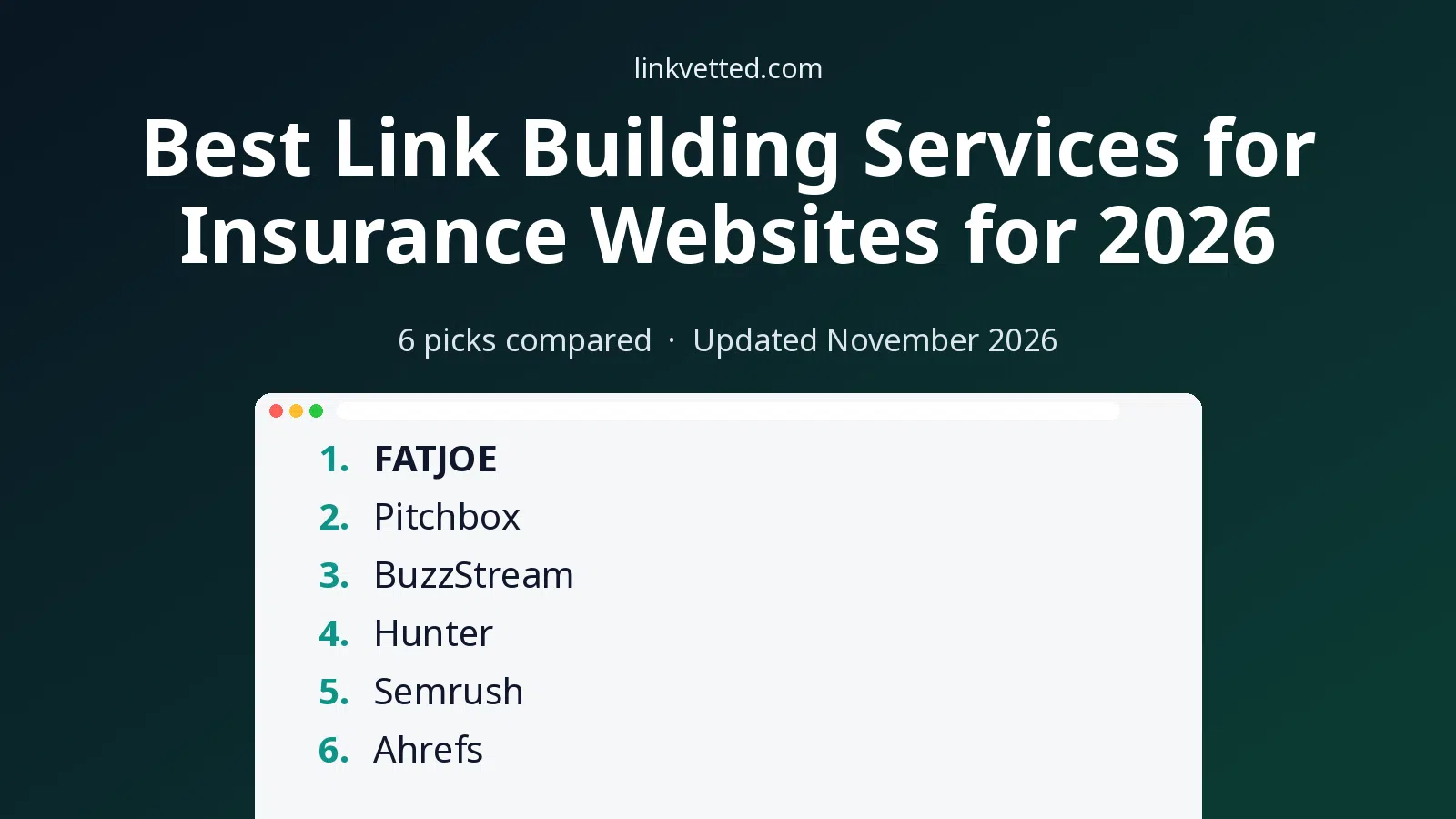
My top pick is FATJOE, because it is built around blogger outreach and editorial placements, which suits insurance sites that need contextually relevant links rather than bulk directories. For agencies that want to run campaigns in-house, Pitchbox gives the outreach workflow. For teams that prefer managed digital PR with journalist relationships, BuzzStream is a reasonable third option. Each fits a different budget and level of involvement.
TL;DR:
- Insurance is a regulated, trust-sensitive niche, so editorial links from finance, legal and local news sources usually matter more than volume.
- Managed services save time but give you less control over which sites link to you.
- Outreach software is cheaper per link but requires your own list building and copywriting.
- Always ask a vendor how they handle YMYL topics and whether they publish a sample placement list.
- Check that any service follows Google's spam policies and avoids paid link schemes.
Last checked November 2026. Plan prices are not quoted in this guide because they change often; see each vendor's own pricing page for current figures before you buy.
Quick comparison
| Tool | Best for | Starts at | Free plan? | |
|---|---|---|---|---|
| FATJOE | Managed blogger outreach and editorial links | See website | Not stated | Visit |
| Pitchbox | In-house outreach campaign management | See website | Free trial | Visit |
| BuzzStream | Digital PR and media relationships | See website | Free trial | Visit |
 Hunter | Finding contact emails for outreach | See website | Free plan | Visit |
 Semrush | Competitor and backlink research | See website | No free plan | Visit |
 Ahrefs | Backlink analysis and prospecting | See website | Not stated | Visit |
The best link building services for insurance websites compared
I put this comparison together from vendor documentation, public help pages and product descriptions. I did not run hands-on tests, and I have not used every tool on a live insurance campaign. The notes below focus on how each option fits the insurance niche, what the workflow looks like, and where it falls short.
FATJOE is a link building marketplace where you order placements on blogs and publisher sites. For an insurance website, the appeal is that links come from articles rather than directories or comment sections. That matters because insurance content sits in the "your money or your life" category, where Google's quality guidelines expect trustworthy sourcing. A managed service like this suits site owners who want to outsource prospecting and writing.
In practice, you describe your niche and target pages, and the service matches you with publishers. You can usually review the site before a link goes live. For insurance, I would ask specifically for finance, legal, local news and consumer advice categories. The workflow is order, review, publish, which keeps the process simple if you do not have an outreach team.
The limit is control. You are choosing from a catalogue, not building relationships with specific journalists. If your compliance team needs to approve every linking domain, a managed marketplace can slow down. Skip it if you want to own the entire outreach process.
- Editorial placement focus
- Simple ordering process
- Content creation included
- Limited control over exact sites
- Pricing needs a quote
Pitchbox is outreach software for finding prospects, sending pitches and tracking replies. It fits insurance companies and agencies that want to run link building themselves rather than buy placements. You build a list of relevant publishers, such as local business journals, insurance trade publications and personal finance blogs, then manage the conversation from one dashboard.
For insurance sites, the value is in repeatable campaigns. You can segment prospects by topic, track who opened a pitch and follow up without losing threads. Because you control the target list, you can screen out anything that looks like a low-quality or paid link scheme, which is important in a regulated niche.
The drawback is that Pitchbox does not supply links. You need someone to build lists, write pitches and handle replies. If you have no outreach capacity, this tool will sit unused. It suits teams with at least one person dedicated to link building.
- Prospecting and outreach in one place
- Campaign automation
- Team collaboration
- Needs your own link targets
- Setup takes time
BuzzStream is a relationship management tool for link building and digital PR. It stores contact details, conversation history and outreach status so you can build long-term relationships with journalists and editors. For insurance, that is useful because the same finance reporters and trade editors cover the topic repeatedly.
The workflow centres on research and follow-up. You find relevant writers, log their details, send pitches and record what happened. Over time you build a list of contacts who know your brand. That is slower than buying placements but often produces more durable links.
The limitation is that BuzzStream is software, not a service. It will not find links for you or guarantee coverage. It suits PR-minded teams, and it is a poor fit for someone who wants links delivered without doing outreach.
- Contact and relationship tracking
- Outreach email tools
- Research features
- Not a placement service
- Best for teams with PR skills
Hunter is an email finding tool. You enter a company domain and it suggests likely email addresses and patterns. In a link building workflow, it helps you reach the right editor at an insurance publication, local newspaper or finance blog when the site does not list a contact.
For insurance sites, Hunter is a supporting tool rather than a complete service. You still need a target list, a pitch and a way to track replies. It works well alongside outreach software or a CRM, and it is cheap to try because a free plan exists.
The limits are clear. Hunter does not place links, and email guesses are not always correct. Verify addresses before sending, and follow anti-spam rules in your region. Skip it if you already have a reliable contact source.
- Email discovery
- Domain search
- Simple interface
- No link placement
- Data accuracy varies
Semrush is an SEO platform with a backlink analytics section. For insurance websites, it helps you see which domains link to competitors, which pages attract links and where gaps exist. That research feeds any outreach campaign, whether you run it in-house or hand it to a service.
The workflow is research first. You export competitor backlinks, filter for relevant finance and local sites, then build a target list. Semrush also tracks your own new and lost links so you can see whether a campaign is working.
It is not a link building service. There is no outreach, no placement and no guarantee of links. It suits teams that want to plan and measure campaigns, and it is overkill if you only need a few placements per month.
- Large backlink index
- Competitor analysis
- Content and SEO tools
- No outreach service
- Data needs interpretation
Ahrefs is another SEO toolkit with a well-known backlink index. Insurance marketers use it to audit their own link profile, spot toxic or irrelevant links and study competitors. The site explorer shows referring domains, anchor text and page-level link data.
For link building, Ahrefs is a research and monitoring tool. You can find link opportunities, check whether a prospect site looks legitimate and track results after a campaign. That makes it a good companion to an outreach service or an in-house team.
Like Semrush, it does not build links. The interface assumes some SEO knowledge, and the data can be overwhelming for beginners. Skip it if you want a done-for-you service rather than a research platform.
- Detailed backlink data
- Strong crawling
- Useful site explorer
- No outreach tools
- Requires SEO knowledge
How I chose
I selected these tools by reading vendor documentation, public help pages and product descriptions, then judging each against the needs of insurance websites. Insurance is a regulated, trust-heavy niche, so I weighted editorial placement quality, outreach control and the ability to screen linking domains. I also noted whether each option is a managed service, software or a research tool, because that changes how much work falls on you.
I did not run hands-on tests, and I am not claiming client results or performance statistics. The comparison reflects fit and stated capabilities, not measured outcomes. Where a vendor does not publish clear details, such as free plan availability, I marked it as not stated rather than guessing. Before buying, confirm current features and terms directly with each vendor, since products change.
What to check before you buy
- Ask whether the service places links on sites relevant to finance, legal or local news, not generic directories.
- Confirm the vendor follows Google's spam policies and does not use private blog networks or paid link schemes.
- Request a sample of past placements or example publisher categories, without expecting client names.
- Check whether you can approve or reject individual linking domains before publication.
- Ask how they handle regulated content and whether they will work with your compliance review.
- Confirm what reporting you get, including live link URLs and removal policy if a link disappears.
FAQ
Are paid link building services safe for insurance websites?
Paid services are not automatically risky, but the method matters. Editorial placements that follow Google's spam policies are different from bulk paid links. Ask vendors how they source sites, whether links are marked as sponsored where required, and whether they avoid link schemes. Your compliance team should review the approach before any campaign starts.
How many links does an insurance website need?
There is no fixed number. It depends on your market, competition and existing profile. A local insurance broker and a national carrier have very different needs. Focus on relevance and quality rather than volume, and track referring domains over time. Avoid any vendor that promises a set number of links for a fixed fee without explaining the sources.
Can I build insurance links in-house instead of hiring a service?
Yes. Tools like Pitchbox, Hunter and Ahrefs let a small team run outreach and research without a managed service. The trade-off is time. In-house work gives you more control over which sites link to you, which helps in a regulated niche, but it requires someone to write pitches and follow up consistently.
Do local citations count as link building for insurance agents?
Local citations, such as business directories and chamber of commerce listings, can support local visibility, but they are not a substitute for editorial links. Use them to confirm your name, address and phone details, then focus outreach on local news, community organisations and trade publications that cover insurance topics.
What should I ask a link building vendor before signing?
Ask for their site sourcing method, whether they follow Google's spam policies, how they handle approvals and what happens if a link is removed. Also ask about reporting, turnaround time and whether they work with regulated industries. Get the answers in writing so you can compare vendors on the same criteria.
Sources
- https://fatjoe.com
- https://pitchbox.com
- https://www.buzzstream.com
- https://hunter.io
- https://www.semrush.com
- https://ahrefs.com