Best Family Office Software in 2026: 8 Tools Compared
We compared the best family office software for consolidated reporting, accounting, entities and private assets, with pricing models for offices of all sizes.

- Editor's choice
 Addepar
Complex, high-value family offices
Starts atSee websiteVisit addepar.comFull review - Great alternative
 Masttro
Offices wanting fixed pricing and private assets
Starts atSee websiteVisit masttro.comFull review - Also consider
 Eton Solutions AtlasFive
Large offices needing a full operating platform
Starts atSee websiteVisit eton-solutions.comFull review
TL;DR:
- Addepar and Masttro suit complex, high-value estates, while Asora and Aleta suit smaller offices at flat monthly prices.
- Reporting-only tools need a separate general ledger, so check whether accounting is included.
- Asset-based pricing can grow fast as wealth grows, while flat pricing suits offices that want predictable bills.
- Implementation takes weeks to months, so plan data cleanup and custodian feeds before you sign.
Quick comparison
| Tool | Best for | Starts at | Free plan? | |
|---|---|---|---|---|
| Addepar | Complex, high-value family offices | See website | No | Visit |
| Masttro | Offices wanting fixed pricing and private assets | See website | No | Visit |
| Eton Solutions AtlasFive | Large offices needing a full operating platform | See website | No | Visit |
 Archway | Offices inside the SEI ecosystem | See website | No | Visit |
 FundCount | Mid-size offices wanting ledger plus reporting | See website | No | Visit |
 Asora | Smaller offices starting consolidated reporting | $900 per month | No | Visit |
 Aleta | Offices wanting reporting without asset pricing | $1,000 per month | No | Visit |
 Asset Vantage | Mid-market offices wanting integrated books | See website | No | Visit |
The best family office software
A family office needs one trusted view of wealth across banks, brokers, private funds, real estate and trusts, plus books that match that view. The tools below cover reporting, accounting, entity management and client portals in different mixes. We compared official product pages and published pricing models, and we note where pricing is quoted, since that is common in this category. This is not financial advice; investment and tax decisions still need qualified professionals.
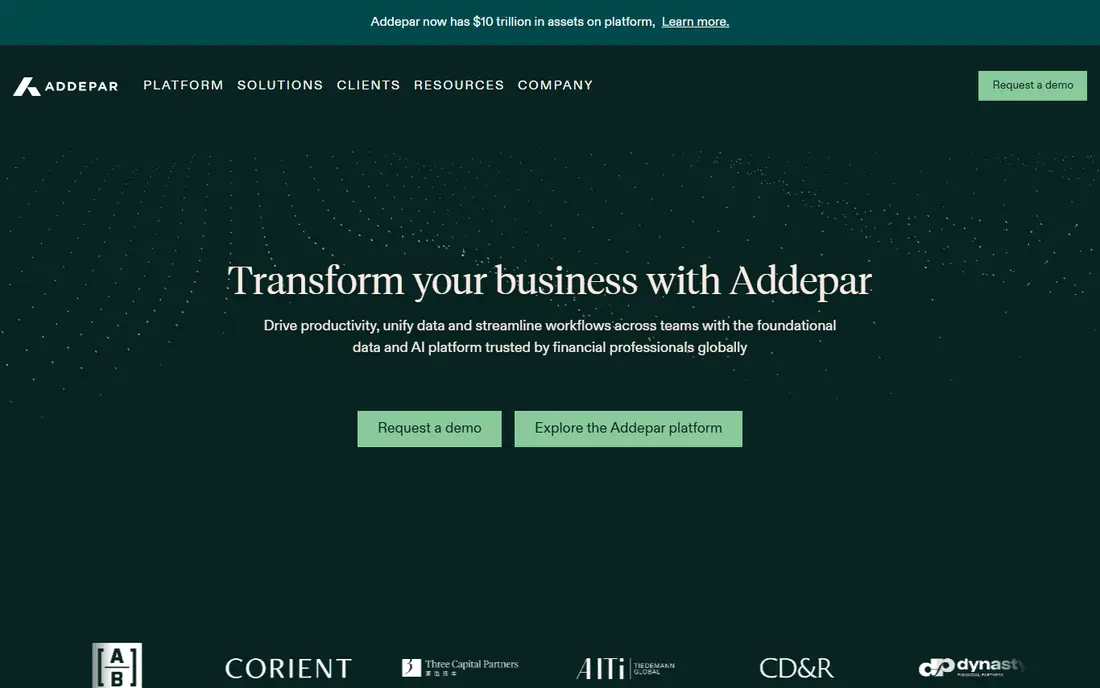
Addepar is the best-known platform for complex family wealth, covering listed securities, private funds, real estate and direct holdings in one data model. Its reporting handles households, entities and ownership structures, with performance, exposure and scenario views. Large offices and advisors to very wealthy clients use it when data complexity is the main problem.
Pricing is quoted and often asset-based, so costs grow with wealth, and onboarding can take months. It is also reporting-first, so many offices pair it with a separate ledger. For a complex estate above the threshold where cost is justified, Addepar sets the standard for reporting depth.
On pricing, Addepar starts at See website, with a free plan status of No. Check the vendor pricing page before you buy, since plans, user counts and add-ons change the total. If that price and scope fit your team, put it on a shortlist and test it with real data before you sign.
- Broad asset coverage
- Performance and ownership reporting
- Large integrations
- Quote-based asset pricing
- Long onboarding
- Reporting-first, not a full ledger
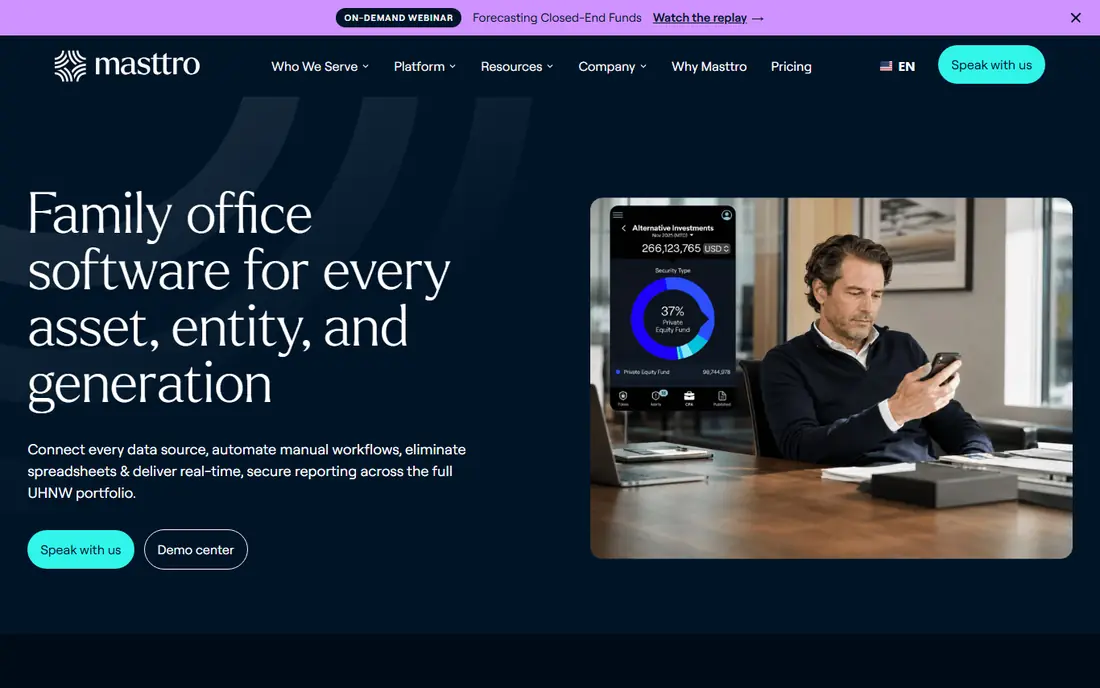
Masttro offers consolidated reporting with fixed license pricing rather than asset-based fees, which suits offices that want predictable bills as wealth grows. Its private-asset workflows, document handling and capital call tools help offices with many alternative investments. Security and Swiss hosting are also part of its pitch.
It is reporting-first and does not include a full double-entry general ledger, though it exports to accounting tools. Pricing is quoted, so get a firm proposal. For an office that prizes fixed pricing and private-asset depth, Masttro is a strong alternative to asset-based platforms.
On pricing, Masttro starts at See website, with a free plan status of No. Check the vendor pricing page before you buy, since plans, user counts and add-ons change the total. If that price and scope fit your team, put it on a shortlist and test it with real data before you sign.
- Fixed license pricing
- Private-asset workflows
- Document AI for calls and tax forms
- Reporting-first
- No full general ledger
- Quote-based pricing
Eton Solutions AtlasFive
Best for: Large offices needing a full operating platform
AtlasFive is a full operating platform for large single and multi-family offices, covering general ledger, accounting, bill pay, entity management and reporting in one system. That breadth suits offices that want one back-office system rather than several linked tools. It is built for scale and complexity.
Enterprise pricing starts high, and implementation can take many months. Small offices will find it more than they need. For a large office replacing several systems with one platform, AtlasFive is a serious, if costly, contender.
On pricing, Eton Solutions AtlasFive starts at See website, with a free plan status of No. Check the vendor pricing page before you buy, since plans, user counts and add-ons change the total. If that price and scope fit your team, put it on a shortlist and test it with real data before you sign.
- General ledger and ERP
- Bill pay
- Entity and tax features
- Enterprise pricing
- Long implementation
- More than small offices need
Archway, from SEI, pairs accounting with reporting for family offices, including partnership accounting and multi-entity books. It suits offices that already work with SEI or that want accounting and reporting in one system. The platform handles complex ownership and reporting needs for larger offices.
Pricing is quoted and asset-based in many cases, and value is highest inside the SEI ecosystem. Implementation also takes time. For an office above 50 million dollars in assets that wants accounting plus reporting, Archway deserves a demo.
On pricing, Archway starts at See website, with a free plan status of No. Check the vendor pricing page before you buy, since plans, user counts and add-ons change the total. If that price and scope fit your team, put it on a shortlist and test it with real data before you sign.
- Accounting and reporting together
- Partnership accounting
- SEI links
- Quote-based pricing
- Best value inside SEI
- Implementation time
FundCount combines portfolio reporting with general ledger and partnership accounting, which suits mid-size offices that need both views in one tool. Multi-currency support and entity handling help offices with global holdings. It is a practical step up from spreadsheets and generic accounting tools.
Pricing is quoted, the interface feels technical, and setup is a project. Offices that only need reporting may prefer a lighter tool. For a mid-size office that wants ledger and reporting together at a lower entry point than enterprise platforms, FundCount fits well.
On pricing, FundCount starts at See website, with a free plan status of No. Check the vendor pricing page before you buy, since plans, user counts and add-ons change the total. If that price and scope fit your team, put it on a shortlist and test it with real data before you sign.
- Portfolio accounting with general ledger
- Partnership books
- Multi-currency
- Quote-based pricing
- Technical interface
- Setup effort
Asora targets smaller family offices with tiered, flat pricing starting near 900 dollars a month. It covers consolidated reporting for mainly public-market portfolios, with a setup that can take days to months rather than a full enterprise project. That makes it a practical first reporting tool for offices moving off spreadsheets.
Private-asset depth and full accounting are limited, so complex offices should test those areas. Asset tiers also affect price as wealth grows. For an office from about five to one hundred million dollars with mainly liquid holdings, Asora gives a clear, affordable start.
On pricing, Asora starts at $900 per month, with a free plan status of No. Check the vendor pricing page before you buy, since plans, user counts and add-ons change the total. If that price and scope fit your team, put it on a shortlist and test it with real data before you sign.
- Low flat monthly pricing
- Public-market reporting
- Fast setup
- Limited private-asset depth
- No full ledger
- Check asset limits
Aleta offers consolidated reporting with entity-based flat pricing starting near 1,000 dollars a month, avoiding asset-based fee growth. AI-assisted data work helps with aggregation and reporting, and setup is measured in weeks rather than many months. That mix suits offices that want modern reporting at a predictable price.
As a newer brand, it has less track record than Addepar or Masttro, so references matter. Private-asset depth should also be tested for your holdings. For an office that wants reporting without asset-based pricing, Aleta is a promising, lower-cost option.
On pricing, Aleta starts at $1,000 per month, with a free plan status of No. Check the vendor pricing page before you buy, since plans, user counts and add-ons change the total. If that price and scope fit your team, put it on a shortlist and test it with real data before you sign.
- Entity-based flat pricing
- AI-assisted data work
- Consolidated reporting
- Newer brand than leaders
- Check private-asset depth
Asset Vantage offers an integrated platform for mid-market family offices, with general ledger, reporting and a family portal in one system. It suits offices that want books and reports together without enterprise cost, and that need multi-entity and multi-currency support. The portal gives family members a clear view of wealth.
Pricing is quoted, and implementation takes effort, as with most tools in this category. Very large or very complex offices may need a larger platform. For a mid-market office that wants an integrated ledger and reporting tool, Asset Vantage is a solid shortlist option.
On pricing, Asset Vantage starts at See website, with a free plan status of No. Check the vendor pricing page before you buy, since plans, user counts and add-ons change the total. If that price and scope fit your team, put it on a shortlist and test it with real data before you sign.
- Integrated general ledger
- Reporting
- Family portal
- Quote-based pricing
- Implementation effort
- Check scale fit
How we picked these
We compared official product pages, pricing pages and app store listings, and we checked that each product exists, works today and truly fits the topic. We favored tools with clear pricing or a clear quote path, honest limits, and a track record in the category. We did not claim hands-on testing that did not happen, and we left out tools that did not fit, even when they were well known in a nearby category.
How to choose family office software
Start with your asset mix. Listed securities alone need far less than a mix of private equity, real estate, trusts and operating businesses. List every asset type, custodian and entity, then test whether the tool can model ownership, valuations and cash flows for each. A tool that handles public markets well may still struggle with private assets.
Next, decide whether you need reporting, accounting or both. Reporting tools give a consolidated view and performance, while accounting tools add a general ledger, bill pay and partnership books. Many offices need both, either in one platform or in two linked tools. Check the link between reporting and books before you buy.
Entities, documents and portals
Look for multi-entity support, multi-currency handling and document storage for statements, capital calls and tax forms. A family portal should give each family member a clear, secure view without exposing data they should not see. Permissions and audit trails matter when several generations and advisors share the system.
Cost and implementation
Compare pricing models, not just headline prices. Asset-based fees scale with wealth, flat fees stay predictable, and enterprise contracts include implementation. Ask how long onboarding takes, what data migration includes, and who owns data cleanup. A rushed implementation with dirty data will undermine even the best tool.
FAQ
What does family office software do?
It consolidates holdings across custodians and asset types into one view, adds performance reporting, and often covers accounting, entities, documents and portals. The goal is one trusted set of numbers for the family, advisors and accountants.
How much does it cost?
Flat tools start near 900 to 1,000 dollars a month, while enterprise platforms start near 50,000 dollars a year and can cost far more. Asset-based pricing scales with wealth. Always get a quote for your asset count and complexity.
Is it different from advisor portfolio software?
The overlap is large, but family office tools add entity, trust, partnership and private-asset handling that advisor tools may lack. Advisor tools focus on client reporting and trading. Choose based on whether entity accounting is a core need.
How long does setup take?
Simple reporting tools can take weeks, while enterprise platforms can take three to twelve months, depending on data quality and complexity. Custodian feeds, private valuations and entity setup drive the timeline. Plan data cleanup early.
Can it handle private equity and real estate?
Leading tools can, but depth varies. Check capital call handling, valuations, cash flow forecasting and ownership modeling for your exact holdings. Test one private fund and one property in a demo before you commit.