Best ETL Tools Comparison in 2026: 8 Platforms Compared
Compare the best ETL tools and platforms for data teams in 2026. We review Fivetran, Airbyte, Talend, Informatica, Matillion and more on price and fit.
- Editor's choice
 Fivetran
Managed connectors with low maintenance
Starts atSee websiteVisit fivetran.comFull review - Great alternative
 Airbyte
Open source control and connector choice
Starts atFreeVisit airbyte.comFull review - Also consider
 Talend
Enterprise data integration
Starts atSee websiteVisit talend.comFull review
TL;DR:
- Fivetran is our pick for teams who want managed connectors with little pipeline maintenance.
- Airbyte is the best open option for teams who want control and a large connector catalogue.
- Talend and Informatica suit large enterprises with complex governance and legacy systems.
- Matillion suits cloud warehouse teams who want visual, SQL-based pipeline building.
- ETL pricing is often usage-based, so estimate rows, refresh frequency and destinations before you commit.
Quick comparison
| Tool | Best for | Starts at | Free plan? | |
|---|---|---|---|---|
| Fivetran | Managed connectors with low maintenance | See website | Free trial | Visit |
| Airbyte | Open source control and connector choice | Free | Yes | Visit |
| Talend | Enterprise data integration | See website | Free trial | Visit |
 Informatica | Enterprise governance and scale | See website | Free trial | Visit |
 Matillion | Cloud warehouse visual pipelines | See website | Free trial | Visit |
 Stitch | Simple SaaS replication | See website | Free trial | Visit |
 Hevo Data | No-code pipelines for small teams | See website | Free trial | Visit |
 AWS Glue | AWS-native ETL work | See website | No | Visit |
The best ETL tools
ETL means extract, transform and load, and modern tools often use ELT, where data loads first and transforms run in the warehouse. We compared official pricing pages, connector catalogues, deployment options and documentation, plus public reviews from data teams.
Fivetran suits teams who want data flowing without building and fixing connectors. It offers managed connectors for common SaaS apps, databases and files, and it handles schema changes and incremental syncs in the background. That saves engineering time, especially for small data teams.
The trade is cost and control. Pricing is usage-based, so high-volume sources and frequent syncs can push bills up quickly. Teams with unusual sources or strict custom logic may find Fivetran less flexible than Airbyte or a code-based tool, but for standard SaaS replication it is hard to beat for reliability.
- Large managed connector library
- Automated schema changes
- Strong warehouse support
- Usage-based pricing can rise fast
- Less control than open source tools
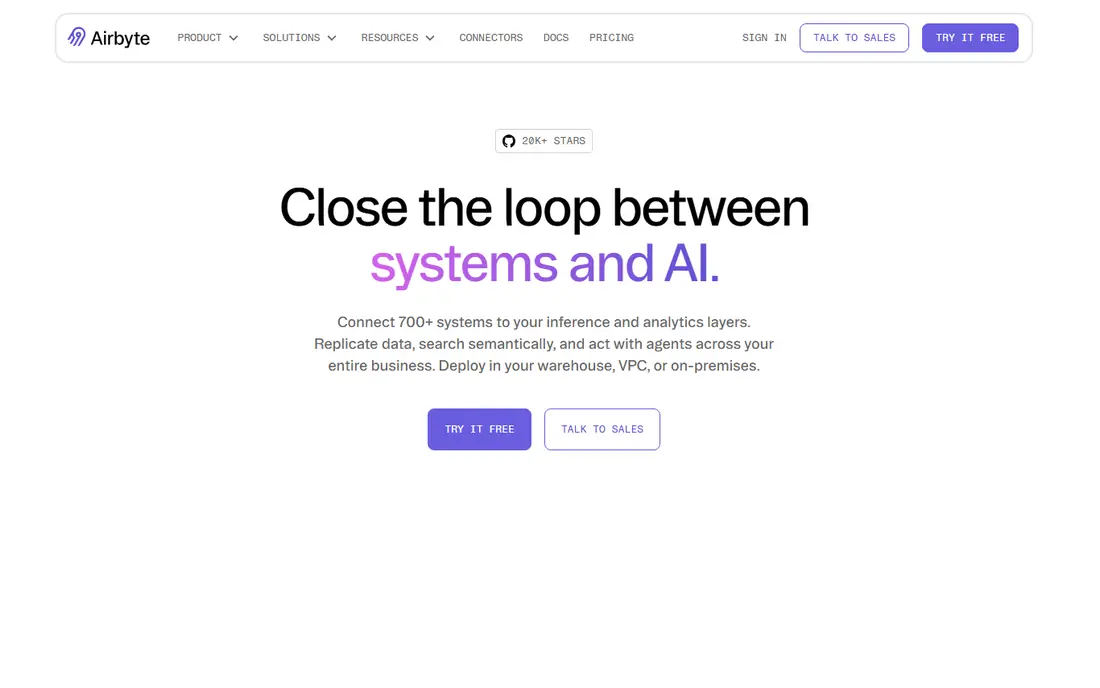
Airbyte gives teams a choice between self-hosting the open source version and using Airbyte Cloud. The connector catalogue is large, and teams can build custom connectors when a source is missing. That openness suits engineering-led teams and companies with data residency needs.
Self-hosting is not free in effort, even though the software is free. You must run, monitor and upgrade it, and handle scaling yourself. Airbyte Cloud removes much of that work, but then pricing becomes usage-based like other managed tools. Choose self-hosted for control, cloud for speed.
- Open source self-hosted option
- Large connector catalogue
- Custom connector builder
- Self-hosting needs engineering effort
- Cloud pricing is usage-based
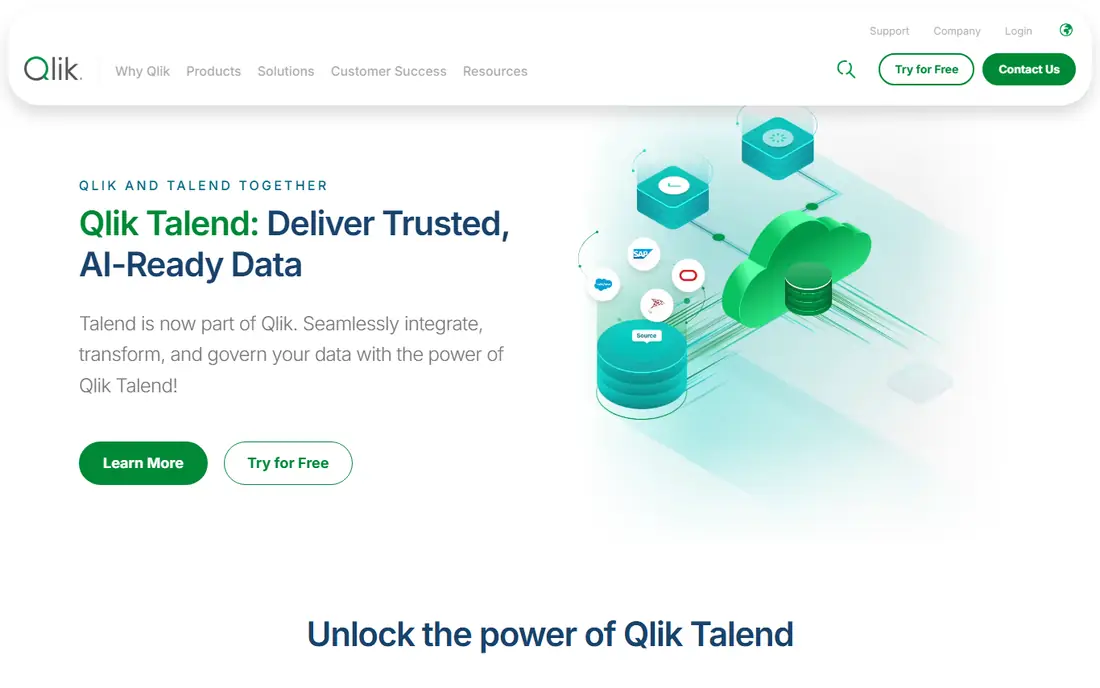
Talend, now part of Qlik, offers data integration, quality and governance tools in one platform. It suits large companies with mixed legacy and cloud systems, where pipelines must meet compliance and quality rules. Visual design helps data engineers build complex jobs without writing every step by hand.
Small teams may find Talend heavy. Pricing is enterprise-focused, setup takes longer than a SaaS connector tool, and the full feature set needs training. For a large firm that already uses Talend or Qlik, that depth is a strength rather than a drawback.
- Broad integration and data quality tools
- Visual pipeline design
- On-premise and cloud options
- Enterprise pricing and complexity
- Steeper learning curve for small teams
Informatica is a long-standing enterprise data platform, and its strength is governance at scale. It offers integration, quality, cataloguing and master data tools, which matter when many teams share the same warehouse. Large regulated firms often choose it for audit trails and control.
The downside is the same as Talend, only larger. Cost, implementation time and specialist skills are real barriers for small teams. If you need simple SaaS replication, Fivetran or Airbyte will be faster and cheaper. If you need enterprise governance, Informatica is a serious contender.
- Strong governance and data quality
- Large enterprise connector set
- Cloud and hybrid deployment
- High cost and complexity
- Long implementation for large rollouts
Matillion is built for cloud warehouses such as Snowflake, BigQuery and Databricks. Its visual designer lets data teams build pipelines and transformations without writing all the code, while still allowing SQL where needed. That balance suits analytics teams who know SQL but do not want to maintain custom Python pipelines.
Matillion is less of a fit if your core systems are on-premise and legacy-heavy, since its strength is cloud warehouse work. Pricing also needs careful scoping, so run a pilot with your real sources and volumes before you sign a yearly deal.
- Visual, SQL-friendly design
- Built for cloud warehouses
- Strong transformation tools
- Warehouse-focused, less suited to legacy on-premise work
- Pricing needs a quote for many teams
Stitch, owned by Talend, focuses on simple, managed replication from SaaS apps and databases into a warehouse. Setup is fast for standard sources, and the interface makes it easy to see sync status and errors. That simplicity suits small analytics teams who want data in a warehouse without a large engineering project.
Transformation is the limit. Stitch moves data well, but teams that need heavy in-pipeline transforms will need a separate tool such as dbt. If your goal is reliable replication plus warehouse transforms, Stitch plus dbt is a clean, common pairing.
- Simple setup for common SaaS sources
- Managed replication
- Clear pipeline monitoring
- Smaller connector range than Fivetran
- Transformation options are limited
Hevo Data offers no-code pipelines for teams that want to move data without a dedicated data engineering team. It supports common SaaS sources, databases and warehouses, with transformation options inside the platform. That makes it a good fit for startups and mid-size companies building their first warehouse.
Enterprise governance and very complex legacy integrations are not its main strength. Larger firms with strict cataloguing and lineage needs may prefer Informatica or Talend. For a small team that needs data flowing this month, Hevo is a practical choice.
- No-code pipeline setup
- Many SaaS connectors
- Built-in transformation options
- Less suited to very large enterprise governance needs
- Usage pricing needs monitoring
AWS Glue is Amazon managed ETL service for teams already on AWS. It can crawl data sources, build a catalog, and run Spark-based jobs that scale without servers to manage. For AWS-heavy teams, that native fit reduces extra vendor work and keeps data inside one cloud account.
Glue is not a simple SaaS connector tool. It needs AWS knowledge and often code, and its console is less friendly than Fivetran or Hevo. If your team lives in AWS and has engineering skills, Glue can be cost-effective at scale. If not, a managed connector tool will be faster to adopt.
- Native AWS integration
- Serverless scaling
- Spark-based jobs for large data
- Needs AWS and coding skills
- Interface is less friendly than SaaS ETL tools
How we picked these
We compared official connector catalogues, pricing models, deployment options and documentation, plus public case studies and data team reviews. We required each tool to be available now, to support common warehouses or data lakes, and to publish clear pricing or trial information. We favoured tools with a clear niche, rather than listing many similar tools with no real difference.
We also considered total effort, not just licence cost. A tool that needs constant connector fixes can cost more in engineering time than a pricier managed tool, while a simple tool can fail if it lacks governance for a regulated firm. That is why the list mixes managed, open and enterprise options.
How to choose an ETL platform
Start with sources and destinations
List every source you must sync in the first six months, plus your warehouse or lake. Check connector availability and whether a connector is managed, community-built or custom. A missing connector can turn a quick project into a long build.
Estimate usage honestly
Most managed tools charge by rows, credits or compute, so sync frequency matters as much as source count. Hourly syncs of a large table cost far more than daily syncs of a small one. Run a pilot with real volumes, and ask for a bill estimate before you sign.
Decide who will maintain pipelines
If you have data engineers, open source or code-based tools give control. If you have analysts, a managed or no-code tool saves time. Also check monitoring, alerting and schema-change handling, since those features decide how often pipelines break at night.
Plan transforms separately
Many ETL tools now focus on loading, with transforms in the warehouse using SQL or dbt. Decide whether you want transforms inside the ETL tool or in the warehouse, and keep that choice consistent. Mixing both without a plan leads to duplicated logic and confusing results.
FAQ
What is the best ETL tools comparison for small teams?
Fivetran is best for managed reliability, Airbyte is best for open control, and Hevo is best for no-code setup. The best ETL platforms comparison for a small team depends on engineering skill and budget. Start with a free trial or open source pilot on your real sources.
What is the difference between ETL and ELT?
ETL transforms data before loading it into a target, while ELT loads raw data first and transforms it inside the warehouse. Modern cloud warehouses favour ELT, because warehouse compute handles transforms well. Many tools now support both, so check how each tool handles your transform step.
Is Airbyte really free?
Airbyte open source is free to self-host, but you pay for servers, monitoring and engineering time. Airbyte Cloud is a paid managed service with usage-based pricing. Free software does not mean free operation, so budget for hosting and maintenance if you self-host.
How much do ETL tools cost?
Costs vary widely, from free self-hosted tools to enterprise contracts that need a quote. Managed tools often charge by usage, such as rows synced or credits used, so a small team may pay modestly while a high-volume team pays far more. Always pilot with real volumes before committing.
Do I still need dbt with an ETL tool?
Often, yes. Many ETL tools focus on replication, while dbt handles transformations, testing and documentation inside the warehouse. Tools such as Matillion and Talend include more transform features, but dbt remains a common pairing for Fivetran, Airbyte and Stitch.
Which ETL tool is best for enterprises?
Informatica and Talend suit large enterprises with governance, quality and legacy needs. Matillion suits cloud-warehouse enterprises, while Fivetran suits enterprises that want managed SaaS replication. The best enterprise pick depends on governance rules, existing stack and in-house skills.