Best Email Verification Tools for Outreach for 2026: Our 6 Vetted Picks
Compare the best email verification tools for outreach in 2026. I cover bounce control, list hygiene and API fit, based on vendor docs and public sources.
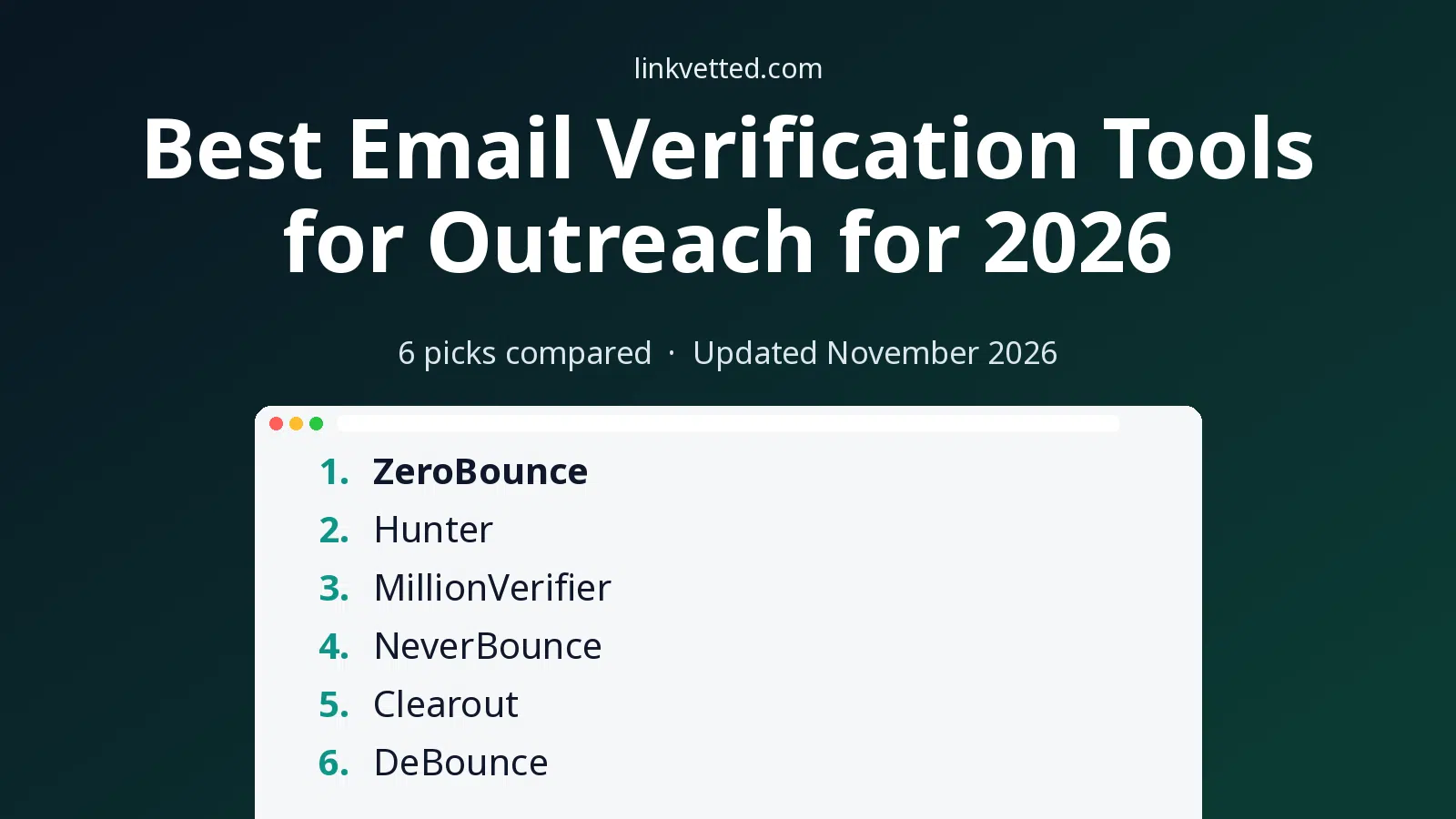
- Editor's choice
 ZeroBounce
API checks plus list cleaning
Starts atSee websiteVisit zerobounce.netFull review - Great alternative
 Hunter
Verification inside prospecting
Starts atSee websiteVisit hunter.ioFull review - Also consider
 MillionVerifier
Large lists at low cost
Starts atSee websiteVisit millionverifier.comFull review
Direct answer
My top pick is ZeroBounce, because its documentation covers real-time API checks, list cleaning and abuse detection in one place, which suits outreach teams that send from several sources. For teams already inside a sales platform, Hunter fits better. For bulk list work at low cost, MillionVerifier is the one I would look at first. All three are compared from vendor documentation and public sources, not hands-on tests.
TL;DR:
- Verify addresses at the point of capture and again before a campaign, because a list that was clean last quarter may not be clean now.
- Catch-all and role addresses need their own rule, since a "valid" result on a catch-all domain still carries bounce risk.
- Match the tool to your sending setup: a sales engagement platform needs a native integration more than a large file upload limit.
- Keep suppression lists for hard bounces and complaints, and do not re-import those addresses on the next campaign.
- Treat verification as one part of list quality; relevance, consent and sending volume still decide whether outreach lands.
Last checked November 2026. Plan prices are not quoted in this guide because they change often; see each vendor's own pricing page for current figures before you buy.
Quick comparison
| Tool | Best for | Starts at | Free plan? | |
|---|---|---|---|---|
| ZeroBounce | API checks plus list cleaning | See website | Free plan | Visit |
| Hunter | Verification inside prospecting | See website | Free plan | Visit |
| MillionVerifier | Large lists at low cost | See website | Free trial | Visit |
 NeverBounce | Straightforward single-file checks | See website | Free trial | Visit |
 Clearout | Verification plus email finding | See website | Free trial | Visit |
 DeBounce | Repeat checks for agencies | See website | Free trial | Visit |
The best email verification tools for outreach compared
I put this list together from vendor documentation, pricing pages and public sources, and I did not run hands-on tests on any of them. The order reflects how well each tool's documented features fit a typical outreach workflow: capture, clean, verify, send. Where a vendor does not publish a detail, I say so rather than guess.
ZeroBounce is an email verification service that checks syntax, domain, MX records and mailbox status, and it also offers spam-trap and abuse detection. Its documentation describes both a bulk upload path for existing lists and an API for checking addresses as they are captured. That combination fits agencies and in-house teams that collect leads from forms, events and scraped sources, then send from more than one platform.
For outreach, the useful part is the API. You can verify an address at the moment someone submits a form, then run the whole list again before a campaign. The vendor documents result codes that separate valid, invalid, catch-all and unknown addresses, so you can decide which categories to suppress. Spam-trap detection matters for cold outreach lists, because a trap hit is a signal that an address should never be mailed.
The limits are practical rather than technical. Credits are consumed per check, so large recurring lists need a forecast before you commit. Catch-all domains still return uncertain results, and no verifier can resolve those with certainty. Skip it if you only need a one-off check of a few hundred addresses and do not want a subscription.
- Real-time API and bulk file verification
- spam-trap and abuse detection
- credits that do not expire on paid plans
- Credit model needs forecasting
- catch-all handling still needs a manual rule
Hunter is best known for finding professional email addresses from company domains, and it includes a verification step for the addresses it returns. Its documentation covers a verifier API and a bulk verification option, so you can check addresses you already have as well as ones the tool discovers. For outreach teams that build lists from company websites, keeping discovery and verification in one place reduces the number of tools to manage.
The workflow benefit is that a found address can be verified before it reaches your CRM or sequencer. Hunter documents confidence levels for the addresses it returns, and its verifier returns status categories you can map to your own suppression rules. If your outreach starts with prospecting rather than with an imported list, that sequence is simpler than exporting to a separate verifier and importing again.
The drawback is focus. Hunter is a prospecting product first, and its verification features are documented in that context. Teams with large legacy lists and no prospecting need may find a dedicated verifier more direct. Check the current plan limits on the vendor site before assuming a volume will fit.
- Email finder and verifier in one workflow
- documented API
- works well with its own search tools
- Verification is one part of a bigger product
- less suited to pure bulk cleaning
MillionVerifier is a dedicated email verification service built around bulk checks. Its documentation describes uploading a file, mapping columns, and downloading results split into valid, invalid, catch-all, unknown and disposable categories. There is also an API for checking single addresses. For agencies that receive lists from clients in spreadsheets, that upload-and-download flow is the shortest path from a raw file to a clean one.
In an outreach workflow, I would use it in two places. First, clean any imported list before it reaches the sending platform. Second, run a periodic re-check on older segments, because addresses go stale when people change jobs or domains. The vendor documents a credit system, so you can estimate cost from list size before uploading. Result files can be filtered so only the categories you trust go into the next campaign.
The limits are about scope. MillionVerifier verifies addresses; it does not find them, enrich records or send email. If you want one vendor for prospecting, verification and sequencing, this is not that. The interface is also plainer than larger rivals, which matters if non-technical colleagues will use it. Check the current free trial terms on the site.
- Bulk file verification with a simple upload flow
- API for real-time checks
- documented result categories
- Fewer surrounding outreach features
- interface is functional rather than polished
NeverBounce is a long-running verification service that checks addresses in bulk or one at a time through an API. Its documentation covers a dashboard upload, a jobs API and result codes for valid, invalid, disposable, catch-all and unknown addresses. The product is now part of a larger email platform, so the surrounding plans and packaging have changed over time. Check the current vendor pages rather than older reviews.
For outreach, the appeal is simplicity. You upload a CSV, wait for the job, and download a file with a status column. That is enough for many teams that just want to remove hard bounces before a send. The API supports checking addresses as they are captured, which helps keep new form submissions clean without a manual step.
The caveat is that packaging has moved. Because NeverBounce sits inside a wider platform, the plan you read about in an older article may not match what the vendor sells now. Teams that want a standalone verifier with no platform context may prefer a dedicated tool. Confirm current features and limits on the official site.
- Simple upload and verify flow
- documented API
- clear result categories
- Now part of a larger platform, so plan details change
- fewer outreach extras
Clearout is an email verification and email finding service. Its documentation describes bulk verification, a real-time API, and a finder for locating addresses from names and domains. It also lists integrations with common CRM and outreach tools. For small teams that want to find and verify addresses without buying two separate products, that combination is worth a look.
In practice, you can verify an imported list, then use the finder to fill gaps for target accounts, verifying each result before it enters a sequence. The API supports checking addresses at capture, which keeps form submissions from adding bounces to your sender reputation. Result categories are documented, so you can build suppression rules around invalid and disposable addresses.
The limitation is documentation depth. Clearout has less public coverage than the largest verifiers, so more of your evaluation depends on the vendor's own docs and a trial. If you need extensive third-party comparisons before buying, that is harder here. Test the free trial on a sample of your own list before committing.
- Bulk verification and API
- email finder alongside verification
- documented integrations
- Smaller public documentation footprint
- less third-party coverage to read
DeBounce is a dedicated email verification service with bulk upload, API access and a dashboard for managing lists. Its documentation covers syntax, domain and mailbox checks, plus disposable and role-account detection. The product is aimed at teams that verify lists regularly rather than occasionally, which fits agencies handling several client lists each month.
For outreach, the repeat-use angle matters. If you clean a client list every month, a tool with a clear upload flow and consistent result categories saves time. DeBounce documents an API for real-time checks, so you can also verify addresses as they arrive from landing pages. Keeping the same verifier across clients also makes result categories comparable between campaigns.
The trade-off is breadth. DeBounce verifies addresses and does little else, so you still need separate tools for finding contacts and sending email. The interface is functional rather than refined, which is fine for technical users and less so for colleagues who want a guided flow. Check the current trial and plan details on the site.
- Bulk and API verification
- documented result categories
- simple pricing structure
- Plainer interface
- fewer extras beyond verification
How I chose
I compared these tools from vendor documentation, pricing pages and public sources, and I did not run hands-on tests. That means I am judging documented features and stated limits, not measured accuracy. Accuracy claims are hard to compare across vendors anyway, because each one tests against different reference lists. What I looked at instead was fit: does the tool document the workflow an outreach team actually runs, from capture through cleaning to sending?
The second filter was honesty about limits. A verifier that documents catch-all and unknown categories, and explains what it cannot resolve, is more useful than one that implies every result is certain. I also weighed how each tool fits alongside sending platforms and CRMs, because a verifier that exports clean files or offers an API is easier to slot into an existing process. Where a vendor's packaging has changed, such as NeverBounce moving inside a larger platform, I noted that rather than repeating older descriptions.
What to check before you buy
- Confirm the API supports real-time checks, not just bulk uploads, if you capture leads from forms.
- Ask how catch-all and unknown addresses are reported, and decide your suppression rule before you send.
- Check whether credits expire, because unused credits on a monthly plan can quietly raise your effective cost.
- Confirm the export format includes a status column you can filter in your CRM or sequencer.
- Look for documented integrations with your sending platform, or a clean CSV path if there is none.
- Test a sample of your own list during the trial and compare result categories across two tools before choosing.
FAQ
Do I need email verification if I only send to people who opted in?
Yes, because opt-in addresses still go stale. People change jobs, domains expire and shared inboxes get abandoned. A verification pass before a campaign removes hard bounces that would otherwise count against your sender reputation. It does not replace consent or relevance; it just keeps the list technically clean.
What is a catch-all address and why does it matter for outreach?
A catch-all domain accepts mail for any address at that domain, so a verifier cannot confirm whether a specific mailbox exists. These results are usually reported as catch-all or unknown. Mailing them carries bounce risk. Many teams suppress catch-all addresses on cold outreach and allow them on opted-in lists, where the contact is known.
Can verification tools guarantee my emails will not bounce?
No. Verification reduces the chance of sending to invalid addresses, but bounces can still happen after a check, for example when a mailbox is closed later. No vendor can promise zero bounces, and any claim of guaranteed delivery should be treated with caution. Verification is one control among several, alongside list source and sending volume.
How often should I re-verify an outreach list?
It depends on how old the list is and how it was built. Lists collected recently from active sources need less frequent checks than lists bought or scraped months ago. A practical approach is to verify at capture, then re-check a segment before each major campaign. Keep hard bounces suppressed so they are not re-imported.
Is a dedicated verifier better than the verification built into my sending tool?
It depends on volume and workflow. Built-in verification is convenient for small lists and keeps everything in one place. A dedicated verifier usually gives more control over result categories, bulk files and API access, which helps when lists come from several sources. Many teams use both: built-in checks at capture, a dedicated tool for full-list cleaning.
Sources
- https://www.zerobounce.net
- https://hunter.io
- https://www.millionverifier.com
- https://www.neverbounce.com
- https://clearout.io
- https://debounce.com