Best Ecommerce Platform for Wholesale in 2026: 10 Compared
Best ecommerce platform for wholesale compared: we review 10 B2B platforms for tiered pricing, quotes, net terms and wholesale ordering online in 2026.
- Editor's choice
 Shopify Plus
Hybrid B2B and direct sales
Starts at$2,300 per monthVisit shopify.comFull review - Great alternative
 BigCommerce B2B Edition
Mid-market distributors
Starts at$399 per monthVisit bigcommerce.comFull review - Also consider
 Adobe Commerce
Complex enterprise catalogs
Starts atSee websiteVisit adobe.comFull review
TL;DR:
- Shopify Plus and BigCommerce B2B Edition are the strongest SaaS options for wholesalers that also sell direct to consumers.
- OroCommerce and Adobe Commerce suit enterprises with complex contract pricing, catalogs, and ERP integrations.
- WooCommerce with B2B plugins is the cheapest route for small wholesalers already on WordPress.
- Wholesale features to test first are tiered pricing, customer-specific catalogs, quotes, purchase orders, and net terms.
- Enterprise platform fees are only part of the cost: implementation, ERP integration, and apps can exceed the subscription.
Quick comparison
| Tool | Best for | Starts at | Free plan? | |
|---|---|---|---|---|
| Shopify Plus | Hybrid B2B and direct sales | $2,300 per month | No | Visit |
| BigCommerce B2B Edition | Mid-market distributors | $399 per month | No | Visit |
| Adobe Commerce | Complex enterprise catalogs | See website | No | Visit |
 OroCommerce | B2B-first workflows | Free | Yes | Visit |
 WooCommerce B2B | Small WordPress wholesalers | Free | Yes | Visit |
 Sana Commerce | ERP-first manufacturers | See website | No | Visit |
 Salesforce B2B Commerce | Salesforce enterprises | See website | No | Visit |
 SAP Commerce Cloud | SAP enterprises | See website | No | Visit |
 NetSuite SuiteCommerce | NetSuite businesses | See website | No | Visit |
 WizCommerce | ERP-connected wholesale ordering | See website | No | Visit |
The best ecommerce platform for wholesale
Wholesale ecommerce is different from consumer ecommerce. Business buyers need tiered pricing, account-specific catalogs, bulk ordering, quotes, purchase order checkout, and net payment terms, all linked to your ERP. The best wholesale ecommerce platform is the one that handles those workflows without heavy custom work. We compared official pricing and B2B platform guides for the platforms below.

Shopify Plus starts at $2,300 per month on a 3-year term, and it opens up Shopify B2B features such as company accounts, price lists, payment terms, and B2B checkout. That makes it the easiest choice for brands that sell both wholesale and direct to consumers on one storefront, with a large app ecosystem for shipping, tax, and ERP links.
The cost is the main drawback, and standard Shopify plans lack the full B2B toolset. Implementation for Plus stores often runs $60,000 to $150,000 in agency guides, before platform fees. Shopify Plus suits fast growing brands that value speed and ecosystem over deep B2B customization.
- Native B2B tools on Plus
- Huge app ecosystem
- Fast deployment for hybrid stores
- Full B2B toolset requires Plus
- $2,300 per month on a 3-year term
- API limits on lower plans
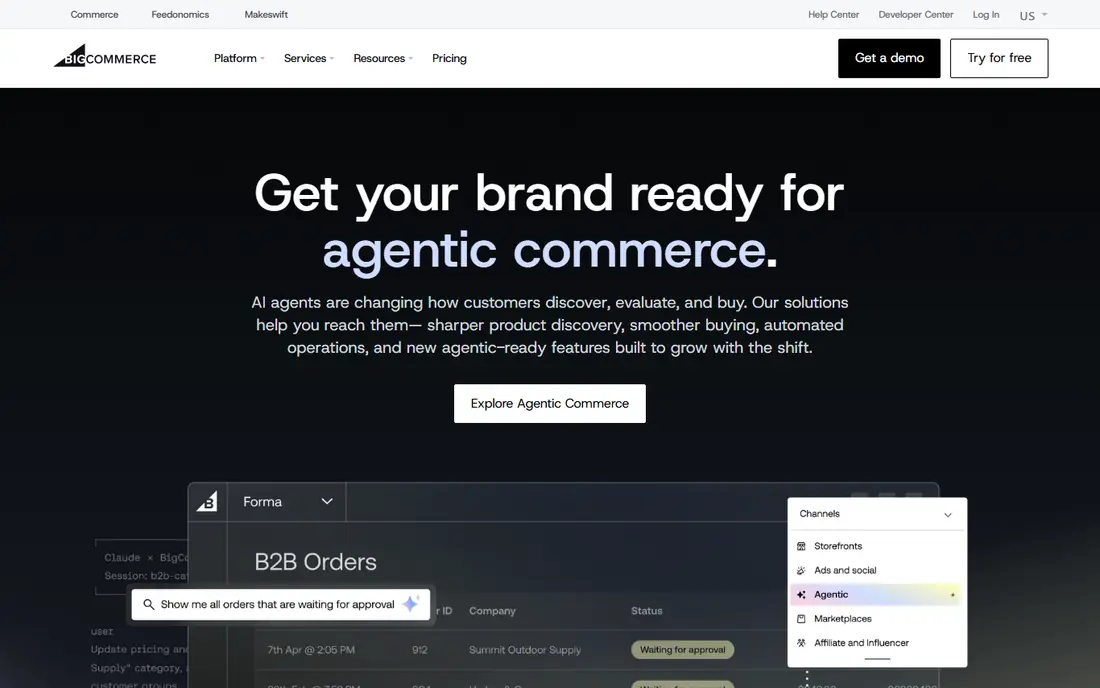
BigCommerce B2B Edition offers company accounts, customer groups, price lists, quotes, and payment terms, with many features native rather than app based. Its Scale plan starts around $399 per month, while Enterprise with B2B Edition is custom priced, often cited from $12,000 per year. API limits are generous compared with Shopify core plans, which helps ERP syncs.
BigCommerce suits mid-market distributors that want pricing transparency and deeper B2B features than Shopify core plans offer. Watch sales caps and payment provider fees, since BigCommerce charges an open payment provider fee on some gateways since June 2026. For pure wholesale, BigCommerce is often stronger than Shopify Plus at a lower entry cost.
- Many B2B features native
- Transparent pricing tiers
- Strong API headroom for ERP syncs
- Enterprise B2B Edition pricing is custom
- Sales caps can add overage costs
Adobe Commerce, formerly Magento, is the enterprise customization pick. It offers native B2B features such as shared catalogs, negotiated pricing, quotes, and approvals, plus full code access for custom workflows. That flexibility suits complex catalogs, configurable products, and deep ERP integrations where SaaS limits would block progress.
Total cost is high. License costs are often cited from $22,000 per year, with full deployments exceeding $100,000, and implementations often run $90,000 to $200,000. Adobe Commerce suits enterprises with developers or agencies, not small wholesalers. If your catalog and pricing rules are truly complex, it remains the most flexible option here.
- Fully customizable
- Strong native B2B capabilities
- No vendor API cap for ERP syncs
- High total cost
- Needs in-house or agency developers
- Long implementation
OroCommerce is built for B2B first, with customer hierarchies, price lists, quotes, workflows, and a native CRM. Its Community Edition is free and open source, which lets teams test B2B workflows without a license fee. Enterprise pricing is reported from $50,000 per year, reflecting its target of larger industrial and distribution businesses.
The trade off is technical effort. OroCommerce rewards teams with developers who can configure workflows and integrations, and it is less plug-and-play than Shopify or BigCommerce. For B2B-first operations with complex contract pricing and high-touch sales, OroCommerce is the strongest purpose built option here.
- Built for B2B from the start
- Community Edition free
- Native CRM and workflows
- Enterprise pricing from $50,000 per year reported
- Needs developers for full use
WooCommerce itself is free open source software for WordPress, and B2B features come from plugins such as Wholesale Suite, which costs roughly $400 to $600 per year for hosting plus the plugin bundle in recent comparisons. That makes WooCommerce the budget route for small wholesalers already on WordPress, with tiered pricing, wholesale registration, and bulk ordering through plugins.
The cost is your time and responsibility. Hosting, security, updates, and plugin compatibility fall to you or your agency, and B2B depth varies by plugin. For small wholesalers with limited budgets and WordPress skills, WooCommerce B2B is hard to beat on price. For larger distributors, a SaaS or enterprise platform will save staff time.
- Free open source software
- Huge plugin ecosystem
- Lowest total cost for small wholesalers
- B2B features need plugins
- Hosting, security, and updates are your responsibility
Sana Commerce is built around ERP integration, especially for SAP and Microsoft Dynamics users. Product, pricing, inventory, and order data stay in the ERP, and the storefront shows real-time data without a separate sync layer. That design suits manufacturers that treat the ERP as the system of record.
Pricing is quote based, with starting figures around $10,000 per year reported and total costs often in the mid-five figures. Sana suits ERP-first manufacturers more than general wholesalers, since its value depends on the ERP link. If your ERP is SAP or Dynamics and you want real-time wholesale ordering, Sana deserves a demo.
- Built for SAP and Microsoft Dynamics ERP
- Real-time ERP data
- Strong security
- Pricing from about $10,000 per year reported
- Total costs can reach mid-five figures
Salesforce B2B Commerce, formerly CloudCraze, builds wholesale storefronts inside the Salesforce ecosystem, using customer, product, and order data from Salesforce. That suits enterprises already running Salesforce for sales and service, where a single customer record matters more than a standalone storefront.
Total cost is high. Some guides rank Salesforce B2B Commerce as having the highest total cost across license, implementation, and middleware, and pricing is quote based. For Salesforce enterprises, the integration value can justify that cost. For wholesalers outside Salesforce, a dedicated B2B platform will be cheaper and faster.
- Native Salesforce data and workflows
- Strong for large enterprises
- Broad ecosystem
- Highest total cost of ownership in some guides
- Implementation is complex
SAP Commerce Cloud is the enterprise choice for SAP S/4HANA companies, with deep ERP integration, configure price quote tools, and dealer portals. It suits large manufacturers in regulated industries with complex B2B scenarios, where SAP data must drive pricing, availability, and order processing without middleware gaps.
Pricing is quote based, with starting figures around $100,000 per year reported, plus implementation. That rules it out for small and mid-size wholesalers. For SAP enterprises, however, the native integration and scale justify a demo, especially where procurement and contract pricing are central.
- Deep SAP S/4HANA integration
- Strong CPQ and dealer portals
- Suited to regulated industries
- Pricing from $100,000 per year reported
- Complex and enterprise only
NetSuite SuiteCommerce builds B2B and B2C storefronts on NetSuite ERP, so inventory, pricing, orders, and financials share one system. That eliminates many sync problems for businesses already running NetSuite, and it supports B2B features such as customer-specific pricing and account management.
Pricing is quote based and bundled with NetSuite licensing, so it is not a standalone cheap option. Customization needs NetSuite development skills, and the storefront is less flexible than Adobe Commerce. For NetSuite businesses that want wholesale ordering without a separate platform, SuiteCommerce is the most direct path.
- Native NetSuite ERP link
- Single system for finance, inventory, and storefront
- B2B features included
- Pricing is quote based and bundled with NetSuite
- Customization needs NetSuite skills
WizCommerce is a newer B2B platform built for wholesale ordering, with ERP-connected workflows, customer-specific pricing, and ordering tools for distributors and manufacturers. Recent B2B guides rank it alongside Shopify Plus and BigCommerce for mid-market wholesalers, especially where reps and buyers need a simple ordering experience.
Pricing is quote based, and the vendor is smaller than the SaaS leaders, so ask for customer references in your industry and ERP. WizCommerce suits distributors that want a wholesale native ordering portal without building a full enterprise storefront. Test its ERP sync and rep tools with your real catalog before committing.
- Built for wholesale ordering
- ERP-connected workflows
- AI assisted ordering features
- Pricing is quote based
- Newer and smaller than Shopify or BigCommerce
How we picked these
We compared official pricing pages and recent B2B ecommerce platform guides from October 2026. We favored platforms with real wholesale features, including tiered pricing, quotes, purchase orders, net terms, and ERP integration, rather than consumer platforms with a wholesale app bolted on. Where pricing was quote based, we said so, and we noted reported figures only where guides published them.
How to choose an ecommerce platform for wholesale
Start with your buyer workflow. List how buyers discover products, see their contract price, place bulk orders, request quotes, and pay on terms. Then test each shortlisted platform with that exact workflow, using your catalog structure and a real customer account, not a demo catalog.
Check ERP and payment terms first
ERP integration decides whether wholesale ordering saves time or creates manual work. Ask how inventory, pricing, and orders sync, how often, and what happens when the ERP is down. Also test purchase order checkout and net terms, since those are the features business buyers expect and consumer platforms often lack.
Count total cost, not just the subscription
Add implementation, ERP integration, apps, payment fees, and staff training to the platform fee. A $399 plan with a $100,000 implementation is not cheaper than a $2,300 plan with a faster launch. Ask each vendor for a total first year cost at your order volume and catalog size.
FAQ
What is the best ecommerce platform for wholesale?
Shopify Plus is best for hybrid B2B and direct sales, BigCommerce B2B Edition is best for mid-market distributors, and OroCommerce is best for B2B-first enterprises. The best platform for wholesale depends on your ERP, your catalog complexity, and whether you also sell direct to consumers.
What is the best wholesale ecommerce platform for small businesses?
WooCommerce with B2B plugins is the best wholesale ecommerce platform for small businesses on a budget, especially those already on WordPress. BigCommerce is a good SaaS step up when you need native B2B features without managing hosting and plugins.
Can Shopify handle wholesale?
Yes, Shopify Plus handles wholesale with native B2B tools such as company accounts, price lists, and payment terms. Standard Shopify plans lack the full B2B toolset, so wholesalers should budget for Plus or use apps and workarounds on lower plans.
What is B2B ecommerce, and how is it different from B2C?
B2B ecommerce sells to business buyers, with customer-specific pricing, bulk ordering, quotes, purchase orders, and net terms. Consumer ecommerce sells to single buyers paying by card, with one public price. Wholesale platforms must handle account hierarchies and ERP data that consumer platforms do not.
How much does a wholesale ecommerce platform cost?
Entry costs range from free for WooCommerce software plus plugin and hosting costs, to $399 per month for BigCommerce Scale, $2,300 per month for Shopify Plus, and $50,000 or more per year for enterprise platforms such as OroCommerce and SAP Commerce Cloud. Implementation can exceed the subscription in the first year.
Do wholesale platforms support net terms and purchase orders?
Yes, the platforms here support net terms and purchase order checkout to varying degrees, with the strongest support on Shopify Plus, BigCommerce B2B Edition, OroCommerce, and Adobe Commerce. Test purchase order checkout and credit limits with a real customer account before you choose.