Best E-Merchandising Software: 8 Tools Compared
Best e-merchandising software compared: Bloomreach, Constructor, Dynamic Yield and more for search, ranking, recommendations and testing for retailers in 2026.
- Editor's choice
 Bloomreach
Large enterprises, full suite
Starts atSee websiteVisit bloomreach.comFull review - Great alternative
 Constructor
AI search and ranking
Starts atSee websiteVisit constructor.comFull review - Also consider
 Dynamic Yield
Personalization and testing
Starts atSee websiteVisit dynamicyield.comFull review
TL;DR:
- E-merchandising software controls what shoppers see first: search results, category ranking, recommendations and promotions.
- Bloomreach and Coveo suit large enterprises that want search, merchandising and content in one platform.
- Constructor, Nosto and Searchspring suit mid-market retailers that want fast, focused merchandising without a full suite.
- Most enterprise tools are quote-based, while Algolia offers a free tier for small catalogs and usage-based pricing.
- Test ranking, synonyms and merchandising rules with your own catalog before you commit, since demo data hides real problems.
Quick comparison
| Tool | Best for | Starts at | Free plan? | |
|---|---|---|---|---|
| Bloomreach | Large enterprises, full suite | See website | No | Visit |
| Constructor | AI search and ranking | See website | Free trial | Visit |
| Dynamic Yield | Personalization and testing | See website | No | Visit |
 Nosto | Mid-market personalization | See website | Free trial | Visit |
 Searchspring | Mid-market search and merchandising | See website | Free trial | Visit |
 Klevu | Search and recommendations | See website | Free trial | Visit |
 Coveo | Enterprise search and relevance | See website | Free trial | Visit |
 Algolia | Developer-friendly search | Free | Yes | Visit |
The best e-merchandising software
We compared official product pages and current independent comparisons for eight e-merchandising tools. All help retailers control product discovery, but they differ on breadth, pricing and the team needed to run them.

Bloomreach combines search and merchandising with content management and marketing automation, which suits large retailers that want one vendor for much of the digital experience. Merchandisers can control ranking, boost and bury products, run rules by segment, and test changes without waiting on developers for every tweak. AI relevance learns from shopper behavior, so search results and category pages improve as traffic grows.
The all-in-one approach adds cost and complexity if you only need search. Pricing is quote-based and contracts are typically enterprise-scale, and implementation takes longer than a point solution. For a large retailer already shopping for several of these functions, Bloomreach can consolidate vendors and data in a useful way.
- Search, merchandising, content and marketing in one suite
- Strong AI relevance
- Built-in testing and analytics
- Enterprise pricing only
- Longer implementation than point tools
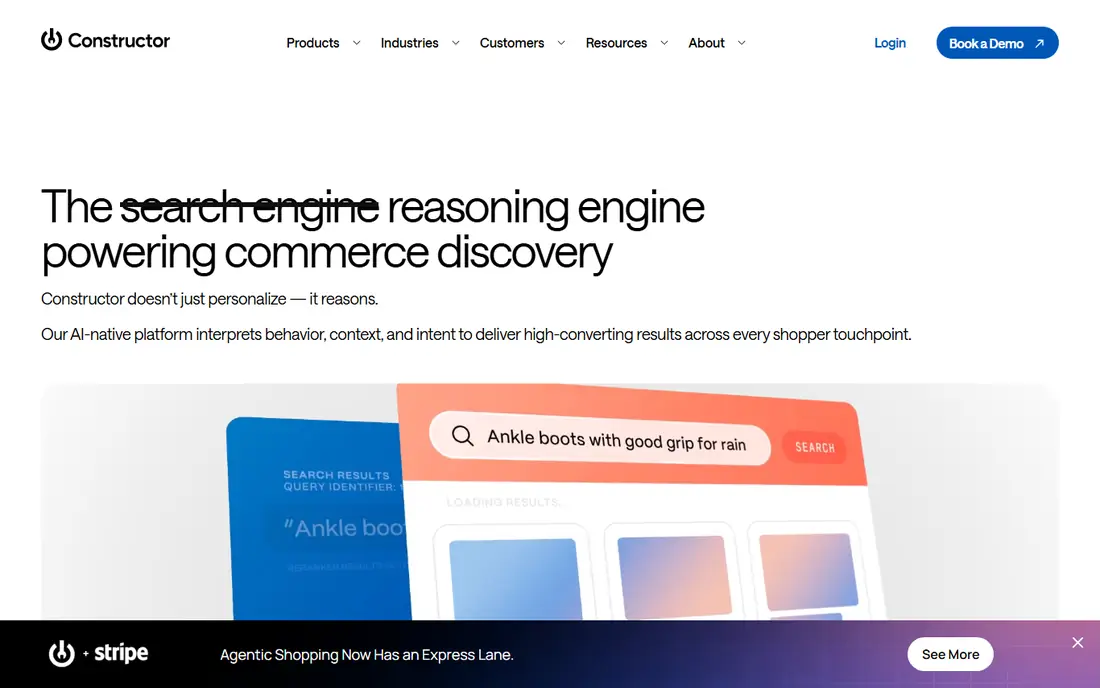
Constructor focuses on product discovery, using shopper behavior to rank search results, category pages and recommendations. Merchandisers get controls for boosting, burying, pinning and slotting products, plus analytics that show what changed and why. That combination suits retailers with large catalogs where manual curation alone cannot keep up with shifting demand.
Pricing is quote-based, and some contracts use a revenue-share model, so a successful conversion lift can raise the bill. Ask how pricing scales before you sign. For a retailer whose main problem is discovery at scale, Constructor is one of the strongest focused options.
- Behavior-based ranking and recommendations
- Strong merchandising controls
- Good for large catalogs
- Quote-based enterprise pricing
- Revenue-share models can grow with success
Dynamic Yield, part of Mastercard, helps retailers personalize product recommendations, content and offers, and test those changes with built-in experimentation. Merchandisers can target segments, run A/B tests on ranking and recommendations, and roll out winners without rebuilding pages. That testing depth is the main reason to choose it over a search-only tool.
Pricing is quote-based at mid-market and enterprise levels, and personalization engines need enough traffic to learn from, so very small stores may see slower results. For a retailer ready to test merchandising systematically, Dynamic Yield is a strong pick.
- Strong testing and personalization
- Recommendations across site and app
- Good analytics
- Quote-based pricing
- Needs traffic volume to learn well
Nosto gives mid-market retailers search, category merchandising, recommendations and personalized content without buying a full enterprise suite. The visual tools let merchandisers drag, pin and boost products, while AI recommendations adapt to shopper behavior across the site. Shopify and other mid-market platforms are a natural fit, and setup is faster than enterprise alternatives.
Pricing is quote-based, so smaller stores should ask for a clear quote tied to traffic and catalog size. For a growing retailer that wants merchandising plus personalization in one contract, Nosto is a practical choice.
- Search, recommendations and personalization in one tool
- Good Shopify and mid-market fit
- Visual merchandising controls
- Quote-based pricing
- Enterprise depth trails the largest suites
Searchspring combines site search, category merchandising and product recommendations with rules merchandisers can manage directly. Teams can control synonyms, redirects, boosting and badging, and see search performance without digging through developer reports. That balance of control and clarity suits mid-market retailers that want merchandising power without a large technical team.
Pricing is quote-based, and the ecosystem is smaller than the biggest suites. For a mid-market store that needs search and merchandising in one tool, Searchspring is a reliable, focused option.
- Search, merchandising and recommendations together
- Clear merchandising rules
- Good reporting
- Quote-based pricing
- Smaller ecosystem than Bloomreach or Coveo
Klevu offers AI-powered site search, category merchandising and recommendations, with natural language understanding that handles synonyms, misspellings and shopper intent. Merchandisers can tune ranking, manage synonyms and promote products, while recommendations fill category and product pages with relevant items. Support for major commerce platforms makes setup straightforward for many retailers.
Pricing is quote-based, and the deepest personalization features sit behind higher tiers. For a retailer whose priority is better search with solid merchandising controls, Klevu is a strong mid-market pick.
- AI search with natural language understanding
- Recommendations and merchandising tools
- Broad platform support
- Quote-based pricing
- Personalization depth trails larger suites
Coveo provides AI search, recommendations and personalization for large commerce and content sites, with relevance models that learn from behavior across channels. Merchandisers can control ranking and promotions, while analytics show search gaps, no-result queries and content performance. That breadth suits enterprises with large catalogs, many sites or complex content alongside products.
Pricing is quote-based and typically enterprise-scale, and implementation takes planning for large catalogs. For a large retailer or B2B seller that needs search relevance at scale, Coveo belongs on the shortlist.
- Strong AI relevance across search and recommendations
- Enterprise scale
- Good analytics
- Quote-based enterprise pricing
- Implementation effort for large catalogs
Algolia is the developer-friendly entry point in this list, with a free tier covering small search volumes and record counts, plus usage-based paid tiers. Search is fast and highly tunable, and the Merchandising Studio on paid tiers lets non-technical teams control ranking, pinning and rules. Documentation and APIs are strong, which helps teams that want to build custom discovery experiences.
Pure merchandising depth on the lowest tiers is thinner than dedicated tools like Constructor or Nosto, and usage costs grow with traffic and catalog size. For a small store, a startup or a team that wants to prototype search before committing to an enterprise contract, Algolia is the best place to start.
- Free tier for small projects
- Fast search with strong developer tools
- Merchandising studio on paid tiers
- Merchandising features need higher tiers
- Usage-based costs grow with traffic
How we picked these
We compared official product pages and current independent comparisons of e-merchandising and product discovery tools, and kept only products with a working homepage and a real merchandising offering in 2026. We favored tools that let merchandisers control search ranking, category order, recommendations and promotions, and we mixed enterprise suites with mid-market and developer-friendly options. We did not claim hands-on testing, and we marked quote-based products as See website where no public price exists.
What to check before you buy e-merchandising software
Discovery tools live or die on your catalog, so test with real products, not a polished demo store.
Test search with your hardest queries
Give each vendor your top searches, including misspellings, synonyms, brand names and vague terms, plus your worst no-result queries. Watch how ranking, synonyms and redirects handle them, and how easily a merchandiser fixes a bad result without developer help. If the tool cannot fix your top ten problem queries in the demo, it will not fix them after purchase either.
Check merchandising rules and reporting
Ask how boosting, pinning, slotting, badging and inventory rules interact, and what happens when rules conflict. Good reporting shows search conversion, click-through and revenue by query and category, plus the effect of each rule change. Without that reporting, merchandising becomes guesswork, and no one can defend a ranking change to the buying team.
Confirm pricing as you grow
Ask how the bill scales with traffic, catalog size, search volume or revenue share, and model it at twice your current traffic. Some tools charge by usage, others by contract, and a few use revenue share, so the cheapest quote today may not be cheapest next year. Get the scaling formula in writing before you sign.
FAQ
What is e-merchandising software?
E-merchandising software controls how products appear on an online store, including search results, category ranking, recommendations, promotions and badging. It helps shoppers find the right product faster and helps retailers promote margin, clearance or seasonal items. Good tools combine AI ranking with manual rules merchandisers can control.
Which e-merchandising software is best for a small store?
Algolia is the best starting point for a small store, thanks to its free tier and usage-based pricing. Nosto, Searchspring and Klevu suit growing mid-market stores that want merchandising plus recommendations without enterprise contracts. Start with a free or trial tier, and upgrade when search volume justifies it.
How much does e-merchandising software cost?
Costs vary widely. Algolia starts free with usage-based tiers, while most mid-market and enterprise tools are quote-based, with enterprise contracts often running into five or six figures annually. Ask each vendor how pricing scales with traffic, catalog size or revenue, since those formulas decide your real cost.
Do I need e-merchandising software if my platform has built-in search?
Built-in search covers the basics, but dedicated tools add AI ranking, synonym handling, merchandising rules, recommendations and search analytics that most platform defaults lack. If search drives a large share of revenue, or if shoppers often hit no results, a dedicated tool usually pays for itself. If search volume is tiny, built-in search may be enough for now.
Can e-merchandising tools work with Shopify or other platforms?
Yes. Most tools here support Shopify, BigCommerce, Adobe Commerce, Salesforce Commerce Cloud and other major platforms, either natively or through APIs. Confirm your platform, catalog size and any headless setup in the demo, since integration effort varies. Ask for a reference customer on the same platform before you commit.