The 5 Best E-Commerce Platforms for Customization in 2026, Ranked
5 tools for the best E-commerce platforms for customization, compared on pricing, free plans and best-fit use. Caveats come with every verdict. Choose faster.
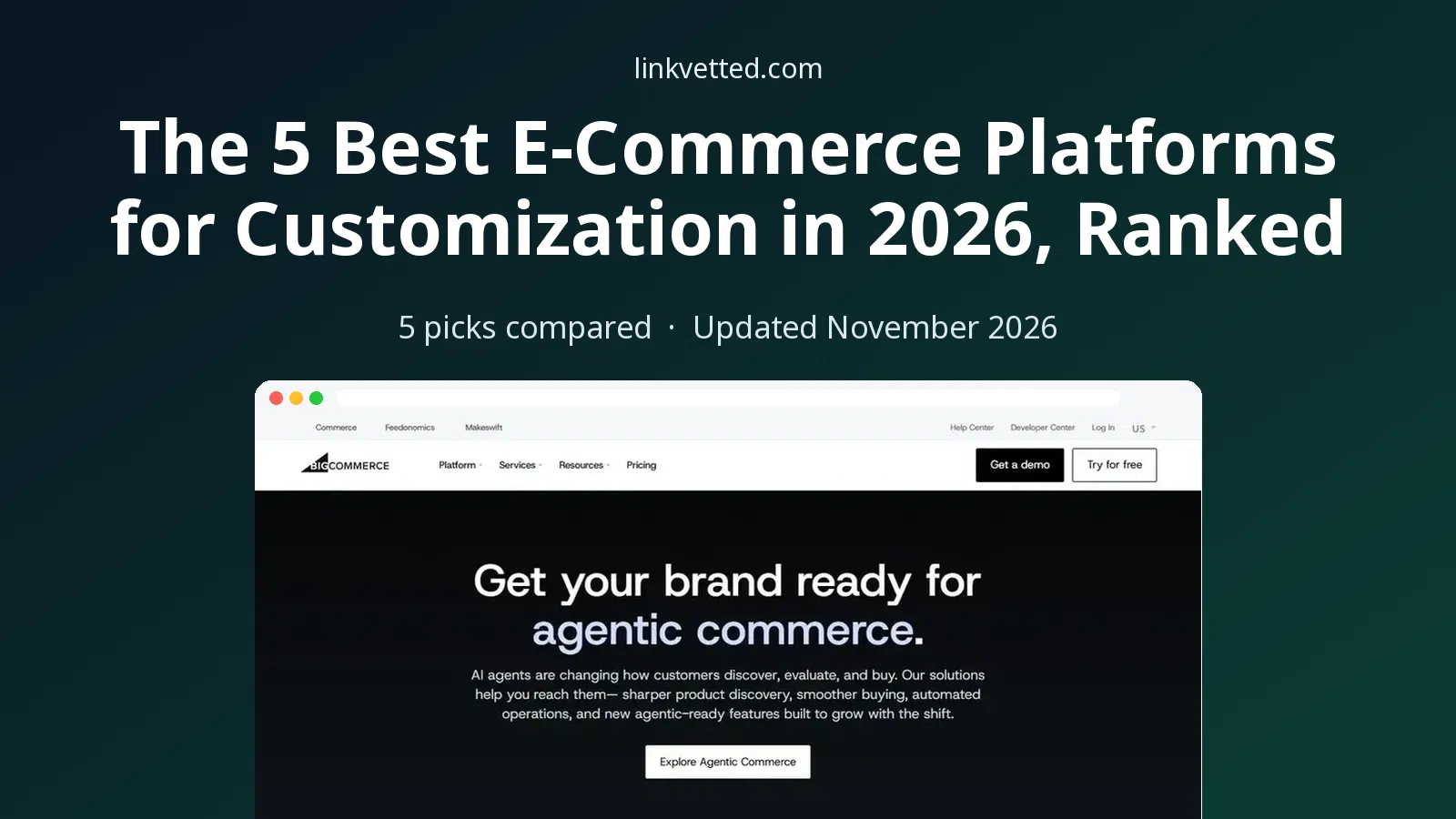
- Editor's choice
 BigCommerce
Scalable multi-channel storefront customization
Starts atSee websiteVisit bigcommerce.comFull review - Great alternative
 WooCommerce
Open-source control on WordPress
Starts at$29 a monthVisit woocommerce.comFull review - Also consider
 Salesforce Commerce Cloud
Customization tied to CRM data
Starts atSee websiteVisit salesforce.comFull review
Direct answer
BigCommerce comes first here, mainly for scalable multi-channel storefront customization. Listed starting prices: WooCommerce from $29 a month and Shopify from $19 per month. WooCommerce is the stronger choice for open-source control on WordPress, while Salesforce Commerce Cloud suits customization tied to CRM data. Details, prices and limits for the rest of the 5 tools are below.
TL;DR:
- Top of the list is BigCommerce, which targets scalable multi-channel storefront customization.
- None of the 5 tools, from BigCommerce to Shopify, has a free plan, so budget for a subscription or use a trial.
- WooCommerce comes with a trade-off: you handle hosting and upkeep.
- Shopify suits balanced customization with managed hosting.
Last checked November 2026. Prices and plan details were read from the vendors' own pages in November 2026; vendors change plans often, so confirm the current price on the vendor site before you buy.
Quick comparison
| Tool | Best for | Starts at | Free plan? | |
|---|---|---|---|---|
| BigCommerce | Scalable multi-channel storefront customization | See website | Not stated | Visit |
| WooCommerce | Open-source control on WordPress | $29 a month | Not stated | Visit |
| Salesforce Commerce Cloud | Customization tied to CRM data | See website | Not stated | Visit |
 Squarespace Commerce | Design-led keeps with straightforward setup | See website | Not stated | Visit |
 Shopify | Balanced customization with managed hosting | $19 per month | Free trial | Visit |
The 5 tools in detail
Choosing E-commerce platforms for customization usually comes down to price, fit and limits. This LinkVetted guide sets 5 tools side by side on those three points, with the facts kept short and checkable.

BigCommerce is aimed squarely at scalable multi-channel storefront customization. Some advanced customizations rely on developer resources, and the product can feel heavier for very small catalogs.
Its customization choices support multi-storefront and multi-channel selling, which fits retailers expanding across markets. Check the vendor site for BigCommerce pricing; none is listed in this comparison. Trial and free access: Not stated.
Where it is weaker: Setup can feel involved.
- Single scalable foundation
- Modern buying experiences
- Advanced edits need developer help
Choose WooCommerce for open-source control on WordPress. WooCommerce is the open-source ecommerce product that helps merchants and developers build firms for the long term.
Developers and content-led keeps frequently favor it for that control. Merchants wanting a completely managed experience may prefer a hosted system, whereas practical teams frequently accept the tradeoff. Starting cost for WooCommerce: $29 per month. Free plan details: Not stated.
Points against: You run hosting and upkeep.
- Long-term ownership focus
- Made for merchants and developers
- Customization needs technical care
Salesforce Commerce Cloud makes the most sense for customization tied to CRM data. Salesforce Commerce Cloud is the commerce product within the broader Salesforce product, targeted at brands that want shopping experiences connected to customer data and service tools. For everyday use, companies without existing CRM ties may find standalone products more straightforward, whereas ecosystem users commonly gain from the connection.
Points against: Implementation is involved.
Also, the system is less approachable for teams outside the Salesforce world, and setup needs planning and specialist help. From a buyer's view, customization leans on integrations and developer work, which fits organizations already invested in the ecosystem. This comparison lists no price for Salesforce Commerce Cloud; ask the vendor. Free plan details: Not stated.
- Supports personalized shopping
- Scales across channels
- Best value within its ecosystem
For design-led keeps with straightforward setup, Squarespace Commerce is a natural candidate. Content and commerce blend naturally on the product. Also, Squarespace Commerce lets you build an ecommerce website to sell products, services or content, starting from a template.
Points against: Restricted deep customization.
Its strength is refined design with straightforward setup, which suits creatives and small brands that prioritize presentation. Customization stays within the template and built-in feature set, so complicated or highly technical keeps may hit limits. In daily use, merchants needing deep code control frequently choose another product, whereas design-first sellers often stay. Check the vendor site for Squarespace Commerce pricing; none is listed in this comparison. Free access: Not stated. Upsides: Sells products.
- Template-based store creation
- Services and content
- Fewer developer hooks

Shopify is aimed squarely at balanced customization with managed hosting. Shopify positions itself as an all-in-one commerce system for firms, with AI tools and software that handles more than storefront selling.
As for the details, customization comes through theme editing, app extensions and its developer framework, which suits merchants who want adaptability without managing servers. On top of that, merchants needing full source-level control may prefer an open-source route, whereas those wanting managed convenience frequently stay with Shopify. Starting cost for Shopify: $19 per month. Free plan details: Free trial.
What to check first: App reliance can add complexity.
- Theme and app-based customization
- Deals with plenty of parts of a business
- Deep code changes need workarounds
What went into this list
LinkVetted looked at what each vendor publishes: pricing, plan limits, feature coverage for E-commerce platforms for customization and stated drawbacks. No hands-on testing is claimed. Where a price is missing, the vendor does not list one publicly or ties it to a quote. Always confirm before budgeting. The order reflects how well each tool fits the most common buying scenario for E-commerce platforms for customization, then price clarity, then free plan access. It is a starting point, not a verdict.
What to confirm before you sign up
- Get a written quote from BigCommerce, Salesforce Commerce Cloud and Squarespace Commerce; the list shows no starting price for them.
- Run a trial of Shopify with real work before paying for a year; your own workflow is the best test.
- Before choosing BigCommerce, weigh its main limit: advanced edits need developer help.
- Run a one or two week pilot of Squarespace Commerce with the people who will use it every day.
- Ask whether WooCommerce integrates with your current software, and whether that comes standard or as an add-on.
FAQ
How are the tools for E-commerce platforms for customization ordered?
The order follows typical fit for E-commerce platforms for customization, with BigCommerce first and Shopify last, then price clarity and free access. It is editorial judgement, not a score, so another team could rank the tools differently.
Can I try these tools before paying?
Often, yes. Shopify offers a free trial. Use your own data and a real task during the test, and check what the free tier or trial limits before you rely on it. All 5 picks in this E-Commerce platforms for customization comparison list a starting price, free plan details and the main limits on their cards above.
Which platform is a good match for code-level customization?
The first pick on this list is BigCommerce, because it suits scalable multi-channel storefront customization. WooCommerce is better for open-source control on WordPress, and Salesforce Commerce Cloud for customization tied to CRM data. Check price and limits against your own needs before choosing.
Do these tools publish their prices?
Not all of them. BigCommerce, Salesforce Commerce Cloud and Squarespace Commerce publish no starting price, so expect a quote request for those. The rest, WooCommerce included, show a starting price, though seats and billing terms still change the final cost.
Is BigCommerce the right pick for everyone comparing E-commerce platforms for customization?
No single tool suits every team. BigCommerce comes first because it fits scalable multi-channel storefront customization, while WooCommerce suits open-source control on WordPress and Salesforce Commerce Cloud suits customization tied to CRM data. Match the tool to your own size, budget and workflow before deciding.
Sources
- https://www.bigcommerce.com
- https://woocommerce.com
- https://www.salesforce.com/commerce
- https://www.squarespace.com/ecommerce
- https://www.shopify.com