E-Commerce Data Integration Software for Remote Teams in 2026: The 6 Best Options Side by Side
Best E-Commerce data integration software for remote teams: 6 tools compared on price, free plans and fit. Short verdicts, no fluff. Updated for 2026.
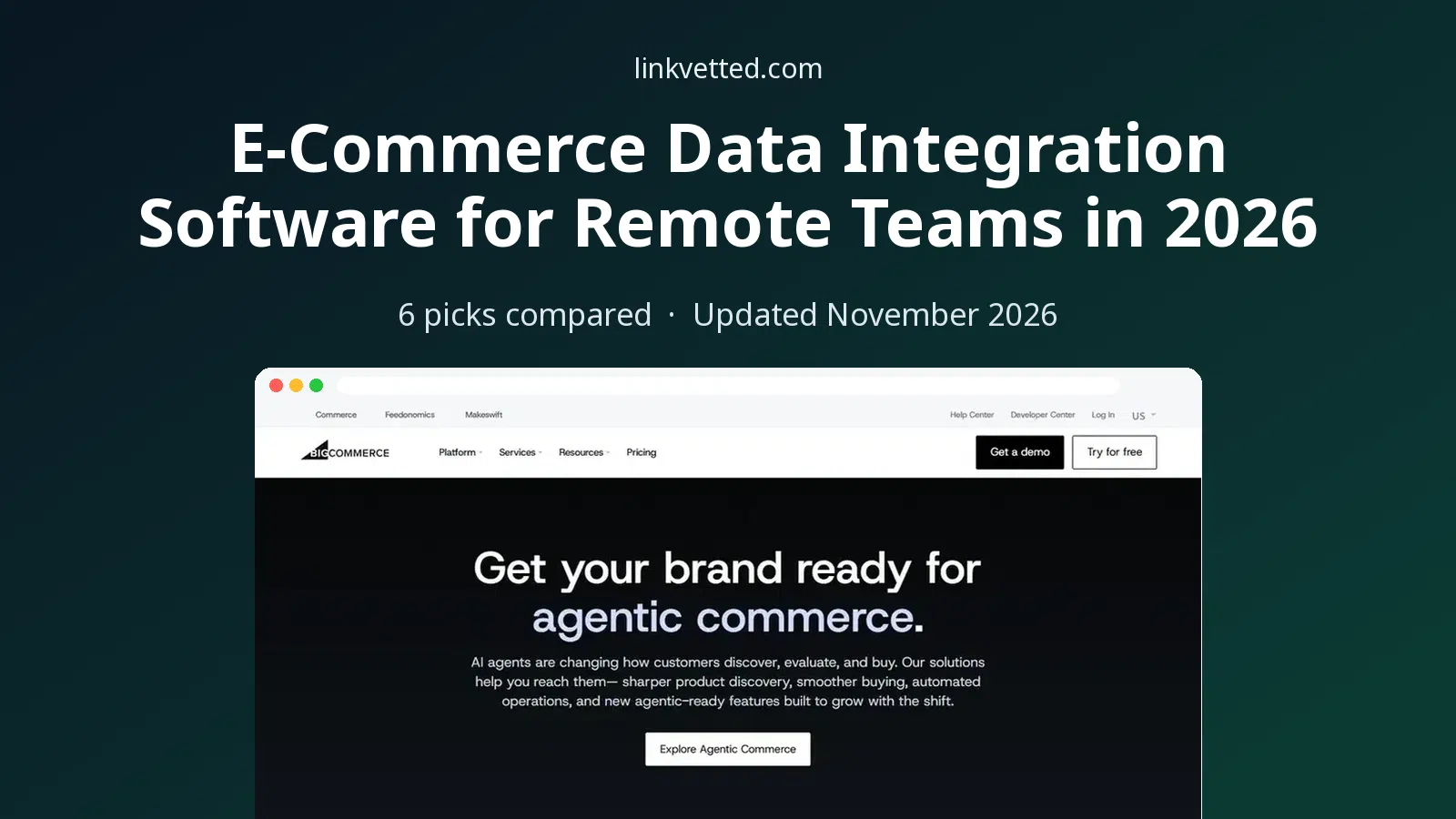
- Editor's choice
 BigCommerce
Multi-channel selling at scale
Starts atSee websiteVisit bigcommerce.comFull review - Great alternative
 Salesforce Commerce Cloud
Teams already inside the Salesforce ecosystem
Starts atSee websiteVisit salesforce.comFull review - Also consider
 WooCommerce
Open-source adaptability for developer teams
Starts at$29 per monthVisit woocommerce.comFull review
Direct answer
BigCommerce is the first pick on this list for multi-channel selling at scale. Listed starting prices: WooCommerce from $29 per month and Shopify from $19 per month. Salesforce Commerce Cloud is the stronger choice for teams already inside the Salesforce ecosystem, while WooCommerce suits open-source adaptability for developer teams. The full list of 6 tools follows, with prices and free plan facts.
TL;DR:
- The list opens with BigCommerce, aimed at multi-channel selling at scale.
- Starting prices begin at $19 per month with Shopify.
- Celigo is the one to check for dedicated integration across plenty of apps.
- Before buying Salesforce Commerce Cloud, weigh this: best value within Salesforce stack.
- BigCommerce, Celigo and the 4 others all need a premium plan or a trial, since no free plan is listed.
Last checked November 2026. Prices and plan details were read from the vendors' own pages in November 2026; vendors change plans often, so confirm the current price on the vendor site before you buy.
Quick comparison
| Tool | Best for | Starts at | Free plan? | |
|---|---|---|---|---|
| BigCommerce | Multi-channel selling at scale | See website | Not stated | Visit |
| Salesforce Commerce Cloud | Teams already inside the Salesforce ecosystem | See website | Free trial | Visit |
| WooCommerce | Open-source adaptability for developer teams | $29 per month | Not stated | Visit |
 SAP Commerce Cloud | AI-assisted enterprise e-commerce | See website | Not stated | Visit |
 Shopify | All-in-one commerce with built-in integrations | $19 per month | Free trial | Visit |
 Celigo | Dedicated integration across plenty of apps | See website | Free trial | Visit |
E-Commerce Data Integration Software for Remote Teams compared in detail
Choosing E-Commerce data integration software for remote teams usually comes down to price, fit and limits. This LinkVetted guide sets 6 tools side by side on those three points, with the facts kept short and checkable.

BigCommerce is built with multi-channel selling at scale in mind. It fits expanding merchants who expect to add channels and regions without rebuilding their commerce core.
Drawbacks to consider: Integration depth varies by channel.
Check the vendor site for BigCommerce pricing; none is listed in this comparison. Free plan details: Not stated.
- Single foundation across brands and regions
- Scalable channel management
- Setup can be involved for large catalogs
Salesforce Commerce Cloud
Best for: Teams already inside the Salesforce ecosystem
Salesforce Commerce Cloud serves teams already inside the Salesforce ecosystem. Salesforce Commerce Cloud is the commerce product within Salesforce's customer product, geared toward unifying shopping experiences with customer data.
Where it is weaker: Best value within Salesforce stack.
In practice, the product is most valuable when paired with other Salesforce products, so teams outside that ecosystem may find it less efficient. Salesforce Commerce Cloud does not show a starting price in this comparison, so check the vendor site for current pricing. Trial and free access: Free trial.
- Suits Salesforce customer data workflows
- Enterprise-grade system
- Configuration needs specialist skills
For open-source adaptability for developer teams, WooCommerce is a natural candidate. WooCommerce is the open-source ecommerce product that helps merchants and developers build successful firms for the long term.
Points against: You run hosting and maintenance.
Because it is open source, hosting, updates, and integration upkeep fall to your team, which can be demanding for distributed staff without technical depth. Extension quality varies, so each connection needs verification. Entry price for WooCommerce: $29 per month. Free options: Not stated.
- Open-source and extensible
- Made for long-term merchant use
- Integration quality varies by extension
Choose SAP Commerce Cloud for AI-assisted enterprise e-commerce. SAP Commerce Cloud is AI-assisted e-commerce software from SAP that aims to drive digital growth and demand whereas offering unified buying experiences to convert visitors into customers.
Success frequently relies on access to SAP-skilled resources. In practice, more straightforward products may deliver quicker results for lean teams. No starting price is listed for SAP Commerce Cloud here; confirm pricing on the vendor site. Free access: Not stated.
Where it falls short: Enterprise focus layers on complexity.
- AI-assisted commerce features
- Unified buying experiences
- Integration work can be deep

Shopify makes the most sense for all-in-one commerce with built-in integrations. Shopify presents itself as an all-in-one commerce system for companies, pairing storefront tools with features to handle numerous parts of an operation. Choose something else if you need a dedicated integration layer across numerous unrelated applications or a completely composable enterprise architecture.
As for the details, for remote teams, that means product, order, and customer data live in one place that distributed staff can reach from anywhere. For everyday use, the product is built around its own data model. So teams with complicated or highly custom integration needs may need external apps or middleware to bridge systems. Entry price for Shopify: $19 per month. As for free access: Free trial.
Trade-offs to know: Data model is oriented around its own product.
- Unified dashboard for orders and data
- AI-assisted business tools included
- Advanced customization can need apps
Celigo serves dedicated integration across numerous apps. Planning and governance effort is required to keep flows dependable.
From a buyer's view, remote teams can use it as the integration layer between a commerce system and back-office systems. Teams with only a couple of straightforward connections may find a commerce product's built-in integrations sufficient. Check the vendor site for Celigo pricing; none is listed in this comparison. Free access: Free trial.
The main drawbacks: Needs integration planning.
- Build, run
- AI workflows
- Not a storefront platform itself
How we compared the tools
The comparison looks at four things: starting price, free access, how well the feature set matches E-Commerce data integration software for remote teams, and the main limit of each tool. Where a price is missing, the vendor does not list one publicly or ties it to a quote. Always confirm before budgeting. The order reflects how well each tool fits the most common buying scenario for E-Commerce data integration software for remote teams, then price clarity, then free plan access. It is a starting point, not a verdict.
What to confirm before you sign up
- Confirm the entry price on the vendor page. For BigCommerce, Salesforce Commerce Cloud, SAP Commerce Cloud and Celigo that means a quote rather than a fixed price.
- Run a trial of Salesforce Commerce Cloud, Shopify and Celigo with real work before paying for a year; your own workflow is the best test.
- Before choosing BigCommerce, weigh its main limit: integration depth varies by channel.
- See whether WooCommerce offers onboarding or training, and whether it is included in the price.
- Read the plan comparison for BigCommerce carefully; key features often start on a higher tier.
FAQ
How are the tools for E-Commerce data integration software for remote teams ordered?
BigCommerce sits first and Celigo last because the order follows typical fit for E-Commerce data integration software for remote teams, then price clarity and free access. It is a judgement call, so read each profile for fit and limits.
Does any tool for E-Commerce data integration software for remote teams here have a free plan?
No tool in this list, BigCommerce and Celigo included, has a permanent free plan. Salesforce Commerce Cloud, Shopify, Celigo offer a trial. Trials and quotes are the usual route, so plan a short evaluation period.
Do these tools publish their prices?
Not all of them. BigCommerce, Salesforce Commerce Cloud, SAP Commerce Cloud and Celigo publish no starting price, so expect a quote request for those. The rest, WooCommerce included, show a starting price, though seats and billing terms still change the final cost.
How do open-source choices compare for distributed teams?
WooCommerce gives you adaptability and control but puts hosting and maintenance on your team. Hosted platforms cut operational burden, which can matter when staff are remote and technical resources are restricted.
Is a commerce product enough, or do I need a separate integration tool?
A system like Shopify or BigCommerce may handle typical connections through its ecosystem. If you run plenty of unrelated systems or need governed automation, a dedicated layer like Celigo can help.
What is the cheapest option for E-Commerce data integration software for remote teams in this list?
On published monthly entry prices, Shopify is the lowest here at $19 per month. Entry price is only part of the cost, because seats, add-ons and billing terms can change the total. For the full picture, the cards above cover all 6 entries of this E-Commerce data integration software for remote teams list, including price, free plan and limits.
Sources
- https://www.bigcommerce.com
- https://www.salesforce.com/products/commerce-cloud/overview
- https://woocommerce.com
- https://www.sap.com/products/crm/commerce-cloud.html
- https://www.shopify.com
- https://www.celigo.com