Best Dropshipping Platforms for Beginners in 2026: 8 Platforms Compared
We compared the best dropshipping platforms for beginners on price, supplier quality, shipping speed and setup ease, so you can start with less guesswork.

- Editor's choice
 Shopify
A complete beginner store
Starts at$39 per monthVisit shopify.comFull review - Great alternative
 Spocket
US and EU suppliers with faster shipping
Starts at$39.99 per monthVisit spocket.coFull review - Also consider
 AutoDS
Automated ordering across suppliers
Starts at$19.90 per monthVisit autods.comFull review
TL;DR:
- Shopify gives beginners the simplest complete store, but the monthly fee plus sourcing apps adds up, so budget for both from day one.
- Spocket and Zendrop suit sellers who want faster shipping from US and EU suppliers, while DSers and CJ Dropshipping suit sellers who want low upfront cost.
- Printful is the lowest risk way to test designs, because you pay per order and never hold stock.
- Check shipping times, return rules and supplier ratings before you list a product, since those details shape reviews more than the product page does.
Quick comparison
| Tool | Best for | Starts at | Free plan? | |
|---|---|---|---|---|
| Shopify | A complete beginner store | $39 per month | Free trial | Visit |
| Spocket | US and EU suppliers with faster shipping | $39.99 per month | Yes | Visit |
| AutoDS | Automated ordering across suppliers | $19.90 per month | Free trial | Visit |
 Zendrop | Branded packaging and US fulfillment | $49 per month | Yes | Visit |
 DSers | AliExpress ordering at low cost | Free | Yes | Visit |
 CJ Dropshipping | Free sourcing with warehousing options | Free | Yes | Visit |
 Wix | A simple drag and drop store | See website | Free trial | Visit |
 Printful | Print on demand with no inventory | Free | Yes | Visit |
The best dropshipping platforms for beginners
We looked at store builders and sourcing tools together, because a beginner needs both. A store builder gives you the shopfront, checkout and pages. A sourcing tool connects that shop to suppliers, stock levels and order fulfillment. The picks below cover each side, and several work best in pairs.

Shopify is our pick for most beginners because it removes the hardest technical work. You get hosting, a checkout, discount tools and a large library of themes in one account, and you can connect a sourcing app in a few clicks. The admin screens are plain and well labeled, which matters when you are learning product pages, shipping zones and taxes at the same time.
The catch is cost and choice. The Basic plan starts at $39 per month, and most sellers add at least one sourcing app and sometimes an email or review app. That stack can reach $80 or more per month before you sell anything, so start with one product category and one sourcing app. If you want a store that can grow into a brand, Shopify is still the safest base.
- Large app store
- Clear checkout
- Many themes and payment options
- Monthly fee plus app fees
- Transaction fees unless you use Shopify Payments
Spocket suits beginners who worry, rightly, about long shipping times. Its suppliers are mainly based in the US and EU, and many orders arrive in a few days rather than a few weeks. That shorter wait reduces refund requests and angry messages, which is a real advantage when you are still learning customer service. The catalog leans toward home, beauty, fashion and accessories.
The free plan lets you browse, but importing products needs a paid plan starting at $39.99 per month. Prices per item also tend to be higher than AliExpress, so margins are thinner unless you pick products with room to price well. For a first store aimed at US buyers, that trade of higher cost for faster delivery is often worth it.
- Curated US and EU suppliers
- Branded invoicing
- One click import to Shopify and WooCommerce
- Smaller catalog than AliExpress tools
- Paid plan needed to import products
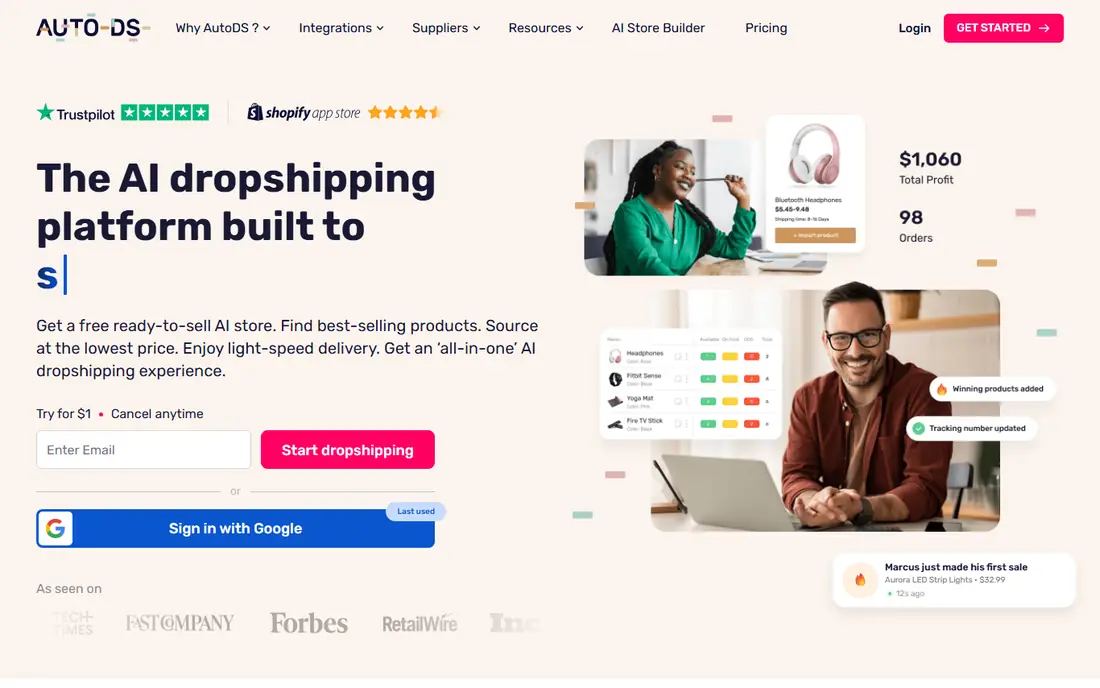
AutoDS is built for sellers who want the routine work handled for them. It watches supplier prices and stock, updates your store when they change, and can place orders automatically when a customer buys. That automation saves hours once you have more than a handful of products, and it works across several selling channels, not just one store.
Beginners should still review the automation settings carefully. Automatic ordering is only helpful if the supplier is reliable, so test a few orders yourself before you turn full automation on. The entry plan starts at $19.90 per month, which is lower than some rivals, but higher tiers are priced by product count, so check the limit before you import a large catalog.
- Price and stock monitoring
- Automatic order fulfillment
- Works with Shopify, eBay and other channels
- Learning curve for automation rules
- Supplier quality still needs checking
Zendrop appeals to beginners who want their store to look like a brand from the first order. It offers custom packaging and branded inserts, and it can source products and arrange faster US fulfillment for proven items. The dashboard is tidy, and the focus on fewer, vetted products suits a seller who would rather build one good store than list hundreds of random items.
The downside is the price ladder. The free tier is useful for research, but linking products and using fulfillment features needs a paid plan from $49 per month. That is a lot before your first sales, so Zendrop fits best if you already have a product idea with demand and you plan to spend on branding. Casual testers may prefer a free tool first.
- Custom branding options
- US based fulfillment for some products
- Product sourcing help
- Free plan is browse only
- Higher entry price for full features
DSers is the classic low cost entry point for AliExpress dropshipping. It is the official partner tool for bulk ordering, so placing many orders at once is far easier than doing it by hand. The free tier lets a beginner learn importing, pricing and order tracking without a monthly bill, and paid plans start at $19.90 per month for higher limits.
The trade is time and quality control. Many AliExpress items ship from China, so delivery can take weeks, and quality varies a lot between suppliers. Read supplier ratings, order samples of your best sellers, and set clear shipping expectations on your product pages. If you accept those limits, DSers is a practical way to learn the model cheaply.
- Official AliExpress integration
- Bulk ordering
- Free tier for getting started
- Long shipping times on many items
- Product quality varies by supplier
CJ Dropshipping is a free to join platform that combines sourcing, warehousing and fulfillment. You can ask its team to source a product, store stock in a warehouse closer to your buyers, and handle packing and shipping. That range makes it useful both for a first store and for a seller who later wants faster delivery without switching platforms.
The platform is broader than a simple Shopify app, so the learning curve is steeper. Finding the right warehouse option and understanding fees for storage, packing and shipping takes some reading. Still, because joining is free and you mainly pay for goods and services used, it is a low risk way to test suppliers and compare delivery times before you commit to a paid tool.
- Free to join
- Sourcing requests
- Warehouses in several regions
- Custom packaging
- Interface takes time to learn
- Shipping speed varies by warehouse
Wix suits beginners who care most about how the store looks and want to build it by dragging blocks into place. The editor is friendly, templates are polished, and you can add a blog, email capture and basic marketing tools without extra apps. For a small store with a tight product range, that simplicity is a genuine strength.
The dropshipping side is thinner than Shopify. There are integrations, including options for print on demand and supplier catalogs, but the choice is smaller and some advanced automation tools are missing. Wix is a good pick if design ease matters more than a large app library, and a weaker pick if you plan to scale to hundreds of products with heavy automation.
- Easy visual editor
- Built in marketing tools
- No coding needed
- Smaller dropshipping app range than Shopify
- Moving to another platform later is harder
Printful is not a general dropshipping marketplace. It prints your designs onto shirts, mugs, posters and other goods only after a customer orders, then ships them for you. That makes it the lowest risk model on this list, because you never buy stock in advance and you can test many designs for the cost of your time. It connects to Shopify, Wix, WooCommerce and other store builders.
Margins need care. Base product costs plus shipping leave less room on cheap items, so price with the full cost in mind and order samples to check print quality, fit and colors. Printful also offers a paid growth plan, but the free account is enough to start. For design led beginners, it is the easiest first step into selling online.
- No upfront stock cost
- Wide product range
- Automatic fulfillment and shipping
- Thin margins on low priced items
- You cannot control print quality directly
How we picked these
We compared official pricing pages, app store listings, supplier coverage and fulfillment options for store builders and sourcing tools that a beginner can actually set up without a developer. We favored tools with a free tier or trial, clear shipping information, and a track record of working with Shopify or WooCommerce. We left out tools that only serve large enterprises, tools with no clear current pricing or product page, and marketplaces that do not handle fulfillment.
What to check before you pick a platform
Start with shipping, not just product price
A cheap product that takes four weeks to arrive can cost you more in refunds and bad reviews than a dearer product that arrives in four days. Check the supplier location, the stated delivery range, and the return policy before you list anything. Order a sample of each hero product so you can see packaging, quality and real delivery time.
Keep the monthly stack small
Add up the store plan, the sourcing app and any email or review app before you launch. Many beginners pay for three tools they barely use. Start with one store builder and one sourcing tool, and add apps only when a real task, such as abandoned cart emails, is costing you sales. Revisit the stack monthly in the first quarter.
Plan for customer messages
Dropshipping puts you between the buyer and the supplier, so you will get questions about tracking, delays and returns. Write clear shipping and return pages, set up tracking emails, and decide who handles a lost parcel before it happens. A platform with clear order tracking and supplier messaging will save you time every week.
FAQ
What is the cheapest way to start dropshipping as a beginner?
Start with a free sourcing tool such as DSers or CJ Dropshipping paired with a store builder trial, and test a small product range before paying for premium plans. Printful is also free to start if you want print on demand. Keep the paid stack to one store plan and one sourcing app until sales cover the cost.
Do I need Shopify to dropship?
No. Shopify is the most popular choice, but Wix and WooCommerce also support dropshipping through apps and integrations. Shopify has the largest app range, Wix is easier for visual design, and WooCommerce suits people already comfortable with WordPress. Pick the builder you will actually maintain.
How long does dropshipping delivery usually take?
It depends on the supplier location. US and EU suppliers on Spocket or Zendrop often deliver in a few days, while many AliExpress suppliers take two to four weeks. Always check the stated range for each product and tell buyers the honest range on the product page.
Can beginners make money with dropshipping?
Some do, but margins are thin and advertising, app fees and returns eat into profit. The sellers who last tend to pick a clear niche, test products with small budgets, and build repeat traffic through email and content rather than relying only on paid ads. Treat the first months as learning, not guaranteed income.
Is print on demand the same as dropshipping?
It is a form of dropshipping, but with custom printed goods made after each order instead of ready made goods shipped from a supplier warehouse. That removes inventory risk but adds design work and print quality checks. Many beginners start with print on demand and move into general dropshipping later.