Best Direct Mail Automation Software in 2026: 9 Platforms Compared
Compare the best direct mail automation software for 2026, with pricing, CRM triggers, delivery tracking, and honest limits for each platform reviewed.
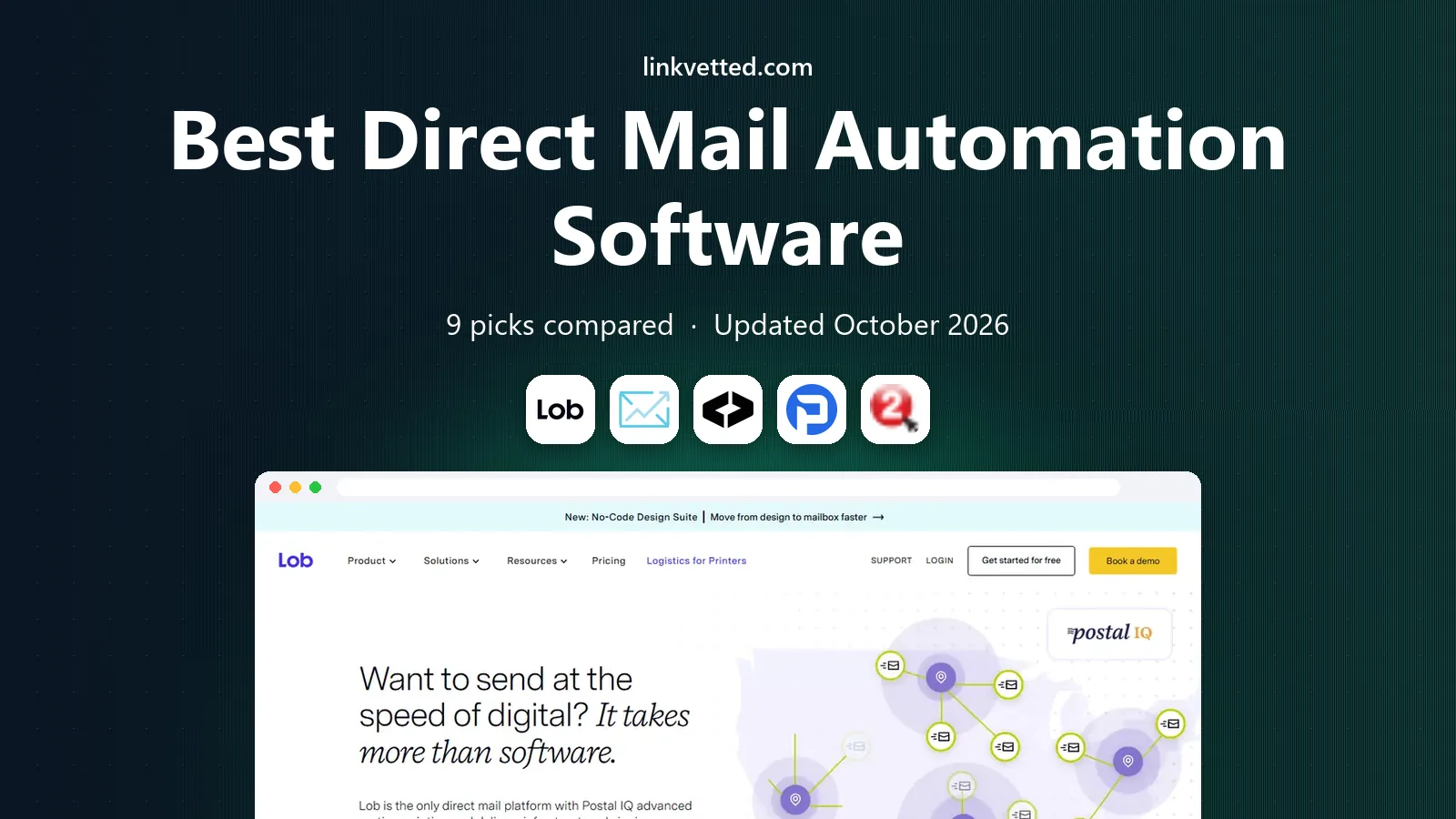
- Editor's choice
 Lob
API-driven mail at scale
Starts at$260 per monthVisit lob.comFull review - Great alternative
 Postalytics
CRM-triggered campaigns
Starts atSee websiteVisit postalytics.comFull review - Also consider
 Inkit
Enterprise document workflows
Starts atSee websiteVisit inkit.comFull review
TL;DR:
- Lob is our pick for developer-led teams that need an API, address checks, and mail tracking at scale.
- Postalytics is the strongest fit for HubSpot and Salesforce users who want mail triggered by CRM activity.
- Per-piece cost, monthly platform fees, and print quality matter more than a long feature list.
- Small teams should start with a low minimum platform, then move up once volume is steady.
- Always order a test batch and check delivery scans before a large campaign.
Quick comparison
| Tool | Best for | Starts at | Free plan? | |
|---|---|---|---|---|
| Lob | API-driven mail at scale | $260 per month | Free trial | Visit |
| Postalytics | CRM-triggered campaigns | See website | No | Visit |
| Inkit | Enterprise document workflows | See website | No | Visit |
 PostGrid | Address data and print API | See website | Free trial | Visit |
 Click2Mail | Simple online mailing | See website | No | Visit |
 LetterStream | Letters and certified mail | See website | No | Visit |
 Sendoso | Gifting plus direct mail | See website | No | Visit |
 PFL | Tactile campaigns and swag | See website | No | Visit |
 PostPilot | Shopify retention mail | See website | Free trial | Visit |
The best direct mail automation software
Direct mail still works when it is timed well, addressed correctly, and tied to a clear next step. These platforms handle printing, postage, and delivery tracking, so a team does not need a local print shop for every send. We compared official feature pages, pricing pages, integrations, and public reviews.

Lob suits teams that treat mail as part of a software workflow rather than a one-off campaign. A developer can trigger a postcard, letter, or check when a customer signs up, churns, or reaches a milestone. Address verification helps reduce returned mail, and tracking gives a clearer view of delivery than a bulk print run alone.
The trade-off is cost and setup effort. The paid plans start at $260 per month in the pricing we found, so occasional senders may find it hard to justify. Marketing teams without developer support should ask for a demo first and confirm which templates can be edited without code.
- Strong API and address verification
- In-transit tracking
- Wide range of mail formats
- Monthly cost is high for small tests
- Developer help is often needed for setup
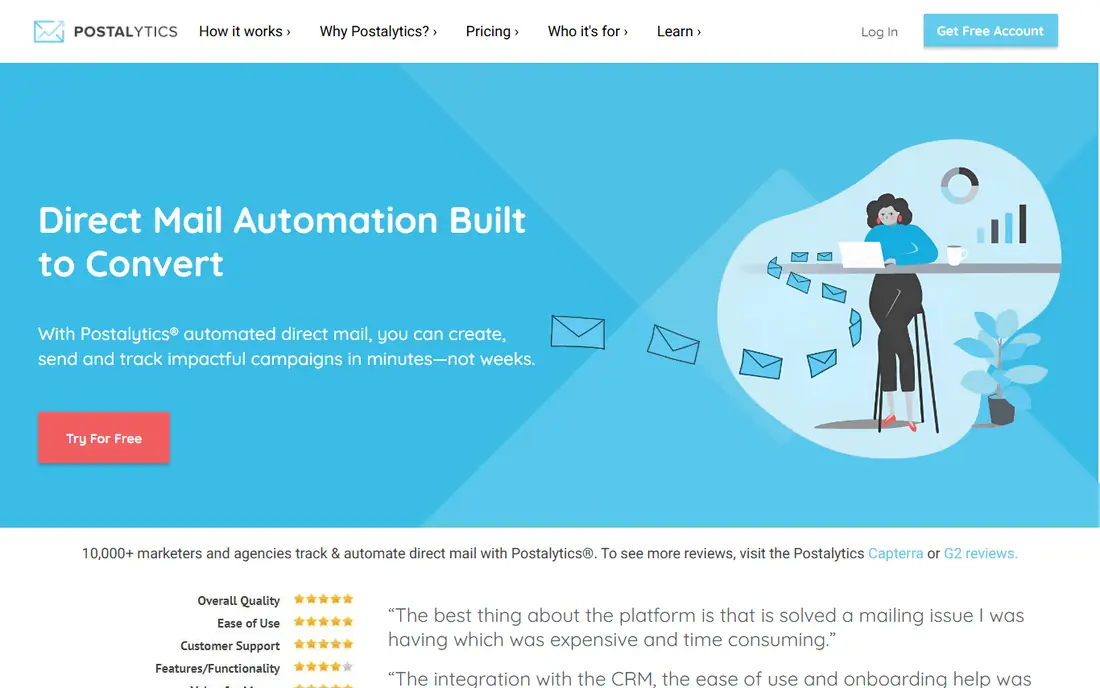
Postalytics is built for marketers who already live in a CRM. A change in a contact record, a deal stage, or a list membership can trigger a printed piece without manual exports. That timing is the main reason to choose it over a generic print service, since mail arrives close to the digital touch that prompted it.
The catch is total cost. Platform fees and per-piece charges need to be modelled together, and list costs can add more. It is still a good fit for mid-size teams with steady CRM activity, but small teams should test a single workflow before committing to a larger plan.
- Deep HubSpot and Salesforce triggers
- Templates for postcards and letters
- Campaign reporting
- Pricing is not fully public
- Per-piece costs add up at volume
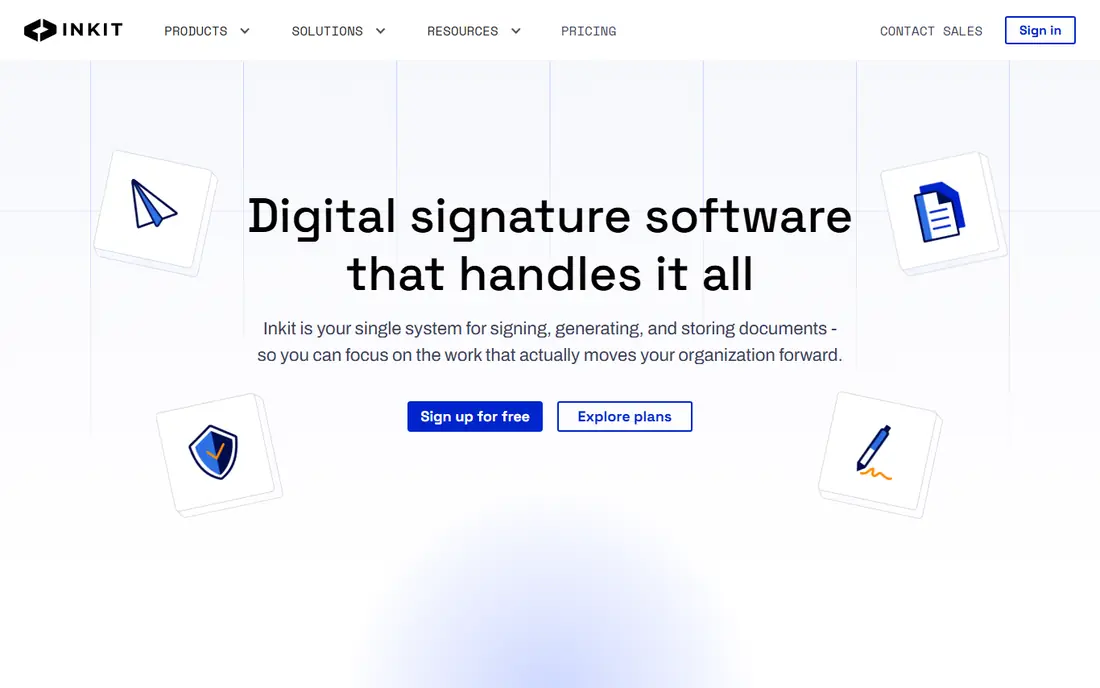
Inkit focuses on documents that must be correct, secure, and sent on time, such as statements, notices, and customer letters. It connects document creation to print and mail, which reduces manual handling and version errors. Teams in finance, insurance, and health care often value that control.
Smaller businesses may find the platform heavy. Implementation takes planning, and pricing is quoted rather than published. It makes most sense when mail volume is high, accuracy matters, and several systems feed the same documents.
- Document generation plus mailing
- Controls for regulated mail
- Integrations with business systems
- Enterprise pricing and onboarding
- More than small teams need
PostGrid stands out for data quality. Address autocomplete and verification catch errors before printing, which saves postage and avoids wasted pieces. The print API also lets developers send letters and postcards from an existing app, with tracking to follow delivery.
Marketers looking for a polished campaign builder may want more hand-holding. PostGrid is closer to infrastructure than a full campaign studio. For product and operations teams, that focus is a strength, since clean addresses and reliable delivery are the foundation of any mail program.
- Address verification and autocomplete
- Print and mail API
- Coverage for the United States and Canada
- Pricing for volume plans is quoted
- Marketing templates are less central
Click2Mail is a practical choice for a team that wants to send mail without building an integration. Users can upload a document or a mailing list, choose a format, and have pieces printed and mailed. That simplicity helps for notices, invitations, and periodic customer letters.
It is not the best pick for complex triggered workflows. Teams that need deep CRM automation should look at Postalytics or Lob first. For straightforward sends, however, Click2Mail keeps the process short and the learning curve low.
- Easy upload and mailing for letters and postcards
- No software to install
- Mailing list tools
- Automation is lighter than API-first rivals
- Design tools are basic
LetterStream fits senders who need proof of mailing and delivery for important letters. Certified mail, return receipt options, and tracking give a paper trail that matters for legal, tax, and compliance mail. Uploading a PDF and sending it the same day is far faster than a trip to the post office.
Marketing teams may find the creative options limited compared with campaign platforms. The value here is reliability for official correspondence, not colourful postcard design. If delivery proof is the priority, LetterStream deserves a close look.
- Certified mail and tracking options
- Online document upload
- Good for legal and official letters
- Less suited to large marketing campaigns
- Pricing varies by format
Sendoso is best viewed as a sending platform, not only a mail printer. Sales and marketing teams can send a handwritten-style note, a gift, or a printed piece as part of the same outreach sequence. Integrations with common CRMs help teams track sends alongside emails and calls.
The main drawback is price. Sendoso is aimed at larger sales teams, and smaller businesses may struggle to justify it for mail alone. It works best when gifting and mail are both part of a coordinated account-based plan.
- Direct mail, gifts, and swag in one platform
- CRM and sales integrations
- Sending playbooks
- Platform pricing is enterprise level
- Mail alone may not justify the cost
PFL, formerly PrintingForLess, focuses on mail that people notice and keep. Dimensional mailers, premium paper, and integrated swag can lift response for high-value prospects, event invitations, and customer thank-you campaigns. Its integrations let marketers trigger these pieces from automation platforms.
That quality comes at a price, and standard postcards may be cheaper elsewhere. PFL is a strong choice for targeted campaigns where a small number of high-value recipients matters more than mass volume.
- High-quality tactile mail and dimensional pieces
- Marketing automation integrations
- Fulfilment support
- Premium formats cost more
- Quoted pricing makes budgeting slower
PostPilot is designed for Shopify stores that want to bring back past buyers. It can trigger postcards after a purchase, a lapsed period, or a cart event, and it reports on orders tied to campaigns. For direct-to-consumer brands, that closed loop is easier to judge than generic mail metrics.
Businesses outside Shopify will get less from it. The platform is also less suited to transactional or compliance mail. For ecommerce teams, though, PostPilot is one of the simplest ways to test whether printed mail can lift repeat purchases.
- Shopify integration
- Postcards for winback and retention
- Performance reporting
- Less relevant outside ecommerce
- Pricing depends on volume and plan
How we picked these
We compared official feature pages, pricing pages, integration lists, and public reviews for platforms that still operate in October 2026. We favoured tools that handle printing and postage, offer tracking or delivery reporting, and fit a clear use case, from developer APIs to Shopify retention. We left out generic print shops with no automation, trigger, or tracking features, since they do not meet the brief for direct mail automation platforms and tools.
What to check before you commit
Start with data, not design. A clean mailing list and verified addresses will save more money than a prettier postcard. Ask each vendor how it handles duplicates, moves, and undeliverable addresses, and whether address checks are included or billed separately.
Match the platform to the trigger
API platforms suit product-led sends, CRM tools suit marketing workflows, and Shopify tools suit retention. A mismatch here creates extra work, even if the per-piece price looks low. Map one real workflow end to end before signing, from trigger to print to delivery scan.
Model the full cost
Add platform fees, per-piece charges, postage, list costs, and design time. A low per-piece price with a high monthly fee can be expensive for seasonal senders, while a no-fee service can be costly at high volume. Run the math at your expected monthly volume, not at the vendor's example volume.
Test before you scale
Send a small batch to your own team first. Check print quality, colour, paper feel, and the accuracy of personalisation fields. Then send a test to a small customer segment and compare response with a control group before rolling out a large campaign.
FAQ
What is the best direct mail automation software for small businesses?
For small teams, a simple platform such as Click2Mail or a Shopify tool such as PostPilot is often easiest, since setup is short and there is no large monthly fee to justify. Teams with CRM triggers should compare Postalytics, while developer-led teams should look at Lob or PostGrid. The best choice depends on volume, triggers, and whether design or automation matters more.
What are the best direct mail automation platforms for CRM users?
Postalytics is a strong CRM-first option because of its HubSpot and Salesforce triggers. Sendoso and PFL also integrate with marketing and sales systems, though they are priced for larger teams. Check that the trigger you need, such as a deal stage change or a list entry, is supported without custom code.
What are the best direct mail automation tools for developers?
Lob and PostGrid are the clearest developer options, with APIs, address verification, and tracking. Inkit also suits enterprise document workflows that need system integrations. Ask for API documentation and sandbox access before committing, and confirm rate limits and support hours.
How much does direct mail automation cost?
Costs vary widely, from pay-per-piece services with no monthly fee to platforms that charge hundreds of dollars per month plus per-piece fees. Lob paid plans start at $260 per month in the pricing we found, while other vendors quote by volume. Always model platform fees, print, postage, and list costs together.
Can direct mail be tracked like email?
Yes, in part. Most platforms in this list offer delivery scans, QR codes, or personalised URLs to link a mailed piece to a website visit or order. Tracking is not as precise as email opens, so use a unique offer code or landing page for each campaign to measure response cleanly.
Is direct mail still effective in 2026?
It can be, when it is targeted and timed well. Mail stands out because inboxes are crowded, but untargeted bulk mail wastes money. The best results come from small, relevant sends tied to a customer action, such as a recent purchase, a lapsed account, or a local event.