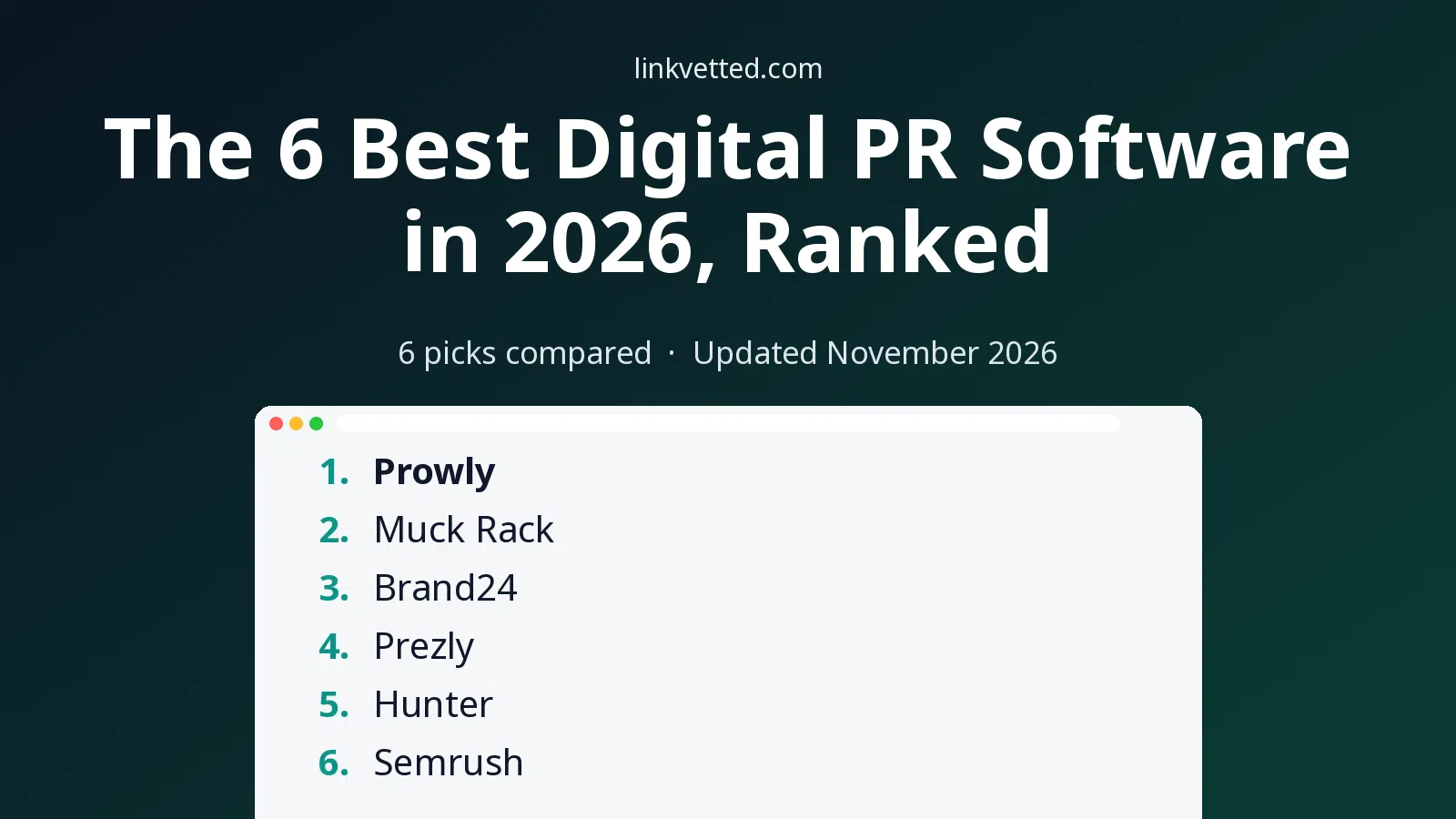
The 6 Best Digital PR Software in 2026, Ranked
A comparison of the best digital PR software in 2026, covering journalist databases, media monitoring and outreach tools, with pros, cons and buying checks.
- Editor's choice
 Prowly
All-in-one campaigns for small teams
Starts atSee websiteVisit prowly.comFull review - Great alternative
 Muck Rack
Journalist research and media lists
Starts atSee websiteVisit muckrack.comFull review - Also consider
 Brand24
Monitoring mentions and coverage
Starts atSee websiteVisit brand24.comFull review
Direct answer
My top pick is Prowly, because it combines media database search, press release publishing and campaign reporting in one place, which suits small teams running regular campaigns. If journalist contact data is the main need, Muck Rack is the stronger fit. For monitoring coverage and tracking mentions across the web, Brand24 is the one I would look at first. Each serves a different part of the digital PR workflow, so the right choice depends on where your process is weakest.
TL;DR:
- Digital PR software usually covers one or two of three jobs: finding contacts, sending outreach, and monitoring coverage.
- A media database is only useful if it is accurate for your region and beat, so check coverage before you commit.
- Press release distribution tools help with publishing and reporting, but they do not replace a real pitch.
- Monitoring tools catch mentions you would otherwise miss, including unlinked brand coverage that can become link opportunities.
- Most vendors publish feature and pricing details on their sites, so confirm current terms directly before buying.
Last checked November 2026. Plan prices are not quoted in this guide because they change often; see each vendor's own pricing page for current figures before you buy.
Quick comparison
| Tool | Best for | Starts at | Free plan? | |
|---|---|---|---|---|
| Prowly | All-in-one campaigns for small teams | See website | Free trial | Visit |
| Muck Rack | Journalist research and media lists | See website | No free plan | Visit |
| Brand24 | Monitoring mentions and coverage | See website | Free trial | Visit |
 Prezly | Publishing releases and newsroom pages | See website | Not stated | Visit |
 Hunter | Finding and verifying email addresses | See website | Free plan | Visit |
 Semrush | Teams already working in SEO tools | See website | No free plan | Visit |
The best digital PR software compared
I put this comparison together from vendor documentation and public sources, not from hands-on tests. I looked at what each tool says it does, which part of a digital PR workflow it covers, and where its limits are. The six below are real, currently operating products, and the order reflects how I would match them to common needs rather than an overall ranking.
Prowly is a PR platform that brings contact search, outreach and reporting together. It fits small agencies and in-house teams that run campaigns regularly and want one tool instead of stitching several together. The media database lets you filter contacts by beat and location, and you can build lists and send pitches from the same account.
For digital PR work, the useful part is the link between outreach and results. You can publish a release, send it to a list, and then look at opens and coverage in the reporting section. That makes it easier to see which pitches led to coverage, which is the question most digital PR campaigns need to answer.
The limit is scale. If you need a very large database with deep filtering across many markets, a bigger platform may suit you better. Teams that only need contact emails should look at a simpler tool first.
- Media database with contact filters
- press release publishing and newsroom
- campaign reporting in one place
- Database is smaller than enterprise PR platforms
- less depth for very large media lists
Muck Rack is a media relations platform built around journalist profiles. You can search for reporters by beat, outlet and recent articles, then build lists and track coverage. It is aimed at PR teams that pitch media often and need reliable contact research.
In a digital PR context, it helps most at the research stage. Finding the right journalist for a data story or expert comment is often the difference between a reply and silence. The platform also tracks coverage, so you can log placements and see who wrote about a campaign.
The main drawback is fit for very small operations. It is a professional tool with a professional price, and a solo operator sending a handful of pitches a month may not get enough from it. Check the current plans on the site before deciding.
- Large journalist profiles with recent work
- media list building and monitoring
- coverage reporting
- Priced for professional PR teams
- may be more than a small agency needs
Brand24 is a media monitoring tool. It watches for keywords and brand names across news sites, blogs and social platforms, then shows you what it found. For digital PR, that means you can see who covered a campaign without manually searching every outlet.
The practical use is finding unlinked mentions. If a site writes about your client but does not link, that is a natural outreach opportunity. You can also track a campaign hashtag or a spokesperson's name to see where a story travelled after launch.
It is not an outreach tool. There is no media database and no pitch sending, so it works alongside a contact tool rather than replacing one. If you only need to send pitches, skip it.
- Tracks mentions across social and web sources
- sentiment and reach context
- alerts for new mentions
- No media database or outreach tools
- coverage depends on source indexing
Prezly is a PR publishing platform. It gives you a newsroom where releases and stories live, plus tools for contacts and campaigns. It suits teams that publish regularly and want a professional home for their announcements.
For digital PR, the newsroom matters more than it looks. Journalists and bloggers often check a company's newsroom before writing about it, and a clear, current page helps. Prezly also handles contact lists and campaign sends, so publishing and outreach sit in one place.
The gap is prospecting. It is not built around finding new journalists by beat, and it is not a monitoring tool. Teams that need heavy media research should pair it with a database or use a broader platform.
- Clean newsroom and story pages
- contact and campaign management
- built for PR publishing
- Less focused on prospecting
- not a monitoring-first tool
Hunter is an email discovery and verification tool. You enter a domain and it returns email addresses it has found, along with confidence signals. It is a practical utility for outreach when you already know which outlets you want to contact.
In digital PR, it fills a narrow gap. Once you have a target publication, Hunter helps you find the right address and check that it is likely to work. That reduces bounces, which protects your sending reputation when you pitch from a normal mailbox.
It is not a media relations platform. There is no journalist database, no pitch tracking and no coverage monitoring. It is best used as a small add-on to a wider workflow, not as your main digital PR tool.
- Finds email addresses from domains
- verification to reduce bounces
- simple to use
- Not a media database
- no campaign or coverage tools
Semrush is an SEO and marketing platform with many modules. For digital PR, the useful parts are research: finding link sources, checking competitors' coverage, and spotting topics that attract links. It is a sensible choice for teams that already use it for SEO.
The digital PR workflow is indirect. You use the data to shape a campaign, then take outreach elsewhere. Some plans include content and outreach features, but the core strength is research rather than journalist contact or monitoring.
The drawback is focus. If you want a tool built only for media relations, a dedicated platform will fit better. Semrush makes sense when digital PR is one part of a wider SEO programme and you want fewer logins.
- Broad SEO and content toolkit
- competitor and backlink research
- useful for campaign ideas
- Digital PR is one part of a large suite
- not a dedicated media database
How I chose
I selected these tools by reading vendor documentation and public sources, then matching each one to a stage of the digital PR workflow. I did not run hands-on tests, so I have not scored interface speed, database accuracy or support response times. Instead, I looked at what each vendor says the product does, which jobs it covers, and where the documentation is clear about limits.
The second filter was fit. A tool that does everything for a large PR team is often wrong for a solo operator, and a cheap utility is wrong for a team running weekly campaigns. I also avoided tools where the public information was too thin to describe honestly. Prices and plan details change, so I have pointed you to each official site rather than quoting figures that may be out of date.
What to check before you buy
- Confirm the media database covers your target countries and beats, not just the largest markets.
- Ask whether contact data includes verification or bounce handling, since bad addresses hurt deliverability.
- Check if coverage monitoring is included or sold separately, because digital PR reporting depends on it.
- Look at how the tool exports data, so lists and reports can move into your own systems.
- Read the current plan limits on the vendor site, including seats, contacts and monitoring keywords.
- Ask for a trial or demo and test one real campaign before committing to an annual plan.
FAQ
What is digital PR software used for?
It supports the work of earning media coverage and links. That includes finding journalists and outlets, building contact lists, sending pitches, publishing releases and monitoring where a brand or campaign is mentioned. Most tools cover one or two of these jobs rather than all of them, so teams often combine a contact tool with a monitoring tool.
Do I need a paid media database for digital PR?
Not always. If you pitch a small number of familiar outlets, you can build lists manually and use an email finder to confirm addresses. A paid database earns its place when you need to research many journalists by beat and location, or when you run campaigns often enough that list building takes too much time.
Can digital PR software guarantee coverage or links?
No. These tools help you find contacts, send pitches and track results, but coverage depends on the story, the timing and the journalist's judgement. Any vendor or agency promising guaranteed placements should be treated with caution. Use the software to improve your process, not to promise outcomes.
How is digital PR software different from an SEO backlink tool?
An SEO backlink tool analyses existing links and domains. Digital PR software focuses on the outreach side: who to contact, how to send a pitch and where coverage appeared. The two overlap when you use link data to find campaign targets, which is why some teams run both.
What is the best starting point for a small agency?
Start with the stage that costs you the most time. If list building is slow, look at a contact tool. If you lose track of coverage, start with monitoring. A combined platform like Prowly suits small teams that want one account, while separate tools can be cheaper if you only need one function.
Sources
- https://prowly.com
- https://muckrack.com
- https://brand24.com
- https://www.prezly.com
- https://hunter.io
- https://www.semrush.com