Best Digital Credential Management Software in 2026: 8 Tools Compared
We compared the best digital credential management software for badges, certificates and verified credentials, with prices, verification and LMS links.
- Editor's choice
 Accredible
Universities and training providers
Starts at$45 per monthVisit accredible.comFull review - Great alternative
 Credly
Large enterprise badge programs
Starts atSee websiteVisit credly.comFull review - Also consider
 Certifier
Small teams issuing certificates
Starts at$76 per monthVisit certifier.ioFull review
TL;DR:
- Accredible, from $45 per month for 50 recipients, and Certifier, from $76 per month for 1,000 credentials a year in recent pricing, offer the clearest published prices.
- Credly suits large enterprise and association programs that value a well known badge marketplace and discovery, but issuer pricing is quoted.
- Badgr offers an open source option for organisations with technical staff, while Sertifier and POK suit smaller programs with per person or per credential pricing.
- Verification matters more than design: check public verification, expiry handling and Open Badges support before choosing on templates alone.
Quick comparison
| Tool | Best for | Starts at | Free plan? | |
|---|---|---|---|---|
| Accredible | Universities and training providers | $45 per month | No | Visit |
| Credly | Large enterprise badge programs | See website | No | Visit |
| Certifier | Small teams issuing certificates | $76 per month | Yes | Visit |
 Badgr | Schools and open source users | See website | Yes | Visit |
 Sertifier | Small programs with per person pricing | $750 per year | Yes | Visit |
 POK | Blockchain verified credentials | $3,000 per year | No | Visit |
 Certopus | Budget certificate issuing | $24.99 per month | Yes | Visit |
 Open Badge Factory | Open Badges focused issuers | See website | Yes | Visit |
The best digital credential management software
We compared vendor pricing pages, feature pages and public reviews, focusing on credential issuing: badges and certificates, design and branding, bulk issuing, public verification, expiry and revocation, analytics, and learning management system connections.
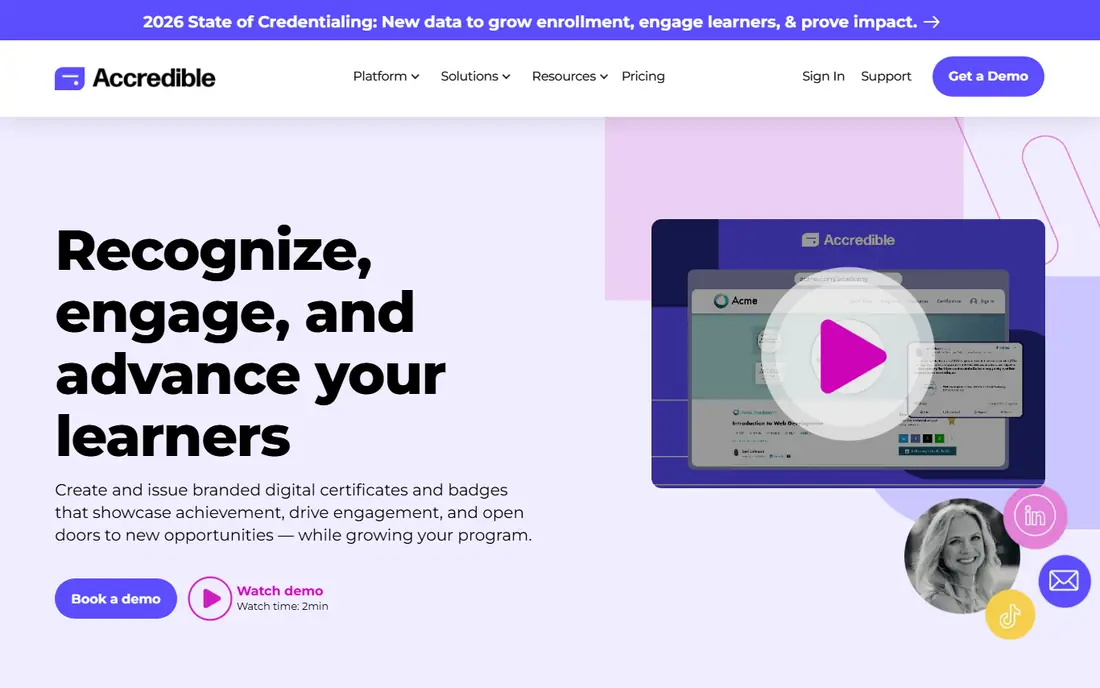
Accredible prices by recipient, not by credential, so one recipient can receive unlimited credentials per year under the plan, which suits a university or training provider that issues several certificates to the same learner over time. The Launch plan starts at $45 per month on a 12-month term billed monthly, with 50 recipients to start, badge and certificate design, blockchain credentials, email support and add-ons. Higher plans add custom branding, pathways, digital wallet cards, insights reporting and dedicated support.
The catch is recipient counting. A program with many one-time recipients will pay more than a program with fewer repeat learners, so model your recipient count for the year, not just your credential count. For education and professional training, Accredible's polished credential pages and learning system links make it a strong default.
- Published pricing from $45 per month for 50 recipients
- Blockchain credentials from the Launch plan
- Canvas, Moodle, Blackboard and Brightspace links
- Pricing is per recipient, not per credential, so a large recipient list costs more
- Advanced branding needs higher plans
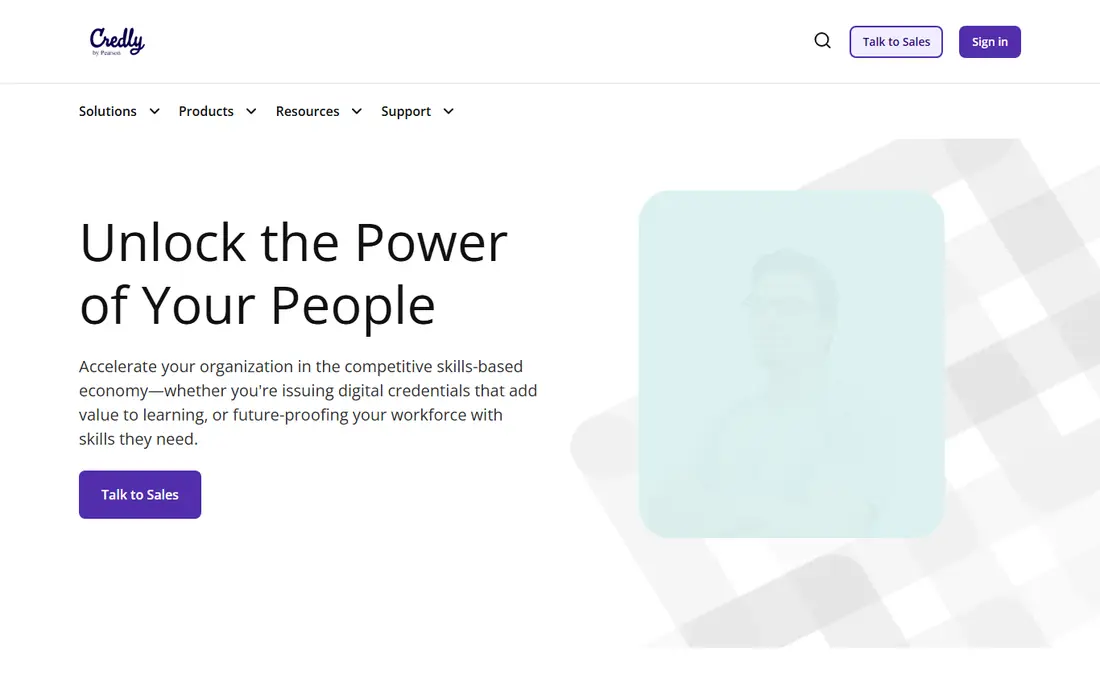
Credly, owned by Pearson, is the best known digital badge platform, and that recognition matters: earners can share badges on LinkedIn and other profiles, employers can verify them, and a badge from a known platform carries weight in hiring. It supports bulk issuing, analytics, learning system links and a REST API, and it suits large enterprise, association and university programs that issue thousands of badges a year.
The limit is cost and access for small issuers. Credly does not publish a simple issuer price list, and public listings describe annual fees in the thousands of dollars for typical badge volumes, with onboarding fees on top, and no meaningful free tier for issuers. Individual earners can accept and share badges at no cost, but an organisation that issues only dozens of badges a year should compare Accredible, Certifier or Badgr first.
- Well known badge marketplace with strong discovery for earners
- Canvas, Moodle and Brightspace links
- REST API and bulk issuing
- Issuer pricing is quoted, with no low volume entry tier in public listings
- No free trial for issuers in many cases

Certifier is the simplest route for a small team that mainly issues certificates and badges for courses, events and training. The free plan covers up to 250 credentials per year, which lets a small program test design, issuing and verification before paying, while Professional at $76 per month billed annually covers 1,000 credentials a year, with Advanced at $399 per month for 5,000 credentials a year in recent listings. Canvas and Moodle links, an API and custom domains on higher plans cover common needs.
The trade-off is volume pricing. Because Certifier prices by credentials issued per year, a program that grows quickly will need to move tiers sooner than a per recipient model such as Accredible might require. For a small to mid-sized program with predictable annual volume, Certifier's clarity and free start make it easy to recommend.
- Free plan capped at 250 credentials per year
- Professional at $76 per month billed annually for 1,000 credentials a year
- Simple design and bulk issuing
- Per credential pricing means high volume costs rise
- Blockchain anchoring is not included in the same way as some rivals
Badgr is an open badges platform used by schools, universities and education programs, with an open source version that an organisation can self-host. That open approach suits an education provider that wants control over data, hosting and Open Badges compliance, and that has technical staff to run the system. Badgr supports badge design, issuing, backpacks for earners, and learning system connections.
The catch is support and pricing clarity. Self-hosting saves licence cost but adds hosting, maintenance and security work, and hosted pricing is less transparent than Accredible or Certifier, so a written quote is needed. A school that wants a managed service with a clear monthly price should compare Accredible or Certifier first, while a technically strong education team may prefer Badgr's openness.
- Open source option for self-hosting
- Open Badges support
- Used by schools and education programs
- Lower cost for education in many listings
- Hosted pricing is less transparent than Accredible or Certifier
- Self-hosting needs technical staff and maintenance
Sertifier prices by person, so a program pays for the number of people it serves, not for each certificate, which suits a training provider that issues several credentials per learner. At $750 per year for 500 people in recent listings, it is affordable for a small to mid-sized program, and it offers badge and certificate design, public verification, expiry handling and learning system links. Optional blockchain backed validation through the Velocity Network is available for programs that need it.
The limit is scale and branding. Per person pricing still rises as the audience grows, and full custom domain branding may need a higher plan or add-on. For a small program that wants a clear annual price and simple issuing, Sertifier is a practical middle option between free tools and enterprise platforms.
- Pricing from $750 per year for 500 people in recent listings
- Canvas, Moodle, Blackboard and Brightspace links
- API plus Zapier links
- Per person pricing can rise with recipient count
- Advanced branding needs an add-on in some cases
POK, formerly Proof of Knowledge, focuses on blockchain verified credentials for universities, training providers and associations that need strong fraud resistance and long term verification. One listing describes Blockchain Verify Basic at $3,000 per year for up to 50,000 credentials, with premium per credential options and no implementation fee, which makes it cost effective at high volume even though the entry price is high for a small program. That volume model suits a large issuer better than a small course provider.
The trade-off is fit. A program that only needs simple certificates with public verification does not need blockchain anchoring, and will get better value from Certifier or Sertifier. Choose POK when verification longevity, fraud resistance and high volume are core requirements, not just nice extras.
- Blockchain verification options from $3,000 per year for up to 50,000 credentials in one listing
- No implementation fee in that listing
- Strong for high volume
- Starting price is high for a small program
- Blockchain focus may be more than a simple certificate program needs
Certopus is a budget friendly certificate and badge tool for small training providers, event organisers and schools that need clean certificates with public verification without enterprise pricing. A free plan lets a team test issuing, while paid plans from $24.99 per month in recent listings add higher volumes, branding and expiry management. For a small program with a tight budget, Certopus is the cheapest credible start in this list.
The limit is ecosystem size. Certopus does not offer the marketplace discovery of Credly, and its analytics and learning system integrations are thinner than Accredible. For a small program that issues certificates directly to known learners, that trade-off is acceptable, but a program that relies on public discovery should consider Credly or Accredible.
- Free plan available
- Paid from $24.99 per month in recent listings
- Digital certificates and badges with public verification and expiry handling
- Smaller vendor with less marketplace discovery than Credly
- Advanced analytics and integrations are thinner
Open Badge Factory is built around the Open Badges standard, which matters for education providers that need badges to work across platforms, backpacks and verifiers. It covers badge design, issuing, verification and sharing, with a free plan for small use and paid plans from about 220 euros per year in recent listings. That standards focus helps when learners need to carry badges between systems over many years.
The catch is scope. Open Badge Factory is badge focused, so a program that mainly issues formal certificates with complex layouts may prefer Certifier or Accredible, which centre certificate design more strongly. For a badge first program that values open standards, Open Badge Factory is a solid choice.
- Free plan available
- Strong Open Badges compliance
- Badge design, issuing and verification for education and training
- Pricing varies by region and plan
- Certificate design is less central than in Certifier or Accredible
How we picked these
We compared vendor pricing pages, feature pages and public reviews, keeping only tools that are actively sold for digital credential issuing and that offer public verification, not just PDF generation. We favoured tools with published pricing, a free plan or trial, learning system links and expiry or revocation handling, and we marked pricing as quoted where a vendor does not publish a price. We did not claim hands-on testing; our notes rest on published features, prices and user feedback.
How to choose a credential platform
A credential is only useful if an employer or another institution can verify it years later, so verification, standards and data export matter more than template style. Trial issuing with a real cohort before a full launch.
Check verification, expiry and revocation
Confirm that each credential has a public verification page, that expiry dates and revocation work as expected, and that verification does not depend on the earner keeping an account active. Ask what happens to verification if you leave the vendor, and whether credentials follow the Open Badges standard for portability.
Model pricing on recipients and volume
Vendors price in three different ways: per recipient (Accredible, Sertifier), per credential per year (Certifier), and quoted annual fees (Credly). Model your cost at your actual recipient count and credential volume for the next 12 months, including onboarding fees, before comparing headline prices.
Test learning system links and bulk issuing
Connect your learning system, whether Canvas, Moodle, Blackboard or Brightspace, and test bulk issuing for a full cohort, including name data, dates and custom fields. Check analytics for views, shares and verification checks, since those numbers show whether credentials are actually being used by earners and employers.
FAQ
What is the best digital credential management software for a university?
Accredible is a strong university pick, with per recipient pricing from $45 per month, blockchain credentials, pathways and learning system links for Canvas, Moodle, Blackboard and Brightspace. Credly suits a very large university that values marketplace discovery, while Badgr suits a university with technical staff that wants open source control.
How much does digital credential software cost?
Recent prices include Certopus from $24.99 per month, Accredible from $45 per month for 50 recipients, Certifier Professional $76 per month for 1,000 credentials a year, Sertifier $750 per year for 500 people, and POK $3,000 per year for up to 50,000 credentials in one listing. Credly and some enterprise plans use quoted annual pricing, often in the thousands of dollars.
What is the difference between a digital badge and a digital certificate?
A digital badge is usually a visual, shareable credential for a skill or achievement, often following the Open Badges standard, while a digital certificate is a formal document style credential for course completion or qualification. Many platforms in this list issue both, with badges suited to sharing on professional profiles and certificates suited to formal records.
Can employers verify a digital credential?
Yes, when the platform offers public verification. An employer can open the credential link, check the issuer, recipient, issue date, expiry and revocation status, and confirm that the credential is genuine without contacting the issuer. Blockchain anchored credentials add an extra verification layer, but a clear public verification page is the essential feature.
Do I need blockchain for digital credentials?
Not always. Blockchain anchoring helps when long term, tamper evident verification is a core requirement, such as for diplomas or professional licences. For most course certificates and training badges, standard public verification with expiry and revocation handling is enough, and blockchain adds cost and complexity without a clear benefit.
Which credential tool works with Canvas and Moodle?
Accredible, Credly, Certifier and Sertifier all list Canvas and Moodle links, with Accredible and Sertifier also listing Blackboard and Brightspace. Confirm the exact integration for your learning system version before buying, and test bulk issuing from your course roster during the trial.