Best Data Management Software in 2026: 8 Tools Compared
Compare 8 best data management software tools for integration, quality, and governance in 2026. We review pricing and which platform fits your team best.
- Editor's choice
 Informatica
Enterprise data integration and governance
Starts atSee websiteVisit informatica.comFull review - Great alternative
 Talend
Data integration and quality pipelines
Starts atSee websiteVisit talend.comFull review - Also consider
 Alation
Data discovery and catalog
Starts atSee websiteVisit alation.comFull review
TL;DR:
- Data management covers integration, quality, cataloging, and governance, and no single tool does all four equally well.
- Informatica and Talend are strongest for integration and pipelines, while Alation and Collibra are strongest for catalog and governance.
- Ataccama suits teams that need quality and governance together, and Microsoft Purview suits Microsoft-centered estates.
- Denodo helps teams query data where it sits, and Fivetran helps teams move data into a warehouse with less manual work.
- Start with one clear problem, such as messy customer data or unclear ownership, and pick the tool that solves that problem first.
Quick comparison
| Tool | Best for | Starts at | Free plan? | |
|---|---|---|---|---|
| Informatica | Enterprise data integration and governance | See website | Free trial | Visit |
| Talend | Data integration and quality pipelines | See website | Free trial | Visit |
| Alation | Data discovery and catalog | See website | No | Visit |
 Collibra | Enterprise data governance | See website | No | Visit |
 Ataccama | Data quality and governance combined | See website | No | Visit |
 Microsoft Purview | Governance in Microsoft estates | See website | Free trial | Visit |
 Denodo | Data virtualization and access | See website | Free trial | Visit |
 Fivetran | Automated data movement to warehouses | See website | Free trial | Visit |
The best data management software
We compared platforms that help teams collect, clean, organize, and govern data, and we kept only tools with broad connector ranges and active enterprise use in 2026.
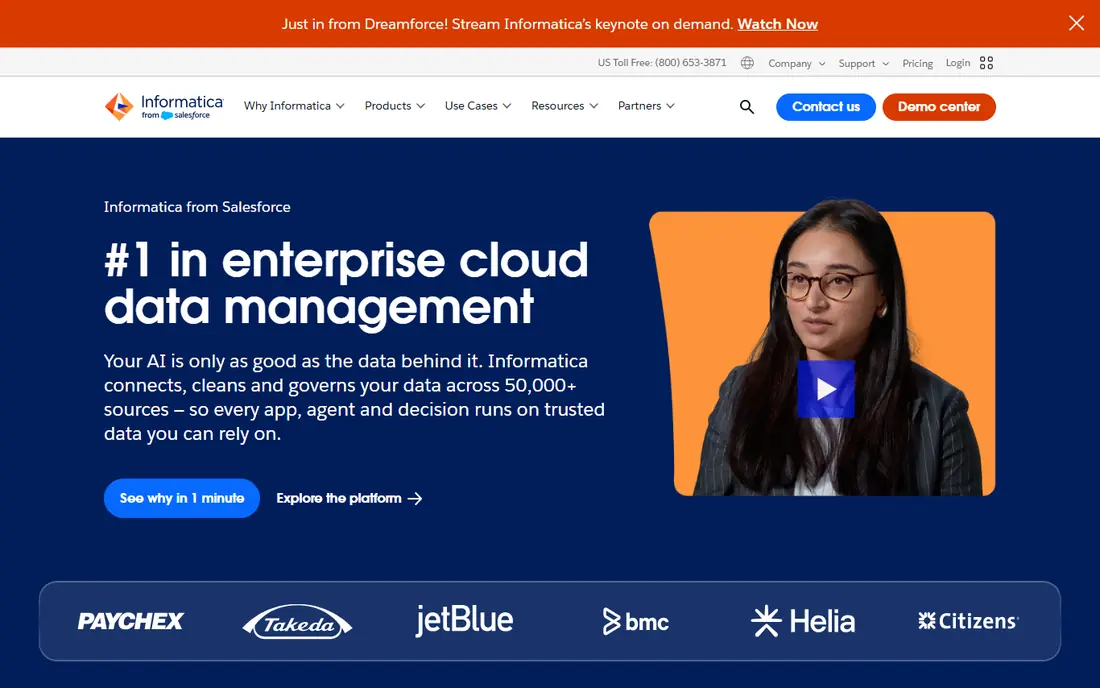
Informatica is a broad platform for large firms with data spread across cloud apps, databases, and local systems. Its integration tools move and transform data, its quality tools profile and clean it, and its catalog and governance tools help teams find data and track ownership. That breadth suits firms that want one vendor for several data management jobs rather than stitching together many point tools.
Breadth brings complexity. Implementation often needs data engineers and a clear plan for sources, owners, and rules, and pricing depends on usage, connectors, and services in the contract. Small teams will likely find it more than they need. For large, multi-cloud estates with strict governance needs, Informatica is a strong, proven choice.
- Very broad connector and integration range
- Strong governance and catalog features
- Cloud and hybrid deployment options
- Complex setup for large estates
- Pricing and licensing need careful scoping
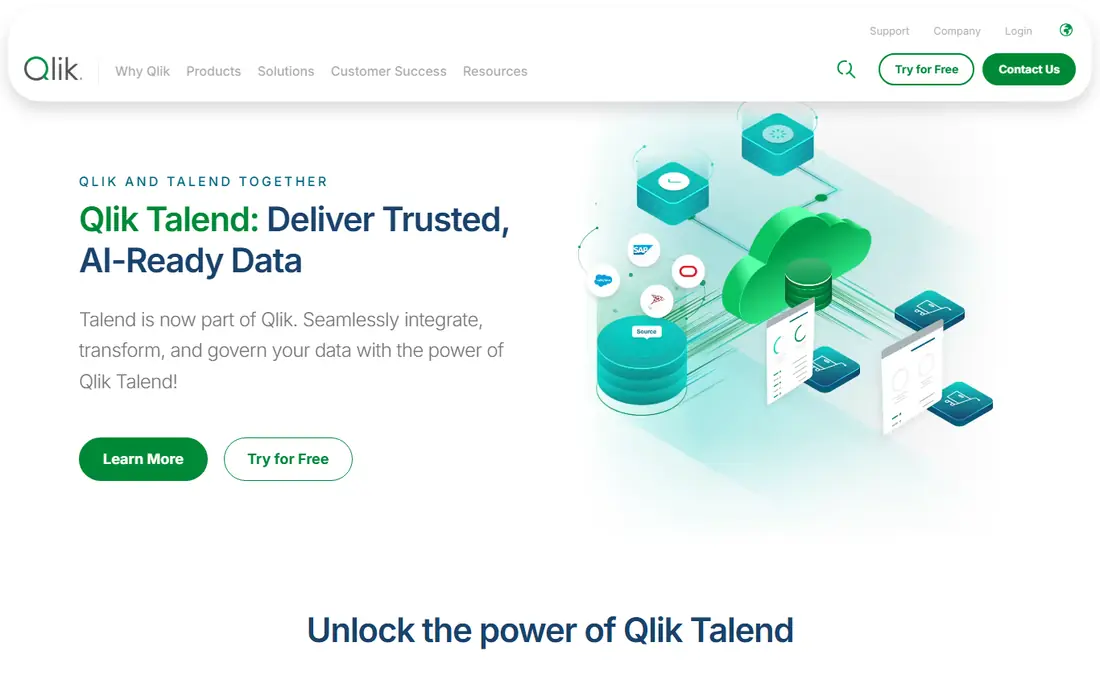
Talend suits data teams that build integration pipelines every day. A visual builder lets engineers design jobs that pull data from apps and databases, clean and transform it, and load it into a warehouse or lake. Built-in profiling helps teams spot missing values, duplicates, and format problems before bad data reaches reports. That mix of integration and quality in one tool saves time for mid-size and large teams.
Complex pipelines still need skill. Error handling, scheduling, and performance tuning take practice, and teams should plan testing for each job. Talend also has roots in open-source tools, but current enterprise plans are commercial, so check what the trial and paid plans include. For teams that need reliable, repeatable pipelines, Talend is a practical pick.
- Visual pipeline builder for integration jobs
- Data quality and profiling tools
- Broad source and target support
- Learning curve for complex pipelines
- Enterprise pricing needs a sales discussion

Alation helps people find data they can trust. It catalogs tables, reports, and dashboards, shows lineage and usage, and lets analysts add notes, warnings, and ratings. That social layer matters, because a catalog that only lists tables is less useful than one that shows which tables people actually use and which ones have known issues. Search is fast, and the interface suits business analysts as well as engineers.
The main risk is adoption. A catalog only helps if teams keep metadata current and use it as their first stop for data questions. Pricing is also enterprise-level, with no public free plan, so smaller teams should test the business case carefully. For firms where analysts waste time hunting for data or guessing which table is correct, Alation is a strong investment.
- Strong search and discovery for data assets
- Usage-based trust signals
- Collaboration for analysts and stewards
- No public free plan
- Value depends on good metadata and adoption by analysts
Collibra is built for formal governance. It lets firms define data owners, stewards, policies, and business terms, then link those definitions to technical assets and lineage. Workflows route approvals and issues to the right people, and reporting helps compliance teams show how rules are applied. That structure suits banks, insurers, healthcare firms, and other regulated teams.
It is not a quick install-and-go tool. Governance needs agreed terms, owners, and processes before the software can enforce them, and firms without that maturity may struggle to get value. Pricing is also aimed at large firms. For teams that must prove control over data to auditors and regulators, Collibra is one of the strongest options in this list.
- Formal governance, policy, and stewardship workflows
- Clear data ownership and lineage
- Strong compliance support
- Implementation takes time and governance maturity
- Pricing is enterprise-level
Ataccama combines data quality with catalog and governance, which suits teams tired of using separate tools for each job. Profiling shows where data is broken, rules clean and validate it, and catalog features help teams find and understand the corrected data. Master data features also help firms build a single, trusted view of customers, products, or suppliers across systems.
As with other quality tools, results depend on rules. Teams must decide what counts as valid, complete, and duplicate data, and that work takes time and business input. Pricing is enterprise-level, so it fits mid-size and large firms better than small teams. For firms where bad data causes reporting errors or customer complaints, Ataccama offers a useful combined approach.
- Data quality, catalog, and governance in one platform
- Profiling and rule-based cleansing
- Good for master data work
- Setup needs data quality rules defined up front
- Enterprise pricing
Microsoft Purview suits firms that already run on Microsoft tools. It maps data across Microsoft 365, Azure, and Fabric, catalogs assets, tracks lineage, and links to compliance and risk tools that many Microsoft admins already use. That native fit reduces integration work and keeps governance close to where data already lives.
Outside Microsoft systems, coverage is thinner, and firms with large non-Microsoft estates may need another catalog or governance tool alongside it. Features also vary by licence, so teams should check which Purview services their current plan includes. For Microsoft-centered firms that want governance without adding a wholly separate platform, Purview is a sensible first choice.
- Native links to Microsoft 365, Azure, and Fabric
- Data map, catalog, and compliance tools
- Familiar admin model for Microsoft shops
- Less complete outside Microsoft systems
- Feature set varies by licence and service
Denodo takes a different approach to data management. Instead of moving all data into one warehouse first, it creates a virtual layer that lets analysts query data where it sits, across databases, cloud apps, and files. That can speed up access, reduce duplication, and help teams that cannot or do not want to copy sensitive data into a central store. A single access layer also helps with security and governance rules.
Performance is the key risk. Slow source systems, complex joins, and large queries can affect report speed, so modelling and caching need care. Denodo also works best as part of a wider data setup, alongside a warehouse or lake for heavy analytics. For firms with scattered data that need fast, governed access, it is a strong and distinct option.
- Query data across sources without moving it first
- Single access layer for reports
- Good for hybrid and multi-cloud data
- Performance depends on source systems
- Needs careful modelling for complex queries
Fivetran suits teams that want data in a warehouse without building and maintaining every pipeline by hand. Prebuilt connectors sync data from common apps, databases, and events, handle schema changes, and keep data fresh on a schedule. That automation saves engineering time, especially for small data teams that need reliable reporting data but cannot staff a large pipeline team.
Control is more limited than a custom pipeline tool, and pricing scales with usage, so teams with very large or fast-changing data should model costs carefully. Transformations after loading are also handled in a separate tool in many setups. For standard reporting pipelines from common sources, Fivetran is a low-maintenance, reliable choice.
- Many prebuilt connectors for apps and databases
- Automated schema changes and sync
- Low maintenance for common pipelines
- Less control than hand-built pipelines
- Usage-based pricing can rise with data volume
How we picked these
We compared official feature pages, pricing pages, and public docs for each platform, and we checked connector ranges, governance features, quality tools, and deployment options. We also looked at public reviews and analyst-style comparisons for common issues with setup, adoption, and pricing. We did not claim hands-on lab testing, and we treated pricing as a starting point only, since enterprise contracts vary by usage, users, and services.
How to choose data management software
Start with the problem that hurts most. Is data hard to find, hard to trust, hard to move, or hard to govern? Each answer points to a different tool type. Discovery problems point to a catalog like Alation. Trust problems point to quality tools like Ataccama or Talend. Movement problems point to Fivetran or Talend. Governance problems point to Collibra or Microsoft Purview. A clear problem keeps the shortlist short.
Map sources, owners, and rules before you buy
List your main data sources, who owns each one, and what rules apply to sensitive data. That map shows whether you need broad connectors, formal stewardship, or both. It also reveals gaps, such as sources with no owner or rules that no one enforces. A tool cannot fix missing ownership on its own, so agree owners and basic rules during the trial, not after purchase.
Run a pilot on real data
Test the shortlist with two or three real sources and a real reporting question. Check how long setup takes, whether lineage looks correct, and whether analysts can find and trust the data without help. Watch for hidden work, such as manual metadata entry or pipeline fixes, and ask what happens when a source schema changes. A pilot on real data reveals total effort far better than a demo.
Plan for adoption and upkeep
Data tools fail when only the data team uses them. Plan training for analysts, a simple process for reporting bad data, and regular reviews of owners and rules. Assign someone to maintain the catalog, pipelines, or governance workflows after launch, even if it is part-time. A smaller tool that people actually use will beat a larger platform that sits unused.
FAQ
What is the best data management platform for small teams?
Small teams should start with a focused tool, not a full enterprise suite. Fivetran suits small teams that need reliable data movement, and Talend suits teams that need pipelines with quality checks. A full governance suite like Collibra is usually more than a small team needs at first. Pick the tool that solves your main problem, and add governance features as the team grows.
What are the best data management tools for data quality?
Ataccama and Talend are strong for profiling, cleansing, and rule-based quality checks. Informatica also offers quality tools as part of its broader platform. The best choice depends on whether quality is your main job or one part of a wider integration and governance project. In either case, agree quality rules with business owners before you buy.
How is data management software different from a data warehouse?
A warehouse stores data for analysis, while data management software helps you move, clean, catalog, and govern that data. Many teams use both, with tools like Fivetran moving data into a warehouse, and tools like Alation or Collibra helping people find and trust it. A warehouse alone does not fix messy, undocumented, or ungoverned data.
Do I need data governance software?
You need some form of governance if you handle sensitive data, report to regulators, or struggle with unclear ownership. Formal software like Collibra or Microsoft Purview helps at scale, but small teams can start with agreed owners, terms, and access rules in a catalog. Buy formal governance software when manual processes can no longer keep up with data growth or compliance needs.
What is the best software for data management in Microsoft environments?
Microsoft Purview is the natural pick for Microsoft-centered estates, thanks to its links to Microsoft 365, Azure, and Fabric. It covers mapping, cataloging, and compliance in one family of services. Firms with large non-Microsoft data may still need a second catalog or integration tool, but Purview is a good starting point for Microsoft shops.
How much does data management software cost?
Most enterprise tools in this list use custom or usage-based pricing, so check the vendor pricing page and ask for a quote based on your sources, users, and data volume. Fivetran and similar tools often charge by usage, while governance suites often charge by users and services. Run a pilot first, and model total cost over a year, including implementation and upkeep, not just the licence fee.