Data Management Software for Analytics in 2026: The 6 Best Options Side by Side
Weighing the best data management software for analytics? We lined up 6 products by cost, free access and fit. Real limits included. Straight answers.
- Editor's choice
 dbt
Steady, governed data pipelines
Starts at$100 per user per monthVisit getdbt.comFull review - Great alternative
 Amazon Redshift
Managed cloud data warehousing on AWS
Starts atSee websiteVisit aws.amazon.comFull review - Also considerMicrosoft Azure Synapse Analytics
Enterprise SQL warehousing plus big data
Starts atSee websiteVisit azure.microsoft.comFull review
Direct answer
If you need dependable, governed data pipelines, dbt is the first tool to look at here. Listed starting prices: dbt from $100 per user per month and Fivetran from $12,000. Look at Amazon Redshift for managed cloud data warehousing on AWS, and at Microsoft Azure Synapse Analytics for enterprise SQL warehousing plus big data. The other 3 tools in the list cover narrower or pricier cases.
TL;DR:
- This list starts with dbt, which is built for dependable, governed data pipelines.
- Dbt is the lowest-priced starter here at $100 per user per month.
- The main caution on Amazon Redshift: warehouse scope, not full data product.
- For unified data, analytics and AI work, Databricks is worth a look.
Last checked November 2026. Prices and plan details were read from the vendors' own pages in November 2026; vendors change plans often, so confirm the current price on the vendor site before you buy.
Quick comparison
| Tool | Best for | Starts at | Free plan? | |
|---|---|---|---|---|
| dbt | Steady, governed data pipelines | $100 per user per month | Free trial | Visit |
| Amazon Redshift | Managed cloud data warehousing on AWS | See website | Not stated | Visit |
| Microsoft Azure Synapse Analytics | Enterprise SQL warehousing plus big data | See website | Not stated | Visit |
 Google BigQuery | Autonomous, serverless analytics | See website | Not stated | Visit |
 Fivetran | Automatic data movement and centralization | $12,000 | Yes | Visit |
 Databricks | Unified data, analytics and AI work | See website | Not stated | Visit |
6 data management software for analytics in detail
If you are comparing data management software for analytics, this page covers 6 tools in one place: what each is best for, what it costs to start, whether it has a free plan, and the main limit to know about.
Choose dbt for steady, governed data pipelines. dbt, from dbt Labs, is positioned around enabling data teams to build steady, governed data pipelines so analytics and AI initiatives move with speed and confidence.
Downsides: Transformation layer, not a warehouse.
It works at the transformation and modeling layer instead of storing data itself. Price to start with dbt: $100 per user per month. Free access: Free trial.
- Focus on pipeline reliability
- Supports analytics and AI initiatives
- Needs an existing data system
Amazon Redshift targets managed cloud data warehousing on AWS. Amazon Redshift is a quick, completely managed cloud data warehouse that the vendor says makes it straightforward and economical to analyze all your data.
Drawbacks to consider: Warehouse scope.
It suits teams that primarily need a dependable place to store and query analytical data, particularly those already running workloads on AWS. No starting price is listed for Amazon Redshift here; confirm pricing on the vendor site. Free access: Not stated.
- Built to analyze all your data
- Positioned as straightforward and economical
- Not full data product
Microsoft Azure Synapse Analytics
Best for: Enterprise SQL warehousing plus big data
Microsoft Azure Synapse Analytics was built for enterprise SQL warehousing plus big data. It suits bigger organizations that already run Microsoft data estates and want warehouse and big data analysis handled together instead of through separate services.
What to check first: Wide service that needs planning.
- Merges SQL warehousing and big data
- Aims to accelerate time to insight
- Most natural within the Azure ecosystem
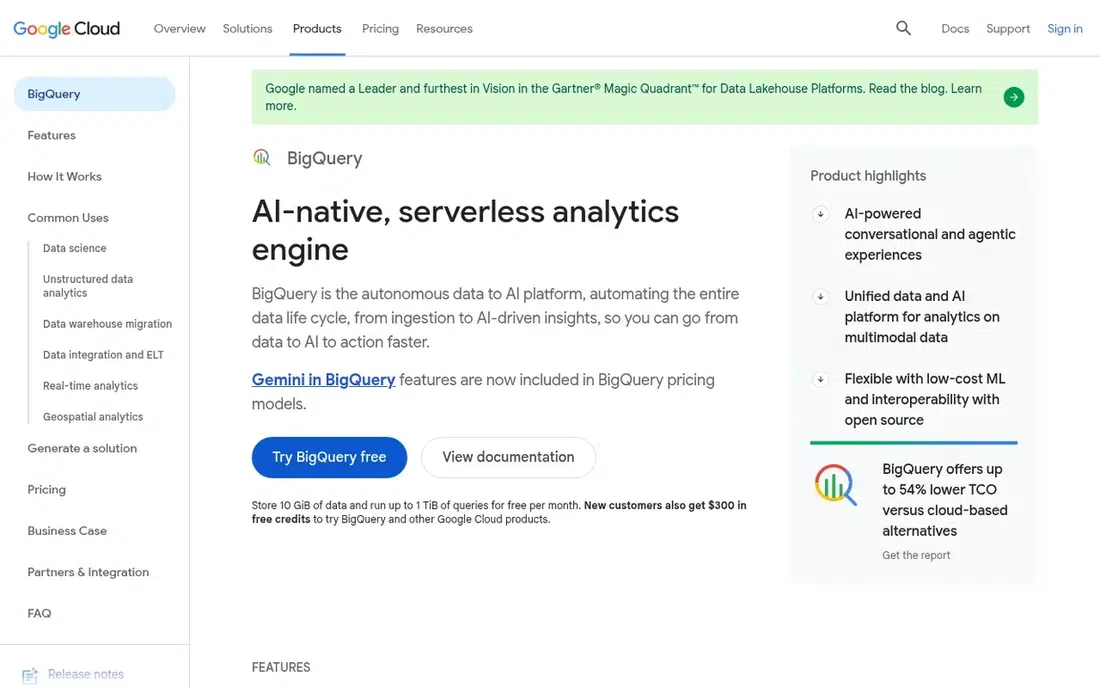
For autonomous, serverless analytics, Google BigQuery is a natural candidate. The vendor frames it as both an analytics and an enterprise data warehouse.
BigQuery is most natural for organizations already invested in Google Cloud, and teams committed to another cloud may prefer that provider's warehouse. Its automation cuts tuning work but can limit fine-grained control that some specialized workloads expect, so confirm fit before standardizing. Google BigQuery shows no starting price here, so confirm the cost on the vendor site. On free options: Not stated.
Watch-outs: Less suited to multi-cloud warehouse needs.
- Positions data to AI to action
- Automates the data life cycle
- Deepest value inside Google Cloud
In short, Fivetran is for automatic data movement and centralization. Fivetran describes itself as an automatic data movement system, built to easily centralize the data a team needs so insights arrive quicker.
What to check first: Centred on movement, not analysis.
It suits teams that want connectors and pipelines maintained for them instead of building and babysitting custom ingestion code. The starting price for Fivetran: $12,000. Free access exists with Fivetran.
- Centralizes data for quicker insight
- Automatic data movement system
- Needs a destination warehouse to be handy
Databricks works best for unified data, analytics and AI work. Databricks presents itself as a unified product for data, analytics and AI, built around a data-centric approach.
Its documented scope comes with simplifying ETL, data warehousing, governance and AI work on what the vendor calls the Data + AI Platform. Also, the breadth that makes Databricks attractive can also make it heavier to set up than a focused warehouse or pipeline tool. No starting price is listed for Databricks here; confirm pricing on the vendor site. Trial and free access: Not stated.
Honest limits: Wide scope can be complex to adopt.
- Warehousing and governance
- Covers ETL
- Overlaps with narrower warehouse tools
How the list was put together
Each tool was reviewed on what its vendor publishes: price, plan limits, core features and stated drawbacks. We did not run hands-on tests. Treat prices as a snapshot: vendors change plans often, so check the vendor site for the figure that applies today. Tools are placed by general fit for data management software for analytics, with price clarity and free access as tie-breakers. A different team can reasonably rank them differently.
What to check before you buy
- Ask Amazon Redshift, Microsoft Azure Synapse Analytics, Google BigQuery and Databricks for a written quote, since no starting price is shown.
- Test the free plan from Fivetran against your real workload before relying on it.
- Run a trial of dbt with real work before paying for a year; your own workflow is the best test.
- Before choosing dbt, weigh its main limit: transformation layer, not a warehouse.
- Price dbt for your actual team size; headline prices rarely include add-ons or overage.
- Check how data leaves Microsoft Azure Synapse Analytics: formats, limits and whether exports are available on every plan.
FAQ
How are the tools for data management software for analytics ordered?
The order follows typical fit for data management software for analytics, with dbt first and Databricks last, then price clarity and free access. It is editorial judgement, not a score, so another team could rank the tools differently.
Which tool is best for a small analytics team?
Start with dbt if you need reliable, governed data pipelines. Amazon Redshift is the better match for managed cloud data warehousing on AWS, and Microsoft Azure Synapse Analytics for enterprise SQL warehousing plus big data. The best choice depends on budget, team size and workflow.
Can I try these tools before paying?
Often, yes. Fivetran has a free plan and dbt offers a free trial. Use your own data and a real task during the test, and check what the free tier or trial limits before you rely on it.
How does dbt differ from a data warehouse?
dbt works at the transformation and modeling layer, helping teams build dependable, governed pipelines that feed analytics. Worth adding: warehouses deal with storage and query performance; dbt takes care of how data is shaped.
Do I need both a warehouse and a pipeline tool?
Frequently yes. Some products, including Databricks and Synapse, bundle more of these layers, which can cut the number of separate products you run.
Do these tools publish their prices?
Not all of them. Amazon Redshift, Microsoft Azure Synapse Analytics, Google BigQuery and Databricks publish no starting price, so expect a quote request for those. The rest, dbt included, show a starting price, though seats and billing terms still change the final cost.
Sources
- https://www.getdbt.com
- https://aws.amazon.com/redshift
- https://azure.microsoft.com/en-us/products/synapse-analytics
- https://cloud.google.com/bigquery
- https://www.fivetran.com
- https://www.databricks.com