Best Data Discovery Software in 2026: 9 Tools Compared
Compare the best data discovery software in 2026, with data catalogs, lineage, glossaries, and search tools that help teams find trusted data much faster.
- Editor's choice
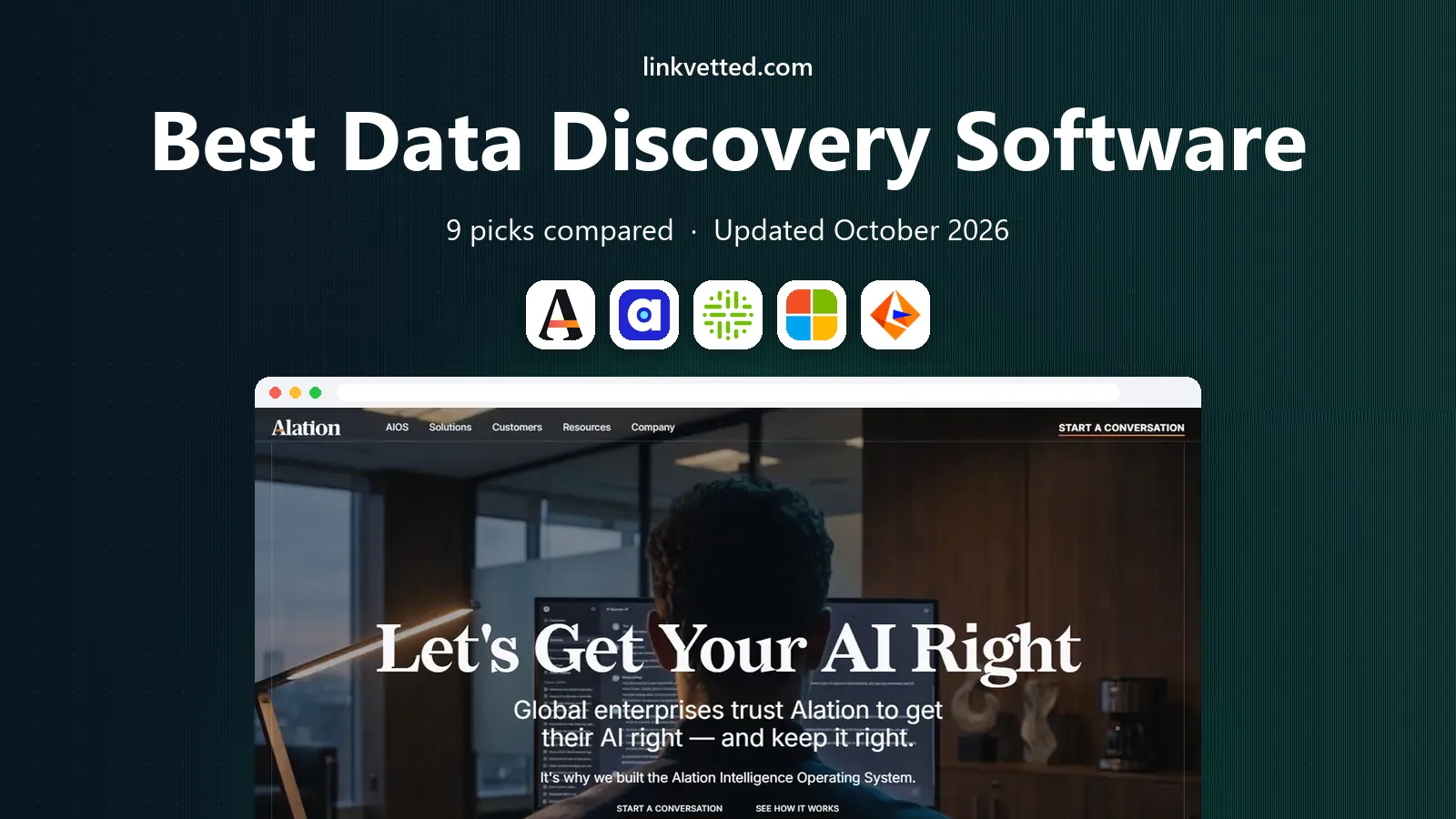
 Alation
Enterprise discovery with high analyst adoption
Starts atSee websiteVisit alation.comFull review - Great alternative
 Atlan
Cloud-native data teams
Starts atSee websiteVisit atlan.comFull review - Also consider
 Collibra
Regulated enterprises needing formal governance
Starts atSee websiteVisit collibra.comFull review
TL;DR:
- Data discovery software helps analysts find, understand, and trust data across warehouses, databases, and business tools, instead of asking around for the right table.
- The best data discovery platforms combine search, lineage, a business glossary, and data quality signals in one place.
- Enterprise tools such as Alation and Collibra are powerful but quote only, while Secoda and open source options suit smaller teams and budgets.
- OpenMetadata and DataHub can work well for engineering-led teams, but they need internal effort to run and maintain.
- Our pick for most mid-size teams is Atlan for its modern interface, with Alation as the strong enterprise alternative.
Quick comparison
| Tool | Best for | Starts at | Free plan? | |
|---|---|---|---|---|
| Alation | Enterprise discovery with high analyst adoption | See website | No | Visit |
| Atlan | Cloud-native data teams | See website | Free trial | Visit |
| Collibra | Regulated enterprises needing formal governance | See website | No | Visit |
 Microsoft Purview | Microsoft and Azure environments | See website | Free trial | Visit |
 Informatica Cloud Data Governance and Catalog | Large enterprises already using Informatica | See website | No | Visit |
 data.world | Knowledge graph based catalogs | See website | Free trial | Visit |
 Secoda | Mid-size teams wanting fast time to value | $800 per month | Yes | Visit |
 DataHub | Engineering teams wanting open source discovery | Free | Yes | Visit |
 OpenMetadata | Open source metadata and data contracts | Free | Yes | Visit |
The best data discovery software
These tools differ in price and depth, but they share one goal: making trusted data easy to find. The right choice depends on your stack, your governance needs, and how much admin effort you can spare.

Alation is built around a simple idea: a catalog only helps if people open it. Its search, behavioral signals, and in-tool collaboration make it easy for analysts to find a table, see who uses it, and ask questions in context. Column-level lineage, built from query logs, helps teams trace a dashboard metric back to its source without a long investigation.
The trade-off is enterprise pricing and effort. Alation does not publish list pricing, and first-year costs can run well into six figures once services and add-ons are included. For large analytics-driven companies, that cost can be justified by adoption. Smaller teams should look at Secoda or an open source option first.
- Search-first design analysts actually use
- Column-level lineage
- Business glossary and collaboration
- Quote-only pricing
- Implementation and add-ons add to total cost
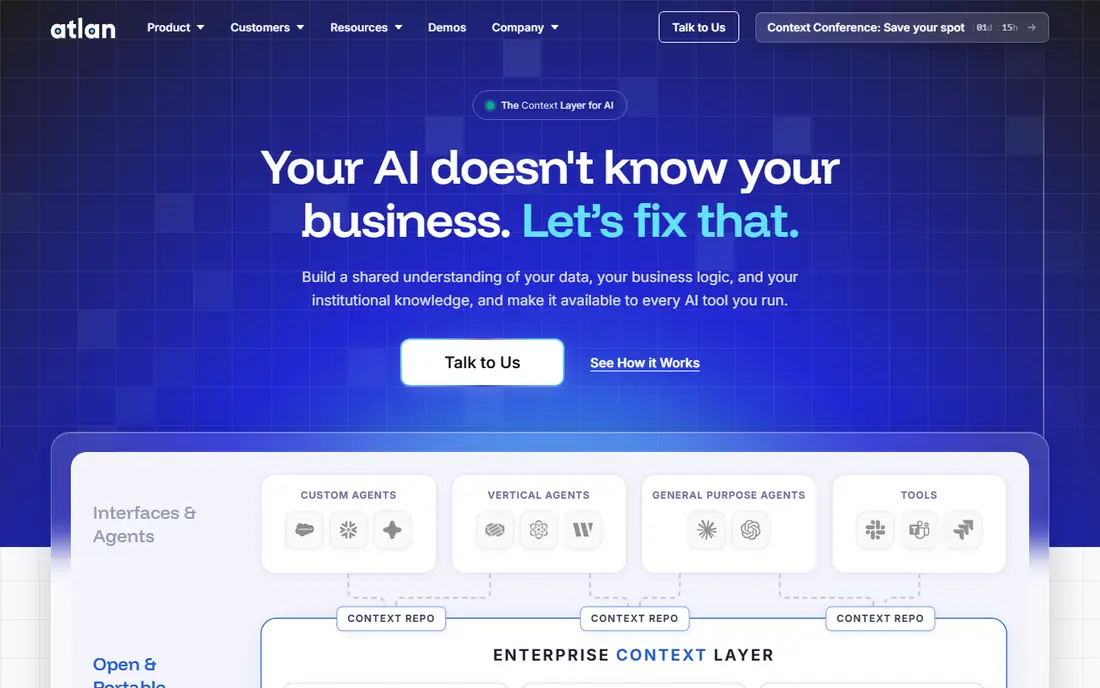
Atlan is our pick for most cloud data teams because it feels built for the modern stack. It connects to warehouses, lakes, BI tools, and transformation tools, then builds a living map of data assets with lineage, ownership, and quality signals. Its interface is closer to a consumer product than a legacy catalog, which helps adoption among analysts and engineers alike.
Atlan does not publish pricing, and costs scale with users and sources, so get a written quote for your actual footprint. It also leans more toward discovery and collaboration than the formal policy workflows some regulators demand. For most mid-size and growing teams, that balance is right.
- Modern interface
- Active metadata automation
- Strong dbt and warehouse integrations
- Quote-only pricing
- Governance depth is lighter than Collibra in some regulated cases
Collibra is the governance-first choice. It offers structured stewardship, approval chains, policy enforcement, and audit trails that banks, insurers, health care firms, and government teams often need. Its data quality module and hierarchical business glossary make it a full governance platform, not just a search tool.
That depth comes with cost and time. Collibra sits at the top of the market on price, and implementation is a serious project rather than a quick setup. If your priority is fast analyst adoption on a modest budget, Alation or Atlan will fit better. If regulators and auditors will read your governance records, Collibra is hard to beat.
- Deepest stewardship workflows
- Policy and audit trails
- Native data quality module
- Highest prices in this group
- Longer implementation, often six to twelve months
Microsoft Purview suits teams that already live in Azure, Microsoft 365, and Power BI. It scans Azure data sources, maps lineage, and ties catalog entries to compliance and data protection controls in the same Microsoft ecosystem. That native fit reduces connector work and keeps access controls consistent.
Outside the Microsoft stack, Purview loses some of its edge, and pricing is usage based, so costs depend on assets scanned and processing used. Teams with mixed clouds should compare it closely with Atlan or Alation. Microsoft-heavy teams, though, will find Purview the most natural and often the most affordable path.
- Native Azure and Microsoft 365 integration
- Unified catalog and governance
- Usage-based pricing
- Best value only inside the Microsoft stack
- Setup can be complex for mixed estates
Informatica Cloud Data Governance and Catalog
Best for: Large enterprises already using Informatica
Informatica brings decades of data integration experience to discovery, with a wide connector set and lineage that spans complex pipelines. For companies already running Informatica for integration or data quality, adding its catalog keeps lineage and governance in one vendor relationship. It handles scale well, which matters for global enterprises with many sources.
Pricing uses a consumption model, so forecasting costs takes careful scoping of usage. It is also more platform than a small team needs. If Informatica is already central to your stack, it is a strong pick. If not, a lighter catalog will get you value faster.
- Broad connector library
- Strong lineage and quality features
- Enterprise scale
- Consumption-based pricing is hard to predict
- Heavyweight for small teams
data.world uses a knowledge graph under the hood, which helps connect datasets, terms, and business concepts in ways a flat list cannot. That model suits teams that want to ask how data, metrics, and definitions relate, not just where a table lives. Its AI assistant can help analysts explore that graph in plain language.
The ecosystem is smaller than the biggest vendors, so check connectors for your specific sources before committing. Pricing is also quoted for enterprise use. For mid-size teams that like the graph approach and want something between a lightweight tool and a legacy platform, data.world is worth a trial.
- Knowledge graph model links data and concepts well
- AI assistant features
- Good mid-size fit
- Smaller ecosystem than Alation or Collibra
- Enterprise pricing still quoted
Secoda is the most approachable paid option on this list for mid-size teams. It offers AI-assisted search, automated documentation help, and lightweight governance at a published starting price, with a free tier to try first. Deployment is faster than the enterprise platforms, which matters when a small data team cannot spare months for implementation.
The trade-off is depth. Secoda will not match Collibra on formal stewardship or Alation on scale in the largest estates. For teams of tens to low hundreds of data users who mainly need to find trusted data quickly, that trade is often worth making.
- Published pricing
- AI-assisted search
- Lightweight governance
- Fast deployment
- Fewer enterprise governance features
- Less suited to very large regulated estates
DataHub, originally built at LinkedIn and now maintained as an open source project with a managed cloud option, gives engineering teams a capable catalog without license fees for the core. It ingests metadata from many sources, shows lineage, and supports search and ownership. Teams with platform skills can shape it to their stack.
The cost is effort, not licenses. Self-hosting, upgrades, and connector maintenance fall on your team unless you pay for managed cloud. For engineering-led companies that want control and can staff the platform, DataHub is excellent value. For teams without that capacity, a managed product will be cheaper in practice.
- Free open source core
- Managed cloud option
- Broad ingestion framework
- Needs engineering time to run
- Support depends on plan or community
OpenMetadata is another strong open source choice, with a unified metadata graph, data profiling, quality checks, and growing support for data contracts. It suits teams that want to own their metadata platform and build governance around open standards. The community and managed vendors around it have grown steadily.
As with DataHub, the real cost is people time. Hosting, upgrades, and support need a plan, and feature depth varies by connector. If your team has platform capacity and values openness, OpenMetadata is a credible alternative to paid catalogs. If not, start with Secoda or a trial of Atlan.
- Free under an open license
- Unified metadata graph
- Data quality and profiler features
- Needs internal hosting and maintenance
- Managed offerings are quoted
How we picked these
We compared official product pages, pricing disclosures, and independent 2026 catalog comparisons for tools that cover search, lineage, glossary, and governance. We favored tools with real deployments, a clear discovery use case, and coverage of the main stacks, from cloud warehouses to Microsoft and open source. We did not claim hands-on testing. Where vendors do not publish prices, we say so plainly instead of repeating unverified estimates as fact.
What to check before you buy
Start with your top sources and your top questions. List the warehouses, databases, and BI tools that hold your most-used data, then test search and lineage on those sources during a trial. A catalog that covers only half your stack will leave analysts guessing, no matter how polished its interface looks.
Next, check ownership, glossary, and quality signals. Can a data owner be named for each asset, can business terms be defined once and reused, and can users see freshness or quality warnings before they build on a table. Those three features separate a useful discovery tool from a simple inventory list. Finally, scope total cost honestly, including implementation, connectors, and the staff time to keep metadata current.
Open source versus paid
Open source tools save license fees but cost engineering time, while paid tools cost more up front but ship support, hosting, and faster onboarding. Choose open source when you have platform staff and want control. Choose paid when time to value and vendor support matter more than license savings.
FAQ
What is the best data discovery tool?
Atlan is our pick for most cloud data teams, thanks to its modern interface and active metadata. Alation suits larger enterprises that prioritize analyst adoption, while Collibra suits regulated firms that need formal governance. Smaller teams often do best with Secoda or an open source tool.
What are the best data discovery platforms for small teams?
Secoda, DataHub, and OpenMetadata are the strongest small-team options. Secoda offers managed hosting and published pricing, while DataHub and OpenMetadata are free to run if you have engineering capacity. All three cover search and lineage for common warehouse stacks.
How much does data discovery software cost?
Costs range from free open source to six-figure enterprise contracts. Secoda starts near $800 per month, while Alation, Atlan, Collibra, and data.world are quote only and scale with users and sources. Microsoft Purview and Informatica use usage-based pricing, so ask for a scoped estimate.
What is the difference between a data catalog and data discovery software?
A data catalog is the inventory and metadata store, while data discovery is the act of finding and understanding data inside it. In practice, most modern tools combine both, pairing a catalog with search, lineage, collaboration, and quality signals so users can trust what they find.
Do I need data governance to use a discovery tool?
No, you can start with search and lineage alone and add governance as your team grows. Naming owners, defining key terms, and flagging quality issues early will still help, even without formal approval workflows. Regulated teams should plan governance from the start, since retrofitting it later is harder.
Can open source data discovery tools handle enterprise scale?
Yes, with the right staffing. DataHub and OpenMetadata both run in large environments, but they need engineers for hosting, upgrades, and connector care. Enterprises without that capacity usually get better value from a managed platform, even at a higher license cost.