Data Catalog Software in 2026: A Guide to 8 Tools
Best data catalog software: 8 contenders ranked by fit, with entry costs and free tiers. Price notes and drawbacks come with each one. Updated November 2026.
- Editor's choice
 Informatica Enterprise Data Catalog
Large enterprises with sprawling hybrid estates, including legacy sources newer catalogs cannot reach
Starts atSee website (consumption-based IPU model via Intelligent Data Management Cloud)Visit informatica.comFull review - Great alternative
 Atlan
Mid-market to enterprise teams on the modern data stack that want quick time-to-value
Starts atSee website (custom enterprise; free trial available)Visit atlan.comFull review - Also consider
 Secoda
Small to mid-size modern-stack teams that want catalog, lineage, governance and observability in one system
Starts atSee website (tiers: Free, Growth, Business, Enterprise; no published figures)Visit secoda.coFull review
Direct answer
Start with Informatica Enterprise Data Catalog if you need large enterprises with sprawling hybrid estates, including legacy sources newer catalogs cannot reach. Atlan is the stronger choice for mid-market to enterprise teams on the modern data stack that want quick time-to-value, while Secoda suits small to mid-size modern-stack teams that want catalog.
TL;DR:
- Informatica Enterprise Data Catalog takes the first slot, best suited to large enterprises with sprawling hybrid estates, including legacy sources newer catalogs cannot reach.
- Pricing for Informatica Enterprise Data Catalog, Atlan, Secoda and others is quote-based, which adds a sales step before you can compare cost.
- Atlan comes with a trade-off: custom enterprise pricing with no self-serve level.
- 2 of 8 tools offer a free plan: Secoda, Select Star.
- CastorDoc (now Coalesce Catalog) fits firms that want a light, business-friendly catalog.
Quick comparison
| Tool | Best for | Starts at | Free plan? | |
|---|---|---|---|---|
| Informatica Enterprise Data Catalog | Large enterprises with sprawling hybrid estates, including legacy sources newer catalogs cannot reach | See website (consumption-based IPU model via Intelligent Data Management Cloud) | No | Visit |
| Atlan | Mid-market to enterprise teams on the modern data stack that want quick time-to-value | See website (custom enterprise; free trial available) | No | Visit |
| Secoda | Small to mid-size modern-stack teams that want catalog, lineage, governance and observability in one system | See website (tiers: Free, Growth, Business, Enterprise; no published figures) | Yes | Visit |
 Microsoft Purview | Organizations already committed to Azure and Microsoft 365, where the catalog is part of a broader governance program | See website (pay-as-you-go through Azure) | No | Visit |
 Alation | Large enterprises that require a proven, broad-coverage data catalog | See website (subscription, quote-based) | No | Visit |
 Select Star | Analytics-heavy teams that want lineage and automatic documentation live within a day, without a governance program | See website (no published figures; free plan with limited sources/tables/users) | Yes | Visit |
 data.world | Teams that value semantic context and open collaboration around data, notably where a knowledge graph layers on meaning | See website (tiers: Essentials, Standard, Enterprise, Enterprise+; custom quotes) | No | Visit |
 CastorDoc (now Coalesce Catalog) | Businesses that want a light, business-friendly catalog with quick adoption instead of a governance-heavy system | Starter from $10,000/year (per CastorDoc's own site); Premium and Enterprise custom | Free trial (14 days) | Visit |
The full data catalog software list
LinkVetted put together this guide to data catalog software for readers who want a clear shortlist without reading every vendor page. It compares 8 tools on starting price, free plans, who each one suits and where each one falls short.
Informatica Enterprise Data Catalog
Best for: Large enterprises with sprawling hybrid estates, including legacy sources newer catalogs cannot reach

Where Informatica Enterprise Data Catalog fits: large enterprises with sprawling hybrid estates, including legacy sources newer catalogs cannot reach. The honest catch is commercial complexity: the consumption model and system upsell make it the most procurement-heavy choice here. From a buyer's view, lineage and impact analysis support change management at enterprise scale.
On top of that, Informatica EDC is the estate-scale scanner. It indexes tens of millions of datasets across cloud and on-premises sources, with AI-driven classification that cuts the steward burden. This comparison lists no price for Informatica Enterprise Data Catalog; ask the vendor. Informatica Enterprise Data Catalog has no permanent free option.
Downsides: Buying the catalog commonly means buying into the broader Informatica ecosystem.
- AI-powered domain discovery
- End-to-end column-level lineage with capable impact analysis
- Consumption-based pricing makes cost forecasting hard without a sizing exercise
Atlan
Best for: Mid-market to enterprise teams on the modern data stack that want quick time-to-value
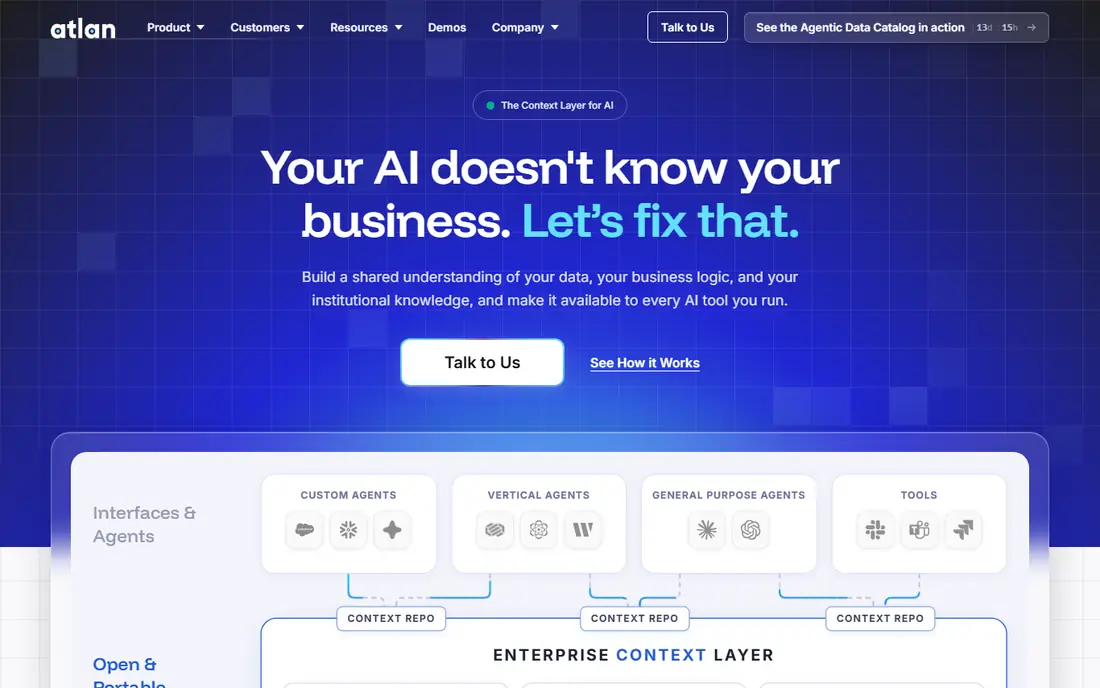
Atlan makes the most sense for mid-market to enterprise teams on the modern data stack that want quick time-to-value. The honest catch is that governance depth and complicated policy configuration still take months and commonly professional services. Most teams see initial value in weeks with self-service setup and no-code configuration.
Main advantages: Tableau and Power BI.
Watch-outs: Legacy and enterprise connectors (mainframe, SAP) are shallower than Collibra or Informatica.
The catalog updates itself from real usage, so documentation stays current without a steward army. The UX drives the adoption where legacy catalogs stall. Contracts are annual and custom-quoted per user. Atlan is the modern-stack favorite. Pricing for Atlan is not stated here, so ask the vendor for current figures. Atlan has no free tier.
- Notion-like UX that analysts actually open daily
- Column-level lineage from day one for Snowflake, dbt, Airflow
- Custom enterprise pricing with no self-serve level
Secoda
Best for: Small to mid-size modern-stack teams that want catalog, lineage, governance and observability in one system
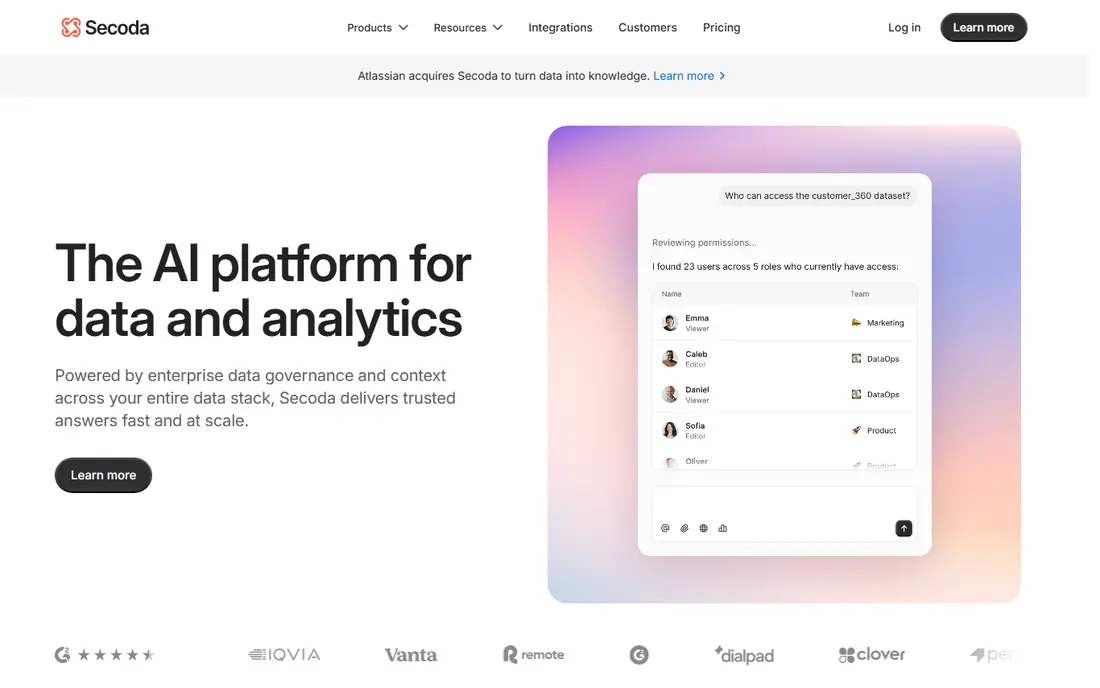
In short, Secoda is for small to mid-size modern-stack teams that want catalog, lineage, governance and observability in one product. The honest catch is the Atlassian acquisition (December 2025, per external profiles): confirm roadmap and support terms in writing before signing.
AI-assisted documentation and generated lineage mean a small data team gets catalog value without a steward army. The workspace spans observability and governance alongside the catalog. Secoda shows no starting price here, so confirm the cost on the vendor site. Secoda includes a free tier.
What works well: AI agents (search, documentation, governance, observability) built into the core product.
Downsides: Acquisition by Atlassian introduces product-direction uncertainty.
- Observability and documentation in a single workspace
- Modern UX that non-technical users can actually use
- Quotes are per-customer, which hurts budget planning
Microsoft Purview
Best for: Organizations already committed to Azure and Microsoft 365, where the catalog is part of a broader governance program
Pick Microsoft Purview if this describes you: organizations already committed to Azure and Microsoft 365, where the catalog is part of a broader governance program. Microsoft Purview is the native choice for Microsoft estates.
Watch-outs: Heavily Microsoft-centric.
As for the details, scan, classify and govern data without leaving the Microsoft portal, with the unified catalog spanning security, compliance and governance in one surface. Microsoft Purview shows no starting price here, so confirm the cost on the vendor site. There is no free plan with Microsoft Purview.
- Unified portal combining the data map, catalog, governance
- Microsoft 365 and Power BI means no separate connectors to maintain
- Feature availability varies by tenant, license and region
Alation
Best for: Large enterprises that require a proven, broad-coverage data catalog
Alation makes the most sense for large enterprises that require a proven, broad-coverage data catalog. Analysts find trusted tables through search and usage signals rather than tribal knowledge, and the product now positions itself as an intelligence layer for AI apps and agents with governance baked in.
Where it falls short: No published pricing and no self-serve signup.
The honest catch is cost and buying friction: expect a guided, sales-led rollout with professional services for lineage and governance configuration, and annual subscriptions custom-quoted per seat type. In practice, setup runs weeks to months. Alation shows no starting price here, so confirm the cost on the vendor site. Alation has no free plan.
- BI and ETL tools
- Credited with creating the ML data catalog category
- Enterprise-class cost base makes it overkill for teams under ~50 data users
Select Star
Best for: Analytics-heavy teams that want lineage and automatic documentation live within a day, without a governance program
For analytics-heavy teams that want lineage and automatic documentation live within a day, without a governance program, Select Star is a natural candidate. Setup is the fastest in this set, under 24 hours for standard sources. The AI co-pilot answers internal data questions for analysts.
What works well: Auto-generated documentation and an AI co-pilot for analyst questions.
As for the details, for analytics teams that want lineage now, not after a governance program, it gives. Column-level lineage across every integration plus entity-relationship diagrams built from query logs, live within hours of connecting sources. Select Star shows no starting price here, so confirm the cost on the vendor site. Free access exists with Select Star. Where it is weaker: Smaller vendor with a narrower analyst footprint than the enterprise incumbents.
- Setup in under 24 hours with zero maintenance
- Generated within hours of connecting sources
- No published pricing despite the "transparent pricing" marketing
data.world
Best for: Teams that value semantic context and open collaboration around data, notably where a knowledge graph layers on meaning
data.world was built for teams that value semantic context and open collaboration around data, particularly where a knowledge graph layers on meaning. The knowledge graph models relationships, business logic and context natively, which translates well to AI use cases: the catalog understands what data means, not just where it lives. Beyond that, collaboration features make it a working space for producers and consumers.
Where data.world stands out: Solid collaboration model: discussions.
Setup is SaaS-fast with collectors for on-prem sources at higher levels. From a buyer's view, verify current terms before committing. Pricing for data.world is not stated here, so ask the vendor for current figures. data.world does not include a free plan.
What to check first: Quote-only enterprise pricing with no published numbers.
- Projects and datasets in one place
- Knowledge-graph foundation hands genuinely semantic discovery
- Acquisition by ServiceNow builds roadmap and pricing uncertainty
CastorDoc (now Coalesce Catalog)
Best for: Businesses that want a light, business-friendly catalog with quick adoption instead of a governance-heavy system
CastorDoc (now Coalesce Catalog) serves businesses that want a light, business-friendly catalog with quick adoption instead of a governance-heavy product. It is the only vendor here with a published entry price: Starter from $10,000 per year.
In practice, for businesses where adoption by business users matters more than governance depth, the plain-language experience is the selling point. CastorDoc (now Coalesce Catalog) starts at: Starter from $10,000/year. Trial and free access: Free trial (14 days).
Trade-offs to know: Rebrand to Coalesce Catalog after acquisition builds brand and roadmap confusion.
Best features of CastorDoc (now Coalesce Catalog): Plug-and-play setup with metadata ingestion in minutes.
- Not just data teams
- Designed for business users
- Less proven at very large enterprise estates
How we chose
For each of the 8 tools we noted price, free plan or trial, fit for data catalog software and the main limit, using vendor pages and documentation. Figures are shown as the vendors publish them. Billing terms, seat minimums and add-ons can change the real cost. Tools are placed by general fit for data catalog software, with price clarity and free access as tie-breakers. A different team can reasonably rank them differently.
Questions to settle before buying
- Get a written quote from Informatica Enterprise Data Catalog, Atlan, Secoda and others; the list shows no starting price for them.
- Look at free plan limits closely: Secoda and Select Star have one, and the caps decide whether it is usable for real work.
- Run a trial of CastorDoc (now Coalesce Catalog) with real work before paying for a year; your own workflow is the best test.
- Read the limits listed for Informatica Enterprise Data Catalog first: Consumption-based pricing makes cost forecasting hard without a sizing exercise.
- The entry price of CastorDoc (now Coalesce Catalog) is only the starting point; model the full cost with seats and extras.
- Pick one real project and run it in Informatica Enterprise Data Catalog first; a small pilot shows fit faster than a checklist.
FAQ
Which options for data catalog software have a free plan?
On this list, Secoda and Select Star include a free plan. Caps on seats, usage or features are common, so test the free plan against your real workload. One other tool offers a trial instead.
What is data catalog software?
Modern catalogs add AI search, automatic documentation and governance workflows so analysts and AI agents can find and trust data without tribal knowledge.
How are the tools for data catalog software ordered?
The order follows typical fit for data catalog software, with Informatica Enterprise Data Catalog first and CastorDoc (now Coalesce Catalog) last, then price clarity and free access. It is editorial judgement, not a score, so another team could rank the tools differently.
Do these tools publish their prices?
Not all of them. Informatica Enterprise Data Catalog, Atlan, Secoda and others publish no starting price, so expect a quote request for those. The rest, CastorDoc (now Coalesce Catalog) included, show a starting price, though seats and billing terms still change the final cost.
Can I try these options before paying?
Often, yes. Secoda and Select Star have a free plan and CastorDoc (now Coalesce Catalog) offers a free trial. Use your own data and a real task during the test, and check what the free tier or trial limits before you rely on it.