5 Data As a Service Software for Remote Teams Worth Shortlisting in 2026
Best data as a service software for remote teams: 5 contenders ranked by fit, with entry costs and free tiers. Every tool lists pros and cons. Straight answers.
- Editor's choice
 Databricks
Unified data, analytics and AI work
Starts atSee websiteVisit databricks.comFull review - Great alternative
 Airbyte
Open-source data integration and ELT
Starts at$20 a monthVisit airbyte.comFull review - Also consider
 Fivetran
Automatic data movement and centralization
Starts at$12,000Visit fivetran.comFull review
Direct answer
Databricks comes first here, mainly for unified data, analytics and AI work. Listed starting prices: Airbyte from $20 a month, Fivetran from $12,000 and dbt Labs from $100 per user per month. For a different need, Airbyte covers open-source data integration and ELT and Fivetran covers automatic data movement and centralization. Prices, free plans and limits for all 5 tools follow.
TL;DR:
- Top of the list is Databricks, which targets unified data, analytics and AI work.
- Just one of the 5 tools, Fivetran, has a free plan.
- For managed autonomous data and AI system, Google BigQuery is worth a look.
- A fair warning about Databricks: wide scope can overwhelm beginners.
- Airbyte has the lowest monthly starting price in this list: $20 per month.
Last checked November 2026. Prices and plan details were read from the vendors' own pages in November 2026; vendors change plans often, so confirm the current price on the vendor site before you buy.
Quick comparison
| Tool | Best for | Starts at | Free plan? | |
|---|---|---|---|---|
| Databricks | Unified data, analytics and AI work | See website | Not stated | Visit |
| Airbyte | Open-source data integration and ELT | $20 a month | Free trial | Visit |
| Fivetran | Automatic data movement and centralization | $12,000 | Yes | Visit |
| dbt Labs | Trusted, governed transformation pipelines | $100 per user per month | Free trial | Visit |
 Google BigQuery | Managed autonomous data and AI system | See website | Not stated | Visit |
The 5 tools in detail
LinkVetted put together this guide to data as a service software for remote teams for readers who want a clear shortlist without reading every vendor page. It compares 5 tools on starting price, free plans, who each one suits and where each one falls short.
Databricks was built for unified data, analytics and AI work. Databricks provides a unified product for data, analytics and AI, with a data-centric approach that eases ETL, data warehousing, governance and AI work.
Trade-offs to know: Needs data engineering skills.
Beyond that, for remote teams, that consolidation means fewer separate systems to coordinate across time zones, and a shared workspace where engineers and analysts collaborate on the same data assets. No starting price is listed for Databricks here; confirm pricing on the vendor site. As for free access: Not stated.
- Contains governance capabilities
- Supports ETL and warehousing together
- Broad scope can overwhelm beginners
Airbyte targets open-source data integration and ELT. Airbyte describes itself as an open-source data integration and ELT system, with pipelines for a large catalog of sources that can run in your VPC or on Airbyte Cloud, giving AI agents context you own.
Running pipelines in your own environment shifts operational responsibility to your team, and connector reliability can differ across sources. The starting price for Airbyte: $20 per month. As for free access: Free trial.
Trade-offs to know: Self-hosting needs maintenance.
- Runs in your VPC or on its cloud
- Pipelines for a large range of sources
- Connector quality varies by source
Fivetran serves automatic data movement and centralization. For remote teams, automation matters since pipelines keep running without someone manually tending them, letting distributed analysts focus on questions instead of connector upkeep.
Trade-offs to know: Connector behavior needs monitoring.
As for the details, teams that require deep in-house control over connector code or prefer open-source tooling may want to evaluate alternatives alongside it. Entry price for Fivetran: $12,000. You can start on Fivetran without paying.
- Centralizes data for quicker insights
- Automated data movement system
- Concentrated on movement, not analysis
dbt Labs
Best for: Trusted, governed transformation pipelines
dbt Labs was built for trusted, governed transformation pipelines. dbt Labs enables data teams to build dependable, governed data pipelines, accelerating analytics and AI initiatives with speed and confidence.
In practice, remote teams benefit from version-controlled, documented transformations that keep distributed contributors aligned on shared definitions rather than scattered spreadsheets and ad hoc queries. Starting cost for dbt Labs: $100 per user per month. Trial and free access: Free trial.
Downsides: Transformation focus, not ingestion.
- Governed pipelines
- Emphasizes trust in data
- Needs SQL and modeling skills
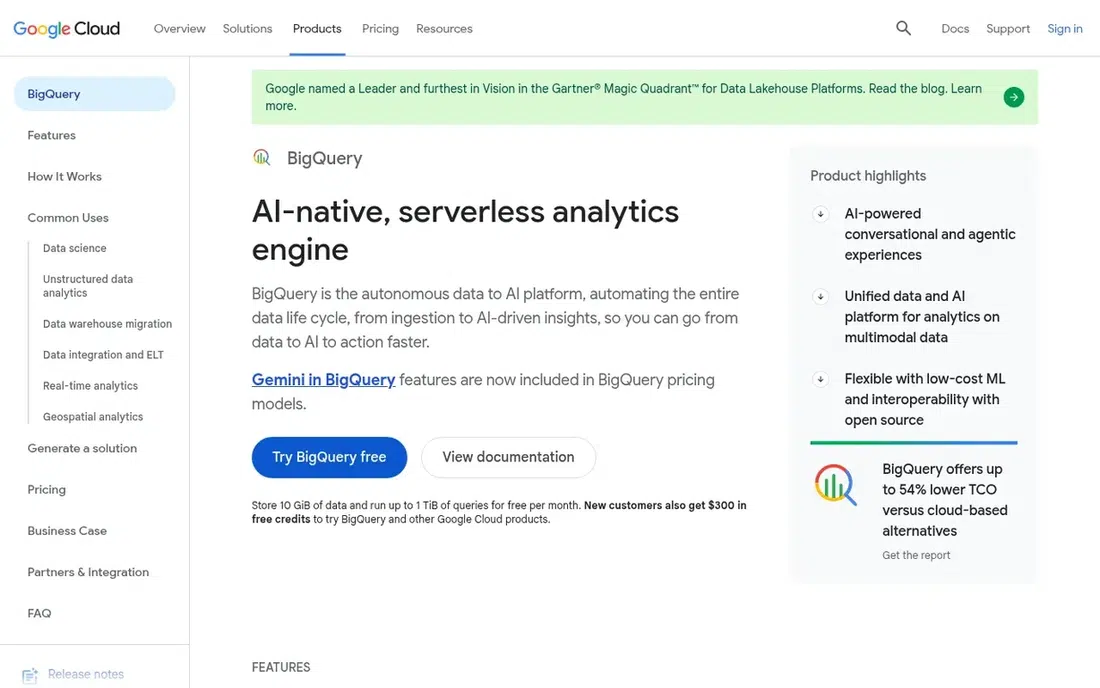
Pick Google BigQuery if this describes you: managed autonomous data and AI platform. The system's breadth can mean a ramp-up time for smaller teams and those without cloud data experience.
The main drawbacks: Needs cloud data skills.
As for the details, Google BigQuery is described as an autonomous data and AI system that automates the whole data life cycle so teams move from data to AI to action quicker. Check the vendor site for Google BigQuery pricing; none is listed in this comparison. As for free access: Not stated.
- Merges warehouse and AI capabilities
- Automates much of the data life cycle
- Complexity grows with advanced use
How we built this list
Questions to settle before buying
- Confirm the entry price on the vendor page. For Databricks and Google BigQuery that means a quote rather than a fixed price.
- Test the free plan from Fivetran against your real workload before relying on it.
- Take the trial from Airbyte and dbt Labs and push a live task through it before you pay.
- Before choosing Databricks, weigh its main limit: broad scope can overwhelm beginners.
- Ask the daily users to test Google BigQuery on a live task before you roll it out to everyone.
- Verify that exporting from Fivetran is possible on your plan and covers all your records.
FAQ
What is the cheapest option for data as a service software for remote teams in this list?
On published monthly entry prices, Airbyte is the lowest here at $20 per month. Entry price is only part of the cost, because seats, add-ons and billing terms can change the total. Each of the 5 options in this data as a service software for remote teams guide has its own card above with the price, free plan and limits.
Is Databricks the right pick for everyone comparing data as a service software for remote teams?
No single tool suits every team. Databricks comes first because it fits unified data, analytics and AI work, while Airbyte suits open-source data integration and ELT and Fivetran suits automated data movement and centralization. Match the tool to your own size, budget and workflow before deciding.
Do I need both an integration tool and a warehouse?
Tools like Fivetran or Airbyte move data from sources into a warehouse like BigQuery or Redshift, where analysis happens. Transformation tools for example dbt Labs then shape that data into trusted, documented models.
How are the tools for data as a service software for remote teams ordered?
Databricks sits first and Google BigQuery last because the order follows typical fit for data as a service software for remote teams, then price clarity and free access. It is a judgement call, so read each profile for fit and limits.
Can I try these tools before paying?
Often, yes. Fivetran has a free plan and Airbyte and dbt Labs offer a free trial. Use your own data and a real task during the test, and check what the free tier or trial limits before you rely on it. All 5 picks in this data as a service software for remote teams comparison list a starting price, free plan details and the main limits on their cards above.
Is open-source integration better for remote teams?
It relies on engineering capacity. Airbyte's open-source model hands control over where pipelines run, which fits teams with engineers to maintain them.
Sources
- https://www.databricks.com
- https://airbyte.com
- https://www.fivetran.com
- https://www.getdbt.com
- https://cloud.google.com/bigquery