Best Data Aggregation Tools in 2026: 8 Tools Compared
We compared the best data aggregation tools for combining data from apps, databases, and APIs, from Fivetran and Airbyte to Hevo and NiFi in 2026 today.
- Editor's choice
 Fivetran
Managed automated pipelines
Starts atSee websiteVisit fivetran.comFull review - Great alternative
 Airbyte
Open source connectors
Starts atFreeVisit airbyte.comFull review - Also consider
 Stitch
Simple managed replication
Starts atSee websiteVisit stitchdata.comFull review
TL;DR:
- Fivetran is our pick for teams that want managed, automated pipelines with minimal maintenance.
- Airbyte is the best open source option, with a large connector library and a cloud version for teams that do not want to self-host.
- Apache NiFi suits data engineers who need fine control over flows, routing, and transformation.
- Pricing for managed tools is usually usage-based, so estimate rows, connectors, and refresh frequency before you commit.
- A tool that aggregates data well still needs clean source data, or it will only move bad data faster.
Quick comparison
| Tool | Best for | Starts at | Free plan? | |
|---|---|---|---|---|
| Fivetran | Managed automated pipelines | See website | Free trial | Visit |
| Airbyte | Open source connectors | Free | Yes | Visit |
| Stitch | Simple managed replication | See website | Free trial | Visit |
 Hevo Data | No-code pipelines | See website | Free trial | Visit |
 Talend | Enterprise integration | See website | Free trial | Visit |
 Apache NiFi | Engineer-controlled flows | Free | Yes | Visit |
 Integrate.io | Low-code data pipelines | See website | Free trial | Visit |
 Matillion | Cloud data warehouse pipelines | See website | Free trial | Visit |
The best data aggregation tools
We looked for tools that pull data from apps, databases, and APIs into one destination, such as a warehouse, for reporting and analysis. Here are eight that cover managed, open source, and enterprise approaches.
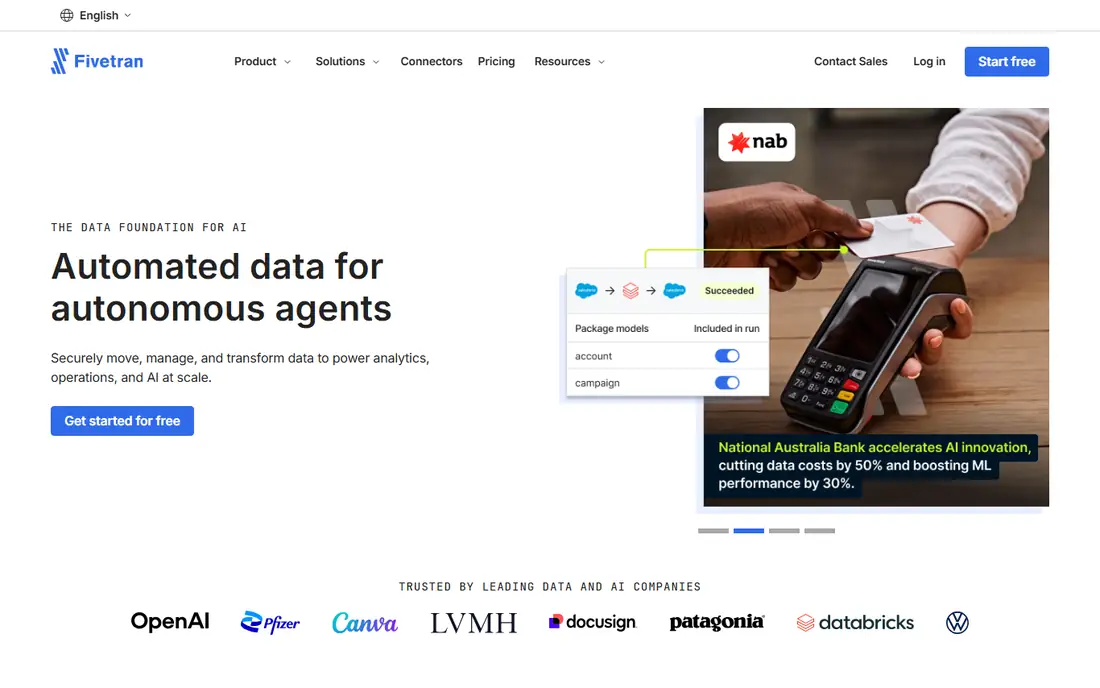
Fivetran is built for teams that want data pipelines to run without constant care. You connect a source, choose a destination warehouse, and Fivetran replicates data on a schedule, handling schema changes and retries. That managed approach saves engineering time, especially when many sources are involved.
The cost model is usage-based, tied to monthly active rows and other factors, so a high-volume source can raise the bill. Check current Fivetran pricing and use the free trial to estimate usage with a real source. For a team that values reliability over custom code, Fivetran is a strong default.
- Large connector library
- Automated schema changes
- Managed maintenance and monitoring
- Usage-based pricing can grow with volume
- Less custom transformation than a code tool

Airbyte gives teams an open source way to move data from many sources into warehouses, lakes, and databases. You can self-host the open source version for free in license terms, or use Airbyte Cloud for managed execution. The connector library covers common apps, databases, and APIs, with community contributions adding more.
Self-hosting is the trade-off. You handle deployment, scaling, and monitoring, which needs engineering time. If you prefer managed service, Airbyte Cloud removes that work at a usage-based price. Check the current Airbyte pricing page and test your most important connector during a trial.
- Open source core
- Large connector library
- Cloud option for managed runs
- Self-hosting needs setup and monitoring
- Some connectors need community support

Stitch, now part of Talend, focuses on simple, managed data replication. You connect a source, pick a warehouse, and Stitch moves data on a schedule. That simplicity suits small data teams that need reliable replication without a complex platform.
Stitch is less suited to heavy transformation or custom logic, which belongs in a warehouse tool such as dbt. Check current Stitch pricing, because plans are based on replicated rows and frequency. For straightforward aggregation from standard sources, Stitch remains a practical, low-friction choice.
- Simple setup for common sources
- Managed replication
- Clear destination support
- Smaller connector set than Fivetran or Airbyte
- Transformation is limited
Hevo Data is a no-code pipeline platform for moving data from apps, databases, and APIs into a warehouse. You build pipelines visually, apply transformations, and monitor runs from a dashboard. That approach suits teams without a dedicated data engineering group.
Pricing is usage-based, so check events, rows, and source counts on the Hevo pricing page before you scale. Use the free trial with a real source to see how Hevo handles schema changes and errors. For a small team that needs pipelines fast, Hevo is a strong managed option.
- No-code pipeline builder
- Many sources and destinations
- Transformations and monitoring
- Usage-based pricing
- Advanced use needs plan review
Talend is an enterprise integration platform that covers data aggregation, transformation, and governance. It suits large organizations that need data quality checks, lineage, and compliance controls alongside pipelines. Talend Data Fabric and related products bundle those features for enterprise use.
Complexity is the trade-off. Talend is more than a simple replication tool, and it needs trained users to get full value. Pricing is often by quote, so contact Talend for a plan that matches your sources and volume. For enterprise governance needs, Talend is worth a formal evaluation.
- Broad integration and governance features
- Data quality tools
- Enterprise support
- Complex platform
- Pricing by quote for many plans
Apache NiFi is a visual data flow tool for engineers who want control over every step. You design flows with processors for fetching, routing, transforming, and delivering data, and you monitor queues and provenance in real time. It handles files, APIs, databases, and streaming sources.
NiFi is not a simple managed pipeline tool. You need to host, secure, and scale it, and design flows carefully to avoid bottlenecks. For a data engineering team that needs custom routing and transformation, NiFi offers flexibility that managed tools do not. It is free and open source under the Apache license.
- Free and open source
- Visual flow designer
- Fine control over routing and processing
- Needs engineering skill to run well
- Hosting and scaling are your responsibility
Integrate.io offers low-code pipelines for ETL, ELT, and reverse ETL, plus API generation from data. That range suits teams that need to move data into a warehouse and also push data back into business apps. The visual builder helps non-engineers build standard pipelines.
Pricing and product details vary, so check the current Integrate.io site and request a quote for your volume. Use a trial to test your main sources and destinations, and confirm whether reverse ETL or API features are included in the plan you need.
- Low-code pipeline builder
- ETL and reverse ETL options
- API generation for data
- Pricing by quote for many plans
- Feature set varies by product line
Matillion is built for data pipelines inside cloud warehouses such as Snowflake, BigQuery, and Databricks. You design pipelines visually, run transformations in the warehouse, and use AI assistance to speed up pipeline building. That warehouse-first approach suits teams already invested in a cloud warehouse.
Matillion is less of a general app-to-app integration tool. Check current Matillion pricing, which uses credits and plan tiers, and test it with your warehouse before you commit. For cloud warehouse teams, Matillion is a focused, capable choice.
- Built for cloud warehouses
- Visual pipeline designer
- AI-assisted pipeline help
- Warehouse-focused
- Pricing and credits need careful review
How we picked these
We compared official feature pages, pricing pages, and documentation for data aggregation tools that move data from multiple sources into a central destination. We favored tools with broad connector support, scheduled replication, monitoring, and error handling. We included managed, open source, and enterprise options. We did not claim hands-on testing that did not happen, and we used See website where a price could not be verified at writing time.
How to choose a data aggregation tool
Start with sources and destination. List every app, database, and API you need to combine, and confirm each tool has a maintained connector for it. A tool with a large library is only useful if it covers your specific sources, including any custom API you rely on.
Next, estimate volume and refresh needs. A daily batch for reporting costs far less than near-real-time sync for operations. Usage-based pricing means frequency and row counts matter as much as the number of sources. Test with a real source during a trial to get a realistic usage estimate.
Finally, decide who will own the pipelines. Managed tools such as Fivetran, Stitch, and Hevo suit small teams, while Airbyte and NiFi suit engineering teams that want control. A tool your team can monitor and fix is better than a more powerful tool that no one owns when a pipeline fails.
FAQ
What is the best data aggregation tool?
Fivetran is a strong default for managed pipelines, while Airbyte is best for open source flexibility. Hevo Data suits no-code teams, and Apache NiFi suits engineers who need fine control. The best choice depends on sources, volume, and who will maintain the pipelines.
What is a data aggregation tool?
A data aggregation tool pulls data from multiple sources, such as apps, databases, and APIs, into one destination like a data warehouse. That central data can then be used for reporting, dashboards, and analysis without querying each source separately.
Is Airbyte free?
Yes, Airbyte open source is free to self-host in license terms, though you still pay for hosting and maintenance. Airbyte Cloud is a managed service with usage-based pricing. Check the current Airbyte pricing page to compare self-hosted and cloud costs for your volume.
How is data aggregation different from ETL?
Aggregation focuses on bringing data together into one place, while ETL also includes transformation steps such as cleaning, joining, and modeling. Many tools in this list do both, with transformation ranging from simple mapping to full warehouse modeling with a tool such as dbt.
Do I need a data warehouse to use an aggregation tool?
Most aggregation tools are designed to load data into a warehouse, lake, or database, because that is where reporting tools connect. Some tools can also load into spreadsheets or apps for simpler use. If you only need a single dashboard from one sheet, a BI tool alone may be enough.