8 Best CSM Software Platforms for Customer Success Teams
We compared the best CSM software and best CSM platforms for SaaS teams, covering health scores, playbooks, renewals, pricing, and fit by team size in 2026.
- Editor's choice
 Gainsight
Large enterprise CS teams with complex accounts
Starts atSee websiteVisit gainsight.comFull review - Great alternative
 Totango
Growing SaaS teams that want templated workflows
Starts atSee websiteVisit totango.comFull review - Also consider
 ChurnZero
Mid-market subscription businesses focused on retention
Starts atSee websiteVisit churnzero.comFull review
TL;DR:
- The best CSM software is customer success management software, built to track account health, renewals, and expansion, not a CRM with a renamed tab.
- Gainsight leads for large enterprise teams, while Totango, ChurnZero, and Vitally fit mid-market teams faster and with less admin overhead.
- Pricing is mostly quote-based in this category, so the pricing unit matters: per-seat pricing punishes hiring, while per-account pricing punishes a long tail.
- Small teams should start with a lighter tool such as Custify or HubSpot Service Hub, and move to a full suite only when playbooks and health scoring are used weekly.
Quick comparison
| Tool | Best for | Starts at | Free plan? | |
|---|---|---|---|---|
| Gainsight | Large enterprise CS teams with complex accounts | See website | No | Visit |
| Totango | Growing SaaS teams that want templated workflows | See website | Free trial | Visit |
| ChurnZero | Mid-market subscription businesses focused on retention | See website | No | Visit |
 Vitally | Mid-market B2B SaaS teams that value a clean workspace | See website | Free trial | Visit |
 Planhat | Data-driven teams with CS Ops capacity | See website | No | Visit |
 Custify | Early-stage B2B SaaS teams on a budget | See website | Free trial | Visit |
 ClientSuccess | Small to mid-market SaaS teams wanting an affordable platform | See website | No | Visit |
 HubSpot Service Hub | Teams already using HubSpot CRM | $90 per month | Yes | Visit |
The best CSM software
We compared official feature pages, pricing pages, app store listings, and public reviews to find the best CSM platform for different team sizes. Customer success management software, often shortened to CSM software, helps customer success managers see which accounts are healthy, which are at risk, and which are ready to grow, before renewal season forces the question.
Gainsight is the benchmark other CSM tools are measured against, and for good reason. Its Customer 360 view pulls usage, support, billing, and relationship data into one account record, and its health scoring lets teams weight those signals in detail instead of relying on a single gut-feel rating. Journey Orchestrator then turns that insight into action, with playbooks that trigger tasks, emails, and check-ins across a large team. The cost of that depth is real. Pricing is not published, implementation is commonly reported in months rather than days, and running it well usually needs a dedicated CS Ops owner. Teams with fewer than a few hundred accounts often buy more platform than they can operate in year one. If you manage complex, multi-product enterprise accounts and have the operations capacity to match, Gainsight is still the strongest choice. If not, the tools below will get you value sooner.
- Deepest health scoring and Customer 360 views
- Journey Orchestrator for multi-step playbooks
- Mature ecosystem and board-level reporting
- Quote-based enterprise pricing
- Implementation often takes months and needs a dedicated admin
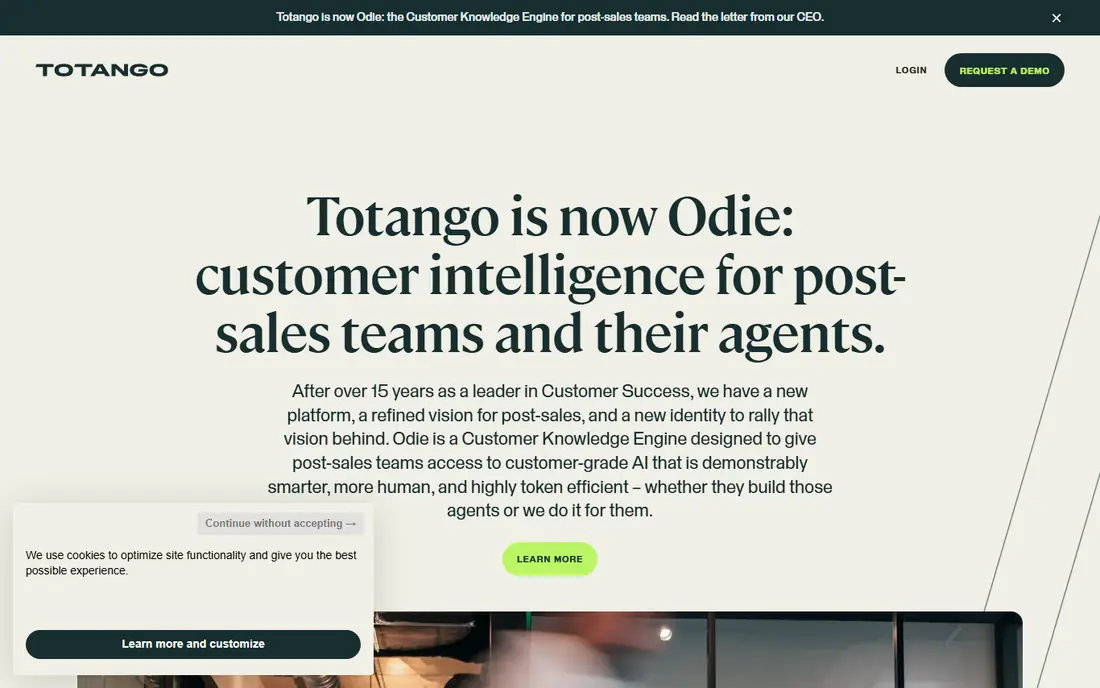
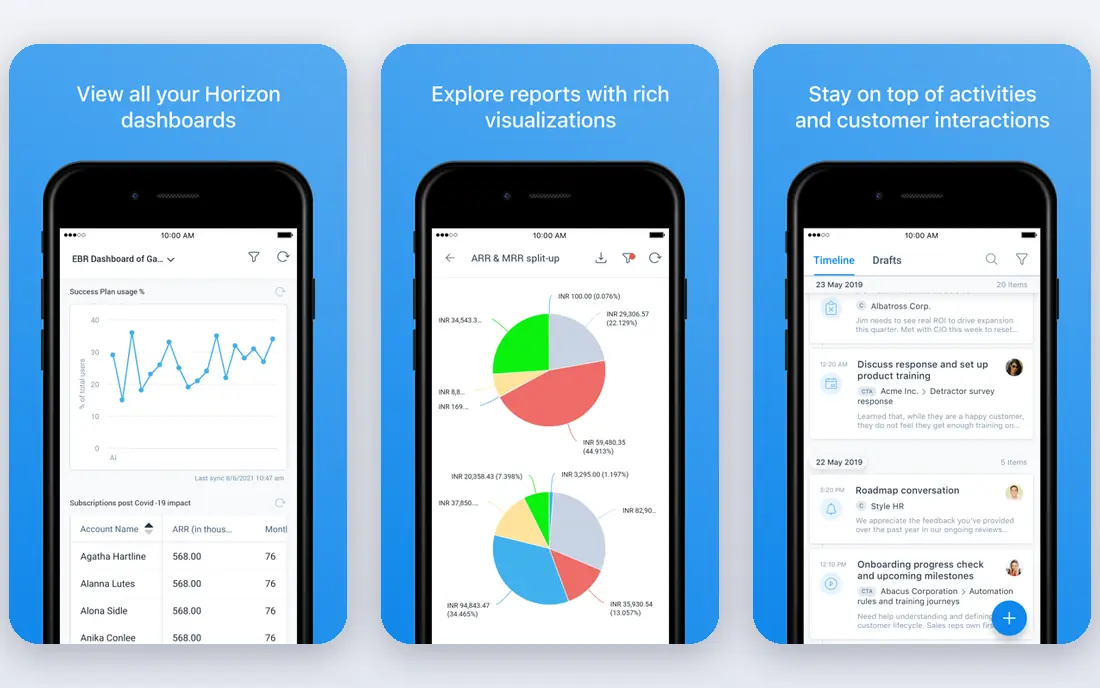
Totango, now combined with Catalyst, sits in the middle of this market in a useful way. It offers health scoring, journey templates, and account views without demanding the same implementation project as Gainsight. Teams with several customer segments can build a different journey for each segment, so onboarding for a small account does not follow the same heavy process as onboarding for an enterprise account. That middle position is also its limit. If you need highly custom data models or deeply tailored reporting, you may hit edges that Gainsight handles more cleanly. For mid-market teams with roughly five to twenty CSMs, though, Totango often delivers working playbooks in weeks rather than months. Ask for a Starter-level quote early, because published pricing is limited and total cost depends on account volume and modules.
- Faster deployment than enterprise suites
- SuccessBLOC journey templates for common motions
- Good fit for segmented books of business
- Quote-based pricing for most plans
- Customization depth is below Gainsight
ChurnZero is built around a clear job: stop churn before it shows up in revenue. Its health scores combine product usage, support activity, and billing signals, and its in-app messages let CSMs reach users inside the product instead of only by email. That matters for subscription businesses where the end user and the buyer are different people, because usage by the team often predicts renewal better than a quarterly business review. Pricing by customer account rather than by CSM seat changes the math for some teams. A larger CSM team on a modest account list may pay less here than on a per-seat tool, while a small team with thousands of accounts may pay more. Get a quote based on your actual account count, and confirm what counts as a managed account. For mid-market SaaS with 100 to 2,000 accounts, ChurnZero is a strong, focused pick.
- Strong health scoring tuned for subscription models
- In-app messaging and engagement tools
- Priced by customer account, not only by seat
- Quote-based pricing
- Implementation and training still take several weeks
Vitally wins fans for usability, which sounds soft until you have watched a CSM tool sit unused because it felt like admin work. The interface is clean, projects and tasks sit next to health data, and teams can track onboarding, adoption, and renewal work in one place. For product-led and hybrid SaaS teams, that day-to-day usability drives adoption, and adoption is what makes health scores trustworthy. The catch is that Vitally is still priced by conversation, and tiers are organized by touch model, from tech-touch to high-touch, so two similar teams can receive different quotes. It also lacks some of the deepest enterprise configuration that Gainsight offers. If your team is in the 50 to 500 account range and wants a tool CSMs enjoy using, Vitally deserves a trial. If you run thousands of enterprise accounts with complex hierarchies, test the enterprise tier carefully.
- Polished interface that teams actually open daily
- Flexible health scores and project tracking
- Unlimited seats on some plans
- Quote-based pricing
- Less enterprise depth than Gainsight for very large orgs
Planhat appeals to teams that think in data first. Its data model can be shaped without code, so you can model parent and child accounts, multiple products, and custom objects in ways that rigid tools resist. Dashboards and workflows follow that model, which means reports reflect how your business actually works rather than forcing your business into a preset template. That flexibility asks for ownership. Without someone who understands your data sources and can maintain the model, Planhat can feel like a powerful engine with no driver. Teams with CS Ops support, or a technically confident CS leader, get the most from it. Teams without that support should favor Totango or Vitally, where more structure comes out of the box.
- Flexible, no-code data model
- Priced by active customer account with unlimited seats
- Strong dashboards and workflow customization
- Needs data maturity to get value
- Implementation effort is higher than plug-and-play tools
Custify is a sensible first CSM platform for a startup that has outgrown spreadsheets but cannot justify an enterprise contract. It covers the essentials: a unified customer view, health scores, lifecycle stages, and playbooks that prompt CSMs when an account needs attention. Setup is quicker than with the enterprise tools, and the team can start with a focused set of accounts and expand from there. The limit is scale and depth. Very large portfolios, complex multi-product hierarchies, and heavy custom reporting will stretch Custify sooner than Gainsight or Planhat. That is not a flaw for its audience. If you manage under a few hundred accounts and need a real CSM tool this quarter, Custify gives you structure without a six-figure commitment. Upgrade later, when your playbooks are proven and your data is clean.
- Lightweight Customer 360 and playbooks
- Faster time to value for small books
- Lower entry cost than enterprise suites
- Less depth for large, complex portfolios
- Some advanced analytics sit on higher tiers
ClientSuccess
Best for: Small to mid-market SaaS teams wanting an affordable platform
ClientSuccess positions itself as the practical CSM platform for teams that want real customer success tooling without enterprise complexity. Health scores, success plans, and renewal tracking are presented in a way that a small team can learn quickly, and the focus stays on CSM daily work rather than on platform administration. That simplicity helps when your CSMs also handle onboarding and support. The trade-off is ecosystem size. Integrations, marketplace apps, and community resources are thinner than for the category leaders, so check your CRM, billing, and product analytics connections before committing. If those core connections work, ClientSuccess is a credible, lower-cost path into structured customer success. If you need dozens of niche integrations, a larger platform may save integration time.
- Straightforward CSM workflows at a lower entry point
- Clear account health and renewal views
- Good support reputation among smaller teams
- Quote-based pricing
- Smaller ecosystem than Gainsight or Totango
HubSpot Service Hub is not a dedicated CSM suite, and we include it for a practical reason: many small teams already live in HubSpot. If your contacts, tickets, and deals are there, adding health scores, customer feedback, and playbooks in the same workspace avoids a new data project. The free tier lets a tiny team start without a purchase, and the Professional tier adds the CSM features most small teams need first. The honest limit is depth. Health scoring, journey orchestration, and expansion tracking are improving, but they do not match Gainsight, Totango, or ChurnZero for a mature CS org. Use HubSpot when customer success is one job among several and HubSpot is already your system of record. Move to a dedicated CSM tool when renewals, health scoring, and playbooks become a full-time operation.
- Free tier to start
- Health scores plus ticketing in one workspace
- Fast setup for existing HubSpot users
- CSM depth is lighter than dedicated tools
- Advanced CSM features sit on higher tiers
How we picked these
We compared official feature pages, pricing pages, app store listings, and public reviews, and we kept only tools that are sold today as customer success platforms or as a service hub with CSM features. We weighted health scoring, playbooks, renewal visibility, integrations with CRM and product data, and time to value, because a CSM tool that sits unused helps no account. Where vendors do not publish pricing, we wrote See website rather than presenting third-party contract estimates as vendor prices.
What to check before you buy
Match the pricing unit to your team
Ask whether you pay per CSM seat, per customer account, or per managed workload, then model the cost for your team size and account count a year from now. The cheapest quote today can become the most expensive one after hiring or growth.
Test health scoring with your own data
A demo with clean sample data always looks good. Ask for a trial using a sample of your real accounts, and check whether at-risk accounts you already know about actually score as at risk.
Count implementation time, not just license cost
Enterprise CSM tools often need weeks of setup, data cleaning, and training. Ask for a written implementation plan, who owns it on each side, and what happens if you miss the go-live date.
Check who owns the tool after launch
Every CSM platform needs an owner for health score tuning, playbook updates, and integrations. If no one on your team can take that role, favor a simpler tool with more structure out of the box.
FAQ
What is the best CSM software for a small SaaS team?
Custify, ClientSuccess, and HubSpot Service Hub are the best starting points for small teams, because they cover health, playbooks, and renewals without an enterprise contract. Start with the one that connects cleanly to your CRM and product data.
What is the best CSM platform for enterprise teams?
Gainsight remains the enterprise leader for complex accounts, deep health scoring, and journey orchestration, provided you have CS Ops capacity to run it. Totango and Planhat are strong alternatives when you want faster deployment or a more flexible data model.
What is the best tool for CSMs who need health scoring?
Gainsight, ChurnZero, and Vitally all offer strong health scoring, but they weight signals differently. Test each one with your own usage, support, and billing data, because the best score is the one that flags accounts your team already knows are struggling.
How much does CSM software cost?
Most dedicated CSM platforms are quote-based, and published buyer data puts many mid-market contracts in the tens of thousands per year, with enterprise deals higher. HubSpot is the exception on this list, with a free tier and a Professional seat price you can check publicly.
Do I need CSM software if I already have a CRM?
A CRM tracks deals and contacts, while CSM software tracks account health, adoption, and renewal risk over time. Small teams can start with CRM plus spreadsheets, but once you manage dozens of renewals, a CSM tool saves time and catches risk earlier.
What is the difference between CSM software and customer support software?
Support software handles tickets and individual problems. CSM software looks across the whole account, including usage, sentiment, and contract dates, to guide proactive work such as onboarding, expansion, and renewal conversations.