Best Competitive Intelligence Software in 2026: 8 Tools Compared
Compare the best competitive intelligence software for 2026, from dedicated CI platforms like Crayon and Klue to affordable tools like SpyFu for teams.

- Editor's choice
 Crayon
Enterprise competitive programs
Starts atSee websiteVisit crayon.coFull review - Great alternative
 Klue
Sales battlecards and win-loss
Starts atSee websiteVisit klue.comFull review - Also consider
 Kompyte
Mid-market tracking and battlecards
Starts at$300 per monthVisit kompyte.comFull review
TL;DR:
- Crayon and Klue are the leading dedicated platforms for teams that run a formal competitive program with sales battlecards.
- Kompyte offers competitor tracking and battlecards at a lower published entry point than the enterprise platforms.
- Similarweb, Semrush, Ahrefs, and SpyFu cover digital intelligence well and cost far less than a full CI platform.
- Owler is a useful free starting point for company alerts, but it is not a substitute for a real CI program.
Quick comparison
| Tool | Best for | Starts at | Free plan? | |
|---|---|---|---|---|
| Crayon | Enterprise competitive programs | See website | No | Visit |
| Klue | Sales battlecards and win-loss | See website | No | Visit |
| Kompyte | Mid-market tracking and battlecards | $300 per month | No | Visit |
 Similarweb | Traffic and market benchmarking | See website | Free trial | Visit |
 Semrush | SEO and paid-search intelligence | $139.95 per month | Free trial | Visit |
 Ahrefs | Backlink and content gaps | $29 per month | No | Visit |
 SpyFu | Affordable PPC and SEO history | $39 per month | No | Visit |
 Owler | Free company alerts | Free | Yes | Visit |
The best competitive intelligence software
Competitive intelligence software tracks what rivals change, then turns those changes into material sales teams can use. We compared official product pages, pricing pages, and public reviews for dedicated CI platforms and digital intelligence tools, and we favored a mix that covers both enterprise programs and smaller budgets.
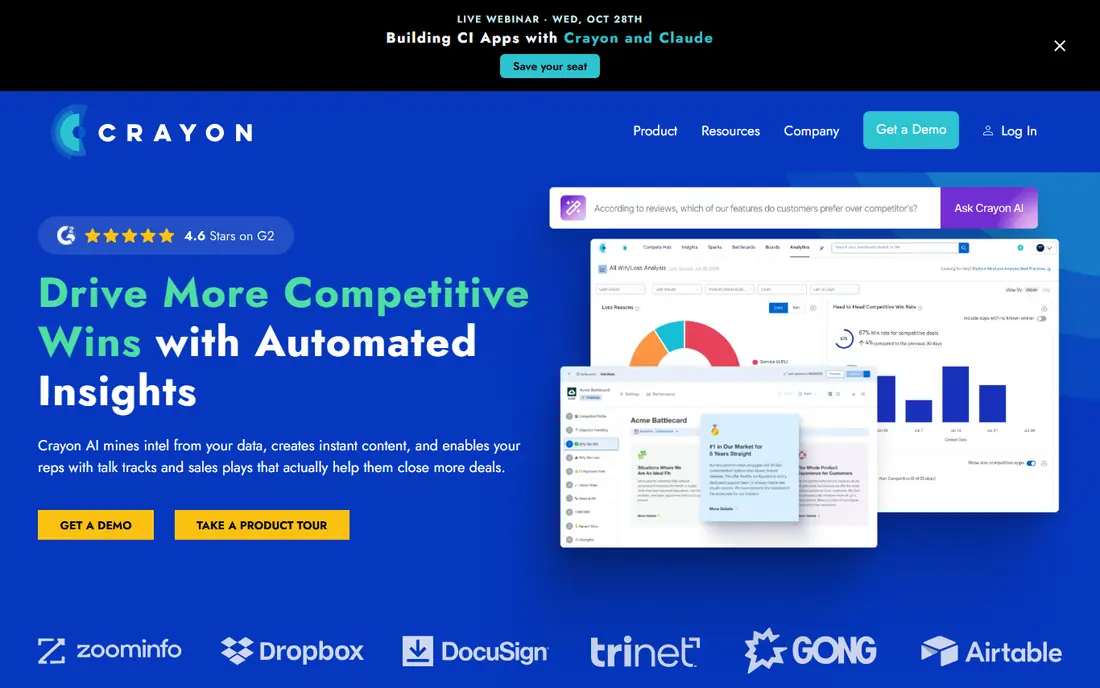
Crayon is the benchmark for a full competitive intelligence program. It monitors competitor websites, pricing pages, reviews, job posts, and news, then uses AI analysis to surface meaningful changes and push them into battlecards, newsletters, and dashboards. Distribution into Salesforce, Slack, and email means sellers see intel where they already work, not in another portal they forget to open.
The cost and effort are real. Pricing is quote-based and typically lands in enterprise territory, and Crayon works best with a product marketing owner who curates signals and trains sellers. A small team with few competitive deals will not get its money's worth. A larger B2B company losing deals to the same rivals repeatedly will find Crayon's depth hard to replace.
- Automated tracking across many sources
- Battlecards and newsletters
- Salesforce and Slack delivery
- Quote-based enterprise pricing
- Needs a dedicated owner to get full value
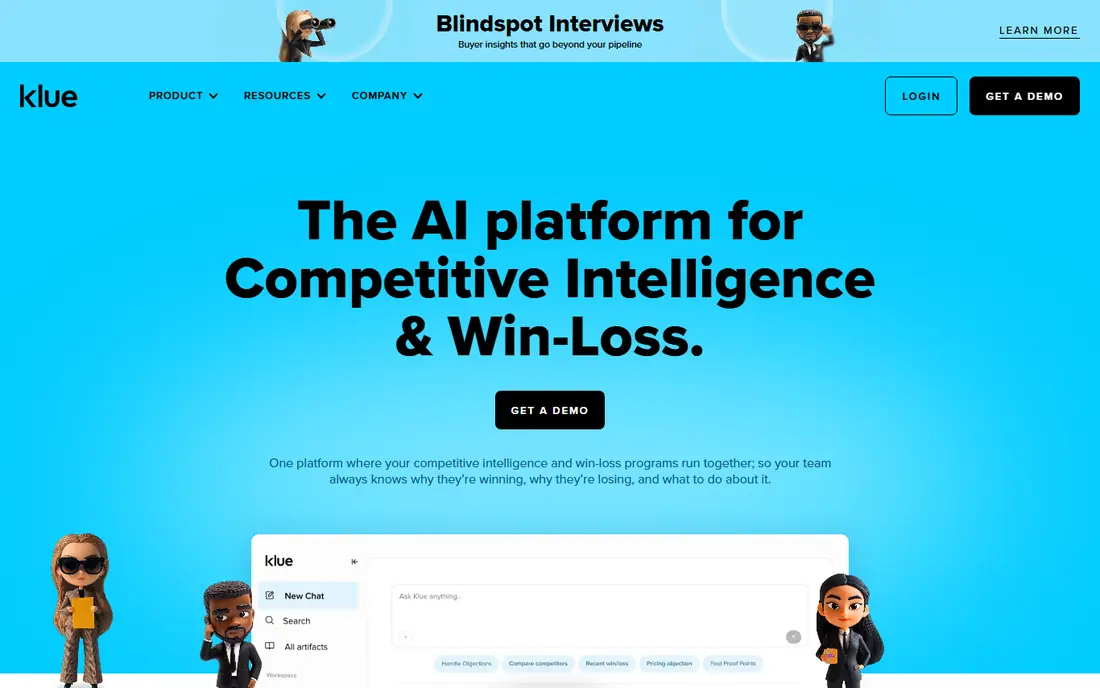
Klue pairs competitor tracking with win-loss analysis, which is a combination its rivals match less well. Product marketers build battlecards from tracked changes and from interviews with buyers who chose you or a rival, then deliver those cards into Salesforce, HubSpot, Slack, and Teams. That loop, from lost deal to better talk track, is why sales-led teams pick Klue.
Like Crayon, Klue prices by quote and suits companies with a real competitive program, not a casual interest in rivals. Implementation needs sales leadership support, because battlecards only help if sellers actually open them. If your team already runs competitive deals weekly and wants win-loss insight in the same system, Klue is our top pick.
- Strongest battlecards in the category
- Win-loss research included
- Wide CRM and chat integrations
- Quote-based pricing
- Setup needs buy-in from sales leadership
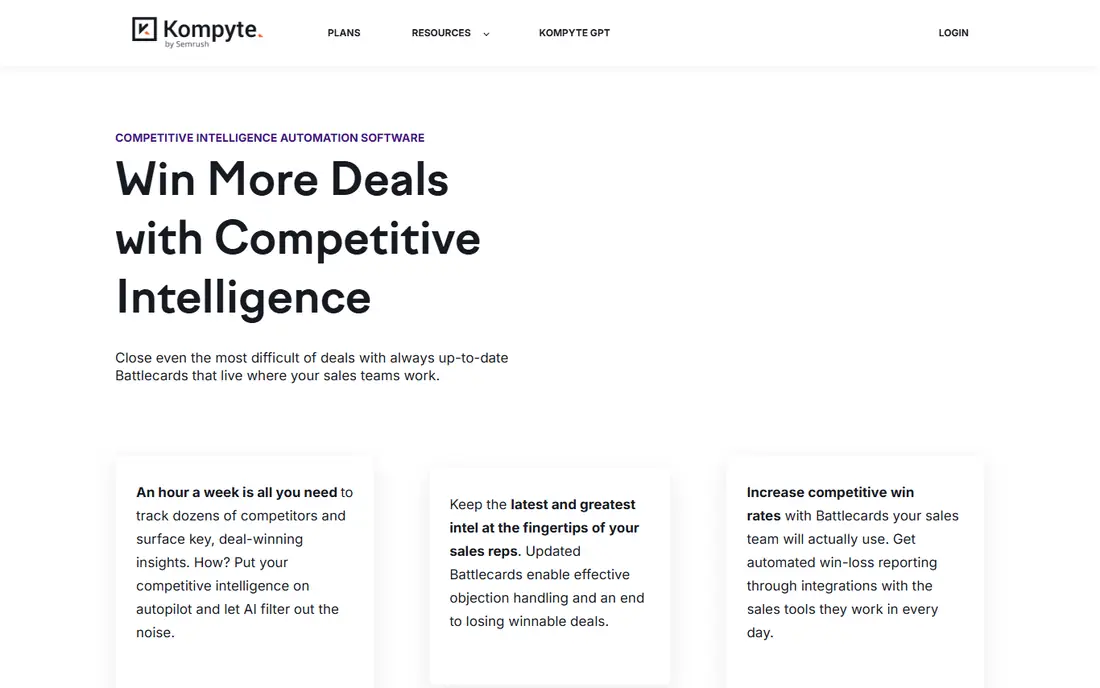
Kompyte is the most accessible dedicated CI platform in this list. It tracks competitor websites, product pages, reviews, pricing, and job posts, then builds battlecards and alerts automatically. Published pricing starts near $300 a month, which is far below enterprise CI quotes, and onboarding help is included on some plans, which matters for a small product marketing team.
It does not match Crayon or Klue on analyst support or the depth of win-loss research. Teams that want a fully managed program with human curation will still lean enterprise. For a mid-market company that wants real tracking and battlecards without a five-figure annual contract, Kompyte is the sensible middle ground.
- Published pricing from around $300 a month
- Automated tracking and battlecards
- No charge for onboarding on some plans
- Smaller analyst layer than Crayon or Klue
- Interface takes learning
Similarweb answers a different question from Crayon: not what a rival changed, but how much attention it gets and where that attention comes from. Its traffic estimates, channel mix, audience data, and market benchmarks help a team size a market, spot a rival's rising channel, or check whether a competitor's growth is real. A free limited version lets you test the basics before paying.
Treat its numbers as estimates, not audited traffic, and budget carefully, because paid plans climb fast with data depth. Similarweb pairs well with a CI platform: use Similarweb for market context, then Crayon or Klue for the specific changes behind the numbers. On its own, it is best for marketing and strategy teams, not for daily sales battlecards.
- Competitor traffic and channel mix estimates
- Market segment benchmarking
- Large data panel
- Starter pricing is not cheap
- Estimates, not exact traffic figures
Semrush is primarily an SEO and marketing toolkit, but its competitive intelligence is strong enough to earn a place here. It shows which keywords rivals rank for, where they spend on paid search, how their traffic trends, and which pages draw the most visits. That view is essential when search is a key battleground, and the same subscription covers keyword research, site audits, and content tools.
At $139.95 a month for the entry plan, it is a real subscription, and teams that only want CI may find it broad. But for a marketing team that already needs SEO tools, the competitive data comes almost free with the plan. Use Semrush for search-driven rivals, and a dedicated CI tool for product and pricing changes.
- Deep keyword and paid-search competitor data
- Traffic analytics
- Wide toolkit beyond CI
- Monthly price adds up for a single use case
- Learning curve for new users
Ahrefs is the backlink authority. Its crawler maps who links to rivals, which pages earn those links, and which keywords those pages rank for, which reveals content and partnership strategies that pricing trackers miss. Content gap analysis shows keywords rivals rank for that you do not, giving a concrete list of pages to build. The Starter plan from $29 a month makes it accessible to small teams.
It is not a CI platform: there are no sales battlecards or CRM-delivered alerts in the Crayon sense. Use Ahrefs for search and content intelligence, alongside a tracker for product changes. For an SEO-led team, its backlink depth is unmatched at this price.
- Best backlink data in the category
- Content gap analysis
- Starter plan from $29 a month
- No native CRM battlecard delivery
- Enterprise plans get expensive
SpyFu is the budget pick for search intelligence. It shows the keywords rivals have bought and ranked for over years, including ad history that reveals which campaigns they kept running, a useful signal for what actually converts. At $39 a month for the Basic plan, it undercuts Semrush and Ahrefs while covering the core question: what are rivals doing in search, and for how long.
Data depth and freshness trail the leaders, and the tool is narrower in scope. It will not track product changes or build battlecards. For a small team that mainly needs to see rival search strategy without a big subscription, SpyFu is excellent value. Pair it with Owler alerts for a low-cost CI starter kit.
- Long PPC and SEO keyword history
- Low $39 entry price
- Easy competitor keyword exports
- Data depth below Semrush and Ahrefs
- Limited free searches
Owler is the free starting point every small team should use. Follow a rival and get alerts on funding rounds, leadership changes, acquisitions, and news, all drawn from a large company database with community contributions. For a founder or solo marketer tracking a handful of rivals, Owler delivers the headline changes at no cost.
Depth is the limit. Owler will not track pricing page changes, build battlecards, or analyze search strategy, and community data should be checked against primary sources before acting on it. Use Owler as the alert layer, then verify important changes on the rival's own site. When the alert volume and deal stakes grow, graduate to Kompyte, Klue, or Crayon.
- Free company profiles and alerts
- Funding, leadership, and news tracking
- Huge company database
- Thin depth compared with paid CI tools
- Community-sourced data needs checking
How we picked these
We compared official product pages, pricing pages, and public reviews for competitive intelligence platforms and digital intelligence tools available in October 2026. We kept only tools that genuinely track competitors or rival performance, and we covered dedicated CI platforms, digital benchmarking, and a free alert tool so different budgets are served. Where a vendor does not publish a price, we wrote See website.
How to run competitive intelligence without drowning
Start with five to ten rivals, not fifty. For each one, name the changes that actually matter: pricing, positioning, product launches, hiring in key roles, and major campaigns. Track those signals only, and set alert thresholds so your team hears about real changes, not every blog post. A weekly digest beats a daily firehose that everyone learns to ignore.
Turn intel into sales material
Tracking alone does not win deals. For each major rival, keep one battlecard with its strengths, its weaknesses, proof points, and talk tracks for common objections, and review it after lost deals. Distribute cards where sellers work, in the CRM or chat, and retire cards that no longer match what rivals actually sell. Win-loss interviews, like those Klue supports, are the fastest way to keep cards honest.
FAQ
What is the best competitive intelligence platform?
For enterprise teams, Crayon leads on automated tracking breadth, while Klue leads on battlecards and win-loss. For mid-market teams, Kompyte offers the best balance of features and published pricing. The right pick depends on whether sales enablement or broad monitoring matters more.
How much does competitive intelligence software cost?
Dedicated platforms range from about $300 a month for Kompyte to quote-based enterprise contracts for Crayon and Klue. Digital tools cost less: SpyFu from $39 a month, Ahrefs from $29, and Semrush from $139.95. Owler is free for basic alerts.
What is the difference between CI software and SEO tools?
CI software tracks rival product, pricing, and messaging changes and delivers sales battlecards. SEO tools like Semrush and Ahrefs track rival search performance, keywords, and backlinks. Many teams need both, since search moves reveal strategy while product tracking reveals positioning.
Can small businesses use competitive intelligence tools?
Yes. Start free with Owler alerts and add SpyFu or Ahrefs for search insight. Move to Kompyte when you need automated tracking and battlecards. A full enterprise platform only pays off once competitive deals are a regular, costly part of your pipeline.
Is tracking competitors legal?
Yes, when you use public information: websites, pricing pages, job posts, news, filings, and public reviews. Do not use stolen data, false identities to access private material, or a rival's confidential information. Stick to public sources and your own win-loss interviews, and keep records of where intel came from.