8 Best Companies to Climb Kilimanjaro for a Safe, Well-Run Trek
We compared the best companies to climb kilimanjaro on safety, guides, routes, group size and porter care, using official sites and public reviews today.
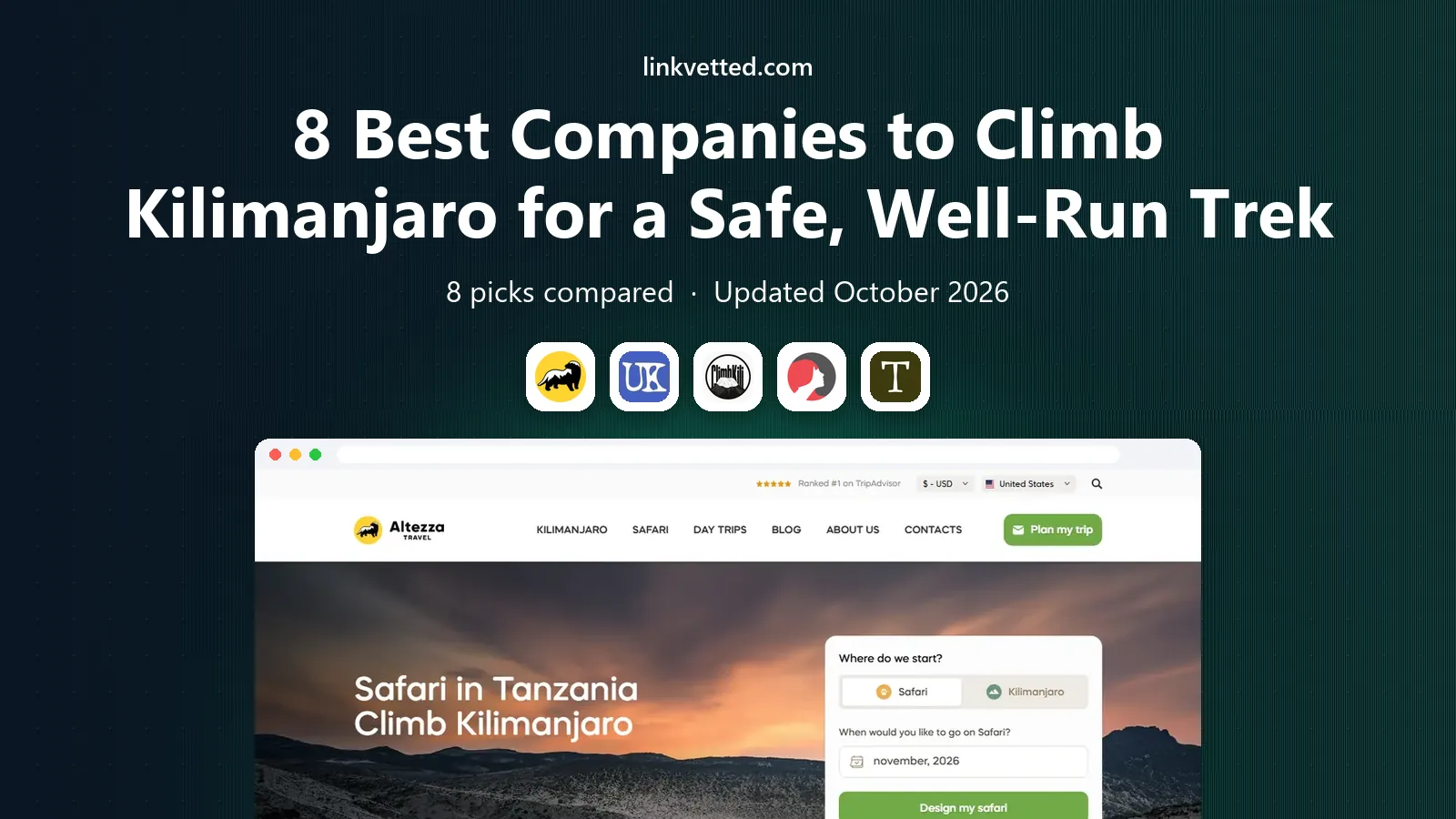
- Editor's choice
 Altezza Travel
Overall operation and safety systems
Starts atSee websiteVisit altezzatravel.comFull review - Great alternative
 Ultimate Kilimanjaro
Value and long track record
Starts atSee websiteVisit ultimatekilimanjaro.comFull review - Also consider
 Climb Kili
Small groups and local ownership
Starts atSee websiteVisit climbkili.comFull review
TL;DR:
- Safety habits matter more than price: look for trained guides, daily health checks, emergency oxygen and a clear evacuation plan.
- Longer routes with more acclimatisation days give a better chance of reaching Uhuru Peak than the shortest, cheapest itinerary.
- Porter welfare is a useful quality signal: KPAP partner status and fair treatment policies point to a better-run operation.
- Prices vary by route, group size, season and inclusions, so compare what is included before you judge a quote.
Quick comparison
| Tool | Best for | Starts at | Free plan? | |
|---|---|---|---|---|
| Altezza Travel | Overall operation and safety systems | See website | No | Visit |
| Ultimate Kilimanjaro | Value and long track record | See website | No | Visit |
| Climb Kili | Small groups and local ownership | See website | No | Visit |
 Follow Alice | Private and small-group treks | See website | No | Visit |
 Thomson Safaris | Guided treks with US support | See website | No | Visit |
 G Adventures | Group travel with a set itinerary | See website | No | Visit |
 African Scenic Safaris | Tanzania-based treks and safaris | See website | No | Visit |
 Kiliwarrior Expeditions | Local guides and flexible routes | See website | No | Visit |
The best companies to climb kilimanjaro
We compared official company pages, route and safety information, porter welfare policies and public reviews for operators that run Kilimanjaro treks in October 2026. Prices are listed as See website because they change with route, dates, group size and what is included, such as park fees, food, tents and transfers.
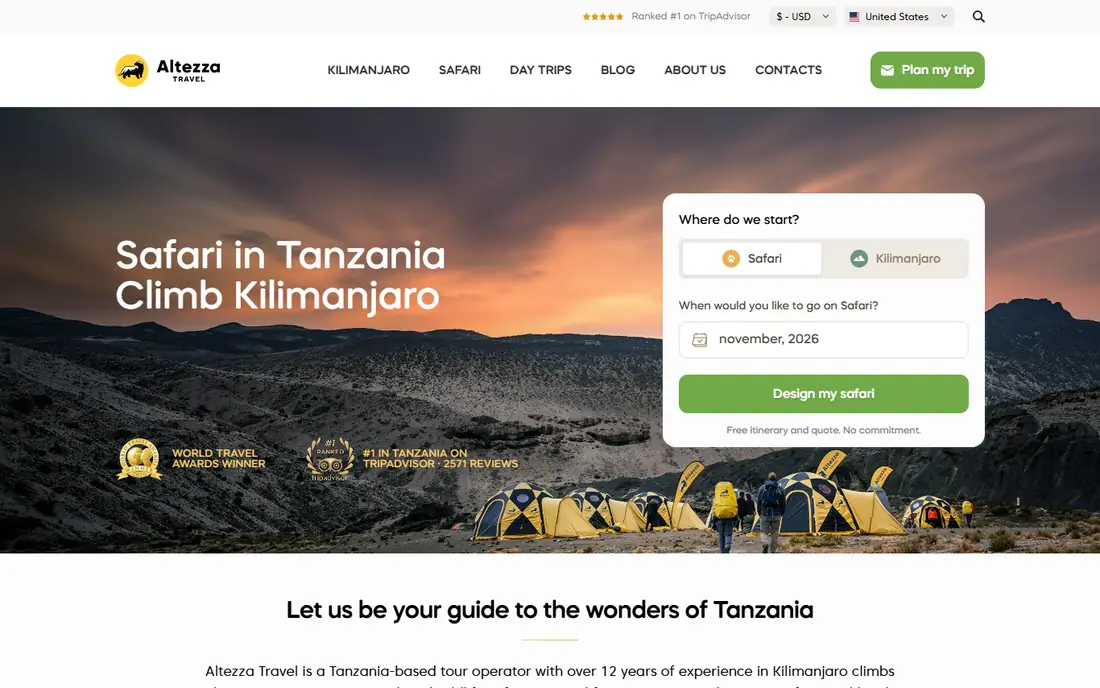
Altezza Travel, based in Moshi, is one of the largest Kilimanjaro operators, and its scale shows in safety systems rather than just marketing. Its published material describes bottled oxygen, medical kits and pulse oximeters on expeditions, daily health checks, Wilderness First Responder certified guides, and its own rescue and emergency response centre. It also owns lodges used before and after treks, which simplifies arrival, gear checks and rest days. The size cuts both ways. A large company can staff climbs well and handle problems, but climbers who want a very small, quiet group should ask about group size and guide ratios for their exact departure. Altezza also holds B Corporation and Travelife certification in the material we reviewed, and it is a member of the Kilimanjaro Porters Assistance Project, which sets standards for porter pay and conditions. For a first climb where safety systems and clear organisation matter most, it is a strong starting point.
- Tanzania-based operator with its own lodges
- Dedicated safety staff and rescue infrastructure
- KPAP member with certified guides
- Large operation can feel less personal than a tiny local team
- Popular dates book early
Ultimate Kilimanjaro has a long public record on the mountain, with guides described as Wilderness First Responders, health checks twice daily, emergency oxygen, a portable stretcher and medical kits, and coordination with Kilimanjaro Search and Rescue for helicopter evacuation when needed. It is also listed as a KPAP partner company, which is a useful check for porter welfare. Those details, taken together, explain why it appears so often in independent recommendations. Value is the other reason to look here. Ultimate Kilimanjaro tends to price below some boutique operators while still including the core safety kit and experienced guides, though exact inclusions vary by route. Ask for a written list of what is included, such as park fees, meals, tents, sleeping bags and transfers, and compare that list rather than the headline price alone. Choose a longer route if you can, since extra acclimatisation days help more than any single piece of gear.
- Operating since 2007
- Twice-daily health checks with pulse oximeters
- Emergency oxygen and evacuation coordination
- Group treks can be larger than boutique operators
- Route choice still matters more than brand alone
Climb Kili presents itself as a locally owned operator that has run Kilimanjaro climbs since 1984, with a maximum of six climbers per scheduled group. Small groups make it easier for a guide to watch each climber's pace and health, and they keep camp life calmer than a large mixed group. Its published material also points to higher-altitude summit camps, which shorten summit night, and KPAP certification for porter treatment. For climbers who value local ownership and a quieter trek, that combination is attractive. The main limits are practical: small groups fill up, and a six-person cap means you should book early for peak season. Ask about the guide-to-climber ratio, the exact summit camp for your route, and how the team handles a climber who needs to descend, since those answers tell you more than a summit success figure on its own.
- Tanzanian-owned since 1984
- Maximum of six climbers per group
- KPAP certified with higher-altitude summit camps
- Small groups mean limited places on popular dates
- Pricing varies by route and season
Follow Alice is a Tanzania-based operator that appears in several best-operator lists for its private and small-group Kilimanjaro treks. The appeal is control: you can shape the route, pace and dates around your group, rather than joining a large scheduled departure with mixed fitness levels. That flexibility helps families, couples and small friend groups who want to climb together without adjusting to strangers' pace. The trade-off is scale. A smaller team cannot run as many departures as a large operator, so dates and guide availability need checking early. Ask about guide experience on your chosen route, what happens if a guide falls ill, and how the company supports porters, including pay, gear and load limits. For a private trek where pace and privacy matter, Follow Alice is worth a quote beside a larger operator.
- Focus on private and small-group climbs
- Flexible route advice
- Tanzania-based team
- Less scale than the largest operators
- Availability depends on guide team size
Thomson Safaris, also known as Thomson Treks, is a US-based company with a long history of Tanzania treks and safaris. For climbers based in North America, the benefit is pre-trip support in your time zone, clear paperwork and a familiar booking process, plus guides on the mountain who know the routes well. It also suits travellers who want to add a safari after the climb without booking a second company. The cost is usually higher than booking a Moshi-based operator directly, because you pay for that support layer and for a US office. That premium can be worth it if you want help with flights, gear lists, training advice and travel insurance questions. Compare the full itinerary, including acclimatisation days and rest days, and ask whether the price includes park fees and tips guidance, so you can judge value fairly.
- Long-running US-based operator
- Experienced guides and detailed pre-trip support
- Safari combinations available
- Prices tend to sit above local-only operators
- Group departures follow set dates
G Adventures suits solo travellers and first-time group travellers who want a clear itinerary, a set departure date and a group to climb with. The company publishes route, duration and inclusions for each Kilimanjaro trip, which makes comparison easier, and its group model keeps the social side of the trek simple: you book a place, meet the group in Tanzania, and follow the plan. That structure helps if you are travelling alone and do not want to organise a private climb. The limits are the usual group trade-offs. Pace is shared, dates are fixed, and route choice is limited to the itineraries on offer. If you need extra acclimatisation days or a private pace, a local operator may fit better. Check the group size, the guide ratio and the exact route length before you book, and read recent reviews for your specific departure style, since experience can vary by local partner and guide team.
- Clear set itineraries and departure dates
- Suits solo travellers joining a group
- Responsible travel policies
- Fixed group pace and dates
- Less route flexibility than a private trek
African Scenic Safaris is a Tanzania-based operator that runs Kilimanjaro treks and northern Tanzania safaris, and it appears in operator lists compiled by Tanzania-focused guides. Booking with a local company can mean direct contact with the team that will run your climb, local knowledge of routes and weather patterns, and an easier combination of trek and safari in one trip. That direct line can help when you need to adjust dates or ask detailed questions about gear and food. Because its international profile is smaller than the biggest brands, you should do a little more checking: read recent independent reviews, ask for guide names and experience, confirm KPAP or porter welfare practices, and get inclusions in writing. Those checks apply to every operator, but they matter more with a smaller company. For climbers who prefer a local team and a combined trek and safari, it is a credible option to quote.
- Tanzania-based operator
- Kilimanjaro treks plus safari options
- Local guide knowledge
- Smaller international profile than the largest brands
- Check inclusions carefully
Kiliwarrior Expeditions, also written as KiliWarriors, is a locally rooted operator that focuses on Kilimanjaro climbs with flexible route and date options. Its appeal is similar to other local teams: guides who climb the mountain regularly, direct booking, and a trek shaped around your group's fitness and schedule rather than a fixed large-group departure. For climbers who want a local feel without joining a big international group, that is a real benefit. As with any smaller operator, confirm the details that matter on the mountain: guide certification, daily health checks, emergency oxygen, evacuation plan, tent and food quality, and porter pay and load limits. Ask for recent references or reviews for your route, and make sure park fees and transfers are included in the quote. Done carefully, a smaller local operator can give a personal, well-run climb at a fair price.
- Locally rooted team
- Flexible route and date options
- Focus on guided Kilimanjaro climbs
- Smaller operation with limited departures
- Verify safety kit and porter policies in writing
How we picked these
We compared official operator pages, route and safety information, porter welfare statements and public reviews, and we kept operators with a clear Kilimanjaro focus, published safety practices and a track record that could be checked. We did not climb with these companies for this guide, and we did not treat a single summit success figure as proof of quality, since route length, season and group fitness affect outcomes. Prices are listed as See website because they vary by route, group size, season and inclusions, so request a written quote for your exact dates.
How to choose a Kilimanjaro company
Route first, company second
A longer route, such as Lemosho or Machame over seven or eight days, gives more time to acclimatise than a five-day climb. Ask each company how many days your route spends above 4,000 metres, how summit day is planned, and what happens if you need an extra rest day. The right route often matters more than small price differences.
Safety questions to ask every operator
Ask about guide certification, daily health checks with a pulse oximeter, emergency oxygen, radio or satellite communication, and the evacuation plan from each camp. Ask how the team decides when a climber must descend, and whether that decision rests with the guide. A good operator will answer plainly and welcome the questions.
Porter welfare and tipping
Ask whether the company is a KPAP partner or follows similar standards for pay, food, shelter and load limits, and ask for clear tipping guidance before you travel. Fair treatment is not just an ethical point: a well-supported crew is more likely to run a safe, organised camp. Budget for tips separately from the trek price, and confirm the recommended amount in writing.
FAQ
What is the best company to climb Mount Kilimanjaro with?
There is no single best company for every climber. Altezza Travel and Ultimate Kilimanjaro suit climbers who want large, well-documented safety systems, Climb Kili suits small groups, and Thomson Safaris suits travellers who want US-based support. Shortlist two or three operators, compare the same route and inclusions, and choose on safety answers and group size, not on price alone.
How much does it cost to climb Kilimanjaro?
Prices vary widely by route, group size, season and inclusions, and park fees form a large part of the total. Local operators often quote less than international companies, but inclusions differ, so compare a written list of park fees, food, tents, guides, porters and transfers. Budget separately for flights, travel insurance, gear, visas and tips.
Which Kilimanjaro route is best for beginners?
Longer routes with gradual ascent, such as Lemosho and Machame over seven or eight days, are usually recommended for first-time high-altitude trekkers, because they allow more acclimatisation. Shorter routes can work for very fit climbers with prior altitude experience, but they carry a higher risk of altitude sickness and a lower summit chance for most people. Discuss your fitness and prior altitude exposure honestly with the operator.
When is the best time to climb Kilimanjaro?
The drier months, generally January to March and June to October, offer clearer skies and more stable trail conditions, though weather on the mountain can change quickly in any season. Peak months book early and cost more, while shoulder months can be quieter but wetter. Check your operator's advice for your exact dates, and pack for rain and cold even in the dry season.
Do I need travel insurance for Kilimanjaro?
Yes, and it should cover trekking to 6,000 metres, emergency evacuation including helicopter rescue, and medical treatment in Tanzania. Many standard travel policies exclude high-altitude trekking, so read the altitude limit and evacuation terms before you buy. Share your policy details with your operator before departure.
How fit do I need to be to climb Kilimanjaro?
You need solid walking fitness, not elite athletic ability, plus the ability to walk for five to seven hours a day on uneven ground for several days in a row. Train with long hill walks carrying a day pack, and build in rest days before the trek. Altitude affects fit people too, so fitness helps with stamina but does not remove the need for a slow, well-paced ascent.