Best Cloud Infrastructure Automation Software in 2026: 9 Tools Compared
Compare the best cloud infrastructure automation software and tools for provisioning, config, and policy, with free tiers and pricing explained in plain terms.

- Editor's choice
 HCP Terraform
Multi-cloud provisioning
Starts atFreeVisit hashicorp.comFull review - Great alternative
 Pulumi
Code-first infrastructure teams
Starts at$40 per monthVisit pulumi.comFull review - Also consider
 OpenTofu
Open-source Terraform alternative
Starts atFreeVisit opentofu.orgFull review
TL;DR:
- HCP Terraform and OpenTofu are the default choices for multi-cloud provisioning, with licensing as the main difference between them.
- Pulumi suits teams that prefer real programming languages over a dedicated config language.
- Cloud-native tools like CloudFormation and Bicep cost nothing as tools, but they lock you to one cloud.
- Automation platforms like Spacelift and env0 add governance and runs on top of the tools you already use.
Quick comparison
| Tool | Best for | Starts at | Free plan? | |
|---|---|---|---|---|
| HCP Terraform | Multi-cloud provisioning | Free | Yes | Visit |
| Pulumi | Code-first infrastructure teams | $40 per month | Yes | Visit |
| OpenTofu | Open-source Terraform alternative | Free | Yes | Visit |
 Ansible | Configuration and operations | Free | Yes | Visit |
 AWS CloudFormation | AWS-only estates | Free | Yes | Visit |
 Azure Bicep | Azure-only estates | Free | Yes | Visit |
 Spacelift | Governing IaC at scale | See website | Yes | Visit |
 env0 | Managed IaC runs and environments | See website | Yes | Visit |
 Crossplane | Kubernetes-native control planes | Free | Yes | Visit |
The best cloud infrastructure automation software
Cloud infrastructure automation covers several jobs: provisioning resources, configuring servers, enforcing policy, and keeping environments consistent. No single tool does all of them best, so the right choice depends on your cloud mix, your team's skills, and how much governance you need. These nine tools cover the main approaches.
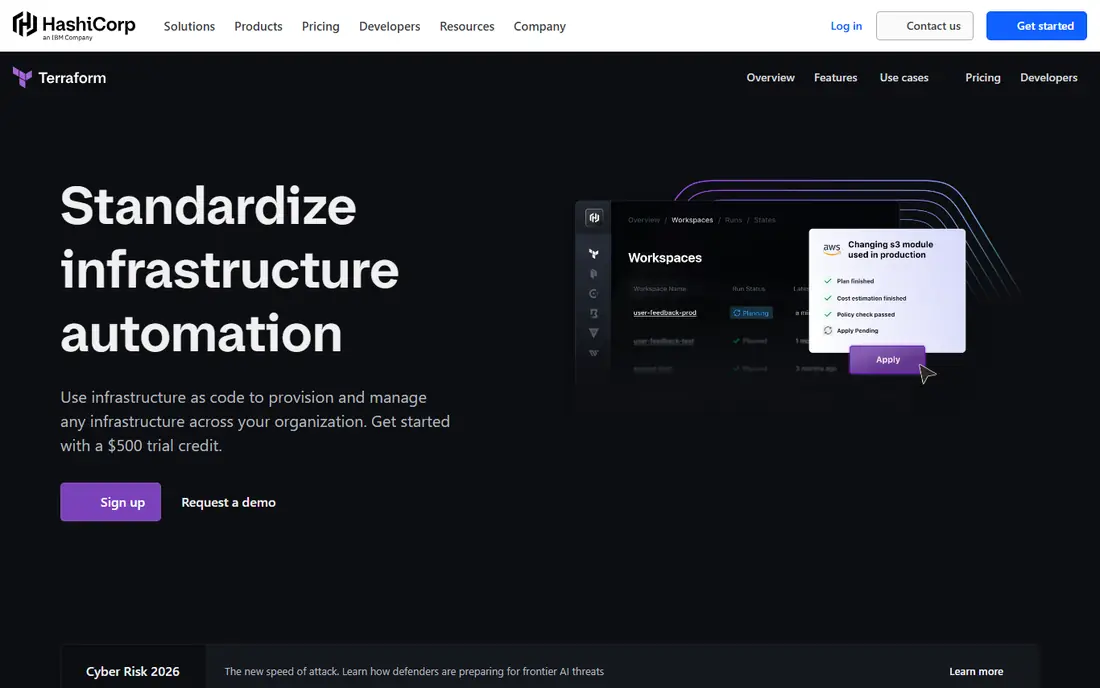
Terraform remains the default for provisioning across AWS, Azure, and Google Cloud from one workflow. You describe resources in HCL, preview changes with a plan, and apply them in a controlled way. The managed cloud version, HCP Terraform, adds remote state, team runs, and policy checks, with a free tier covering up to 500 managed resources.
The main point to understand is licensing. Terraform is now under the Business Source License, which restricts some commercial uses, and that pushed part of the community toward OpenTofu. Paid HCP Terraform pricing is usage-based, at $0.10 per resource per month on the Essentials tier, so costs grow with your estate. For most multi-cloud teams, though, the ecosystem and hiring pool still make it the first tool to evaluate.
- Huge provider ecosystem
- Plan previews before applying
- Managed state and runs in the cloud version
- Business Source License, not fully open source
- Costs scale per managed resource on paid tiers
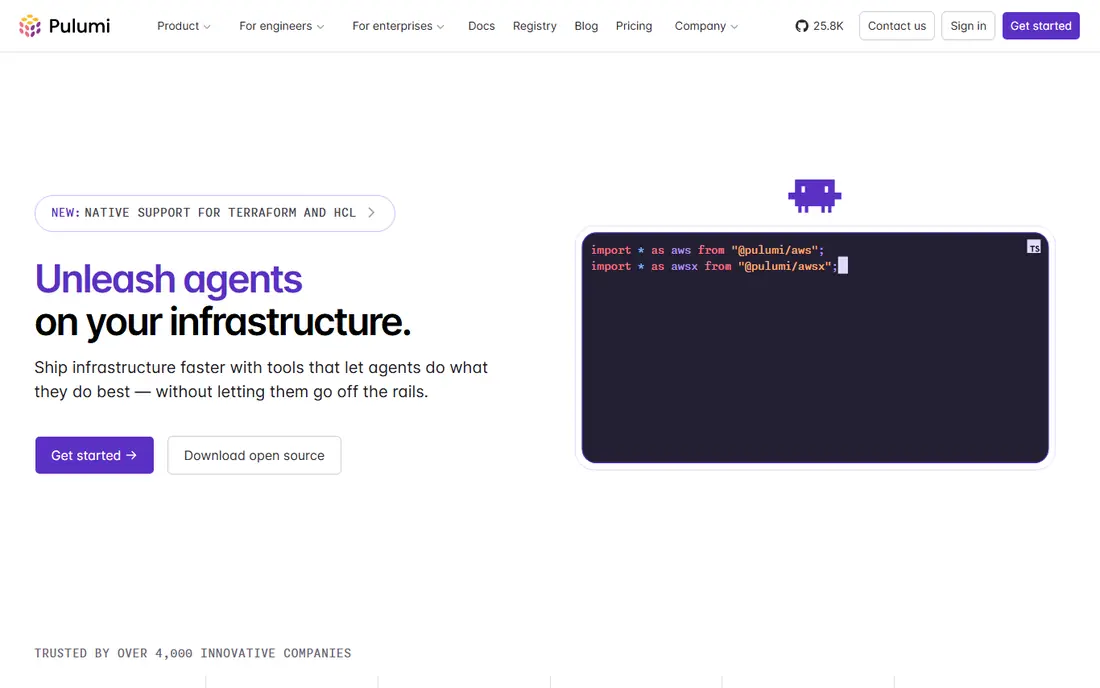
Pulumi lets software engineers define infrastructure in the same languages they use for applications, with loops, functions, and tests. That appeals to teams that find config languages limiting, and it makes reuse through packages feel natural. Pulumi Cloud adds state, runs, and policy, with a free individual tier and an Essentials team tier from $40 per month.
The trade-off is ecosystem size. Terraform has more providers and more examples for unusual resources, so Pulumi teams sometimes write more themselves. Credit-based pricing also needs care: the base fee includes a credit pool, and usage above it is billed separately. If your team is strong in code and wants infrastructure to feel like software, Pulumi is a serious alternative.
- Use TypeScript, Python, Go, and other languages
- Strong testing and reuse
- Managed cloud option
- Smaller ecosystem than Terraform
- Credit-based pricing can be hard to forecast
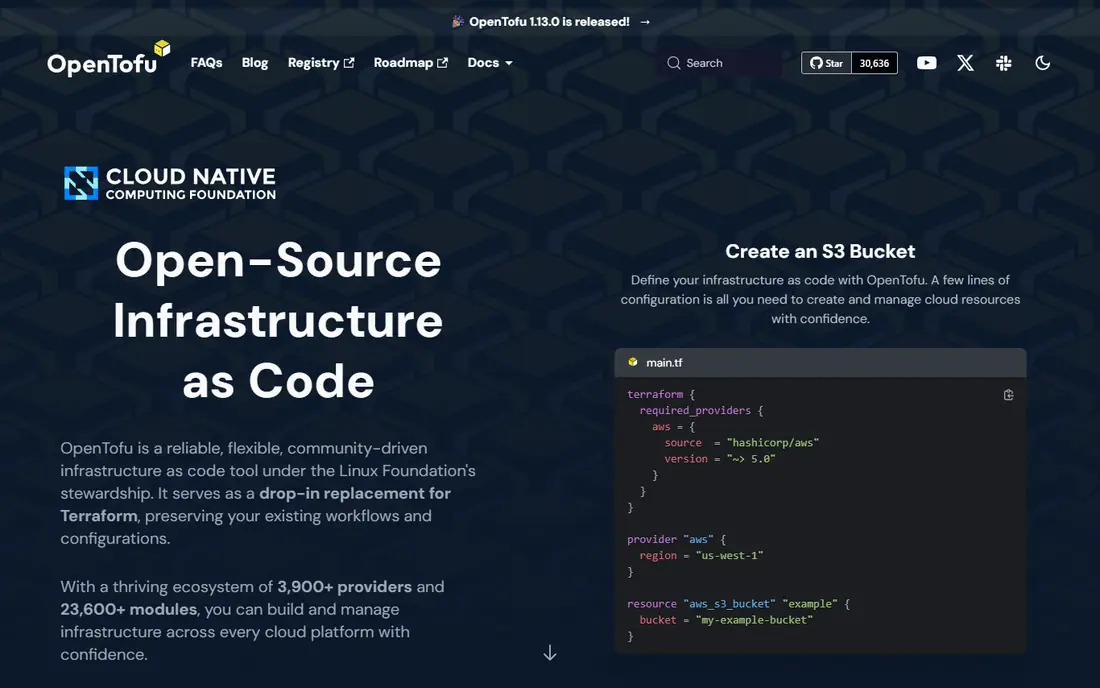
OpenTofu is a fork of Terraform created after the license change, and it keeps the familiar workflow under an open-source license. Teams that want to avoid the Business Source License, or that prefer a community-governed project, can often move existing Terraform code with modest changes. The core tool itself is free, and you can run it with your own state backend.
There is no single managed cloud service behind OpenTofu in the way HCP Terraform backs Terraform, so teams usually pair it with a platform like Spacelift or env0, or run it in CI. That is fine for platform teams with the skills to run it, but smaller teams may prefer the managed path. Test a migration on a non-critical stack before moving production.
- Open-source license
- Compatible with much Terraform code
- Community-driven
- Smaller ecosystem and fewer managed services
- Migration still needs testing
Ansible is best understood as an operations tool rather than a provisioning tool. It connects over SSH, applies configuration, installs packages, and runs tasks across servers without agents. Playbooks are written in YAML and read like a task list, which makes them approachable for operations staff who do not write code all day.
It can provision cloud resources, but it does not track desired state as carefully as Terraform, so drift is harder to catch. Many teams use both: Terraform provisions, Ansible configures. The core tool is free and open source, while Red Hat Ansible Automation Platform is the paid, supported version with a quoted price. If your main pain is configuration drift on existing servers, start here.
- Agentless and easy to learn
- Strong for configuration and patching
- Huge module library
- Not a full provisioning replacement
- Large runs need care with speed and state
CloudFormation is the native way to define AWS infrastructure as templates, and there is no separate tool fee: you pay only for the AWS resources you create. It covers AWS services deeply, works with AWS Organizations and Config for governance, and fits teams that have standardized on AWS. Stacks, change sets, and drift detection are built in.
The limit is obvious: it does not help with Azure or Google Cloud, and templates in JSON or YAML can become long. Teams that use the AWS CDK can write CloudFormation in code instead, which helps. If you are all-in on AWS and want the least extra tooling, CloudFormation is the pragmatic choice.
- Native to AWS with no tool fee
- Deep service coverage
- Integrates with AWS governance tools
- AWS only
- Templates can grow large and hard to read
Bicep is Microsoft's language for deploying Azure resources, and it compiles down to ARM templates. Compared with writing ARM JSON by hand, Bicep is shorter, easier to read, and less error-prone, with modules and parameters that encourage reuse. There is no tool fee, and deployment runs through Azure itself.
Like CloudFormation, Bicep is single-cloud by design. If your estate spans clouds, you will still need a multi-cloud tool alongside it. For an Azure-focused team, though, Bicep removes a lot of friction, and it pairs well with Azure Policy for guardrails. It is a good default for teams that live in the Microsoft world.
- Cleaner syntax than raw ARM templates
- Free and open source
- Native Azure deployment
- Azure only
- Smaller community than Terraform
Spacelift is not another provisioning language. It is a platform that runs the tools you already use, with pull-request previews, approvals, policy checks, and drift detection layered on top. It supports Terraform, OpenTofu, Pulumi, Ansible, CloudFormation, and others, so a team with a mixed estate can govern it from one place. A free tier covers small use, and paid plans scale by workers.
The cost of that control is complexity and price opacity: paid plans are largely quoted, and published figures vary by source, so we list See website. Spacelift makes most sense once you have several teams, several clouds, or compliance needs that plain CI runs cannot meet. Smaller teams can often get by with CI plus HCP Terraform or Pulumi Cloud.
- Runs Terraform, Pulumi, Ansible, and more
- Policy as code
- Private workers and drift detection
- Paid pricing is largely quoted
- Adds a platform to learn and run
env0 provides managed runs, environment lifecycle management, and governance for infrastructure as code. It helps teams spin up review environments, run plans and applies with approvals, and track costs across environments. A free tier covers a limited number of runs and environments, which is enough to evaluate it properly.
Paid pricing is quoted and often tied to applies or environments, so total cost depends on how your team works. That makes it hard to compare on sticker price alone. If your pain is environment sprawl, slow reviews, or inconsistent runs across teams, env0 is worth a trial. If you only run a handful of stacks, a simpler managed option may be enough.
- Managed runs for Terraform and related tools
- Environment management
- Policy and cost controls
- Paid pricing is quoted
- Per-environment pricing needs careful budgeting
Crossplane turns Kubernetes into a control plane for cloud infrastructure. You define cloud resources as Kubernetes objects, and Crossplane reconciles them toward the desired state, just as Kubernetes does for containers. That fits platform teams already running Kubernetes and using GitOps, since infrastructure and applications can share the same workflow.
The barrier is Kubernetes itself. Teams without that skill will find Terraform or Pulumi faster to adopt. Crossplane is free and open source, with paid managed control planes available from vendors such as Upbound. For a platform team building an internal developer platform on Kubernetes, it is a powerful and distinctive choice.
- Manage cloud resources with Kubernetes APIs
- GitOps-friendly
- Composable platform building
- Requires Kubernetes skill
- Steeper learning curve for non-Kubernetes teams
How we picked these
We compared official documentation and pricing pages for tools that provision, configure, or govern cloud infrastructure, and we favored tools that are actively maintained and widely used in 2026. We included both languages and platforms, because many teams use one of each. Where pricing is quoted or usage-based in a way that varies by estate, we wrote See website. We did not claim hands-on testing; our comparison rests on vendor docs, pricing pages, and public comparisons.
Choosing between the main approaches
Start by listing your clouds. One cloud points toward the native tool for that cloud, often with Terraform or Pulumi alongside it for anything shared. Multiple clouds point toward Terraform, OpenTofu, or Pulumi as the core language, with a platform like Spacelift or env0 if governance becomes a bottleneck. Kubernetes-heavy teams should also weigh Crossplane.
State, policy, and drift
Whatever language you pick, settle three questions early: where state lives, who can approve an apply, and how you detect drift. Managed services handle state for you, while self-run tools need a backend you maintain. Policy checks catch risky changes before they apply, and drift detection tells you when someone changed a resource by hand. These controls matter more as team size grows.
FAQ
What is the best cloud infrastructure automation software for a small team?
For a small multi-cloud team, HCP Terraform on its free tier or Pulumi Cloud on its free individual tier are both strong starts. A single-cloud team can often start with CloudFormation or Bicep at no tool cost. Add a governance platform only when reviews, approvals, or drift become real problems, not before.
What are the best cloud infrastructure automation tools for large enterprises?
Large enterprises usually combine a provisioning language like Terraform or Pulumi with a platform such as Spacelift or env0 for runs, policy, and audit trails. That combination gives central control without forcing every team onto one language. Budget for the platform on top of cloud costs, and confirm support for your compliance needs during a trial.
Is OpenTofu a safe replacement for Terraform?
OpenTofu aims for compatibility with much existing Terraform code, and many teams have moved successfully. It is still a separate project with its own release pace, so migration needs testing, especially for providers and modules you rely on. Run a pilot on a lower-risk stack, check provider support, and confirm your governance platform supports OpenTofu before a full move.
Do I need Ansible if I already use Terraform?
Often yes, for different work. Terraform provisions resources, while Ansible configures what runs on them, patches systems, and handles day-to-day operations. Many teams use both, with Terraform creating servers and Ansible setting them up. If your servers are immutable images built once and replaced rather than patched, you may need less Ansible.
How much does cloud infrastructure automation software cost?
Core tools are often free: OpenTofu, Ansible, CloudFormation, Bicep, and Crossplane carry no tool fee, though you pay for the cloud resources they create. Managed services add cost: Pulumi Cloud Essentials starts at $40 per month, HCP Terraform Essentials is usage-based from $0.10 per resource per month, and platforms like Spacelift and env0 are quoted. Always model cost at your resource count, not at the free tier.
Sources
- https://www.hashicorp.com/products/terraform
- https://www.pulumi.com/pricing/
- https://opentofu.org
- https://www.ansible.com
- https://aws.amazon.com/cloudformation/
- https://learn.microsoft.com/en-us/azure/azure-resource-manager/bicep/
- https://spacelift.io/pricing/
- https://www.env0.com/pricing/
- https://www.crossplane.io