Best Children Learning Software for Science for 2026: Our 5 Vetted Picks
Need the best children learning software for science? We compare 5 tools on cost, free access and who each suits. Short verdicts, no fluff. Facts only.
- Editor's choiceMinecraft Education
Game-based classroom exploration and building
Starts atSee websiteVisit education.minecraft.netFull review - Great alternative
 Kahoot.
Fast game-based review and engagement
Starts at$3 a monthVisit kahoot.comFull review - Also considerLegends of Learning
Standards-aligned science learning games
Starts at$790 a year per teacherVisit legendsoflearning.comFull review
Direct answer
Minecraft Education is the first pick on this list for game-based classroom exploration and building. Listed starting prices: Kahoot. from $3 a month, Legends of Learning from $790 a year per teacher and Nearpod from $159 per year. Kahoot. Is better for fast game-based review and engagement, and Legends of Learning is better for standards-aligned science learning games. All 5 tools are compared below on price, free plan and limits.
TL;DR:
- Top of the list is Minecraft Education, which targets game-based classroom exploration and building.
- Free plans exist at 2 of 5 tools (Kahoot., Nearpod).
- Kahoot. Is the lowest-priced starter here at $3 per month.
- Kahoot. Comes with a trade-off: not a full curriculum.
- For ready-to-teach elementary science lessons, Mystery Science is worth a look.
Last checked November 2026. Prices and plan details were read from the vendors' own pages in November 2026; vendors change plans often, so confirm the current price on the vendor site before you buy.
Quick comparison
| Tool | Best for | Starts at | Free plan? | |
|---|---|---|---|---|
| Minecraft Education | Game-based classroom exploration and building | See website | Not stated | Visit |
| Kahoot. | Fast game-based review and engagement | $3 a month | Yes | Visit |
| Legends of Learning | Standards-aligned science learning games | $790 a year per teacher | Not stated | Visit |
 Nearpod | Interactive lessons with active participation | $159 per year | Yes | Visit |
| Mystery Science | Ready-to-teach elementary science lessons | $149 a year | Free trial | Visit |
Tool-by-tool breakdown
LinkVetted put together this guide to children learning software for science for readers who want a clear shortlist without reading every vendor page. It compares 5 tools on starting price, free plans, who each one suits and where each one falls short.
Minecraft Education
Best for: Game-based classroom exploration and building
Minecraft Education serves game-based classroom exploration and building. Minecraft Education brings the game into the classroom for teaching and learning. Its open sandbox encourages building, exploration and collaboration, and educators can shape activities around topics for example ecosystems, chemistry and physics.
What to check first: Science content relies on lesson design.
Families wanting structured science instruction may find it too open-ended. From a buyer's view, choose it when engagement, creativity and collaborative projects are the priority. This comparison lists no price for Minecraft Education; ask the vendor. As for free access: Not stated.
- Supports collaborative classroom projects
- Familiar game environment
- Needs setup and guidance
Kahoot. Is aimed squarely at fast game-based review and engagement. Kahoot. Does not supply a complete science curriculum on its own, so it fits best alongside lessons and reading.
Trade-offs to know: not teaching new content.
As for the details, pick it as an engagement layer instead of a primary science program. On cost, Kahoot. Starts like this: $3 per month. A free plan is available with Kahoot.
- Encourages participation
- Quick to run in groups
- Not a full curriculum
Legends of Learning
Best for: Standards-aligned science learning games
For standards-aligned science learning games, Legends of Learning is a natural candidate. Legends of Learning gives you science, history and math learning games built to engage students and support achievement. Its science games are aligned to standards and reviewed by educators, making it a practical choice for teachers who want game-based practice that links to classroom goals.
Trade-offs to know: Game format may not suit every learner.
Some children may find the game format distracting. Game-based learning does not replace explanation, discussion or practical investigation, so it fits best as part of a broader plan. Legends of Learning pricing: $790 per year per teacher. Trial and free access: Not stated.
- Science-focused game library
- Aligned to standards
- Best paired with instruction
Nearpod was built for interactive lessons with active participation. Choose Nearpod when interactivity and participation during lessons are the central goals.
In practice, Nearpod is a presentation and interaction layer, so the science substance comes from the lessons you add. Worth adding: teachers can build interactive science lessons with questions, activities and checks for understanding, keeping students involved throughout a session. Entry price for Nearpod: $159 per year. Nearpod offers a free plan.
Where it is weaker: Not science-specific.
- Encourages student participation
- Builds active learning experiences
- Needs lesson content to be added
Mystery Science
Best for: Ready-to-teach elementary science lessons
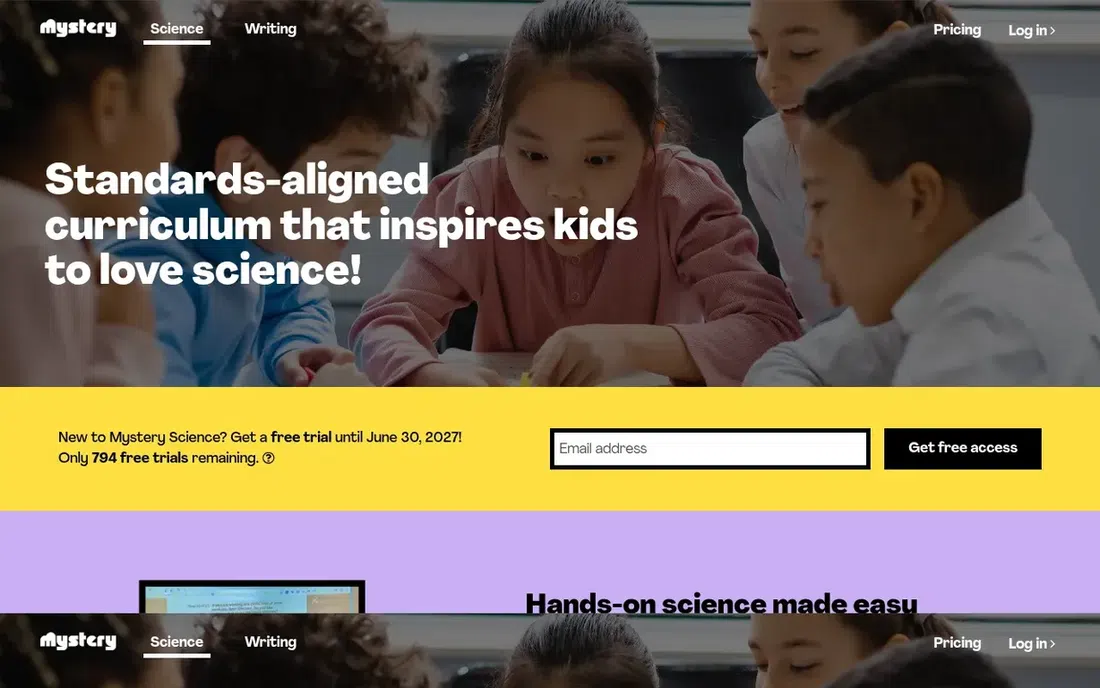
Where Mystery Science fits: ready-to-teach elementary science lessons. Each lesson includes a hook, visuals and an activity already prepared, so educators can spend less time assembling materials and more time guiding discussion. In daily use, teachers who want full lab programs or advanced topics should look at broader systems.
Drawbacks to consider: Less suited to older students.
Worth adding: choose Mystery Science when the priority is straightforward, engaging lessons that are fast to deliver. The emphasis on curiosity-driven questions makes it a natural fit for younger learners. As for the details, since the design targets elementary classrooms, it may feel restricted for middle or high school science needs. Entry price for Mystery Science: $149 per year. Free plan details: Free trial.
- Visuals and activities
- Open-and-go lesson format
- Concentrated on elementary level
Selection criteria
LinkVetted used vendor pricing pages and product documentation as the base, then compared plans, free access and documented limits for 5 tools. Treat prices as a snapshot: vendors change plans often, so check the vendor site for the figure that applies today. The order reflects how well each tool fits the most common buying scenario for children learning software for science, then price clarity, then free plan access. It is a starting point, not a verdict.
Questions to settle before buying
- Get a written quote from Minecraft Education; the list shows no starting price for them.
- Check what the free option really includes: Kahoot. And Nearpod offer a free plan, and usage caps differ.
- Take the trial from Mystery Science and push a live task through it before you pay.
- Before choosing Minecraft Education, weigh its main limit: needs setup and guidance.
- Look at the help docs and support options for Minecraft Education before you commit.
- Confirm you can export your data from Legends of Learning, so leaving later does not mean losing records.
FAQ
Is Minecraft Education the right pick for everyone comparing children learning software for science?
No single tool suits every team. Minecraft Education comes first because it fits game-based classroom exploration and building, while Kahoot. Suits quick game-based review and engagement and Legends of Learning suits standards-aligned science learning games. Match the tool to your own size, budget and workflow before deciding.
Which options for children learning software for science have a free plan?
On this list, Kahoot. And Nearpod include a free plan. Caps on seats, usage or features are common, so test the free plan against your real workload. One other tool offers a trial instead.
What is the cheapest option for children learning software for science in this list?
On published monthly entry prices, Kahoot. Is the lowest here at $3 per month. Entry price is only part of the cost, because seats, add-ons and billing terms can change the total. Prices, free plan details and limits for all 5 tools in this Children learning software for science roundup sit on the individual cards above.
Can I try these tools before paying?
Often, yes. Kahoot. And Nearpod have a free plan and Mystery Science offers a free trial. Use your own data and a real task during the test, and check what the free tier or trial limits before you rely on it.
Sources
- https://education.minecraft.net
- https://kahoot.com
- https://www.legendsoflearning.com
- https://nearpod.com
- https://mysteryscience.com