Best Cash Management Software in 2026: 9 Tools Compared
Compare the best cash management software for visibility, forecasting, payments and risk, from Kyriba and Trovata to Agicap, HighRadius and GTreasury.
- Editor's choice
 Kyriba
Global enterprise treasury
Starts atSee websiteVisit kyriba.comFull review - Great alternative
 Trovata
Mid-market cash visibility
Starts atSee websiteVisit trovata.comFull review - Also consider
 HighRadius
Treasury linked to receivables
Starts atSee websiteVisit highradius.comFull review
TL;DR:
- Kyriba, GTreasury and ION Treasury suit large companies with many banks, entities and currencies, but they are priced by quote and take time to implement.
- Trovata, Agicap and Tesorio suit mid-market teams that want faster cash visibility and forecasting without a full enterprise treasury system.
- HighRadius connects cash forecasting to receivables, which helps when late customer payments are the real cause of cash swings.
- Most enterprise tools do not publish prices, so budget from a scoped quote that lists banks, entities, users and modules.
- This article is general information only and is not financial advice.
Quick comparison
| Tool | Best for | Starts at | Free plan? | |
|---|---|---|---|---|
| Kyriba | Global enterprise treasury | See website | No | Visit |
| Trovata | Mid-market cash visibility | See website | No | Visit |
| HighRadius | Treasury linked to receivables | See website | No | Visit |
 GTreasury | Flexible enterprise treasury | See website | No | Visit |
 ION Treasury | Deep treasury and risk | See website | No | Visit |
 Agicap | Cash flow planning for smaller teams | See website | Free trial | Visit |
 Tesorio | Cash forecasting from receivables | See website | No | Visit |
 Bottomline | Payments and cash management | See website | No | Visit |
 Coupa Treasury | Treasury inside Coupa spend | See website | No | Visit |
The best cash management software
Cash management software pulls bank balances together, forecasts cash flow and helps finance teams plan payments and borrowing. We compared official product pages, bank connectivity, forecasting features and pricing models, and we kept tools that currently serve companies in the United States. This is general information, not financial advice, and treasury decisions should be reviewed with your finance and banking advisers.
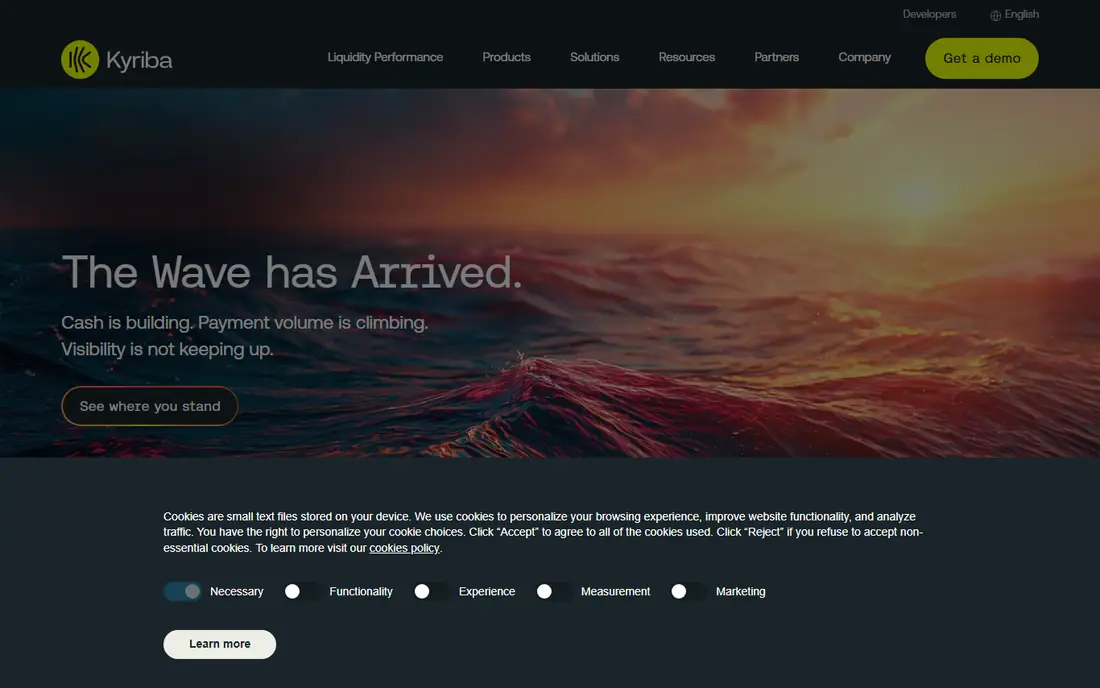
Kyriba is the default shortlist pick for large multinationals. It connects to thousands of banks, consolidates balances across accounts and entities, and adds payments, foreign exchange, debt and investment workflows in the same platform. For a treasury team managing many currencies and subsidiaries, that breadth reduces the spreadsheet work that grows with every new bank account.
The trade-off is cost and effort. Kyriba is priced by quote, and a global rollout needs clean bank data, user roles and approval workflows. Smaller companies will find it heavy, but large teams that need audit trails, payment controls and risk reporting will find the depth hard to match.
- Very broad bank connectivity
- Cash, payments, risk and liquidity in one system
- Strong controls for large teams
- Quote-based pricing
- Implementation can take months for complex global setups
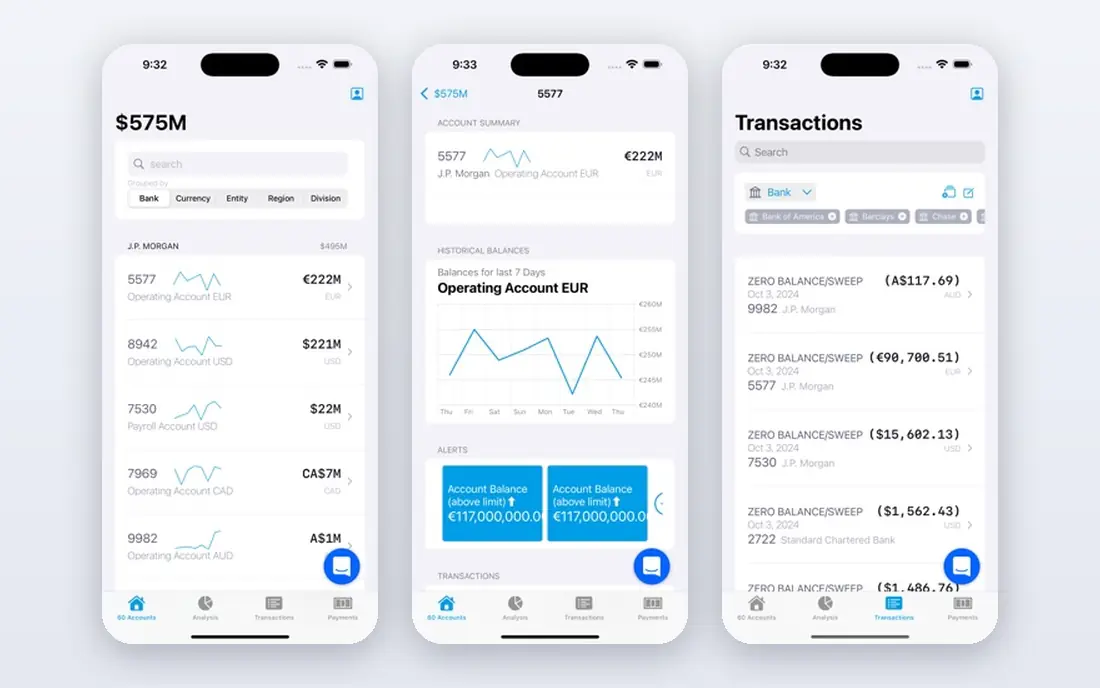
Trovata suits mid-market finance teams that want real cash visibility in weeks rather than months. It connects directly to banks through APIs, refreshes balances automatically and builds forecasts from actual and planned activity. Transaction search and tagging help teams explain cash movements without rebuilding a spreadsheet each week.
The limit is scope. Trovata covers cash visibility and forecasting well, but companies that need deep hedge accounting, complex debt schedules or full payments factories may still need a larger treasury system. For teams replacing Excel as the main cash tool, Trovata is often the fastest credible step up.
- API-based bank connections with fast setup
- Clear cash positioning and forecasting
- Modern interface
- Less depth than full enterprise treasury systems for complex risk and hedge accounting
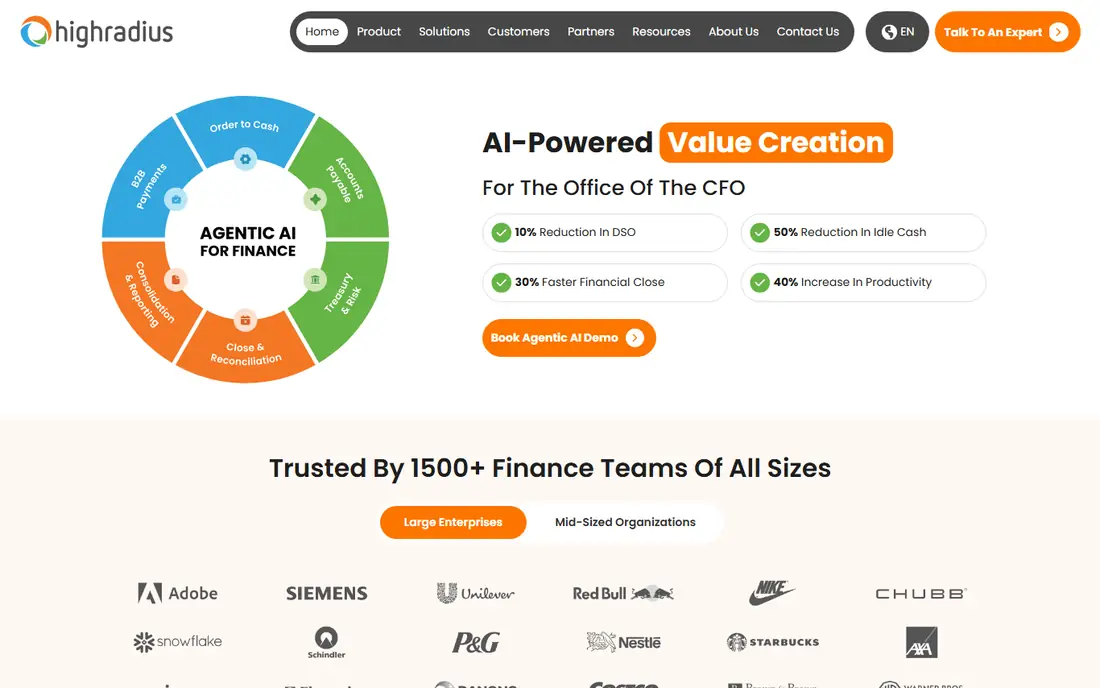
HighRadius is a strong pick when cash problems start with customer payments. Its treasury and receivables tools share data, so forecasts reflect expected collections, payment behavior and open invoices rather than a separate guess. That link helps finance teams spot which customers or invoices are driving a forecast change.
The catch is fit. If your cash flow is driven mainly by payroll, inventory or capital spending, a pure treasury tool may serve you better. If late payments and collections drive most of your variance, HighRadius addresses the cause instead of only modeling the result.
- Connects treasury to order-to-cash and receivables
- AI-assisted forecasting
- Strong automation for collections
- Quote-based pricing
- Best value when receivables are a major part of cash flow
GTreasury offers a modular treasury system that teams can shape around cash management, payments, forecasting and financial risk. That flexibility suits companies that have outgrown spreadsheets but do not want to buy every enterprise module at once. Cash positions, bank connectivity and reporting are central, with risk and debt tools added as needed.
The main risk is buying modules you do not use. Ask for a quote that maps each module to a named use case, such as daily cash positioning, payment approvals or foreign exchange exposure, and confirm which modules are included in the base price.
- Modular treasury workstation
- Cash visibility, payments and risk tools
- Usable for mid-market and enterprise teams
- Quote-based pricing
- Module choices need careful scoping
ION Treasury covers a family of treasury products, including Wallstreet Suite, IT2 and City Financials, which serve different segments from mid-market to large financial institutions. The strength is depth in financial markets, risk analytics, hedge accounting and investment management, which matters for companies with large trading or investment books.
The trade-off is selection complexity. The right ION product depends on your size, your instruments and your existing systems, so a guided scoping call matters more than a feature list. Smaller teams should confirm that the proposed product fits their scale before committing to an enterprise-grade rollout.
- Deep treasury, risk and investment functionality
- Portfolio of products for different company sizes
- Strong for complex financial markets work
- Quote-based pricing
- Product choice across the ION portfolio needs guidance
Agicap suits finance teams that still run cash planning in spreadsheets and want a clearer, shared forecast. It connects to banks, pulls in actual balances and helps teams build scenarios for payments, receipts and hiring plans. The interface is built for finance managers and owners, not only for trained treasury specialists.
The limit is enterprise depth. Companies with many entities, complex hedging or strict payment factory controls may outgrow Agicap. For a single-entity or small multi-entity business, the speed of setup and the clarity of the forecast are the main advantages.
- Cash flow planning built for smaller and mid-market teams
- Bank connections and scenario planning
- Faster to adopt than enterprise systems
- Less enterprise treasury depth for complex global risk
- Pricing by quote in many markets
Tesorio helps B2B finance teams forecast cash from what customers actually owe and when they are likely to pay. By linking invoices, payment behavior and collections work, it gives a forecast that updates as collections progress. That is valuable when a monthly forecast swings because a few large invoices slip by a week or two.
The catch is scope. Tesorio is not a full payments, risk and debt platform, so companies that need those functions will pair it with a treasury system or a bank platform. Use Tesorio when collections timing is your main forecasting problem.
- Cash flow forecasting tied to receivables and collections
- Clear view of expected payment timing
- Useful for B2B companies
- Focused on receivables-driven forecasting, not a full treasury system
Bottomline serves companies that need reliable payments and cash management alongside fraud prevention. Its tools cover business payments, cash management and secure payment workflows, which matter for teams processing many supplier, payroll or customer payments each month. Controls and audit trails help finance teams reduce payment fraud risk.
The trade-off is product matching. Bottomline offers several business lines, so confirm that the product you are quoted covers your payment types, bank connections and approval workflows. A payments-led buyer will value Bottomline more than a buyer who mainly needs forecasting.
- Payments, cash management and fraud controls
- Bank connectivity for US businesses
- Strong for payment operations
- Quote-based pricing
- Product breadth varies by business line
Coupa Treasury suits companies already running Coupa for procurement, invoicing and spend management. Adding treasury gives finance a shared view of committed spend, payments and cash, which helps forecast cash outflows from purchase orders and invoices already in the system. That link reduces duplicate data entry between procurement and treasury.
The limit is ecosystem fit. If you do not use Coupa, a standalone treasury tool such as Kyriba, GTreasury or Trovata may be simpler. If Coupa is already your spend system, the shared data and single vendor relationship are real advantages.
- Treasury view inside the Coupa spend platform
- Links cash to procurement and payments
- Useful for existing Coupa customers
- Best value inside the Coupa ecosystem
- Standalone treasury buyers may prefer a specialist tool
How we picked these
We compared official product pages, bank connectivity, forecasting and payments features, and pricing models for tools that currently serve US companies. We included enterprise treasury systems, mid-market cash platforms and receivables-led forecasting tools, because cash management problems differ by company size and by whether payments, collections or risk drive the forecast.
What to scope before you request a quote
Start with your bank and entity count. A quote that does not list how many banks, accounts, entities and currencies are included is not comparable with another quote. Add user count, payment volumes and the modules you need, such as forecasting, payments, risk or collections, and ask whether implementation, training and bank onboarding are included.
Next, test data quality. Cash tools are only as good as the bank feeds and ERP data behind them. Confirm that your banks support the connection method the vendor proposes, and run a pilot with real balances for two to four weeks before a full rollout. A pilot will reveal missing accounts, timing gaps and forecast errors that a demo will not show.
Finally, check controls and audit needs. Payment approvals, segregation of duties, audit logs and fraud controls matter as much as forecasting charts. Confirm who can approve payments, how changes are logged, and how the tool handles bank credential security and user access when staff change roles.
FAQ
What is cash management software?
Cash management software connects bank accounts, shows current cash positions, forecasts future cash flow and helps teams plan payments, borrowing and investments. It replaces manual spreadsheet consolidation with automated bank feeds and shared forecasts.
Is this financial advice?
No, this article is general information about software features and pricing models, not financial advice for your company. Treasury, borrowing and investment decisions should be reviewed with qualified finance advisers and your banks.
How much does cash management software cost?
Enterprise treasury systems are usually priced by quote and can run into five or six figures a year, while mid-market tools start lower and are scoped by banks, entities and users. Always request a written quote that lists modules, implementation and bank onboarding separately.
What is the difference between cash management and treasury management?
Cash management focuses on daily balances, payments and short-term forecasting, while treasury management adds longer-term liquidity, risk, debt and investment management. Many enterprise tools cover both, while smaller tools focus on cash visibility and forecasting.
Do I need cash management software if I use my bank portal?
A bank portal shows balances at one bank, while cash management software combines many banks, forecasts future cash and links to invoices and payments. Companies with one bank and simple cash flow may not need a separate tool, while multi-bank companies usually benefit.
How long does implementation take?
Mid-market cash platforms can go live in weeks if bank connections are straightforward, while enterprise treasury systems can take several months for global, multi-entity rollouts. Data cleanup, bank onboarding and approval workflows usually take longer than software setup itself.