Best Case Management Software for Law Firms in 2026: 8 Tools Compared
Compare the best case management software for law firms for matters, deadlines, billing and trust accounting, with pricing and honest limits in 2026 today.

- Editor's choice
 Clio Manage
Firms of all sizes
Starts at$49 per user per monthVisit clio.comFull review - Great alternative
 MyCase
Solo and small firms
Starts at$49 per user per monthVisit mycase.comFull review - Also consider
 PracticePanther
Automation-focused firms
Starts at$49 per user per monthVisit practicepanther.comFull review
TL;DR:
- Clio, MyCase and PracticePanther are the strongest all-round picks for small to mid-size firms, each starting around $49 per user per month in many listings.
- Filevine and CASEpeer suit litigation and personal injury firms with phase-based workflows and settlement tracking.
- CosmoLex suits firms that want built-in trust accounting without QuickBooks, while Smokeball suits document-heavy firms.
- Rules-based calendaring and trust accounting are not optional extras for litigation firms, so check them before price.
- Migration is painful, so trial with real matters and test billing, deadlines and client portal access before you commit.
Quick comparison
| Tool | Best for | Starts at | Free plan? | |
|---|---|---|---|---|
| Clio Manage | Firms of all sizes | $49 per user per month | Free trial | Visit |
| MyCase | Solo and small firms | $49 per user per month | Free trial | Visit |
| PracticePanther | Automation-focused firms | $49 per user per month | Free trial | Visit |
 Filevine | Litigation and personal injury | See website | Free trial | Visit |
 Smokeball | Document-heavy firms | See website | Free trial | Visit |
 CosmoLex | Built-in trust accounting | See website | Free trial | Visit |
 CASEpeer | Personal injury firms | See website | Free trial | Visit |
 Rocket Matter | Simple matter management | $39 per user per month | Free trial | Visit |
The best case management software for law firms
Good case management software keeps matters, deadlines, documents, billing and client messages in one place. The tools below differ by practice area, firm size and accounting needs, so match the tool to your work, not just to price.

Clio Manage is the most widely used cloud platform in this group, and its strength is breadth. Matters, documents, time tracking, billing, online payments and a client portal sit together, with more than 200 integrations for accounting, email and document tools. That ecosystem helps a firm keep its existing tools while centralising case work.
The entry price covers core features, but workflow automation, advanced reporting and some intake tools sit on higher tiers. Budget for the tier you actually need, not just the headline price. For a general practice that wants a mature, well-supported platform, Clio is the safest default.
- Large integration ecosystem
- Client portal and billing
- Scales from solo to large firms
- Advanced features need higher tiers
- Cost rises as modules are added
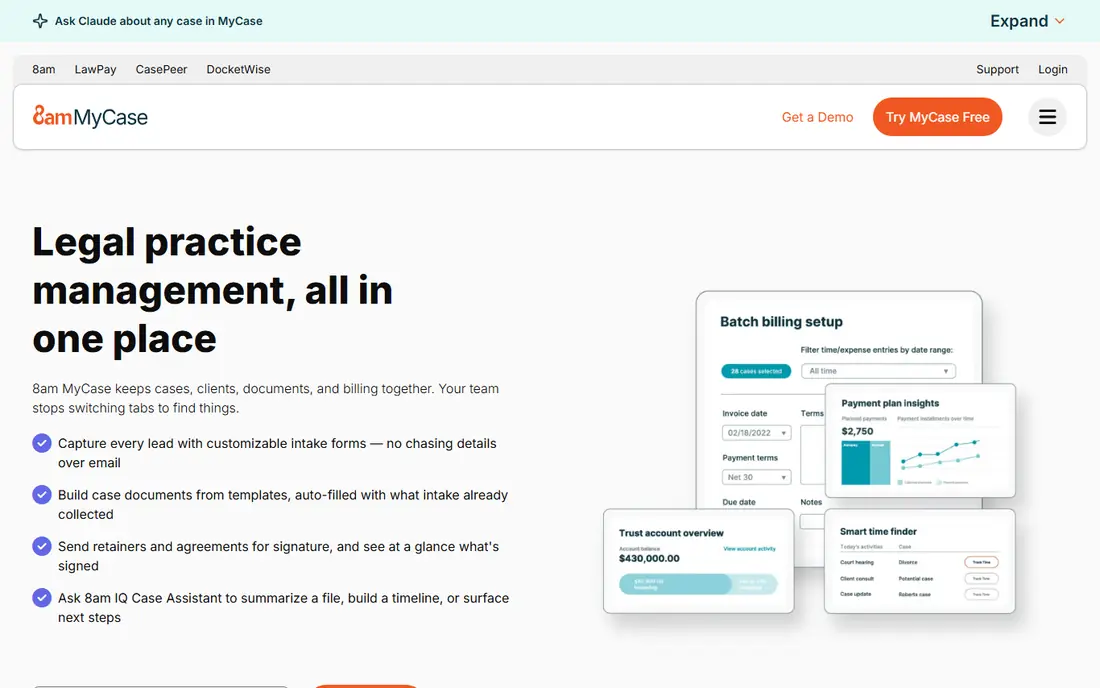
MyCase suits solo attorneys and small firms that want an all-in-one tool without a steep setup curve. The client portal, built-in texting, document sharing and billing cover the daily work of a consumer-facing practice, and the interface is easy for new staff to learn. That simplicity is a real advantage for a firm without IT support.
Larger litigation firms may want deeper workflow customisation than MyCase offers. For a firm of one to five attorneys, though, MyCase hits a good balance of price, ease and completeness, and its support is well regarded by small firm users.
- Built-in client portal and texting
- Simple, approachable interface
- Billing and payments included
- Less customisation than Filevine
- Some advanced reporting needs higher tiers

PracticePanther appeals to firms that want automation without hiring a developer. Rule-based workflows can create tasks, send reminders and move matters forward, while two-way business texting and unlimited eSignatures on many plans reduce separate subscriptions. Native payments also speed collections.
The full automation value sits on higher tiers, so check plan details before you trial it. For a billing-heavy practice that wants to automate routine steps and keep clients informed by text, PracticePanther is a strong, intuitive alternative to Clio and MyCase.
- Code-free workflow automation
- Two-way texting and eSignatures
- Native payments
- Higher tiers needed for fuller automation
- Interface can feel busy at first
Filevine is built for litigation-heavy work, especially personal injury and mass tort. Phase-based workflows track a case from intake to settlement, with custom fields, deadlines, medical timelines and reporting that general tools cannot match. That structure helps a firm manage many similar cases without losing track of stages.
Customisation is both the strength and the cost. Setup takes time, training matters, and pricing is by quote. For a PI or litigation firm with volume, that investment pays back. For a small general practice, Filevine is likely more tool than you need.
- Phase-based litigation workflows
- Deep customisation and reporting
- AI intake and document tools
- Quote-based pricing
- Setup and training take time
Smokeball stands out for automatic time capture. Its AutoTime feature records time spent on documents and emails, which helps firms bill more accurately without manual timers. A library of thousands of legal forms and strong Microsoft integration also suit document-heavy practices.
Pricing is by quote and can be higher than entry-level rivals, especially on full tiers. If your firm loses billable time to manual tracking, Smokeball can pay for itself. If you mainly need simple matter lists and billing, a cheaper tool may serve you just as well.
- Automatic time capture
- Large legal form library
- Strong document and email integration
- Quote-based pricing
- Less suited to firms that need simple, cheap matter tracking
CosmoLex solves an accounting problem that generic tools cannot. It includes native legal accounting with trust account management, three-way reconciliation and matter-based billing, so a firm does not need QuickBooks to run its books. That integration reduces errors and reconciliation work for firms that handle client funds.
The starting price is higher than entry-level case tools, and the integration library is smaller than Clio. For a firm where trust accounting is a daily concern, CosmoLex is worth the premium. For a firm that already runs QuickBooks well, a case tool with a QuickBooks sync may be cheaper.
- Native trust and operating accounting
- IOLTA-compliant workflows
- No QuickBooks needed for core books
- Higher starting price in many listings
- Fewer integrations than Clio
CASEpeer is purpose-built for personal injury firms. Matter templates, settlement calculators, lien tracking and PI reporting reflect how those cases actually run, rather than forcing a general template to fit. That focus saves setup time for a PI firm and gives clearer visibility on case value.
Outside personal injury, that focus becomes a limit. A general practice with mixed work will find CASEpeer too narrow, and pricing is by quote. For a dedicated PI firm, though, it is one of the most tailored options in this list.
- PI-specific matter templates
- Settlement and lien tracking
- Reporting built for PI practices
- Narrow focus outside personal injury
- Quote-based pricing
Rocket Matter keeps matter management simple. Kanban boards show case stages at a glance, invoicing is fast, and setup is quick for a small firm. That simplicity suits a solo attorney or small team that wants to move off spreadsheets without learning a complex platform.
Depth is the trade-off. Advanced automation, litigation workflows and trust accounting are thinner than in Clio, Filevine or CosmoLex. If you want a clear, low-cost starting point and your cases are straightforward, Rocket Matter is a good fit. If your work is complex, test a deeper tool first.
- Kanban boards for matter tracking
- Fast invoicing
- Simple setup for small firms
- Less depth than Clio or Filevine
- Smaller integration ecosystem
How we picked these
We compared official pricing pages, product documentation and recent law firm software guides, focusing on tools still sold in 2026. We favoured platforms with matter management, calendaring, document handling, billing and a client portal, rather than billing-only tools. We also weighed practice area fit, since a PI firm and a transactional firm need different workflows. Prices marked See website reflect quote-based enterprise pricing.
How to choose case management software for your firm
Start with practice area and deadlines. Litigation firms need rules-based calendaring, where entering a trial date populates pre-trial deadlines. PI firms need settlement and lien tracking. Transactional firms need document assembly and form libraries. A tool that misses your core workflow will cost time on every case.
Test billing and trust accounting with real matters. Create a matter, log time, generate an invoice, record a trust deposit and run a reconciliation report. Check how the tool handles your state rules and whether it integrates with your accounting system. A demo that only shows a dashboard hides the work that matters.
Finally, plan migration. Export a sample of matters, documents and contacts from your old system and test the import. Ask about training, data migration help and support hours, since switching after three years of records is costly. Choose a platform you can grow into, not just one that fits this month.
FAQ
What is the best law firm case management software?
Clio Manage is the best all-round pick for most firms, with MyCase and PracticePanther close behind for small firms. Filevine suits litigation and PI firms, CosmoLex suits firms needing built-in trust accounting, and Smokeball suits document-heavy firms.
What is the best attorney case management software for solo lawyers?
MyCase, Rocket Matter and Clio Manage all suit solo lawyers, depending on budget and workflow. MyCase is simplest for client-facing work, Rocket Matter is cheapest for simple tracking, and Clio offers the largest ecosystem if you plan to grow.
How much does law firm case management software cost?
Most cloud platforms start around $39 to $49 per user per month for entry tiers, rising to $89 to $149 for fuller plans. Enterprise and litigation tools such as Filevine and Smokeball are quote-based, so total cost depends on firm size and modules.
Does case management software include trust accounting?
Some do, notably CosmoLex with native trust accounting, while Clio and MyCase offer trust features or accounting integrations. Check three-way reconciliation, IOLTA compliance and your state rules before you rely on any tool for client funds.
What is litigation management software?
Litigation management software tracks cases through phases, deadlines, documents, discovery and settlement, with rules-based calendaring for court dates. Filevine and CASEpeer are strong examples, while general tools such as Clio cover litigation basics with less phase depth.
Can case management software replace QuickBooks?
CosmoLex can replace QuickBooks for core legal books, while most other tools integrate with QuickBooks rather than replacing it. If your firm already runs QuickBooks well, choose a case tool with a reliable sync rather than forcing a full accounting switch.