Best Attack Surface Management Tools in 2026: 8 Tools Compared
Compare the best attack surface management tools for finding unknown assets, exposed services, and risky internet-facing systems in 2026 for security teams.
- Editor's choice
 Cortex Xpanse
Large enterprises
Starts atSee websiteVisit paloaltonetworks.comFull review - Great alternative
 CyCognito
Risk-based prioritization
Starts at$11 per asset per monthVisit cycognito.comFull review - Also consider
 Tenable One Attack Surface Management
Existing Tenable users
Starts atSee websiteVisit tenable.comFull review
TL;DR:
- Cortex Xpanse and CyCognito lead for large enterprises that need continuous discovery of unknown internet-facing assets.
- Tenable One Attack Surface Management suits teams already using Tenable for vulnerability management.
- Censys and Wiz suit teams that need strong internet scanning or cloud asset coverage alongside attack surface data.
- UpGuard and RiskRecon add vendor and third-party risk views that pure internal tools do not cover.
- Most enterprise tools are quote-based, so budget for a sales process and a proof of concept before committing.
Quick comparison
| Tool | Best for | Starts at | Free plan? | |
|---|---|---|---|---|
| Cortex Xpanse | Large enterprises | See website | No | Visit |
| CyCognito | Risk-based prioritization | $11 per asset per month | Free trial | Visit |
| Tenable One Attack Surface Management | Existing Tenable users | See website | Free trial | Visit |
 Censys Attack Surface Management | Internet scanning depth | See website | Free trial | Visit |
 Wiz | Cloud attack surfaces | See website | Free trial | Visit |
 UpGuard | Vendor and third-party risk | See website | Free trial | Visit |
 RiskRecon | Third-party risk ratings | See website | No | Visit |
 Armis Centrix | Asset visibility across IT and devices | See website | No | Visit |
The best attack surface management tools
Attack surface management tools scan the internet from an attacker view and list what your organization exposes, including forgotten servers, test sites, and cloud storage. The best tools do more than list assets. They rank risk, track ownership, and help teams fix the worst exposures first.
Cortex Xpanse starts from Palo Alto Networks internet scanning rather than a list you supply, which helps it find subsidiaries, forgotten domains, and shadow IT. It maps discovered assets to your organization, checks them against hundreds of policy rules for risky exposures, and can open tickets in connected systems. Optional add-ons allow safe attack testing and automated response actions such as firewall blocks.
The trade-off is scale and cost. Xpanse is built for large enterprises with subsidiaries and complex estates, and pricing is quote-based on network size. Smaller teams may find the interface heavy and the sales process long. For a large enterprise that needs deep, continuous discovery, it is a leading choice.
- Internet-wide scanning from Palo Alto data
- Over 700 built-in policy checks
- Optional active testing and response add-ons
- Pricing is not published
- Interface can feel complex for small teams
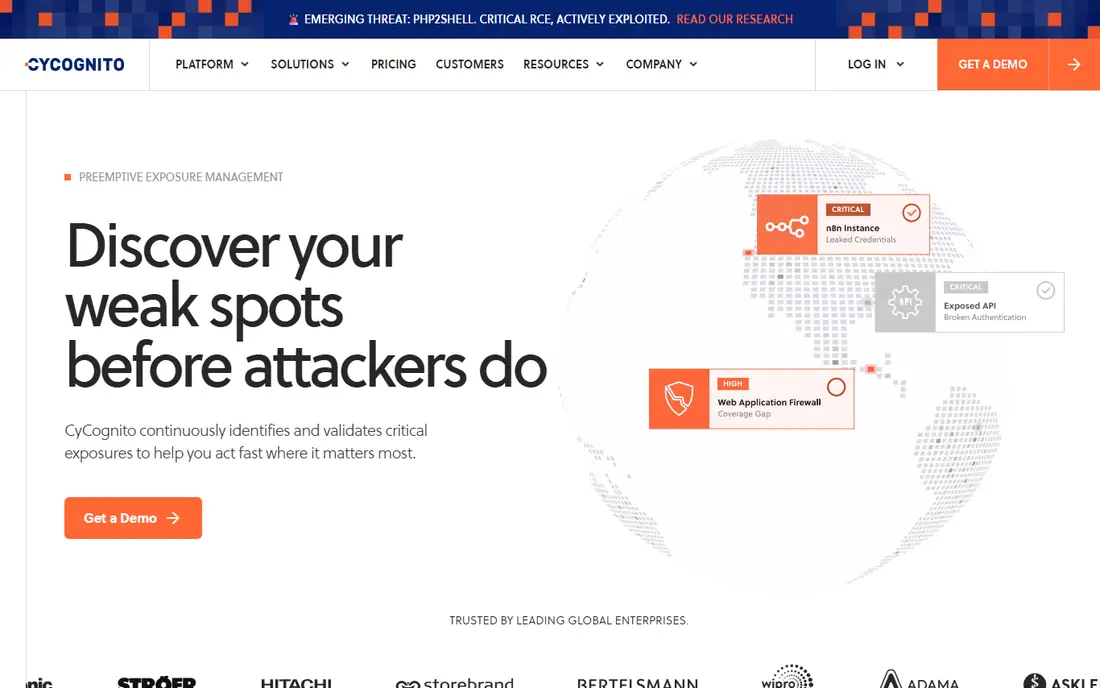
CyCognito uses an external bot network to discover and fingerprint internet-facing assets without installing software on your systems. Its discovery engine maps how assets relate to your business, then scores risks by how attractive they are to attackers and how much business impact they carry. That scoring helps teams cut thousands of findings down to a short list of critical fixes.
Pricing is listed around $11 per asset per month on public directories, with tiers for added testing and intelligence, though final quotes vary by estate size. The per-asset model means a sprawling estate costs more, so count assets before budgeting. For teams drowning in findings, CyCognito prioritization is its main strength.
- Attacker-style discovery with no deployment needed
- Risk scoring by attacker attractiveness
- Clear prioritization of critical issues
- Per-asset pricing can grow fast for large estates
- Advanced testing sits in higher tiers
Tenable One Attack Surface Management maps internet-facing assets, including unknown or unmanaged ones, and adds business context to help teams decide what to fix first. As part of Tenable One, it sits alongside vulnerability management data, which gives security teams one view of internal and external exposure rather than two separate lists.
Standalone buyers may find less value than existing Tenable customers, since the strength is the unified platform. Pricing is quote-based, and a trial helps test whether the external data matches your known estate. For Tenable shops, it is the natural attack surface add-on.
- Fits the wider Tenable One exposure platform
- Business context for external assets
- Continuous mapping of unknown assets
- Pricing is not published
- Best value only for teams already invested in Tenable
Censys built its name on scanning the internet, and its attack surface product uses that data to uncover unknown assets, from internet services to cloud storage buckets. It checks public-facing assets for security and compliance problems regardless of where they are hosted, which helps teams with assets spread across many cloud accounts and providers.
The depth of data is both a strength and a burden. Teams without a clear remediation process can end up with a long list and no owner for each item. Censys suits security teams that want scanning depth and already have a workflow for assigning and tracking fixes.
- Deep internet scanning data
- Finds cloud buckets and forgotten services
- Strong coverage across cloud providers
- Pricing is not published
- Raw data needs a team able to act on findings
Wiz is best known for cloud security, and its attack path and asset graph views help teams see how a cloud misconfiguration could lead to sensitive data. Agentless scanning connects to cloud accounts and maps resources, identities, and exposures without installing agents on every workload. That speed helps teams get a first cloud risk picture quickly.
Wiz is less of a fit for organizations whose main risk is traditional on-premises servers and network devices, since its strength is cloud. Pricing is quote-based and aimed at mid-size to large companies. For cloud-heavy teams, it is a strong attack surface and cloud security choice in one platform.
- Strong cloud asset and risk graph
- Agentless cloud scanning
- Clear attack path views
- Cloud-focused, so on-premises estates need other tools
- Enterprise pricing is quote-based
UpGuard covers a different angle from pure internal tools. It monitors your own attack surface and rates your vendors, which matters when a supplier breach becomes your incident. Security ratings, breach alerts, and vendor questionnaires help procurement and security teams compare suppliers and track improvement over time.
Pure discovery depth is thinner than the enterprise leaders, so UpGuard works best as a vendor risk and external monitoring tool rather than a sole internal discovery engine. Teams that manage many suppliers, or that need to answer customer security questionnaires, get the most value here.
- Monitors your vendors as well as your own surface
- Security ratings for third parties
- Breach and questionnaire tools
- Less deep on internal asset discovery than Xpanse or CyCognito
- Ratings need human review before action
RiskRecon, a Mastercard company, rates third parties by scanning their internet-facing systems and scoring risk across domains such as patching, encryption, and system reputation. Security teams can monitor a vendor portfolio continuously and send action plans when a vendor score drops, which supports contract and renewal discussions with evidence.
It is not a replacement for an internal attack surface tool, since its focus is vendors rather than your own estate. Organizations with large supplier lists, especially in finance and healthcare, use it to prioritize vendor reviews and reduce questionnaire work. Ask for a demo with your own top vendors to judge rating quality.
- Third-party risk ratings from Mastercard
- Continuous monitoring of vendors
- Action plans for vendor issues
- Vendor-focused, not a full internal discovery tool
- Pricing is quote-based
Armis Centrix aims to give a full asset inventory across IT systems, cloud workloads, and connected devices, then add risk and vulnerability context. That breadth helps teams that struggle with basic questions such as what devices exist, who owns them, and which ones are exposed. Integrations push asset data into ticketing and security tools for follow-up.
Breadth brings complexity. A full rollout across IT and operational devices takes planning, and smaller teams may prefer a narrower external-only tool. For organizations with many device types and a weak asset inventory, Armis is a strong foundation for attack surface work.
- Broad asset visibility across IT, cloud, and connected devices
- Risk and vulnerability context
- Integrations with security tools
- Broad scope can mean a longer rollout
- Pricing is quote-based for enterprises
How we picked these
We compared vendor product pages, public pricing and trial information, and independent comparison sources for established attack surface and exposure management tools. We favored tools with continuous external discovery, clear risk prioritization, and a track record serving enterprises or mid-size companies. We included both internal discovery leaders and vendor risk tools, since many teams need both views, and we noted where pricing is quote-based rather than published.
What to check before you buy
Start with a proof of concept on your real estate, not a demo on sample data. Ask the vendor to show unknown assets it finds, how it attributes them to your organization, and how many findings are false positives. A tool that finds everything but ranks nothing will overwhelm a small team.
Next, check ownership and remediation. The best tools assign assets to teams, track fix status, and connect to ticketing systems. Ask how long it takes from discovery to a ticket, and whether the tool retests after a fix. Without that loop, attack surface data becomes a report that nobody acts on.
Finally, clarify pricing units. Some tools charge per asset, some per domain, and some by company size, and those models produce very different bills for the same estate. Get a written quote for your asset count, ask what counts as an asset, and confirm whether testing, third-party monitoring, and support are included or paid extras.
FAQ
What is the best attack surface management software for small businesses?
Small teams often start with UpGuard or a trial of CyCognito, since both are easier to scope than a full enterprise rollout. A smaller estate also means a lower per-asset bill. If budget is tight, start with a focused external scan and a clear owner for fixes, rather than buying the largest platform.
How is attack surface management different from vulnerability scanning?
Vulnerability scanning checks known systems for known flaws, while attack surface management starts by finding systems you may not know exist. It scans from the internet, like an attacker, and lists domains, servers, cloud buckets, and services tied to your organization. The two tools work best together, since discovery feeds scanning and scanning feeds fix lists.
Do I need attack surface management if I already have a firewall?
Yes, because firewalls protect known systems, while attack surface tools find forgotten systems, test sites, and cloud resources outside firewall control. Shadow IT, mergers, and cloud accounts create exposures that a firewall alone does not list. Regular external discovery closes that gap.
What is the best attack surface management platform for cloud security?
Wiz is a strong pick for cloud-heavy teams, thanks to its cloud asset graph and attack path views. Censys also covers cloud buckets and services well from an external view. Teams with both cloud and on-premises estates may need an internal tool plus a cloud tool, rather than one product for both.
How much does attack surface management cost?
Most enterprise tools are quote-based, with CyCognito listed around $11 per asset per month in public directories. Total cost depends on asset count, testing add-ons, and third-party monitoring. Ask vendors for a quote based on your discovered asset count, not a rough company size, to avoid surprises.
Can attack surface tools find my vendors risks too?
Yes, tools such as UpGuard and RiskRecon focus on vendor and third-party risk, rating suppliers and monitoring them over time. Internal discovery tools such as Xpanse also offer separate third-party monitoring products. Choose a vendor risk tool if supplier risk is your main concern, and an internal tool if your own estate is the priority.