Best Arborist Software in 2026: 8 Tools Compared
We compared the best arborist software on estimating, scheduling, and crew work, so tree care companies can run jobs from bid to invoice smoothly every week.
- Editor's choice
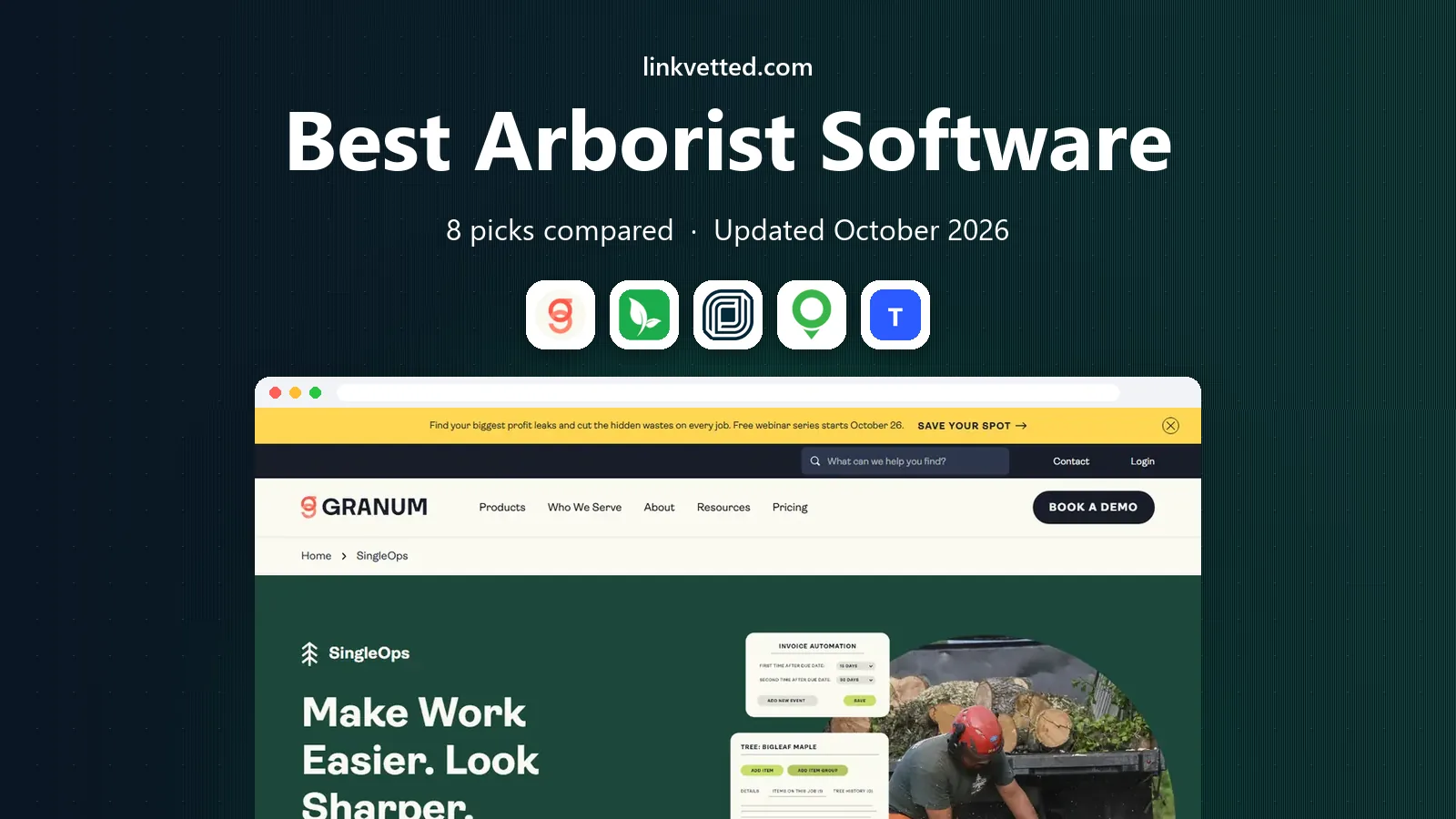
 SingleOps
Tree care companies of all sizes
Starts at$220 per monthVisit singleops.comFull review - Great alternative
 Arborgold
Larger tree and plant health care firms
Starts at$99 per monthVisit arborgold.comFull review - Also consider
 Jobber
Small crews wanting fast setup
Starts atSee websiteVisit getjobber.comFull review
TL;DR:
- SingleOps is our pick for most tree care companies because it combines tree inventory, estimating, and crew work orders in one system.
- Arborgold suits larger tree, lawn, and plant health care companies that need deep job costing and chemical tracking.
- Jobber and ArborNote suit smaller crews that want a faster setup and a lower monthly price.
- TreePlotter suits cities, utilities, and firms that manage tree inventories rather than daily tree work jobs.
- Always test estimating on a real job, since a tool that cannot price your usual work will slow every bid.
Quick comparison
| Tool | Best for | Starts at | Free plan? | |
|---|---|---|---|---|
| SingleOps | Tree care companies of all sizes | $220 per month | No | Visit |
| Arborgold | Larger tree and plant health care firms | $99 per month | No | Visit |
| Jobber | Small crews wanting fast setup | See website | Free trial | Visit |
 ArborNote | Small tree care businesses | $50 per month | Free trial | Visit |
 TreeCommand | Budget tree care software | $149 per month | Free trial | Visit |
 Service Autopilot | Service firms wanting automation | $47 per month | Free trial | Visit |
 TreePlotter | Tree inventory and asset management | See website | No | Visit |
 ArboStar | Tree care estimating and scheduling | See website | Free trial | Visit |
The best arborist software
Tree care work is hard to run on generic job software, because a bid may cover several trees at one address, each with its own species, size, and risk notes, and the crew needs that detail on site. The tools below are built for that workflow, from the first estimate to the final invoice.

SingleOps is built for tree care companies in the US and Canada, and it shows in the details. It covers tree inventory at each property, quick estimating with line items per tree, automated client follow-ups, time-based scheduling and routing, and digital crew work orders that carry the job detail to the field. That chain, from inventory to estimate to work order, is why many arborists pick SingleOps over a generic field service tool.
Pricing starts at $220 a month for a single-crew business in recent listings, with higher tiers for larger firms, and annual contracts are standard. Setup and onboarding fees are also reported by some buyers, so ask for the full first-year total. For a company that lives on tree work every day, SingleOps is the most complete fit on this list.
- Tree inventory and estimating built for arborists
- Automated follow-ups
- Crew work orders
- Higher entry price
- Annual contracts are common
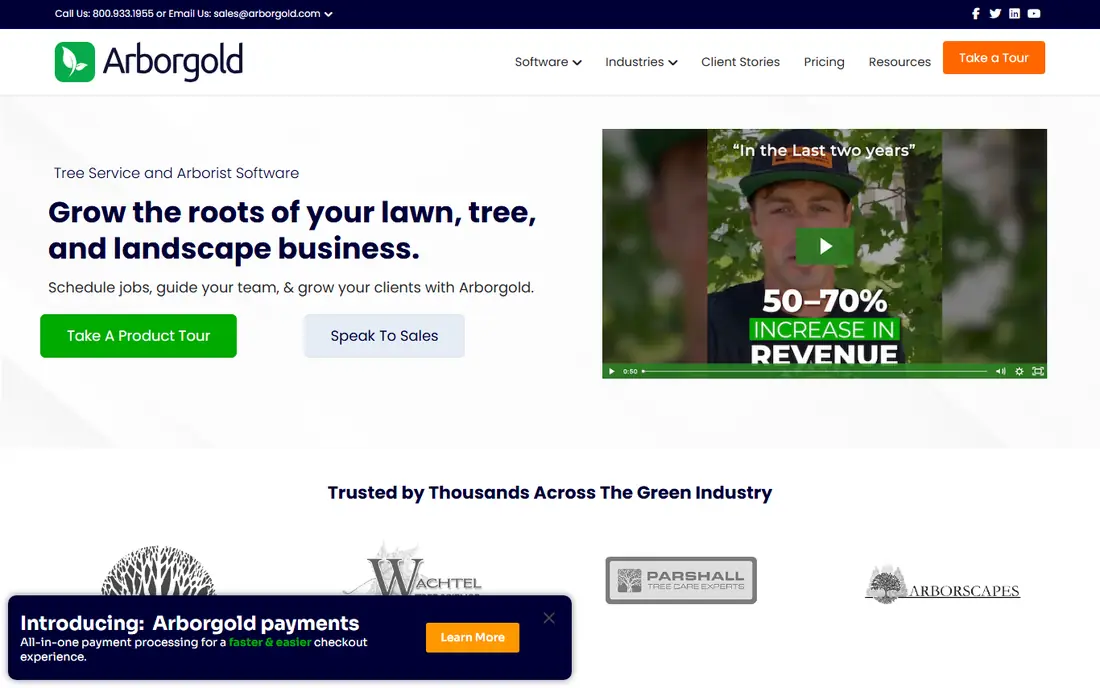
Arborgold has served tree, lawn, and plant health care companies for over 25 years, and its feature set reflects that history. It covers leads and customers, bidding, scheduling, inventory, supply chain, project tracking, and invoicing, with plant health care programs and chemical application tracking that few rivals match. Crew certification tracking and risk assessment documentation also suit firms that do formal arborist reporting.
Pricing starts at $99 a month for the Entrepreneur tier, with Premium at $297 and Ultimate on a quote basis in recent listings. The catch is the learning curve, since the depth that larger firms value can overwhelm a small crew, and training is often sold separately. For a larger firm with plant health care work, Arborgold is hard to beat. For a two-person crew, a simpler tool may be faster to run.
- Deep tree-specific features
- Plant health care and chemical tracking
- Strong scheduling
- Learning curve is steep
- Training can add cost
Jobber is a general field service tool that many tree crews use because it is easy to set up and easy to run. It covers quoting, scheduling, dispatch, invoicing, and payments, with a mobile app that crews can learn in a day. For a small crew that mainly needs clean quotes, a shared calendar, and fast invoices, Jobber does the job with less training than a specialist tool.
The limit is tree-specific depth. Jobber does not offer a native tree inventory with species and condition fields in the way SingleOps or Arborgold do, so crews that need that detail will use custom fields or notes as a workaround. Pricing is tiered and changes often, so we mark it as See website here. If your jobs are straightforward removals and trims, Jobber is a good value pick. If tree records matter, pick a specialist.
- Fast setup and easy quoting
- Scheduling and invoicing in one app
- Good mobile app
- Not tree-specific
- Tree inventory needs workarounds
ArborNote is built for tree care and outdoor maintenance firms that want to get organized without a large monthly bill. Starting at $50 a month, it offers mapping, estimating, proposals, work orders, automated customer notifications, and scheduling in a system aimed at small and mid-size firms. A free 14-day trial lets a crew test it on real jobs before paying.
ArborNote does not match the depth of SingleOps on job costing or Arborgold on plant health care, and its integration list is smaller. For a small firm that needs mapping, clean proposals, and reliable scheduling at a low price, though, ArborNote is a strong pick. It is especially useful for a firm moving off paper quotes and spreadsheets for the first time.
- Low entry price
- Mapping and estimating for tree work
- Automated notifications
- Smaller feature set than SingleOps or Arborgold
- Fewer integrations
TreeCommand positions itself as a simpler, cheaper alternative to SingleOps and Arborgold, at $149 a month with no annual contract, no setup fee, and a 30-day free trial without a credit card. It covers the core tree care workflow, including estimating, scheduling, and job management, in a system that a small firm can start quickly.
The trade-off is maturity. TreeCommand is newer and smaller than Arborgold or SingleOps, so its feature depth and integration list are thinner, and long-term support is less proven. For a budget-conscious firm that wants a published price and an easy exit, TreeCommand is worth testing. For a firm that needs deep job costing or plant health care tools, the established tools still lead.
- Flat published price
- No annual contract
- Free trial without a card
- Newer and smaller than established rivals
- Fewer advanced features
Service Autopilot serves lawn, pest, cleaning, and tree firms that want automation across scheduling, billing, and client communication. Starting at $47 a month in recent listings, it offers dispatch, routing, invoicing, and automated reminders that save office time for a busy service firm. Firms that run tree work alongside lawn or other outdoor services may value that breadth.
Service Autopilot is not built only for arborists, so tree inventory and arborist reporting need custom setup. Its interface also feels older than SingleOps or ArborNote. For a multi-service firm that wants one system for several trades, Service Autopilot is a practical pick. For a pure tree care firm, a specialist tool will fit the daily job better.
- Strong automation and scheduling
- Works across service trades
- Low entry price
- Not tree-specific
- Interface can feel dated
TreePlotter, from PlanIT Geo, is a different kind of tool on this list. It is a web-based GIS platform for collecting and managing tree inventory data, used by cities, utilities, campuses, and firms that manage large tree populations. Field crews can record species, size, condition, and work history on any device, online or offline, with live access for unlimited users in its standard setup.
TreePlotter is not a quoting or invoicing tool, so a tree care firm still needs a job system alongside it. Pricing is quote-based, reflecting the scale of the inventory being managed. If your work is managing a tree population over years, TreePlotter is the right platform. If your work is daily bids and crew jobs, pair it with SingleOps or Jobber rather than using it alone.
- Leading tree inventory platform
- GIS mapping
- Works online and offline
- Not a job bidding tool
- Quote-only pricing
ArboStar is a tree care business system that covers estimating, scheduling, customer management, and job tracking for arborist firms. It is built around the tree job workflow, so estimates, crew schedules, and client records sit in one place rather than across separate tools. A free trial lets a firm test it on its own jobs before committing.
ArboStar does not publish a price, so you will need a quote based on crew size and features, and its user community is smaller than SingleOps or Arborgold, which can mean fewer public guides and peer tips. For a firm that wants a tree-specific system but finds SingleOps or Arborgold too costly or too complex, ArboStar is worth a demo.
- Tree-specific estimating
- Scheduling and CRM for tree firms
- Mobile access
- Quote-only pricing
- Smaller user community than larger rivals
How we picked these
We compared official feature pages, pricing listings, and public comparisons for arborist and tree care software that is live in October 2026, and we kept only tools that serve tree work directly or manage tree inventories. We favored tools with estimating, scheduling, and crew work orders as core features, and we marked quote-only tools as See website rather than guessing a price. We also weighed setup effort, since a tool that a crew will not use in the field helps no one.
What to check before you buy arborist software
Start with a real estimate. Price a job with several trees, different services per tree, and a note on access or risk, and see whether the tool handles it cleanly. Check how that estimate turns into a crew work order, and whether the crew can see tree notes, photos, and site access details on a phone without a signal, since many job sites have poor coverage.
Next, check scheduling and routing for multiple crews, and how follow-ups work when a bid goes unanswered. Ask about invoicing and payment links, since getting paid quickly matters as much as winning the bid. Finally, confirm contract terms, setup fees, and data export, and ask how plant health care records, chemical applications, and certifications are stored if your firm does that work.
FAQ
What is arborist software?
Arborist software is business software built for tree care companies, covering estimating, scheduling, crew work orders, invoicing, and often tree inventory and client records. It differs from generic field service software by handling work per tree at a property, rather than only per job address. Some tools also add plant health care tracking and risk assessment records.
Is SingleOps or Arborgold better for a small crew?
SingleOps is often easier for a small to mid-size tree crew to adopt, thanks to its modern interface and tree inventory workflow. Arborgold suits larger firms with plant health care programs and deeper job costing needs, but its learning curve is steeper. A two-person crew should trial both, plus ArborNote, and pick the one the crew will actually use daily.
Can Jobber work for tree care?
Yes, Jobber works for tree crews that mainly need quoting, scheduling, and invoicing, and it is easy to set up. It lacks native tree inventory fields, so firms that need detailed per-tree records will need custom fields or a specialist tool. Test a multi-tree estimate in Jobber before you decide whether the workaround is acceptable.
Do I need tree inventory software as well as job software?
You need inventory software if you manage a tree population over time, such as for a city, campus, or utility, or if you sell long-term care plans per tree. A job-focused tree firm can usually manage tree notes inside SingleOps, Arborgold, or ArborNote without a separate inventory platform. TreePlotter is the pick when inventory itself is the job.
How much should a small tree firm budget?
A small firm can start at $47 to $50 a month with Service Autopilot or ArborNote, or $149 a month with TreeCommand, while SingleOps starts at $220 a month and Arborgold at $99 a month for its entry tier. Add setup, training, and payment processing to the subscription before you compare totals. The cheapest tool that your crew will use beats a dearer tool that sits unused.
What about safety and certification records?
Check that the tool can store crew certifications, training dates, and risk notes, and that those records are easy to find before a job starts. Arborgold is known for certification and risk documentation, while other tools handle this through custom fields or documents. Whatever tool you pick, keep a clear process for checking certifications before high-risk work.