Best API Security Platforms in 2026: 8 Platforms Compared
Compare the best API security platforms for discovery, testing, and runtime defence, with edge, gateway, and dedicated tools for security teams in 2026.
- Editor's choice
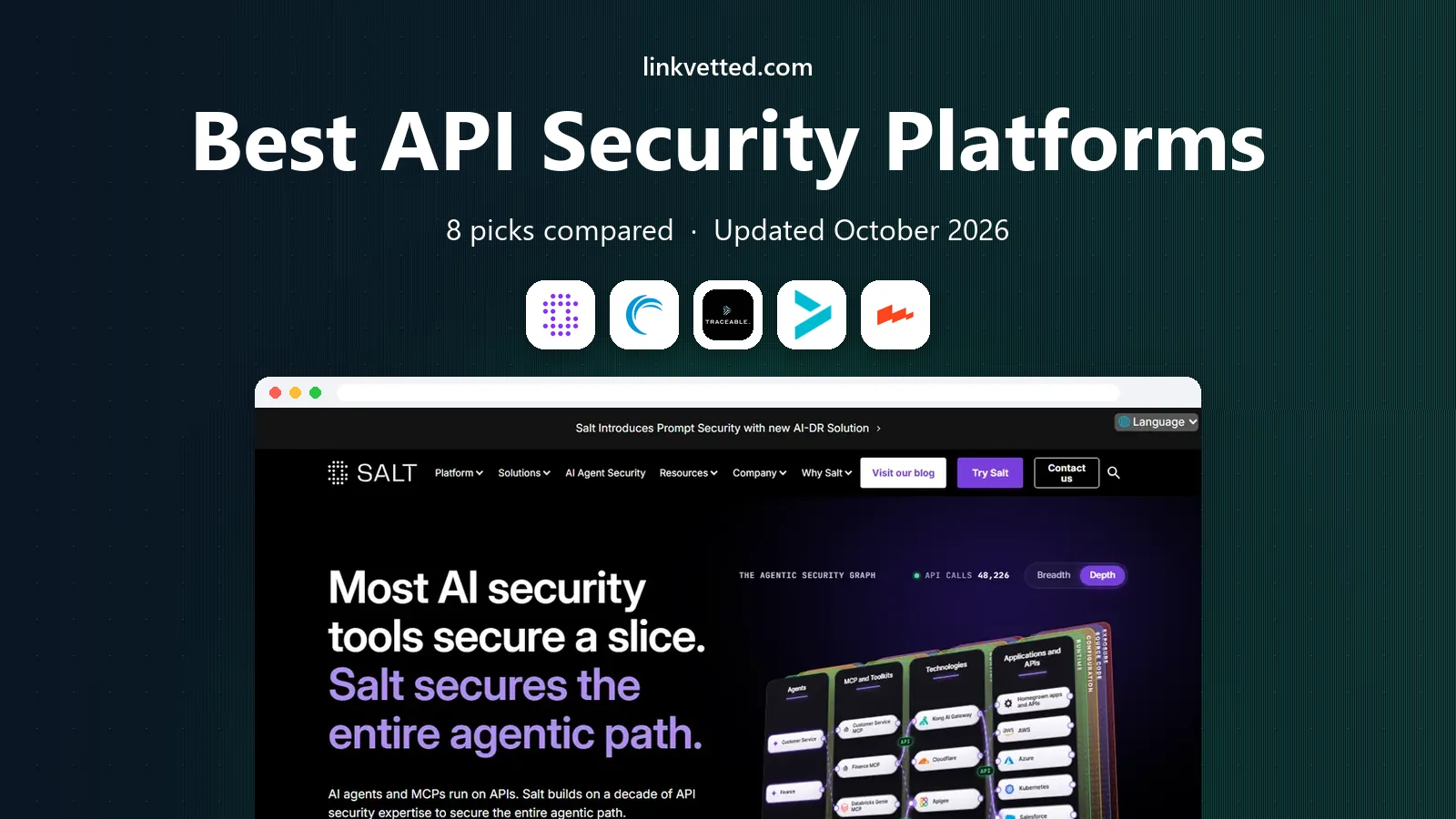
 Salt Security
Enterprise runtime API defence
Starts atSee websiteVisit salt.securityFull review - Great alternative
 Akamai API Security
Edge-native API security
Starts atSee websiteVisit akamai.comFull review - Also consider
 Traceable
Trace-based runtime security
Starts atSee websiteVisit traceable.aiFull review
TL;DR:
- Salt Security is the dedicated runtime pick for large enterprises with big API portfolios and logic abuse risks.
- Akamai API Security suits firms already on Akamai, with edge-native blocking and discovery from the former Noname platform.
- Traceable and Cequence add deep runtime and bot-aware defence for APIs that face automated abuse.
- Cloudflare covers many teams through bundled edge protection, so check what you already own before buying a standalone tool.
- 42Crunch and StackHawk shift security earlier, by testing API contracts and code before production.
Quick comparison
| Tool | Best for | Starts at | Free plan? | |
|---|---|---|---|---|
| Salt Security | Enterprise runtime API defence | See website | No | Visit |
| Akamai API Security | Edge-native API security | See website | No | Visit |
| Traceable | Trace-based runtime security | See website | No | Visit |
 Cequence | API and bot defence together | See website | No | Visit |
 Wallarm | Unified WAAP with API focus | See website | Free trial | Visit |
 Cloudflare | Bundled edge API protection | See website | Yes | Visit |
 42Crunch | API contract security testing | See website | Free trial | Visit |
 StackHawk | API testing in CI pipelines | See website | Free trial | Visit |
The best API security platforms
APIs now carry most application traffic, and they fail in ways a traditional firewall misses, through logic abuse, broken authorisation, and forgotten endpoints. The eight platforms below cover the three jobs that matter, discovery, testing before release, and runtime defence, and they suit different starting points.

Salt Security is built around a simple idea, that real API attacks look like a sequence of normal-looking calls over time, not a single bad request. Its behavioural engine learns normal API use, then flags sequences that suggest abuse, such as credential stuffing followed by data scraping. That approach catches logic abuse that signature rules miss.
Salt also covers discovery, finding shadow and zombie APIs that teams forgot, and in 2026 it added protection for AI agent, MCP server, and LLM traffic. The cost is enterprise scale, with no public pricing and a sales-led process, so smaller teams should look at Cloudflare or 42Crunch first. For a large firm with crown-jewel APIs, Salt is the dedicated runtime pick.
- Behavioural analysis that spots attack sequences over time
- Shadow and zombie API discovery
- AI agent and MCP traffic protection
- Enterprise-only pricing with no public rates
- Sales-led evaluation and tuning time
Akamai API Security comes from the Noname Security acquisition, folded into Akamai's edge platform. It covers discovery, posture management, runtime protection, and active testing, with blocking at the edge where traffic first arrives. That placement matters, because blocking at the edge stops abuse before it reaches your origin servers.
For firms already using Akamai for content delivery or web protection, the API product is often the easiest add-on, since contracts, support, and edge configuration already exist. As a standalone purchase for a team with no Akamai footprint, it is harder to judge on its own, and pricing will come through a sales conversation tied to the wider platform.
- Edge-native blocking close to attackers
- Discovery through traffic, code, and external checks
- Bundles with Akamai contracts
- Less distinct as a standalone purchase
- Pricing tied to broader Akamai deals
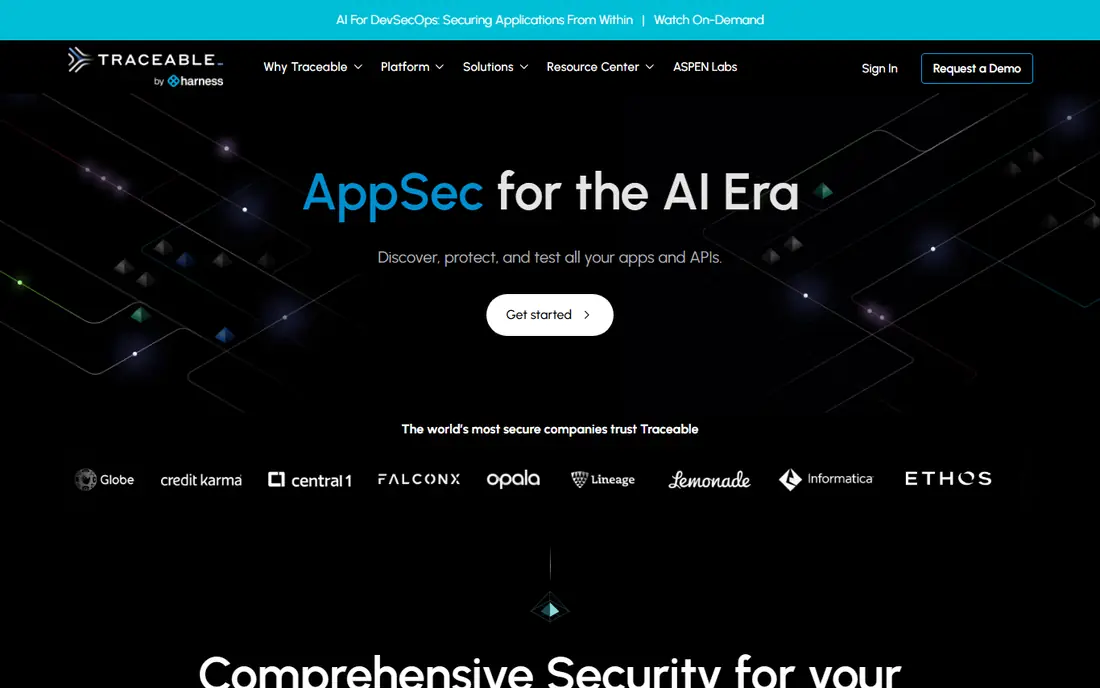
Traceable uses distributed tracing to follow API calls through services, which gives it a detailed view of how an API actually behaves in production. That trace context helps it spot abuse, map sensitive data flows, and build an accurate inventory of endpoints, including ones that do not appear in documentation. Runtime blocking lets teams stop confirmed abuse rather than just reporting it.
The trade-off is integration effort and price. Traceable is a quote-based enterprise product, and getting full trace coverage across microservices takes engineering time. Teams with a large, complex API estate will get the most from that depth, while smaller teams may find a bundled edge tool covers their main risks.
- Deep API discovery from traffic traces
- Runtime blocking
- Sensitive data flow tracking
- Quote-based pricing
- Needs traffic integration work to reach full value
Cequence is the pick when API abuse and bot traffic arrive together, which they often do. Scraping, credential stuffing, and account takeover attempts all hit APIs, and Cequence treats them as one problem, with discovery, behavioural detection, and native blocking in the same platform. That combined view helps security teams stop automated abuse without buying a separate bot product.
Pricing is quote-based, and the bot capabilities may be more than a team with only internal APIs needs. For public-facing APIs that face constant automated traffic, though, the combined approach saves the work of stitching two tools together and arguing about which one owns a given attack.
- Native blocking for API and bot abuse
- Discovery and risk scoring
- Machine learning based behavioural detection
- Quote-based pricing
- Bot focus may be more than some teams need
Wallarm positions itself as a unified web application and API protection platform, rather than a narrow API-only tool. It offers API discovery, testing, and runtime blocking, with deployment in agent or inline modes to fit different architectures. That flexibility suits teams that want one WAAP for web apps and APIs, instead of separate products for each.
Wallarm also publishes annual API threat research that security teams use for budget discussions, which is a practical bonus. The main gap is pricing transparency, since paid plans are not published, so teams need a sales conversation to compare costs with Cloudflare or a dedicated runtime tool.
- Native blocking in agent and inline modes
- API discovery and testing
- Published threat research
- No published pricing for paid plans
- Deployment choice adds planning
Cloudflare is the first tool to check, not because it is the deepest API platform, but because many teams already own it. API discovery, schema validation, and abuse protection are bundled with its edge, WAF, and bot services, so a team on Cloudflare may already have solid API coverage without a new purchase. The free plan covers basic use, which makes testing easy.
The limit is depth. Cloudflare will not match Salt or Traceable for behavioural runtime analysis across a huge internal API estate, and the most useful API features sit on higher plans. Still, for most small and mid-sized teams, pricing the Cloudflare capability you already have before buying a standalone tool is the right first step.
- API discovery and protection bundled with edge services
- Free plan for basic use
- Huge edge network
- Dedicated API depth is thinner than Salt or Traceable
- Advanced features sit on higher plans
42Crunch starts security at the contract, which is where many API flaws are born. It audits OpenAPI specifications for security issues, scores them, and generates tests that check for broken authorisation, injection, and data exposure. A micro-firewall can then enforce the contract at runtime, blocking requests that do not match the spec.
That design-time strength is also its limit. 42Crunch does not replace a runtime behavioural platform for live abuse detection, so larger firms will pair it with Salt, Akamai, or Cloudflare. For teams that already write good OpenAPI specs, though, it catches problems in CI before they reach production, which is cheaper than fixing them later.
- Contract-based testing from OpenAPI specs
- Security audit scores
- Micro-firewall for enforcement
- Design-time focus means runtime needs a second tool
- Smaller teams may need spec discipline first
StackHawk brings API security testing into the developer workflow, running tests from your API specification inside CI pipelines. Developers get findings tied to the endpoint and the request that failed, which makes fixes faster than a separate security report landing weeks later. That fit with modern delivery pipelines is why smaller engineering teams like it.
Like 42Crunch, StackHawk is a pre-production tool, so it does not block live attacks on its own. Pair it with an edge or runtime platform for production defence, and use StackHawk to stop the obvious flaws before release. Published pricing tiers make it easier to budget than quote-only rivals.
- Spec-driven API testing in CI
- Clear findings for developers
- Published pricing tiers
- Pre-production focus, so runtime defence needs another tool
- Needs OpenAPI or GraphQL specs
How we picked these
We compared official product pages, documentation, and public comparisons for platforms with a clear API security function in October 2026, covering discovery, testing, and runtime defence. We favoured tools with a current product, a distinct role in the buying path, and coverage of shadow APIs, business logic abuse, or contract testing. We noted where pricing is quote-based, because that changes how a team should sequence trials and procurement.
How to choose an API security platform
Start with discovery, because an inventory built from documentation alone is usually wrong. Run traffic-based discovery first, find the shadow and zombie endpoints, and map which APIs carry sensitive data. That inventory tells you whether you need a dedicated runtime tool, an edge add-on, or just better testing.
Next, price the edge capability you already own, whether that is Cloudflare, Akamai, or another WAAP, before buying a standalone platform. Then add contract testing in CI for new APIs, and buy behavioural runtime protection for the APIs that matter most, such as payment, account, and data access endpoints. Finally, run a proof of concept on real traffic, because alert quality on your own APIs matters more than any vendor demo.
FAQ
What is the best API security platform overall?
Salt Security is a strong pick for large enterprises that need deep runtime defence, while Cloudflare suits teams that want bundled edge protection. The best overall choice depends on whether your main gap is discovery, testing, or live abuse.
What is the difference between API security and a WAF?
A traditional WAF blocks known attack patterns in web traffic, while API security adds discovery, contract validation, and behavioural analysis for logic abuse. Many WAAP platforms now combine both, but a WAF alone often misses broken authorisation and business logic flaws in APIs.
How do I find shadow APIs?
Traffic-based discovery tools, such as Salt, Akamai, Traceable, and Cloudflare, watch real API traffic and compare it with your documented inventory. Endpoints that appear in traffic but not in docs are shadow APIs, and old endpoints with no owner are zombie APIs.
Do small teams need a dedicated API security platform?
Many small teams can start with bundled edge protection from Cloudflare or a similar provider, plus contract testing in CI. A dedicated runtime platform becomes worth the cost when APIs carry sensitive data, face public bot traffic, or grow beyond what a small team can inventory by hand.
What is API security testing?
API security testing checks an API for flaws such as broken authorisation, excessive data exposure, and injection, using its specification and live test requests. Tools such as 42Crunch and StackHawk run those tests before release, while runtime platforms watch for abuse after release.