Best API Management Platforms in 2026: 8 Tools Compared
Compare the best API management platforms for 2026, from Kong and Apigee to AWS, Azure, Postman, Tyk and Gravitee, with pricing models explained for teams.
- Editor's choice
 Kong
High-performance gateways
Starts atFreeVisit konghq.comFull review - Great alternative
 Google Apigee
Enterprise API programs
Starts atSee websiteVisit cloud.google.comFull review - Also consider
 AWS API Gateway
AWS-native serverless APIs
Starts at$3.50 per million requestsVisit aws.amazon.comFull review
TL;DR:
- Kong, Tyk and Gravitee suit teams that want an open-source gateway with control over deployment and plugins.
- AWS API Gateway and Azure API Management suit teams already committed to those clouds, with pay-per-use or tiered pricing.
- Google Apigee and MuleSoft suit large enterprises that need full lifecycle management, analytics and monetisation.
- Postman suits teams that want API design, testing and management in one familiar tool, especially at smaller scale.
Quick comparison
| Tool | Best for | Starts at | Free plan? | |
|---|---|---|---|---|
| Kong | High-performance gateways | Free | Yes | Visit |
| Google Apigee | Enterprise API programs | See website | Free trial | Visit |
| AWS API Gateway | AWS-native serverless APIs | $3.50 per million requests | Yes | Visit |
 Azure API Management | Azure-centric teams | See website | Yes | Visit |
 MuleSoft | API-led integration | See website | Free trial | Visit |
 Postman | Design, testing and management | Free | Yes | Visit |
 Tyk | Flat-fee gateway scaling | Free | Yes | Visit |
 Gravitee | Open-source API management | Free | Yes | Visit |
The best API management platforms
API management covers gateways, security, rate limiting, developer portals, analytics and lifecycle control, and different platforms weight those jobs differently. We compared official pricing pages, documentation and public API guides in October 2026, focusing on platforms that are still actively sold and supported.
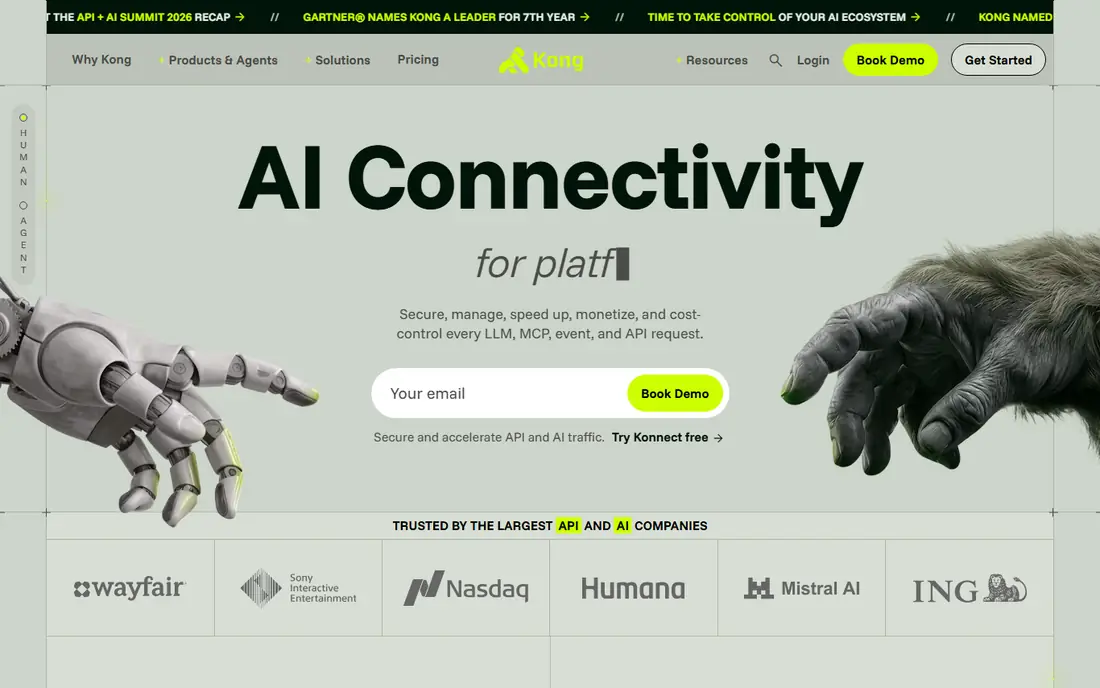
Kong Gateway is an open-source, high-performance gateway used widely for microservices and Kubernetes deployments. Its plugin system covers authentication, rate limiting, caching, logging and transformations, and Kong Konnect adds a managed control plane for teams that do not want to run everything themselves. That combination suits DevOps teams that value speed and flexibility.
Self-managed Kong needs operations effort, and enterprise features and support are quoted. Konnect Plus plans in recent guides start at $25 per month per control plane, with usage charges above included requests. For teams that want a proven gateway they can control, Kong is a strong first choice.
- Open-source gateway
- Large plugin library
- Kubernetes-native deployment
- Enterprise pricing is quoted
- Self-managed setup needs expertise
Google Apigee, now part of Google Cloud, is a full API management platform for large enterprises. It covers design, security, traffic control, analytics, developer portals and monetisation, with hybrid options for on-prem and multi-cloud runtimes. That breadth suits organisations running a formal API program with many consumers.
Pricing is pay-as-you-go and enterprise-led, with environment fees and per-call charges that add up at scale, and a 60-day evaluation period in recent guides. Small teams will find Apigee heavy, but large firms that need governance and analytics will value its depth.
- Full lifecycle management
- Strong analytics and developer portal
- Monetisation features
- Higher cost at enterprise scale
- Complex setup for small teams
AWS API Gateway suits teams already building on AWS, especially serverless apps using Lambda. REST and HTTP APIs are billed per million requests, with a common REST rate of $3.50 per million in recent guides, plus data transfer and feature charges. A free tier covers one million requests per month for twelve months for new accounts.
API Gateway is a gateway first, so teams needing a full developer portal, monetisation or advanced governance may add other AWS or third-party tools. For AWS-native projects with variable traffic, its pay-per-use model is hard to beat.
- Pay-per-use pricing
- Deep AWS integration
- Free tier for new accounts
- Costs can rise with traffic and features
- Less of a full lifecycle portal alone
Azure API Management gives Microsoft-centric teams a unified platform for publishing APIs, applying policies, managing developers and analysing use. Tiers range from a developer tier for testing to premium tiers for global, high-volume deployments, and a self-hosted gateway supports hybrid and on-prem APIs.
Pricing varies by tier, region and unit count, so teams should use the Azure pricing calculator for their traffic and region. That complexity is the main drawback, but for Azure shops, the integration with Microsoft identity, monitoring and DevOps tools is a clear advantage.
- Tiered plans from developer to premium
- Strong policy engine
- Self-hosted gateway option
- Pricing and scaling can be complex
- Premium global setups cost more
MuleSoft, from Salesforce, goes beyond a gateway to connect APIs, applications and data across an enterprise. Its API-led approach helps large firms reuse APIs, automate processes and integrate legacy systems, with Anypoint Platform covering design, management and monitoring. That breadth suits complex integration programs.
Implementation can take months, pricing is quoted, and a simple API gateway need does not justify MuleSoft. For enterprises where APIs are part of a wider integration strategy, MuleSoft offers a depth that gateway-only tools do not match.
- API-led connectivity across systems
- Integration and automation in one platform
- Strong enterprise support
- Higher cost and longer implementation
- Overkill for a simple gateway
Postman started as an API client and now covers design, testing, documentation, mocking and management for many teams. A free plan covers solo use, with Solo at $9 per month and Team at $19 per user per month in recent guides. That low entry cost makes Postman easy to adopt for small and mid-size teams.
Full API management features, such as catalog, insights and governance, sit on enterprise plans, and Postman is not a replacement for a high-throughput gateway on its own. For teams that design, test and document APIs daily, Postman is a natural management layer to add to a gateway.
- Familiar design and testing workflow
- API catalog and governance on higher plans
- Low entry cost
- Full management features sit on enterprise plans
- Not a high-throughput gateway alone
Tyk offers an open-source gateway that runs the same codebase across cloud, hybrid and self-managed deployments. Its professional plan is notable for flat pricing regardless of request volume, with unlimited gateways, APIs and requests, which helps teams whose traffic grows faster than forecasts. GraphQL support is a particular strength.
The professional price is not published, so teams need a sales conversation, and the plugin marketplace is smaller than Kong's. A 48-hour cloud trial helps test the platform. For teams that want predictable gateway costs at scale, Tyk deserves a close look.
- Open-source gateway
- Flat professional pricing regardless of volume
- Strong GraphQL support
- Professional price is not published
- Smaller plugin marketplace than Kong
Gravitee is an open-source API management platform covering gateways, developer portals, analytics and event management. Its community edition is free and self-hosted, while paid API management plans start at $2,500 per month for a production gateway in recent guides. That split suits teams that want open source first, with a commercial path later.
Paid entry is high for small teams, and Gravitee is a smaller vendor than Google, AWS or Microsoft, so support and ecosystem depth differ. For open-source-first teams that need both API and event handling, Gravitee is a credible enterprise option.
- Open-source community edition
- Paid plans from $2,500 per month for production
- Event and API support
- Paid entry is high for small teams
- Smaller vendor than cloud giants
How we picked these
We compared official pricing pages, platform documentation and public API management guides in October 2026, and included open-source gateways, cloud-native gateways, full lifecycle platforms and a design-led tool. We excluded discontinued gateways and tools that only handle API testing without management features, so the list covers real management choices at different scales.
How to choose an API management platform
Start with deployment and cloud fit
Cloud-native teams usually save time with AWS API Gateway or Azure API Management, while multi-cloud and on-prem teams often prefer Kong, Tyk or Gravitee. A gateway that fits your existing infrastructure will be easier to operate than a feature-rich platform that fights it.
Compare pricing models, not just headline prices
Pay-per-call, tiered, flat-fee and quoted models behave very differently as traffic grows. Model your expected requests, data transfer, caching and gateway count, and ask vendors how spikes, premium features and support change the bill. A flat fee can beat pay-per-call at high volume, and the reverse at low volume.
Test governance before you scale
Developer portals, authentication, rate limiting, versioning and analytics matter once many teams consume your APIs. Run a pilot with two or three APIs, real consumers and a policy change, and check how easy it is to publish, deprecate and monitor an API without manual work.
A final point for API teams is documentation and versioning, because an API that developers cannot understand will not be adopted, no matter how fast its gateway is. Publish clear getting-started guides, working examples and error messages, and keep a changelog when behaviour changes. Version APIs carefully, give consumers time to migrate, and monitor which versions and endpoints are actually used before retiring old ones. It also helps to set up alerts for error spikes, latency changes and quota breaches, so problems are found by your team before consumers report them. A well-documented, well-monitored API program builds trust with developers and reduces support work over time.
FAQ
What is the best API management platform?
Kong suits high-performance, open-source gateways, while AWS API Gateway and Azure API Management suit cloud-native teams. Google Apigee and MuleSoft suit large enterprises, and Postman suits design-led teams. The best API management platform depends on cloud fit, traffic, governance needs and budget.
What is the best API management tool for small teams?
Postman offers a free plan and low-cost team plans for design, testing and basic management, while Kong and Tyk offer free open-source gateways. Small teams with low traffic may also start with AWS API Gateway pay-per-use pricing. Choose based on whether you need a gateway, a design tool, or both.
How much do API management platforms cost?
Costs range from free open-source gateways and Postman free plans, to $3.50 per million requests for AWS API Gateway, to $2,500 per month for Gravitee production plans, to quoted enterprise pricing for Apigee and MuleSoft. Traffic, tiers and support change totals substantially.
What is the difference between an API gateway and API management?
A gateway routes, secures and limits API traffic, while API management adds lifecycle control, developer portals, analytics, versioning and monetisation around that gateway. Many platforms bundle both, but some tools focus on one side, so check which parts you actually need.
Do I need API management for a small API?
A small internal API may only need a gateway or a simple framework, not a full management platform. As consumers, versions and security rules grow, management tools save time and reduce risk. Start simple, and add a platform when publishing, monitoring or governing APIs becomes manual work.