Best AML KYC Software in 2026: 8 Tools Compared
Compare the best AML KYC software for banks and fintechs, with identity verification, sanctions screening, monitoring, pricing models and trial options.
- Editor's choice
 Sumsub
KYC plus AML in one platform
Starts at$149 per monthVisit sumsub.comFull review - Great alternative
 ComplyAdvantage
Screening and monitoring
Starts at$99 per monthVisit complyadvantage.comFull review - Also consider
 Entrust IDV
Enterprise orchestration
Starts atSee websiteVisit entrust.comFull review
TL;DR:
- Sumsub is our pick for onboarding-heavy teams that want KYC, KYB and AML screening in one platform with published pricing.
- ComplyAdvantage suits fintechs that need strong screening data and ongoing monitoring by entity.
- Entrust, Jumio and Trulioo fit larger enterprises with complex global coverage and audit needs.
- Veriff and iDenfy are better for smaller teams that want clear per-check pricing without a long sales cycle.
Quick comparison
| Tool | Best for | Starts at | Free plan? | |
|---|---|---|---|---|
| Sumsub | KYC plus AML in one platform | $149 per month | Free trial | Visit |
| ComplyAdvantage | Screening and monitoring | $99 per month | No | Visit |
| Entrust IDV | Enterprise orchestration | See website | No | Visit |
 Jumio | Large enterprise verification | See website | No | Visit |
 Veriff | Low minimum per-check pricing | See website | Free trial | Visit |
 iDenfy | Pay per verification | See website | No | Visit |
 Trulioo | Global data coverage | See website | No | Visit |
 Shufti | Broad KYC and KYB checks | See website | Free trial | Visit |
The best AML KYC software
AML and KYC software helps regulated firms verify who a customer is, screen them against sanctions and watchlists, and monitor risk over time. The tools below range from self-serve onboarding platforms to enterprise suites for banks.

Sumsub is a strong all-in-one choice for fintechs, crypto platforms, marketplaces and payment firms. It combines document checks, liveness and face matching with sanctions, PEP and adverse media screening, plus ongoing monitoring on its Compliance plan. That breadth means many teams can run onboarding and screening without stitching together several vendors.
Pricing is clearer than most rivals, with a Basic plan from $1.35 per verification and a Compliance plan from $1.85 per verification, each with a monthly minimum. A 14-day trial with free checks lets you measure pass rates before committing. The main limit is that high-volume or complex transaction monitoring needs a custom plan, so enterprise buyers should confirm scope in a demo.
- Identity verification plus AML screening
- Published per-check pricing
- Trial with free checks
- Monthly minimums apply
- Advanced transaction monitoring is on higher plans
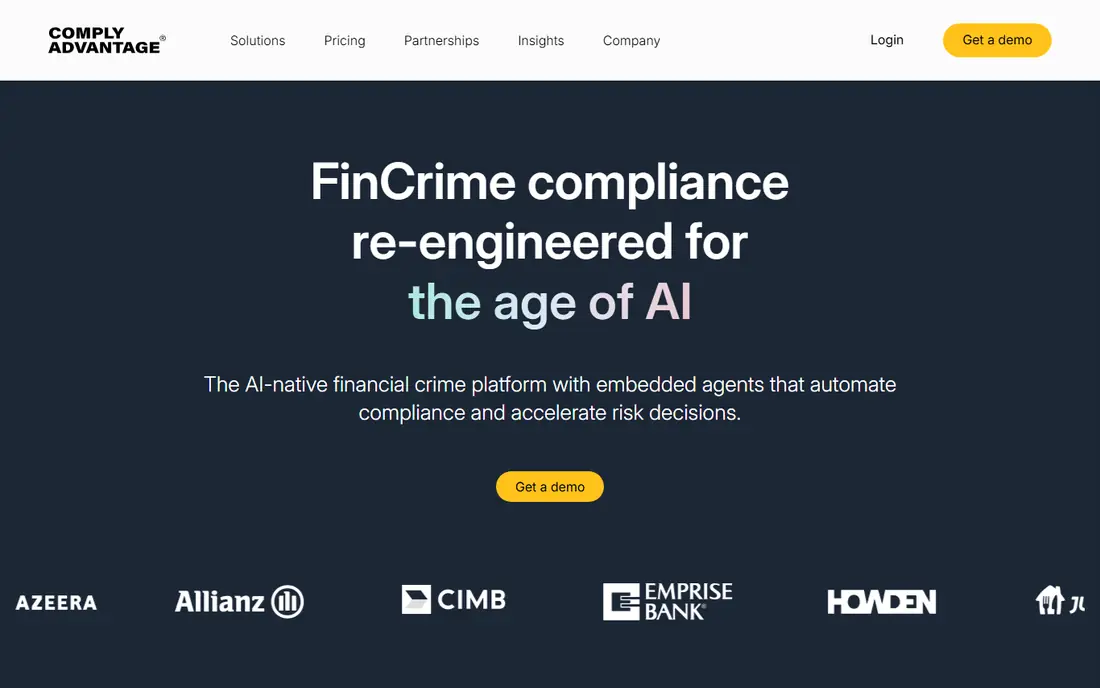
ComplyAdvantage is best known for screening data and monitoring, rather than as a general identity verification tool. Banks and fintechs use it to screen customers and transactions against sanctions lists, PEP lists and adverse media, and to re-screen as lists change. Its entry plan, priced by monitored entities, gives smaller firms a way to start without an enterprise contract.
If your main need is document verification and biometrics, pair ComplyAdvantage with a verification vendor, or pick an all-in-one platform such as Sumsub. If screening quality and monitoring are the priority, and you already have a verification flow, ComplyAdvantage is a strong, focused choice. Note that this is not financial advice, and firms should confirm that any tool meets their own regulatory duties.
- Own sanctions, PEP and adverse media data
- Ongoing monitoring
- Self-serve entry plan
- Identity verification is not its core focus
- Larger deployments need sales pricing

Entrust IDV, formerly Onfido, is aimed at tech-led companies and larger enterprises that need to orchestrate many checks in one workflow. Its Workflow Studio lets teams combine document checks, biometrics, database checks and screening in a custom flow, with SDKs for web and mobile. That flexibility helps when onboarding differs by country, product or risk level.
The trade-off is procurement time. Pricing is quote-based, and a proper rollout needs integration work and testing. Smaller teams may find Sumsub or Veriff faster to launch. For firms that need audit trails, custom rules and global scale, Entrust IDV is a credible enterprise pick.
- Workflow orchestration
- Document and biometric checks
- Strong developer tools
- Quote-based pricing
- Implementation takes more planning than self-serve tools
Jumio is a long-standing enterprise verification vendor, used by banks, crypto firms and large platforms. It offers document verification, biometric checks and liveness detection, with fraud signals built from a large history of transactions. That depth helps firms that face sophisticated fraud attempts and need detailed risk evidence.
Pricing is custom, and the sales and integration cycle reflects an enterprise product. Small startups will likely get faster value from a published-price tool. For regulated firms that need strong assurance, detailed reporting and support at scale, Jumio remains a serious option to shortlist alongside Entrust and Trulioo.
- Strong liveness and fraud signals
- Large transaction history
- Enterprise compliance features
- Quote-based pricing
- Less suited to very small teams on a tight budget
Veriff is a good fit for mobile-first platforms that want to start small. It publishes per-verification pricing with low monthly minimums, which makes budgeting easier than a quote-only vendor. Document and biometric checks are designed for phone onboarding, and a free trial helps teams test how real users pass or fail in their markets.
AML screening is available, but check whether it is included or an add-on on the tier you choose. That detail changes the true cost for regulated firms. If your volume is modest and you want a clear entry price, Veriff is one of the easiest tools on this list to evaluate without a long sales process.
- Published per-check tiers
- Mobile-first verification
- Free trial to test pass rates
- AML screening is an add-on on some plans
- Higher tiers needed for advanced features
iDenfy appeals to firms with unpredictable volume. Its pay-per-verification approach means you are not locked into a high monthly minimum when onboarding is slow, which helps seasonal businesses and early-stage startups. It covers identity verification, business verification and AML screening, with added fraud prevention tools.
The catch is that per-check rates and add-on costs vary, so you need a clear quote for your exact mix of checks and countries. Still, for teams that want to avoid minimums, iDenfy is worth comparing directly with Veriff and Sumsub. Run a pilot with real traffic before committing, since pass rates and manual review rates drive total cost more than the headline rate.
- Pay-per-verification model with no monthly minimum on some tiers
- KYC, KYB and AML options
- Fraud tools
- Pricing varies by volume and check type
- Enterprise features need a custom plan
Trulioo is built for international enterprises that need to verify people and businesses across many jurisdictions. Its strength is data source coverage, which helps when document checks alone are not enough, or when local data sources matter for a market. It also offers business verification and workflow tools for regulated onboarding.
Pricing is usage-based and quote-driven, so budgeting needs a sales conversation and a volume estimate. Smaller firms with a single market will likely find a simpler tool faster. For global firms that onboard in many countries and need consistent coverage, Trulioo is a strong enterprise candidate.
- Wide data source coverage across many countries
- Person and business verification
- Workflow tools
- Usage-based quotes
- Onboarding setup is heavier than self-serve tools
Shufti, formerly Shufti Pro, offers a broad set of checks: identity verification, business verification, AML screening and video KYC, among others. That breadth suits global platforms that want one vendor for many check types, rather than managing several contracts. A free tier or trial, where offered, helps teams test basic flows before a larger commitment.
As with other quote-based vendors, the true cost depends on volume, countries and check mix, so get a written quote for your exact use case. Product breadth can also mean a longer setup if you enable every option at once. Start with the checks you must have for compliance, then add extras only when a clear need appears.
- Wide product breadth including video KYC
- KYC, KYB and AML in one vendor
- Free tier options reported
- Pricing is quote-based for most plans
- Product breadth can complicate a simple rollout
How we picked these
We compared official product pages, pricing pages and recent 2026 vendor pricing checks for AML and KYC software. We favored tools that combine identity verification with sanctions, PEP and adverse media screening, or that provide strong screening and monitoring for firms that already verify identity separately. We excluded tools with no current official homepage, and tools that only offer a single check with no AML relevance.
Prices are starting prices where vendors publish them. Most enterprise tools in this category are quote-based, so we wrote See website rather than guess a number. We did not claim hands-on testing, and we based the comparison on published features, pricing models and coverage claims. Firms should run a pilot and confirm regulatory fit with their own compliance advisers, since this guide is not legal or financial advice.
How to choose AML KYC software
Start with your regulatory scope, not the feature list. A bank, a crypto exchange and a marketplace face different duties, and the checks you must run depend on your jurisdiction, customer types and risk appetite. List the must-have checks: document verification, liveness, sanctions screening, PEP screening, adverse media and ongoing monitoring. Then shortlist only tools that cover that full list, or a pair of tools that cover it together.
Model the true cost, not just the per-check rate
Per-check pricing looks simple, but monthly minimums, failed attempts, manual reviews and add-ons change the total. Some vendors charge only for successful verifications, while others charge for every attempt. Ask each vendor how failed checks, retries and manual reviews are billed, and run a pilot with real traffic to measure pass rates. A low headline rate with a high manual review rate can cost more than a higher rate with better automation.
Test in your real markets
Verification performance varies by country, document type and phone quality. A tool that works well in one market may struggle in another, especially for less common ID documents. Test with documents from your top five markets, including older phones and poor lighting, and measure how many users need manual review. Also check data residency, privacy terms and audit logs, since regulators and enterprise customers will ask for them.
Plan for monitoring, not just onboarding
Onboarding is only the first step. Sanctions lists change, customer risk changes, and adverse media appears over time. Choose a tool that re-screens customers on a schedule you can control, and that gives clear reasons when a match is flagged. A tool that only checks once at signup leaves a gap that auditors will notice, and it creates manual work when lists update.
FAQ
What is the best AML KYC software for banks?
For banks, enterprise tools such as Entrust IDV, Jumio and Trulioo are common shortlist picks, thanks to audit features, global coverage and orchestration. Smaller banks and fintechs often prefer Sumsub or ComplyAdvantage for faster rollout and clearer pricing. The best choice depends on your regulator, markets and existing systems, so run a pilot before a full rollout.
What is the best AML software for fintechs?
Sumsub is our pick for many fintechs, since it combines KYC, KYB and AML screening with published pricing and a trial. ComplyAdvantage is strong if screening and monitoring are the main need. Veriff and iDenfy suit smaller fintechs that want low minimums and pay-per-check pricing.
How much does AML KYC software cost?
Costs range from published per-check rates, such as around $1.35 to $1.85 per verification on Sumsub plans, to custom enterprise quotes for larger firms. Monthly minimums, add-ons and manual review rates affect the total. Always get a quote for your volume, countries and check mix, and test pass rates in a pilot.
Do I need both KYC and AML software?
Most regulated firms need both. KYC verifies identity, while AML screening checks that identity against sanctions, PEP and watchlists, and monitors risk over time. Some platforms cover both in one product, while others pair a verification vendor with a screening vendor. Either model can work, as long as the full required set of checks is covered.
What is the difference between KYC, KYB and AML?
KYC means knowing your individual customer, KYB means knowing your business customer, and AML means the wider set of controls to prevent money laundering, including screening and monitoring. Many tools on this list cover all three, but check the plan details, since some features are add-ons on lower tiers.