Best AI Software for Responding to RFPs and RFQs in 2026: 8 Tools Compared
Compare the best ai software for responding to rfps and rfqs for busy bid teams, with AI drafting, content libraries, pricing, team fit, and review checks.
- Editor's choice
 Loopio
Structured content library teams
Starts at$20,000 per yearVisit loopio.comFull review - Great alternative
 Responsive
Large teams with complex RFPs
Starts atSee websiteVisit responsive.ioFull review - Also consider
 QorusDocs
Microsoft Word and PowerPoint teams
Starts atSee websiteVisit qorusdocs.comFull review
TL;DR:
- Loopio is our pick for teams that want a structured content library with AI drafting on top.
- Responsive suits larger teams running complex, multi-part RFPs and security questionnaires.
- AutoRFP.ai and 1up are worth a look for teams that want AI drafting without per seat pricing or Slack based answers.
- Small teams answering only a few RFPs a year may do better with PandaDoc or Proposify than an enterprise platform.
Quick comparison
| Tool | Best for | Starts at | Free plan? | |
|---|---|---|---|---|
| Loopio | Structured content library teams | $20,000 per year | No | Visit |
| Responsive | Large teams with complex RFPs | See website | No | Visit |
| QorusDocs | Microsoft Word and PowerPoint teams | See website | No | Visit |
 AutoRFP.ai | High volume AI drafting | $899 per month | Free trial | Visit |
 Inventive AI | AI agents with cited drafts | $830 per month | No | Visit |
 1up | Sales teams answering in Slack | $250 per month | Yes | Visit |
 Qvidian | Regulated enterprises needing governance | See website | No | Visit |
 PandaDoc | Proposals with e-signatures | $19 per user per month | Yes | Visit |
The best AI software for responding to RFPs and RFQs
We compared AI drafting quality, content libraries, collaboration, import formats, exports, integrations, and pricing to build this list.

Loopio is built around a central library of approved answers. Teams import RFPs, match questions to library entries, and use AI to draft or refine answers. That structure helps companies answer consistently, since the same security or product question gets the same approved wording each time.
Project tools assign questions, set deadlines, and track progress, which matters when many people contribute to one bid. Templates and exports help teams produce a clean final document without rebuilding formatting each time. For mid-size teams with steady RFP volume, that workflow is a clear step up from shared drives.
The catch is cost and upkeep. Pricing starts at $20,000 per year for the Foundations plan, so low volume teams will struggle to justify it. The library also needs regular review, or old answers will keep appearing. For teams with volume and an owner for the library, Loopio is our pick.
- Strong content library with freshness checks
- AI assisted answers
- Project tracking
- Enterprise price for small teams
- Library upkeep takes ongoing work
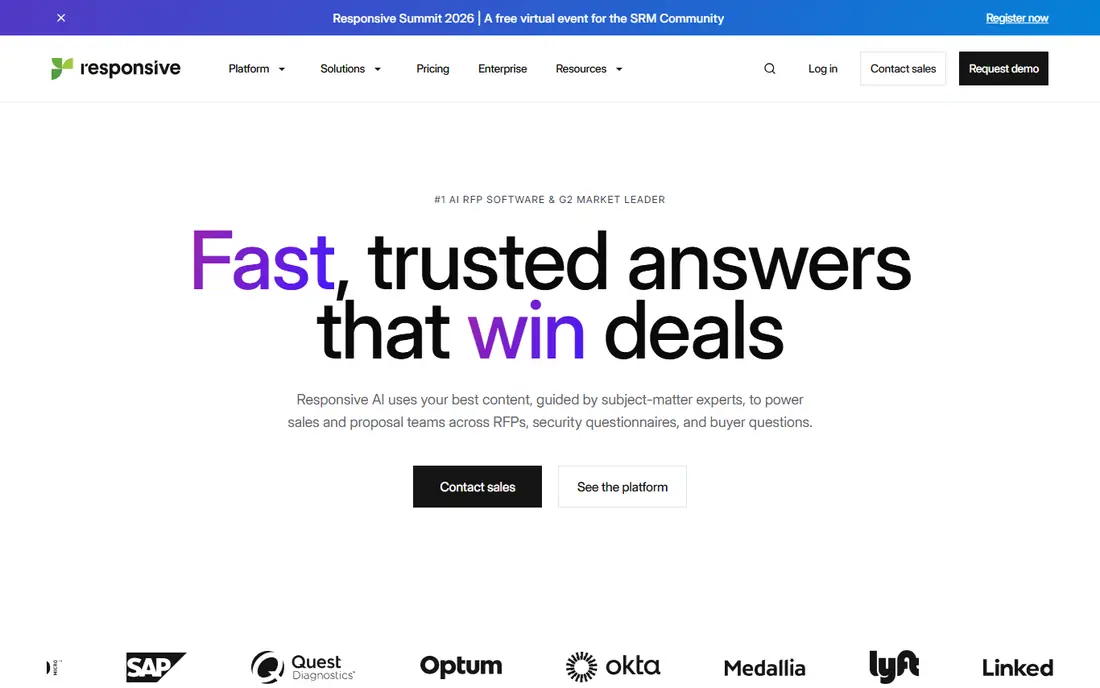
Responsive, formerly RFPIO, is designed for large response operations. It imports messy RFP documents, drafts answers with AI, and coordinates contributors across departments. Assignments, comments, mentions, and review steps keep complex bids moving without endless email threads.
The platform also covers security questionnaires, due diligence questionnaires, and proactive proposals, so one system can serve several response types. Integrations with CRM, storage, and collaboration tools help larger companies fit it into existing workflows. For enterprises with high volume and strict deadlines, that breadth is valuable.
The downside is scale and price. Responsive is quote based and built for teams with serious volume, so small firms may find it more than they need. Implementation takes planning, and admins need time to set up libraries and permissions. Large teams will get the most from it.
- Handles Word, Excel, and PDF imports
- Broad integrations
- Strong collaboration tools
- Quote based pricing
- Setup can be heavy for small teams
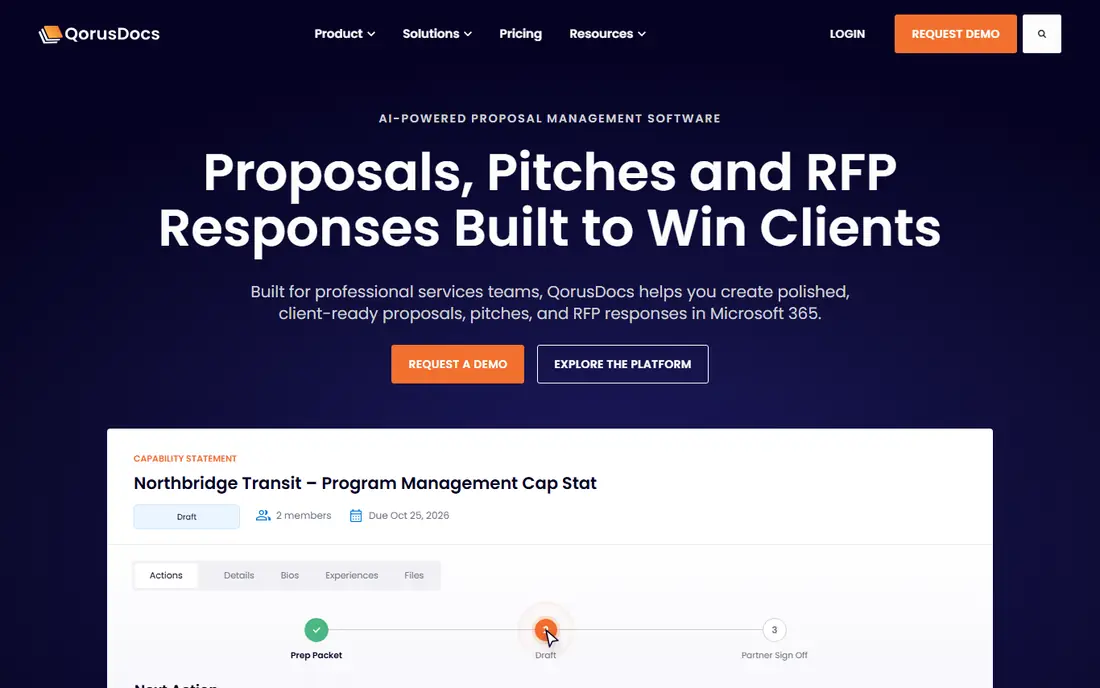
QorusDocs is a strong fit for professional services firms that live in Microsoft Office. It lets teams build proposals and RFP responses inside Word and PowerPoint, pulling approved content from a central library without switching apps. That native feel reduces formatting pain at the end of a bid.
AI features help draft and refine answers, while templates keep branding consistent across proposals. Collaboration tools let reviewers comment and approve content in familiar Office workflows. For law, consulting, and accounting firms, that fit is a real advantage.
The limit is focus. Teams that work mainly in Google Docs or other editors will get less value from the Office integration. Pricing is quote based, so smaller firms should ask for a clear scope. Microsoft first teams should put QorusDocs near the top of the list.
- Native Word, PowerPoint, and Outlook integration
- Strong templates
- Content library
- Quote based pricing
- Microsoft centric workflow may not suit Google teams
AutoRFP.ai is an AI native tool that drafts RFP and RFQ answers from connected knowledge and a self updating library. Instead of charging per seat, it uses project based plans with unlimited users on its Scale plan. That model suits teams that pull in many occasional contributors for one bid.
The platform includes go and no-go screening, semantic drafting, and workflow tools for high volume B2B teams. For companies that answer many RFPs each month, the time saved on first drafts can be large. A 30 day free trial helps teams test it on a real RFP before paying.
The catch is the monthly floor. At $899 per month, it is not a casual purchase for a team that answers a handful of bids a year. Drafts still need human review, since AI can miss nuance or state a capability incorrectly. For steady volume, it is a compelling option.
- AI drafting without per seat fees
- Project based pricing
- Self updating library
- Higher monthly floor
- Best for teams with steady volume
Inventive AI uses task specific AI agents to draft RFP answers, check for conflicts, and pull from connected sources. Drafts include citations, which help reviewers verify claims before submission. That transparency is useful when accuracy matters more than speed alone.
The tool also works where sales teams already work, including Slack, Salesforce, portals, and a browser extension. That reduces the need to copy answers between systems. For revenue and presales teams that answer questionnaires across many channels, that reach is a plus.
The trade off is governance history. As an AI native vendor, it has a shorter track record than library based incumbents, so buyers should test it on real questionnaires. Pricing at $830 per month also suits teams with regular volume. For AI first drafting with citations, it is worth a trial.
- Autonomous agents with citations
- Conflict detection
- Works in Slack and Salesforce
- Newer AI native approach
- Pricing is monthly and not per seat
1up is built for sales and presales teams that answer questions in chat rather than in long documents. It delivers approved answers inside Slack, Microsoft Teams, Salesforce, and a browser extension, so reps do not need to open a separate RFP tool for every question. That speed matters during live deals.
Setup is faster than an enterprise platform, and the Starter plan at $250 per month is far more accessible than quote based suites. A free plan lets small teams try the core answering workflow before paying. For teams drowning in one-off questions, 1up can cut a lot of back and forth.
The limit is scope. It is not a full RFP project management suite with the same depth of document production as Loopio or Responsive. Teams that need complex bid assembly should pair it with, or choose, a larger platform. For question answering speed, it is a strong pick.
- Answers inside Slack, Teams, and Salesforce
- Fast setup
- Lower starting price
- Less full RFP project management than enterprise suites
- Free plan limits apply
Qvidian, part of Upland Software, serves regulated enterprises such as banks and healthcare companies. Its strength is governance. Content goes through approval workflows, version control, and reporting, so teams can show who approved each answer and when. That audit trail matters in regulated bids.
The platform also offers proposal analytics and reporting, which help leaders see win rates, content use, and bottlenecks. For large teams with compliance needs, that control is more important than a flashy AI demo. It handles RFPs, RFIs, and proposals in one system.
The downside is price and feel. Pricing is quote based, and the interface is built for enterprise users rather than small teams. Setup takes time, and smaller firms may find it heavy. Regulated teams that prize governance should shortlist it.
- Strong library governance and approvals
- Reporting
- Proposal analytics
- Quote based pricing
- Interface feels enterprise focused
PandaDoc is not a dedicated RFP platform, but it is a sensible choice for small teams that answer a few RFPs and send many proposals. It offers templates, document tracking, and built-in e-signatures, so a proposal can go from draft to signed deal in one tool. That end to end flow is useful for sales led firms.
Pricing starts at $19 per user per month on annual billing, with a free plan for a small number of documents. That makes it far more accessible than enterprise RFP suites. For agencies, freelancers, and small sales teams, it covers the core need without a large contract.
The catch is depth. PandaDoc lacks the large content library, questionnaire automation, and compliance workflows of dedicated RFP tools. High volume RFP teams will outgrow it quickly. For low volume teams, it is a practical and affordable starting point.
- Low starting price
- Proposals plus e-signatures
- Templates and tracking
- Not a dedicated RFP library platform
- Weaker for complex questionnaires
How we picked these
We compared official pricing pages, product documentation, and public user reviews for AI RFP and RFQ tools in October 2026. We gave weight to AI drafting, library quality, import and export formats, collaboration, and pricing model. We did not claim hands-on testing, and we favored tools with current product pages and clear RFP or RFQ use cases.
How to choose the right tool
Start with volume. Count how many RFPs, RFQs, and security questionnaires you answered in the last year, and how many people contributed. A handful of bids does not justify an enterprise contract, while weekly volume usually does. Match the pricing model to that count, since per seat, flat, and project pricing lead to very different totals.
Next, test with a real document. Import a past RFP, including a messy Word or Excel file, and see how the tool parses it. Check whether AI drafts cite sources, whether reviewers can approve answers, and whether exports keep your branding. A demo with a clean sample file will hide the problems you will face in real bids.
Finally, assign an owner. Every library tool fails when no one updates answers, and every AI tool fails when no one reviews drafts. Pick a person who owns the library, sets review rules, and checks accuracy before submission. That role matters more than any single feature.
FAQ
What is the best ai software for responding to rfps and rfqs for a mid-size team?
Loopio is a strong fit for mid-size teams that want a structured library plus AI drafting. Responsive suits larger teams, while AutoRFP.ai suits high volume teams that want project pricing. Test each with a real past RFP before deciding.
Can AI write a complete RFP response on its own?
AI can produce a strong first draft, but it should not submit alone. Reviewers need to check capabilities, pricing, dates, and compliance claims, since AI can misstate details or miss nuance. Treat AI output as a draft that a human owns.
How much does RFP software cost?
Costs range from $19 per user per month for PandaDoc to $20,000 per year for Loopio Foundations and $899 per month for AutoRFP.ai Scale. Several enterprise tools are quote based, so ask for a total annual price for your team size.
What is the difference between Loopio and Responsive?
Loopio targets small to mid-size teams with a cleaner interface and faster onboarding, while Responsive targets larger enterprises with broader integrations and deeper automation. Both use a library plus AI drafting, but their scale and price differ.
Do I need RFP software for a small business?
Probably not an enterprise platform if you answer only a few RFPs a year. PandaDoc or Proposify can handle proposals at a lower price. Dedicated RFP software earns its cost when volume, question counts, or compliance needs overwhelm manual work.
What about RFQs and security questionnaires?
Most tools on this list handle RFQs, RFIs, and security questionnaires as well as RFPs. If security questionnaires are your main workload, check dedicated features such as trust centers, citation support, and approval workflows before choosing.