Best AI Brand Visibility Tracking Tool in 2026: 8 Tools Compared
Compare the best AI brand visibility tracking tool options in 2026 on engines tracked, prompt data, citations, pricing, and reporting for your team in detail.

- Editor's choice
 Profound
Enterprise coverage
Starts at$99 per monthVisit tryprofound.comFull review - Great alternative
 Peec AI
Agencies
Starts at$95 per monthVisit peec.aiFull review - Also consider
 Otterly
Budget tracking
Starts at$29 per monthVisit otterly.aiFull review
TL;DR:
- Profound is our pick for large brands that need the widest engine coverage and prompt-level reporting across AI answer engines.
- Otterly is the cheapest credible starting point for small teams, with core engine tracking from $29 per month.
- Peec AI suits agencies and multi-brand teams, with unlimited seats and clean competitor comparisons on its brand plans.
- Tools disagree because they measure different prompt sets, so compare trends over time rather than treating one score as exact.
- Check which engines matter for your buyers first: ChatGPT, Google AI Overviews, Perplexity, and Gemini cover most brand searches.
Quick comparison
| Tool | Best for | Starts at | Free plan? | |
|---|---|---|---|---|
| Profound | Enterprise coverage | $99 per month | Free trial | Visit |
| Peec AI | Agencies | $95 per month | No | Visit |
| Otterly | Budget tracking | $29 per month | No | Visit |
 Scrunch | Crawler and persona insights | $250 per month | No | Visit |
 AthenaHQ | Self-serve broad coverage | $295 per month | Free trial | Visit |
 Semrush AI Visibility Toolkit | Existing Semrush users | $99 per month | Free trial | Visit |
 Ahrefs Brand Radar | Existing Ahrefs users | $199 per month | No | Visit |
 Rankscale | White-label reporting | See website | No | Visit |
The best AI brand visibility tracking tools
AI answers now shape how buyers first hear about a brand, so the best AI brand visibility tracking tool is the one that shows where your brand appears, which sources are cited, and who is recommended instead.
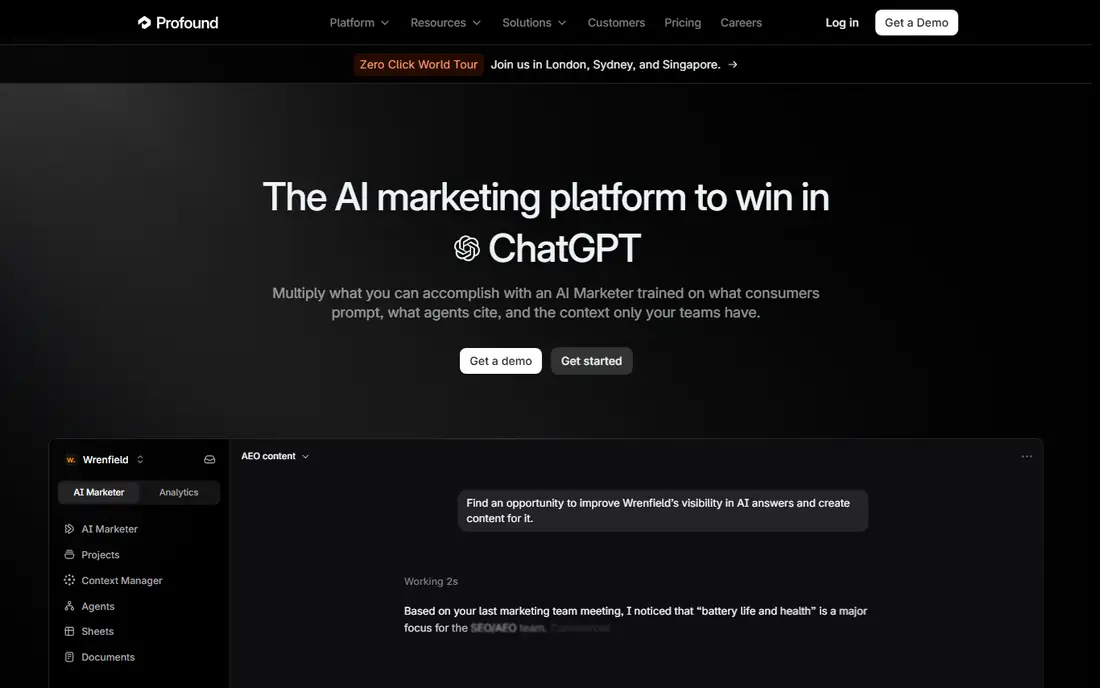
Profound sits at the top of this list for brands that need depth. At higher tiers it tracks ChatGPT, Perplexity, Google AI Overviews, Google AI Mode, Gemini, Claude, Copilot, Grok, and DeepSeek, and it links crawler activity to analytics through integrations with tools such as Google Analytics and content delivery networks. Prompt-level data shows not just whether your brand appears, but which questions trigger it and which sources the answer cites.
The entry price needs careful reading. The $99 per month plan covers ChatGPT only, and broader coverage, extra seats, and agency workspaces cost more, with agency plans adding per-client fees. Small teams may find that structure costly for a first tracker. For large brands and agencies with enterprise clients, Profound depth and reporting justify the price.
- Widest engine coverage at higher tiers, up to nine answer engines
- Prompt volume and citation analysis
- Content recommendations linked to tracking data
- Full engine coverage needs a higher tier or enterprise plan
- Entry plan covers ChatGPT only
- Agency pricing adds per-client workspace fees
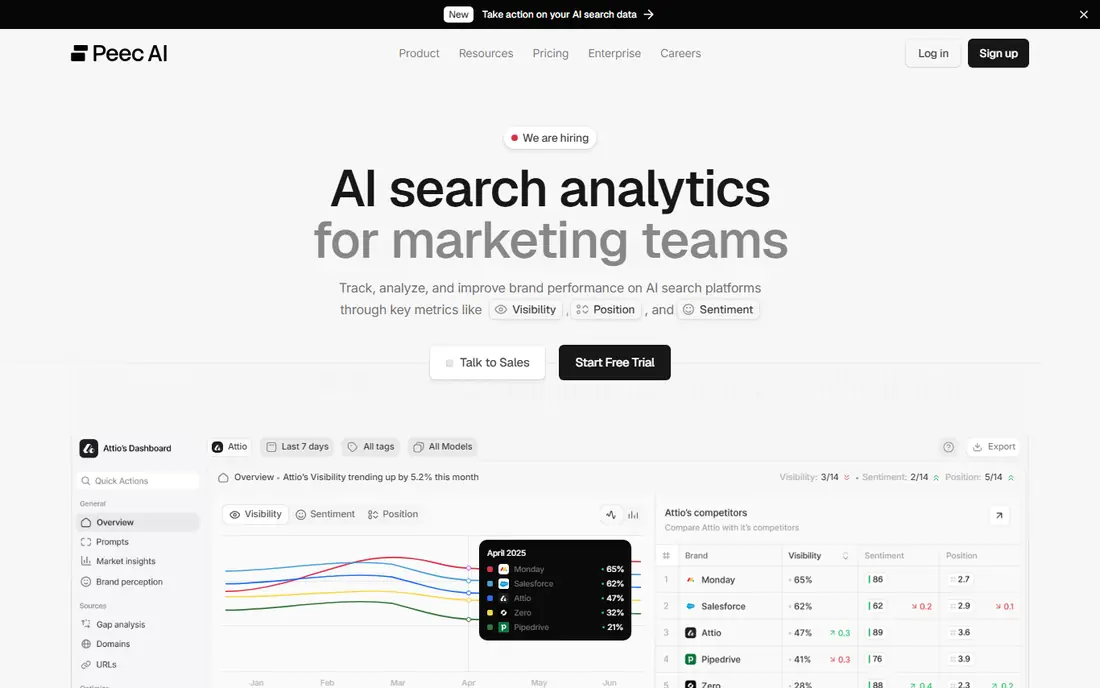
Peec AI is built for teams that track several brands at once. Unlimited seats mean clients, account managers, and content staff can all view the same dashboards without seat fees adding up, and competitor tracking makes it easy to see share of voice against three or four rivals. Setup is short, which matters for agencies that onboard new clients often.
Engine coverage is the main limit. Brand plans cover three of six engines, and full coverage plus Claude requires an enterprise tier, so check which engines your clients care about before you buy. For agencies and multi-brand teams, Peec AI offers a good balance of price, usability, and reporting. For a single small brand, a cheaper tool may cover enough.
- Unlimited seats on brand plans
- Clean competitor comparisons
- Fast setup for multiple brands
- Brand plans cover three of six engines, with full coverage at enterprise tier
- Claude coverage is enterprise only
- Smaller teams may not need agency features
Otterly is the best place to start if you have not tracked AI visibility before. At $29 per month, or $25 per month billed annually in some listings, it covers core engines and shows brand mentions, citations, and competitor positions in a dashboard that small teams can read without training. That low price makes it easy to test AI tracking for a quarter and decide whether deeper tools are worth it.
Limits appear as needs grow. Engine coverage is narrower than enterprise platforms, Claude is not covered on basic plans, and reporting options are simpler. Otterly also suits SEO teams that want a quick weekly check rather than board-level reporting. For a first AI visibility tracker, it is the value pick.
- Lowest entry price in this list
- Covers core engines including ChatGPT, Perplexity, and Google AI Overviews
- Simple dashboards for small teams
- Fewer engines than Profound or AthenaHQ
- No Claude coverage on basic plans
- Reporting is simpler than enterprise tools
Scrunch takes a more technical angle than most trackers here. Alongside brand mentions and citations, it analyzes AI crawler activity on your site, which helps technical teams see whether AI systems can read and use their content at all. Persona insights are another distinct feature: different buyer profiles can receive different AI answers, and Scrunch measures those differences rather than reporting one average score.
That depth comes at $250 per month to start, which puts Scrunch beyond a casual first tracker. Teams that already use analytics and search tools will get more from it than teams that only want a weekly mention count. Choose Scrunch if crawler access and audience differences are central to your AI search work.
- AI crawler analytics plus visibility tracking
- Persona-based insights show how different buyers see different answers
- Covers seven or more engines
- Higher entry price than budget tools
- Technical setup suits larger teams
- Some features need analytics integration to reach full value
AthenaHQ suits single-market teams that want broad coverage without an enterprise sales process. Paid plans cover seven engines including Claude, and a free tier with monthly credits lets teams test the tool before paying. The credit model can be flexible, since you spend credits on prompts and engines you actually track, rather than paying a flat fee for a fixed set.
Credit pricing also needs attention, since heavy tracking can use credits faster than expected, and the paid entry point near $295 per month is high for small brands. AthenaHQ is best for mid-sized teams that want self-serve setup, broad engine coverage, and a free way to trial the product before committing.
- Broad engine coverage including Claude on paid plans
- Credit-based system for flexible tracking
- Free tier with monthly credits for testing
- Credit-based pricing needs careful tracking
- Entry paid plan is costly for small teams
- Newer platform with a smaller user base than Semrush or Ahrefs
Semrush AI Visibility Toolkit makes sense if your team already runs Semrush for search work. AI visibility data sits next to keyword, backlink, and site audit data, so you can link a drop in AI mentions to a content or technical change without exporting data between tools. The toolkit also checks whether AI crawlers can access your pages, which connects visibility problems to fixable site issues.
Pricing is per domain, listed at $99 per month for 25 prompts at entry level, so agencies tracking many domains will pay more. The toolkit also sits inside a larger Semrush subscription structure, so confirm the total cost before you buy. For SEO teams already in Semrush, it is the most convenient AI visibility option.
- AI tracking inside a familiar SEO suite
- Prompt tracking plus technical crawl-access checks
- Competitor comparisons in the same dashboard
- Priced per domain, so multi-brand costs add up
- Prompt limits apply at entry tier
- Full Semrush suite costs extra beyond the toolkit
Ahrefs Brand Radar adds AI visibility to a platform many SEO teams already trust for backlinks and content research. Its AI visibility index draws on a large set of real search-backed prompts, and it can track brand presence beyond standard web answers, including video and forum surfaces that matter for some buyers. That breadth helps teams that want AI data in the same place as their link and content work.
The entry price, from $199 per month for a single platform in published comparisons, is higher than Otterly or Peec AI, and the full value depends on using other Ahrefs tools as well. Teams that only want AI tracking may find a standalone tool cheaper. Teams already paying for Ahrefs should test Brand Radar before buying a separate tracker.
- AI visibility index built from a large prompt set
- Strong backlink and content data alongside brand tracking
- Useful for non-web surfaces such as video and forums
- Higher entry price than standalone trackers
- Best value inside the wider Ahrefs suite
- Brand tracking is one part of a larger toolset
Rankscale rounds out this list for agencies that need client-ready reporting. White-label reports let agencies present AI visibility data under their own brand, which matters when clients expect polished monthly updates. Prompt-level tracking across major engines covers the core job, and workspace structure supports multiple client brands.
Pricing transparency is weaker than Otterly or Peec AI, so agencies should request a quote for their prompt volume and client count before comparing totals. The public review base is also smaller, which makes trials more important. If white-label reporting is a deciding factor, Rankscale deserves a trial alongside Peec AI and Profound.
- White-label client reporting at scale
- Prompt-level tracking across major engines
- Agency-friendly workspace structure
- Pricing is not as transparent as budget rivals
- Smaller public review base than Profound or Peec AI
- Feature details vary by plan
How we picked these
We compared official feature pages, pricing pages, and public 2026 comparisons of AI visibility tools, and we focused on tools that track brand mentions, citations, and competitor positions across AI answer engines rather than general social listening alone. We favored tools with clear engine lists, prompt-level data, and published pricing where available, and we mixed enterprise, agency, and budget options so teams of different sizes have choices. We did not claim hands-on testing we did not do; our comparisons rest on published features, pricing, and public reviews.
We also noted that this category changes fast. Engines add new surfaces, prompt sets change, and pricing tiers shift often, so confirm current engine coverage and prompt limits on the vendor site before you buy.
How to choose an AI visibility tracker
Start with the engines and prompts your buyers actually use, then match the tool to your reporting needs. A tool that tracks ten engines you do not need is worse than a tool that tracks four engines well.
Engines, prompts, and citations
List the engines that matter for your market: ChatGPT, Google AI Overviews, Perplexity, and Gemini cover most brand discovery, while Claude, Copilot, and Grok matter more in specific business or technical audiences. Check how many prompts each plan includes, whether you can add your own prompts, and whether the tool shows cited sources, not just mention counts. Cited sources tell you which pages to improve, while a mention count alone does not.
Trends, competitors, and reporting
AI trackers disagree because they use different prompt sets, so treat scores as trends, not exact truths. Track the same prompts over time, compare your brand with two or three direct competitors, and look for sustained rises or falls rather than weekly noise. Agencies should check seat limits, multi-client workspaces, and white-label reporting before buying, since those features decide whether a tool fits client work.
Acting on the data
Tracking alone does not improve visibility. Use citation data to find pages that AI answers already cite, improve pages that are missing or outdated, and make key facts easy for AI systems to read, such as clear headings, direct answers, and structured product details. Check crawler access with tools such as Scrunch or Semrush, since a page that crawlers cannot read cannot be cited. Review prompts monthly and update them as buyer questions change.
FAQ
What is the best tool for tracking AI brand visibility?
Profound is our pick for large brands that need wide engine coverage, while Otterly is best for small teams on a budget and Peec AI suits agencies. The best AI brand visibility tracking software for you depends on your engine needs, prompt volume, and reporting requirements. Trial two tools on the same prompts before you commit.
What are the best AI visibility tracking tools for brands on a budget?
Otterly, at $29 per month, is the cheapest credible option in this list for core engine tracking. Peec AI at $95 per month adds agency features and competitor tracking for teams that need more. AthenaHQ free tier with monthly credits is also worth testing before you pay.
How do AI brand visibility tools work?
These tools run a set of prompts through AI answer engines such as ChatGPT, Perplexity, and Google AI Overviews, then record whether your brand is mentioned, which sources are cited, and which competitors appear instead. Some tools also analyze crawler logs or licensed prompt data. Results vary by prompt set, so compare trends over time rather than single scores.
Which AI engines should a brand track?
Most brands should start with ChatGPT, Google AI Overviews, Perplexity, and Gemini, since those cover a large share of AI-assisted discovery. Add Claude, Copilot, Grok, or Google AI Mode if your buyers use those systems often. Check your own traffic and customer questions to see which engines matter most for your market.
Can AI visibility tools replace traditional SEO tools?
No. AI visibility tools measure how brands appear in AI answers, while traditional SEO tools measure rankings, backlinks, technical health, and traffic. The two work best together, which is why Semrush and Ahrefs bundle AI tracking with their SEO suites. Use AI data to guide content and citation work, and use SEO data to guide rankings and site health.
How often should I check AI brand visibility?
Weekly checks suit most teams, with a deeper monthly review of prompts, citations, and competitor movement. Daily checks add noise, since AI answers change with small prompt wording changes. Update your prompt list quarterly, or sooner if you launch a product, enter a new market, or see a sharp change in mentions.