Best AI Brand Visibility Analysis Software in 2026: 8 Tools Compared
Compare the best ai brand visibility analysis software in 2026, with prices, engine coverage, prompt limits and honest trade-offs for teams and agencies.

- Editor's choice
 Otterly.AI
Low-cost daily tracking for small teams
Starts at$29 per monthVisit otterly.aiFull review - Great alternative
 Peec AI
Marketing teams that want clean daily reports
Starts at$95 per monthVisit peec.aiFull review - Also consider
 Profound
Enterprise brands with formal reporting needs
Starts atSee websiteVisit tryprofound.comFull review
TL;DR:
- Most tools in this group track the same core job, which is checking how often AI assistants mention your brand, how they describe it, and which sources they cite.
- Entry prices vary a lot, from $29 per month at Otterly.AI to custom enterprise pricing at Profound, so prompt limits matter more than headline prices.
- Some plans cover only three or four AI engines at the entry level, and extra engines can cost extra, so check coverage before you buy.
- Tools that add page audits or content actions help small teams act on the data, while pure trackers suit teams that already have writers and SEO staff.
Quick comparison
| Tool | Best for | Starts at | Free plan? | |
|---|---|---|---|---|
| Otterly.AI | Low-cost daily tracking for small teams | $29 per month | Free trial | Visit |
| Peec AI | Marketing teams that want clean daily reports | $95 per month | Free trial | Visit |
| Profound | Enterprise brands with formal reporting needs | See website | Free trial | Visit |
 Scrunch | Finding content gaps and auditing pages for AI search | $250 per month | Free trial | Visit |
 Semrush AI Visibility Toolkit | Teams already paying for Semrush | $99 per month | No | Visit |
 Ahrefs Brand Radar | Researching any brand across a large prompt database | See website | No | Visit |
 AthenaHQ | Testing many engines before committing to a paid plan | Free | Yes | Visit |
 Goodie AI | Teams that want tracking plus content work in one place | $399 per month | Free trial | Visit |
The best AI brand visibility analysis software
These tools answer a simple question that traditional search tools do not: when a buyer asks an AI assistant for a recommendation, does your brand show up, and in what context. We compared official feature pages, pricing pages, engine coverage, and prompt limits.
Otterly.AI is our pick for a first step into AI brand visibility analysis. The Lite plan tracks ChatGPT, Google AI Overviews, Perplexity, and Microsoft Copilot each day, which covers the assistants most buyers are likely to meet first. It also includes a Brand Visibility Index and GEO URL audits, so you get more than a simple mention count.
The trade-off is scale. Fifteen prompts will suit one brand in one market, but a team tracking several product lines will need the Standard plan at $189 per month or prompt packs on top of Lite. If Gemini or Google AI Mode matter to your buyers, budget for those add-ons from the start. Still, for a small team that wants a daily dashboard without an enterprise contract, this is a sensible place to start.
- Lowest entry price in this list
- Daily tracking across four core engines
- Unlimited team members on every plan
- Entry plan covers only 15 prompts
- Gemini and Google AI Mode are paid add-ons
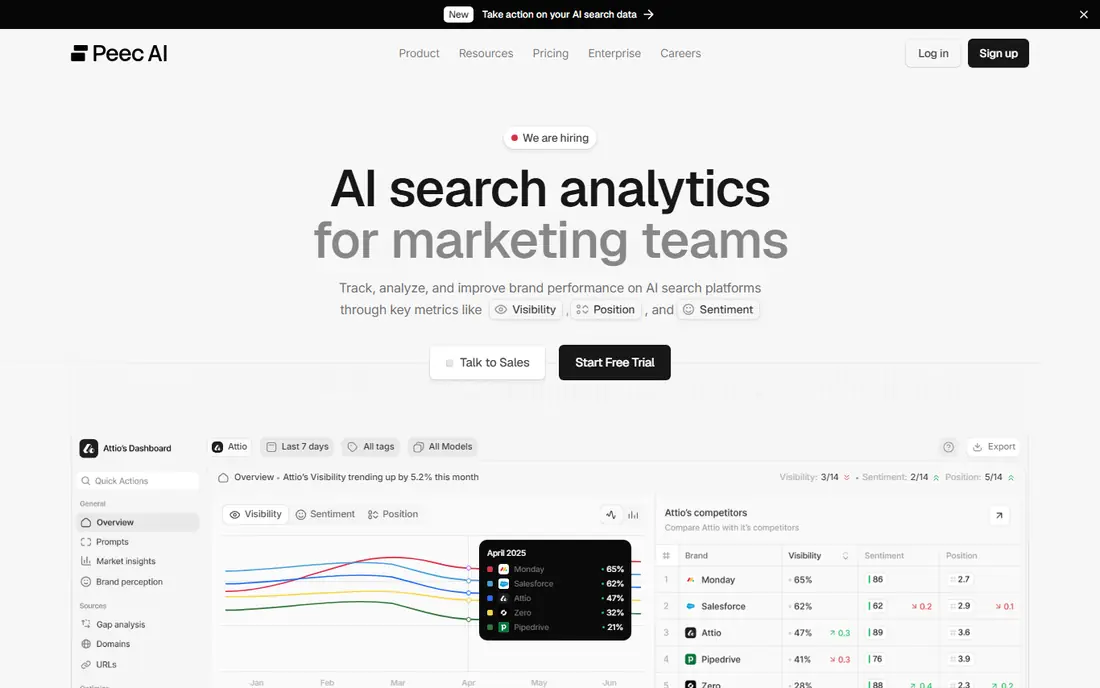
Peec AI keeps the job focused. You supply the prompts your buyers plausibly ask, and the platform runs them daily against the engines you select, reporting mentions, position, sentiment, and cited sources. That focus makes reports easy to share with a manager or a client, because the story is clear: here is where we appear, here is where competitors appear, and here is what changed.
The catch is coverage math. Three engines may be enough if your buyers live mainly in ChatGPT, Gemini, and Google AI Overviews, but full coverage costs more than the headline price once add-ons are included. Peec AI is also mainly a measurement tool, so your team still needs its own plan for fixing weak pages. For teams that value a tidy dashboard and unlimited seats, that trade is often worth it.
- Daily tracking with sentiment and share of voice
- Unlimited seats on every plan
- Clear competitor comparisons
- Self-serve plans cover three engines of your choice
- Extra engines cost extra
- API access is limited to higher tiers in some reports

Profound is the most enterprise-oriented tool in this list. It monitors how AI models describe your brand and your competitors across engines such as ChatGPT, Perplexity, Gemini, Claude, and Google AI Overviews, depending on plan. It also adds prompt volume insight, which helps a team judge which questions matter most before spending time on content.
The honest limit is price and complexity. A free trial can show the category, but a serious multi-engine program sits on a custom enterprise plan, and some agent features run on credits that need watching. Small brands will likely get most of what they need from a cheaper tracker. Larger brands that need daily data across many markets, plus security features such as SSO, will find Profound easier to defend internally.
- Broad engine coverage on enterprise plans
- Prompt volume data and answer engine insights
- Strong compliance options for larger firms
- Enterprise pricing is custom and can be high
- Entry plans are limited in engines and prompts
Scrunch stands out because it moves one step past the report. Its Insights view is built to surface prompts where your brand is missing and a competitor is cited, and its page audits check how well a specific page is set up for AI agents. That pairing helps a content team go from a gap to a concrete page fix inside one product.
The limit is audit volume. Starter includes a small number of page audits per month, so a site with hundreds of pages will hit the ceiling quickly. Seats are also capped on lower plans. If your main problem is knowing what to write next, Scrunch earns its price. If you only need a mention count, a cheaper tracker will do.
- Pairs gap insights with page audits
- Clear published pricing
- Coverage across major engines
- Starter plan includes only a small number of page audits
- Extra seats cost extra
- Email-only support below Enterprise
Semrush makes most sense as an add-on, not a first purchase. If your team already works in Semrush for keywords, rankings, and site audits, adding AI visibility there keeps one workflow and one login. The toolkit tracks a set of prompts daily for one domain and checks how ready your site is for AI answers.
The catch is that the value depends on your existing Semrush setup. A team that does not already use Semrush will find cheaper standalone trackers with similar core coverage. Multi-domain teams should also check the per-domain price before assuming the toolkit is cheap. For a loyal Semrush shop, though, the convenience is real.
- Sits next to your existing SEO data
- Tracks ChatGPT, Google AI, Gemini, and Perplexity
- Includes an AI readiness site audit
- Priced per domain, so multi-brand costs add up
- No free plan listed
- Claude and Copilot coverage is not part of the core toolkit in some listings
Ahrefs Brand Radar takes a different angle from most tools here. Instead of only tracking prompts you write, it lets you research how brands appear across a large database of prompts collected from AI answers. That makes it useful for competitor research and for a quick check on a brand before you commit to tracking it over time.
The trade-off is cost structure. Brand Radar works as an add-on to Ahrefs plans in many setups, and full access across all platforms sits at a higher price point than a basic tracker. Teams that already use Ahrefs for links and keywords will get more from it than a team buying it cold. Check the prompt allowance on your tier, because a small allowance will limit how many of your own questions you can follow closely.
- Large database of pre-collected prompts
- Useful for benchmarking brands you do not own
- Strong citation research
- Full multi-platform access can be costly
- Custom prompt capacity varies by plan
- Best value comes with an existing Ahrefs subscription
AthenaHQ is a good choice if you want to try the category without paying first. Its free plan gives a limited credit balance across several engines, which is enough to see how your brand appears and to judge if daily tracking is worth a budget. Paid plans widen engine coverage to eleven or more models and add integrations with analytics and ecommerce platforms.
The main risk is the credit model. One credit generally equals one AI response, so heavy prompt lists across many engines can burn through credits faster than a flat prompt allowance would. Teams that like predictable monthly costs should model their prompt list carefully. For ecommerce brands that want to link AI visibility to visits and sales, that extra integration work may justify the price.
- Free plan available
- Covers many AI models on paid plans
- Connects visibility to traffic and revenue data through analytics integrations
- Paid Starter plan is $295 per month
- Credit use can be hard to predict
- Some advanced features sit behind custom enterprise pricing
Goodie AI suits a team that does not want to hand a report to someone else and wait. It tracks brand visibility across major AI engines and pairs that data with optimization actions, so the next step after a weak result is clearer than with a pure tracker. That blend appeals to brands that already have content capacity and want to move faster.
The price is the clear barrier. At $399 per month for the entry plan, Goodie AI is not a casual test purchase. Smaller teams should start with a cheaper tracker and only move here when they have a proven list of prompts and a writer ready to act on the findings. For a mid-size brand with a content team in place, the combined workflow can save time that would otherwise go to manual reporting.
- Combines visibility tracking with content optimization actions
- Tracks major engines including ChatGPT, AI Overviews, Perplexity, AI Mode, and Copilot
- Revenue-focused reporting
- Entry price is high for small brands
- Some advanced features sit on higher tiers
- Prompt allowances need checking against your brand list
How we picked these
We compared official feature pages, pricing pages, engine coverage, and prompt limits for tools that offer true AI brand visibility analysis, meaning they run buyer-style prompts against AI assistants and report mentions, position, sentiment, or citations. We left out general SEO tools that only mention AI in passing, and we left out tools that could not show a clear brand visibility feature. Prices and limits change often in this fast-moving category, so check the vendor pricing page before you buy.
What to check before you choose an AI brand visibility tool
Start with the engines your buyers actually use. If most of your customers ask ChatGPT and Google AI Overviews, a tool that covers those two well beats a tool with a long engine list that misses one of them. Write down ten to twenty real buyer questions first, then check each tool's prompt allowance against that list. A cheap plan with too few prompts will force you to drop important questions.
Prompt limits, engines, and refresh speed
Daily tracking matters in this category because AI answers change often. A weekly check can miss a shift that a daily check would catch. Also check if your plan includes the countries and languages you sell in, and if extra engines are add-ons. The headline price is only the start of the true cost when add-ons are involved.
From report to action
A tracker alone does not improve visibility. Decide who will act on the data. If you have writers, a clean tracker plus your own content plan may be enough. If you need help deciding what to fix, look for page audits, source analysis, or content actions. Run any free trial on your own prompts, not only on the vendor's suggested set, and check if the trial covers the engines on the plan you would actually buy.
FAQ
What is the best ai brand visibility analysis software for a small business?
For most small businesses, Otterly.AI is a sensible starting point because its $29 per month Lite plan covers four core engines with daily tracking. Peec AI is a step up if you want cleaner reporting and unlimited seats. Start small, prove that AI answers matter for your buyers, and then move to a larger plan only when your prompt list grows.
What are the best ai brand visibility analysis tools for agencies?
Agencies need multi-brand workspaces, unlimited seats, and reports that clients can read without training. Peec AI, Otterly.AI, and Profound all fit that need at different price points, with Profound suited to larger client rosters and formal reporting. Check seat limits and per-client pricing carefully, because those two items often decide the true agency cost.
What is the best ai brand visibility analysis tool for content gaps?
Scrunch is a strong pick for content gaps because it pairs gap insights with page audits that point to specific pages to fix. Goodie AI also helps here by linking tracking to content actions. A pure tracker can show the gap, but it will not tell you which page to rewrite first.
How much does AI brand visibility software cost?
Prices in this list run from free plans and $29 per month trackers to $399 per month and custom enterprise pricing. The true cost depends on prompt count, engine coverage, seats, and add-ons. Always compare the plan you would actually buy, including add-ons, rather than the lowest headline price on the pricing page.
Can a free tool replace a paid AI brand visibility tracker?
A free plan or a one-off checker can give a useful first look, and AthenaHQ offers a free plan for that purpose. For ongoing work, though, a free plan usually lacks daily tracking, history, and enough prompts to follow a real brand. Use free options to test the category, then pay for daily tracking once you have a prompt list worth following.