Best Agent of Record (AOR) Software in 2026: 8 Platforms Compared
We compared the best agent of record aor software for engaging contractors abroad, covering contracts, payments, compliance rules, and pricing details.

- Editor's choice
 Deel
Global contractor management
Starts atSee websiteVisit deel.comFull review - Great alternative
 Remote
Contractors and employees together
Starts atSee websiteVisit remote.comFull review - Also consider
 Papaya Global
Enterprise global workforce
Starts atSee websiteVisit papayaglobal.comFull review
TL;DR:
- Agent of record services handle contractor administration, not employment, so they differ from employer of record services in legal effect.
- The core value is one contract and one invoice for many contractors, plus local tax and payment handling in each country.
- An AOR reduces admin work but does not remove classification risk, so legal review still matters for contractor decisions.
- Pricing varies widely, from per-contractor monthly fees to quote-based enterprise deals, so get the full fee in writing.
- Country coverage decides the shortlist fast, since no provider covers every market equally well.
Quick comparison
| Tool | Best for | Starts at | Free plan? | |
|---|---|---|---|---|
| Deel | Global contractor management | See website | No | Visit |
| Remote | Contractors and employees together | See website | No | Visit |
| Papaya Global | Enterprise global workforce | See website | No | Visit |
 Oyster | Distributed teams and compliance | See website | No | Visit |
 Multiplier | Fast global hiring coverage | See website | No | Visit |
 Toku | Contributor and token programs | $149 per contractor per month | No | Visit |
 Niural | All-in-one HR and contractor tools | See website | No | Visit |
 Wisemonk | Contractor programs with guidance | See website | No | Visit |
The best agent of record (aor) software
Agent of record, or AOR, software and services let a company engage contractors in other countries through one provider that signs the contractor agreement, handles invoicing and payments, and manages local tax and compliance paperwork. The contractor remains a contractor, not an employee, which is the key difference from employer of record services. We compared official product pages, coverage claims, and pricing pages to build this list. Note that this article covers admin services, not legal advice, and classification decisions should be reviewed with qualified counsel.
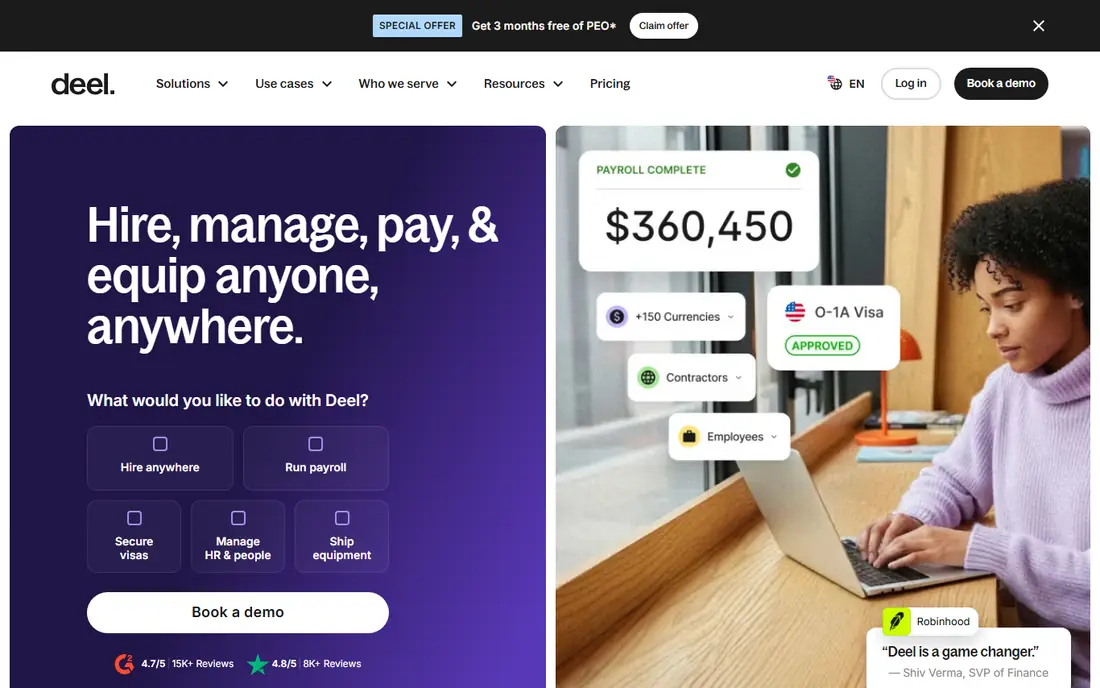
Deel is one of the best-known platforms for hiring contractors and employees across borders, and its contractor tools suit firms scaling a global freelance program. Companies onboard contractors, issue compliant local agreements, and pay through one system, with tax forms and payment records kept in the same place. That single workflow replaces a pile of separate contracts and payment tools.
The drawback is pricing clarity, since costs vary by country and service type and the full quote depends on your mix of contractors and employees. Firms should also remember that Deel handles administration, while the company still owns the classification decision. For a firm adding contractors in many countries, Deel scale and coverage are strong advantages.
- Broad country coverage
- Contractor onboarding and payments
- Compliance documentation
- Pricing varies by service and country
- Enterprise features need a quote

Remote suits companies that mix contractors and employees across countries and want one platform for both. Contractor agreements, payments, and compliance documents sit alongside employee records, which helps finance and HR see the full global workforce in one view. Local expertise in each market supports contracts that reflect local rules.
Pricing is largely quote-based, so small firms need a sales conversation to budget accurately. Coverage and feature depth also vary by country, which is normal in this market but worth checking for your specific hiring locations. For a distributed team with both worker types, Remote reduces the number of vendors to manage.
- Contractor and employee management in one place
- Local compliance support
- Clear dashboards
- Quote-based pricing for many plans
- Feature depth varies by country
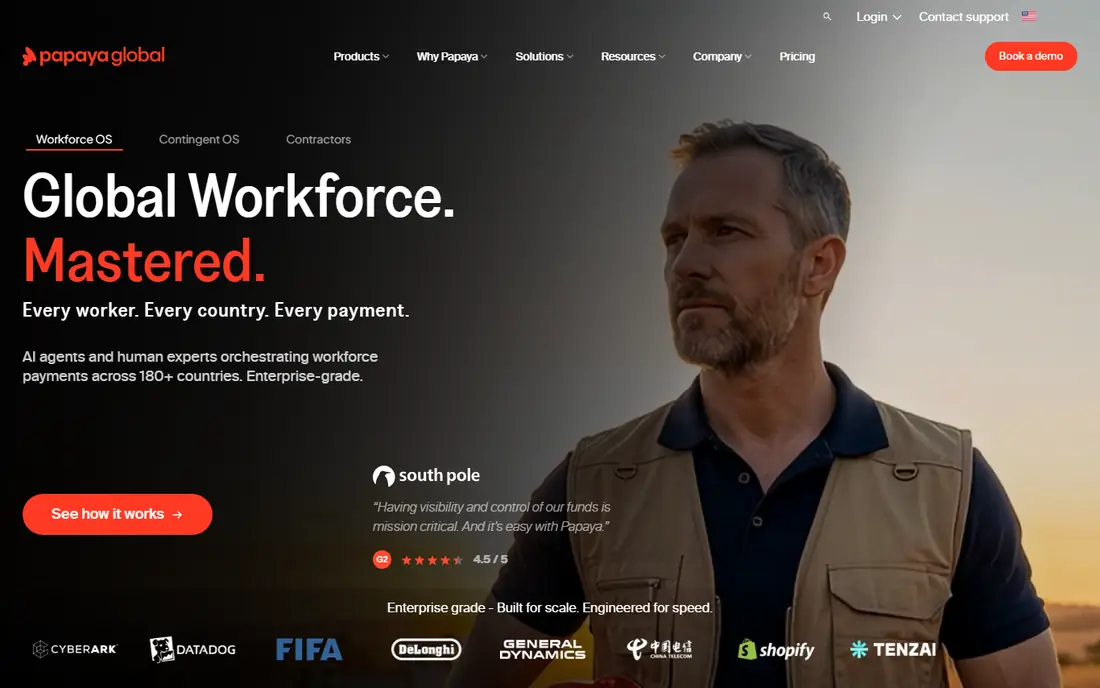
Papaya Global is built for larger firms that need global payroll, contractor management, and workforce reporting in one enterprise system. Its strength is handling complex, multi-country payroll and contractor programs with centralized reporting for finance teams. Companies with entities, contractors, and employees across many markets get one data picture instead of many local systems.
That enterprise depth brings heavier setup and quote-based pricing, which can overwhelm a small firm with a handful of contractors. Smaller teams may find simpler platforms faster and cheaper. For a large firm consolidating global workforce operations, Papaya Global scale and reporting are the main reasons to choose it.
- Enterprise payroll and workforce depth
- Broad country coverage
- Strong reporting
- Enterprise focus and pricing
- Heavier setup than simpler tools
Oyster helps distributed companies hire contractors and employees with guided workflows that explain local requirements at each step. That guidance matters when a hiring manager is entering a new market for the first time and does not know local contract or tax norms. Payments, benefits for employees, and contractor documents stay in one platform.
Pricing requires a quote, and timelines can vary by country when local review is needed. Firms should confirm coverage and setup time for their exact markets before promising start dates to contractors. For a remote-first company building a distributed team, Oyster clarity and support are welcome.
- Guided global hiring workflows
- Contractor and employee options
- Compliance support
- Pricing by quote
- Some countries need extra review time
Multiplier lets companies hire and pay workers in more than 150 countries without setting up a local entity. Contracts are generated to reflect local law, payroll runs in local currency, and statutory benefits and tax withholding are handled by the platform. That speed helps firms that need to engage talent quickly in a new market.
Pricing depends on worker type and country, so a single headline rate does not capture the full cost. Support experience can also vary by market, which is common for global platforms but worth testing early. For a firm that values broad coverage and fast onboarding, Multiplier is a strong contender.
- Coverage in 150 plus countries
- Fast contract generation
- Payroll in local currency
- Pricing varies by worker type and country
- Support quality varies by market
Toku stands out in this list for publishing a clear AOR price of $149 per contractor per month, with contractor management listed separately. It signs AOR agreements with contributors itself and supports payouts in fiat or stablecoins from one system, which suits crypto projects, creator programs, and contributor communities paying across many countries. Its own pages are careful to say the service reduces classification risk rather than removing it, which is an honest framing buyers should note.
The scope is narrower than general contractor platforms, since the AOR product is aimed at ambassador, creator, contributor, and validator programs. A standard freelance engagement may fit the cheaper contractor management tier instead, so firms should check which tier matches their use. For contributor-style programs, Toku clarity on price and scope is rare and useful.
- Published AOR pricing
- Signs AOR agreements itself
- Fiat and stablecoin payouts
- AOR scope fits contributor programs best
- No published misclassification indemnity
Niural combines global HR, payroll, benefits, compliance, contractor oversight, and agent-of-record services in one platform. That breadth suits firms that want HR records, timesheets, expenses, and contractor payments in a single system rather than stitching tools together. Coverage across more than 150 countries supports international hiring without a separate vendor per region.
The all-in-one scope can feel complex for a firm that only needs contractor administration, and full pricing requires a quote. Teams should trial the contractor workflow specifically, rather than judging the whole suite at once. For a firm consolidating HR and contractor operations, Niural breadth is a real advantage.
- HR, payroll, benefits, and contractor tools in one system
- Coverage in 150 plus countries
- Finance automation
- Broad scope can feel complex
- Pricing needs a quote for full use
Wisemonk is a useful option for firms that want clear guidance on how agent of record services actually work. Its explainers spell out the admin benefits, such as one contract and one invoice, while also noting that tax footprint and classification risk stay with the hiring company. That honesty helps buyers set realistic expectations before signing.
As a smaller provider, it lacks the scale and brand recognition of Deel or Remote, so firms should confirm country coverage, payment methods, and support hours for their markets directly. For a firm starting a contractor program and wanting a guided, plain-language approach, Wisemonk is worth including in the shortlist.
- Clear AOR explainers and guidance
- Contractor program focus
- One invoice model
- Smaller provider than global giants
- Coverage details need direct confirmation
How we picked these
We compared official product pages, coverage claims, and pricing pages for platforms that offer agent of record or contractor management services. We favored providers that sign contractor agreements, handle payments and tax paperwork, and cover multiple countries, rather than pure payroll or invoicing tools. Where vendors do not publish prices, we wrote See website, and we noted Toku published AOR price where it was available.
What to check before you choose an AOR
Start with your exact hiring map. List every country where you need contractors, the number of workers in each, and whether they are ongoing freelancers or short contributor engagements. Coverage, payment methods, and setup time vary by country, so a provider that excels in one region may be weaker in another.
Next, separate administration from legal risk in your planning. An AOR handles contracts, invoices, payments, and local paperwork, but it does not turn a misclassified employee into a lawful contractor. Get legal review for borderline roles, keep scope and deliverables clear in each agreement, and ask the provider plainly what it does and does not cover if a classification issue arises.
Finally, get the full commercial picture in writing. Confirm the per-contractor fee, any platform or payment fees, currency conversion costs, and what happens when a contractor leaves or a program ends. Ask for a sample agreement, a sample invoice, and a test payment flow, since those documents reveal more than a sales demo about how the service will actually work.
FAQ
What is agent of record (AOR) software?
It is a platform or service where a provider signs contractor agreements as agent, handles invoicing and payments, and manages local tax and compliance paperwork. The worker stays a contractor, which differs from employer of record services where the provider becomes the legal employer.
How is AOR different from EOR?
With an AOR, the provider acts as agent for contractor engagements, while with an EOR, the provider employs the worker directly in the local country. AOR suits contractor and contributor programs, while EOR suits hiring full employees where you have no local entity.
Does an AOR remove misclassification risk?
No, an AOR reduces admin burden and can lower some risks, but it does not remove classification risk. The hiring company still owns the decision about whether a worker is truly a contractor, and legal review remains important for borderline roles.
How much does AOR software cost?
Pricing varies widely, from published per-contractor fees such as Toku at $149 per contractor per month to quote-based enterprise deals. Always ask for the full fee, including payment, currency, and platform charges, before comparing providers.
Which countries can AOR providers cover?
Coverage varies by provider, with large platforms covering 150 or more countries and smaller providers covering fewer markets. Confirm your exact countries, payment methods, and setup timelines directly with each shortlisted provider.
Can an AOR handle token or stablecoin payments?
Some providers, such as Toku, support fiat and stablecoin payouts for contributor programs, while most general platforms pay in fiat local currency. If token payments matter, confirm payout options, tax reporting, and compliance handling before choosing.