Best Alternatives to SolidJS in 2026: 8 Frameworks Compared
Compare 8 alternatives to solidjs, from React, Vue and Svelte to Preact, Qwik and Angular, on size, learning curve, jobs, ecosystem depth and performance.

- Editor's choice
 React
Largest ecosystem and jobs
Starts atFreeVisit react.devFull review - Great alternative
 Vue
Gentle learning curve
Starts atFreeVisit vuejs.orgFull review - Also consider
 Svelte
Small fast bundles
Starts atFreeVisit svelte.devFull review
TL;DR:
- React is the safest career and hiring choice, with the largest ecosystem of libraries and jobs.
- Svelte and Preact are the closest in spirit to SolidJS, since both keep bundles small and fast.
- Vue is the best balance of gentle learning curve, structure and ecosystem depth.
- Qwik suits content-heavy sites that need fast first loads, while Angular suits large enterprise teams.
- All eight frameworks here are free and open source, so the real cost is learning time and hiring, not licenses.
Quick comparison
| Tool | Best for | Starts at | Free plan? | |
|---|---|---|---|---|
| React | Largest ecosystem and jobs | Free | Yes | Visit |
| Vue | Gentle learning curve | Free | Yes | Visit |
| Svelte | Small fast bundles | Free | Yes | Visit |
 Angular | Large enterprise apps | Free | Yes | Visit |
 Preact | Drop-in React alternative | Free | Yes | Visit |
 Qwik | Instant-loading content sites | Free | Yes | Visit |
 Alpine.js | Sprinkles of interactivity | Free | Yes | Visit |
 Ember.js | Convention-led large apps | Free | Yes | Visit |
The best alternatives to solidjs
SolidJS is a fast, fine-grained reactive framework that compiles away its runtime and skips the virtual DOM. Developers look for alternatives when they need a bigger ecosystem, more hiring options, or a gentler learning path. These eight cover those needs.
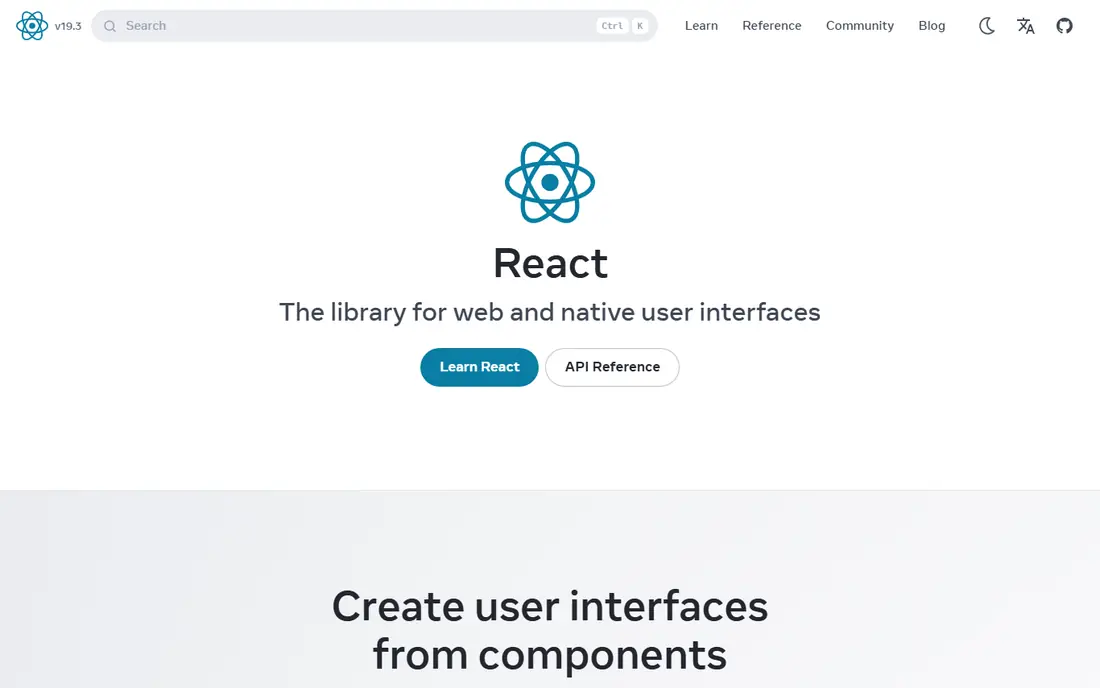
React is the default answer for most teams leaving SolidJS for ecosystem reasons. Almost every UI library, component kit and hiring pool is built around it, and frameworks such as Next.js add routing, rendering and deployment on top. If you need to hire quickly or plug into existing code, React removes the most friction.
The honest trade is performance feel. React re-renders components rather than updating only the changed DOM node, so very reactive interfaces need memoization and care to stay fast. SolidJS developers will notice the extra work, but the ecosystem payoff usually covers it.
- Largest library, tutorial and job market of any UI framework
- Flexible enough for any app shape
- Strong tooling with Vite, Next.js and testing libraries
- Virtual DOM and re-render model is heavier than SolidJS fine-grained reactivity
- Needs extra choices for routing and state

Vue is the best middle ground on this list. Its single-file components keep template, logic and styles together, its reactivity model feels familiar to SolidJS developers, and official tools for routing and state remove guesswork. Teams that want structure without Angular ceremony tend to settle here happily.
The limit is hiring and library depth. Vue has fewer US job listings than React, and some niche libraries ship React-first. For most product teams that trade is fine, but check library support for your specific needs before committing.
- Approachable single-file components
- Official routing and state libraries
- Good docs and a calm upgrade path
- Smaller job market than React in the US
- Ecosystem is split between Vue 2 legacy code and Vue 3
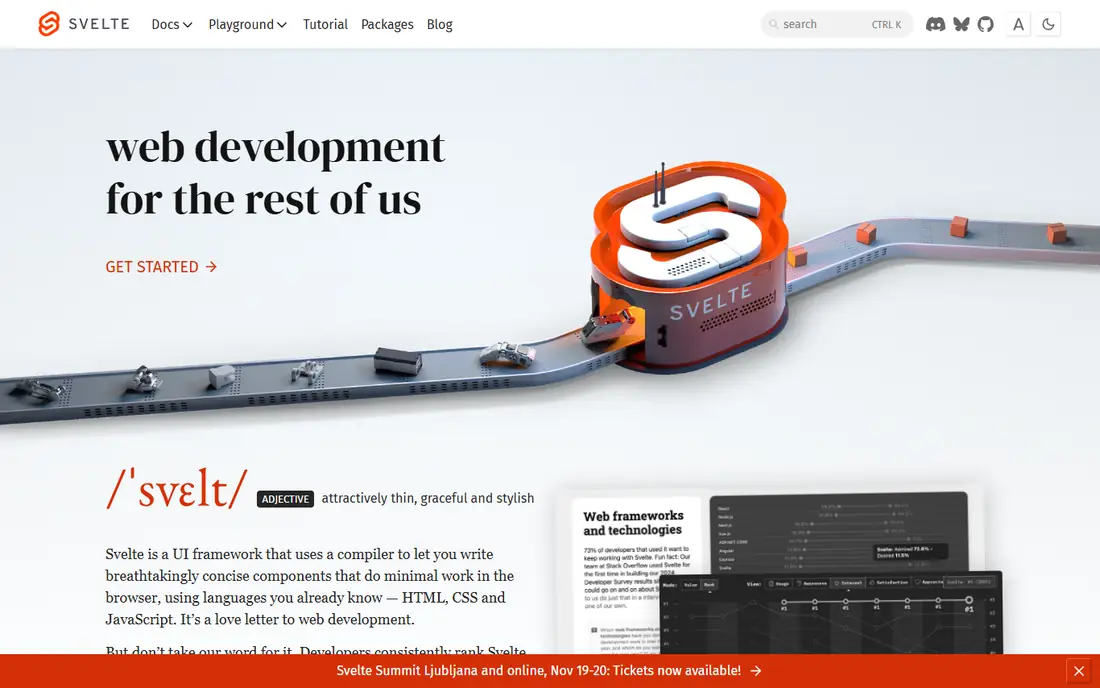
Svelte is the closest cousin to SolidJS in philosophy. Both compile components rather than shipping a heavy runtime, both produce small bundles, and both feel fast without manual optimization. SvelteKit adds routing, server-side rendering and deployment adapters, which makes Svelte a complete app framework.
The catch is ecosystem size. Svelte has fewer component libraries, fewer jobs and fewer Stack Overflow answers than React, so unusual requirements may need custom code. If bundle size and simplicity matter most, Svelte is the most natural SolidJS replacement.
- Compiler-based approach with tiny bundles
- Simple, readable component syntax
- SvelteKit adds routing and server rendering
- Smaller ecosystem and job market than React or Vue
- Fewer ready-made component libraries
Angular suits large teams that value consistency over speed of first build. Everything is included and opinionated, from dependency injection to forms, which keeps a 50-developer codebase coherent. TypeScript is the default, and long-term support makes it a safe enterprise choice.
The trade-off is weight. Angular apps carry more framework code and more ceremony than SolidJS, and small projects can feel over-engineered. Choose Angular when team scale and long maintenance horizons justify the structure, not for a weekend side project.
- Full framework with routing, forms, HTTP and testing built in
- TypeScript-first
- Strong enterprise support from Google
- Steepest learning curve here
- More boilerplate than SolidJS, Svelte or Vue
Preact is the pick when you like React but want SolidJS-style lightness. Its API mirrors React closely, so much React code runs with a compatibility layer, while the core stays around 3 KB. That makes it a strong choice for widgets, embeds and performance-sensitive pages.
The limit is compatibility edges. A few React libraries rely on APIs that Preact only offers through its compat package, so test your dependency list early. For most apps the compat layer covers the gaps, and the bundle savings are real.
- Tiny 3 KB core with a React-compatible API
- Fast rendering
- Easy migration path from React code
- Some React libraries assume full React APIs and need compat shims
- Smaller community than React
Qwik attacks loading speed from a different angle. Instead of hydrating a whole app on the client, it resumes server-rendered HTML, so pages become interactive with far less JavaScript downloaded. For content sites, marketing pages and stores where first-load speed drives conversions, that difference is measurable.
The catch is maturity. Qwik is newer than React, Vue or Angular, with fewer libraries, fewer jobs and fewer production stories. Teams that need proven scale should prototype a real page first and measure the gain against the ecosystem cost.
- Resumable design means almost no JavaScript on first load
- Very fast time-to-interactive
- Built-in routing through Qwik City
- Newer and smaller ecosystem
- Resumability concepts take time to learn
Alpine.js fits a different job from the rest of this list. When a site is mostly server-rendered HTML and only needs dropdowns, modals, tabs and small interactive pieces, Alpine adds that behavior with a script tag and declarative attributes. It pairs well with Laravel, Rails, Django and static sites.
The limit is scale. Alpine has no routing, no component build system and no state story for a large single-page app, so teams that outgrow sprinkles will need to move to Vue, Svelte or React. Use it for enhancement, not as an app platform.
- Tiny footprint for adding interactivity to server-rendered pages
- No build step needed
- Gentle syntax for beginners
- Not a full app framework
- Large single-page apps outgrow it quickly
Ember.js suits teams that want decisions made for them. Its conventions cover routing, data, testing and builds, so a new developer can find their way around a large codebase quickly. The framework has a long history of careful upgrades, which matters for apps that must live for many years.
The trade-off is momentum. Ember's community is smaller than React or Vue, and its learning curve is steeper than Svelte or Alpine. Choose Ember when convention and long-term stability matter more than hiring speed or library fashion.
- Strong conventions that keep large apps consistent
- Built-in router, data layer and testing
- Stable, careful upgrade path
- Smaller community than in its peak years
- Conventions take time to learn for newcomers
How we picked these
We compared official documentation, ecosystem size, bundle approach and hiring signals for JavaScript UI frameworks that are actively maintained in October 2026. We kept only free, open-source frameworks with a clear official homepage and current docs, and we favored options that cover the main reasons developers leave SolidJS: ecosystem depth, hiring, learning curve and load speed. Prices are free for all eight, so we compared learning time and ecosystem fit instead of license cost.
How to choose a SolidJS replacement
Match the framework to the app shape
Content and marketing sites suit Qwik or Svelte. Large team apps suit Angular or Ember. General product work suits React or Vue. Small enhancements suit Alpine or Preact.
Check the libraries you actually need
List your must-have libraries, such as maps, charts, tables and auth, and confirm each one supports your chosen framework. A framework that lacks one critical library can cost more than a slightly larger bundle.
Prototype one real screen first
Build one reactive screen with your real data shape in two finalists and compare code clarity, bundle size and build speed. A short prototype reveals friction that docs and benchmarks hide.
Weigh hiring and community support
A framework with a larger community means more tutorials, more answered questions and a bigger hiring pool when the team grows. That support matters over the life of a product, especially when the original developers move on. A smaller framework can still win on performance and developer joy, but go in with eyes open about the hiring trade-off.
FAQ
What is the best alternative to SolidJS?
React is the best all-round alternative because of its ecosystem, hiring pool and library range. Svelte is the closest in spirit for developers who want small bundles and a compiler-based approach.
Is Svelte faster than SolidJS?
Both are fast, and the difference depends on the app. SolidJS fine-grained reactivity and Svelte compiled output both beat virtual-DOM frameworks on many benchmarks, so choose on ecosystem and syntax feel rather than a single speed claim.
Can I migrate a SolidJS app to React or Vue?
Yes, but it is a rewrite of components, not a mechanical conversion. SolidJS signals and effects map to different patterns in React and Vue, so budget time to rework reactivity, stores and effects rather than copying code across.
Are these SolidJS alternatives free?
Yes. All eight frameworks on this list are free and open source. Costs come from developer time, hosting and any paid services around them, not from framework licenses.
Which alternative to SolidJS is easiest to learn?
Alpine.js is easiest for small interactivity, while Vue is easiest among full app frameworks. Svelte is also gentle, while Angular and Ember take longer to learn because of their conventions and built-in systems.