Alternatives to Profound AI in 2026: 9 Tools Compared
Looking for alternatives to Profound AI? Compare Peec AI, Scrunch, Otterly, AthenaHQ, Goodie, Brandlight, and more for AI visibility tracking for 2026.
- Editor's choice
 Peec AI
Agencies and mid-market teams
Starts at$95 per monthVisit peec.aiFull review - Great alternative
 Scrunch AI
Monitoring plus content for AI agents
Starts at$250 per monthVisit scrunch.comFull review - Also consider
 Otterly.AI
Small teams on a budget
Starts at$29 per monthVisit otterly.aiFull review
TL;DR:
- Profound is strong for large brands, but smaller teams can get useful AI visibility tracking for far less with Otterly or Rankscale.
- Peec AI and Scrunch suit mid-market teams that want prompt level tracking plus competitor comparisons.
- AthenaHQ stands out for teams that want a free starting point and broad engine coverage.
- Goodie and Brandlight suit teams that want tracking linked to actions or enterprise support, at higher prices.
- No tool gives exact visibility scores, so treat trends over time as more useful than any single daily number.
Quick comparison
| Tool | Best for | Starts at | Free plan? | |
|---|---|---|---|---|
| Peec AI | Agencies and mid-market teams | $95 per month | Free trial | Visit |
| Scrunch AI | Monitoring plus content for AI agents | $250 per month | Free trial | Visit |
| Otterly.AI | Small teams on a budget | $29 per month | Free trial | Visit |
 AthenaHQ | Teams that want broad engine coverage | $295 per month | Yes | Visit |
 Goodie AI | Tracking linked to optimisation actions | $399 per month | Free trial | Visit |
 Brandlight | Large enterprise brand teams | See website | No | Visit |
 SE Ranking | SEO teams adding AI tracking | $52 per month | Free trial | Visit |
 Ahrefs Brand Radar | Researching any brand in AI answers | $199 per month | No | Visit |
 Rankscale | Budget multi-engine tracking | $17 per month | Free trial | Visit |
The best alternatives to Profound AI
Profound helped define AI search visibility tracking, which measures how often a brand appears in answers from ChatGPT, Gemini, Perplexity, and similar tools. The tools below cover the same job with different prices, prompt limits, and levels of help with fixes. We compared official pricing pages and recent October 2026 pricing coverage to keep the figures current.
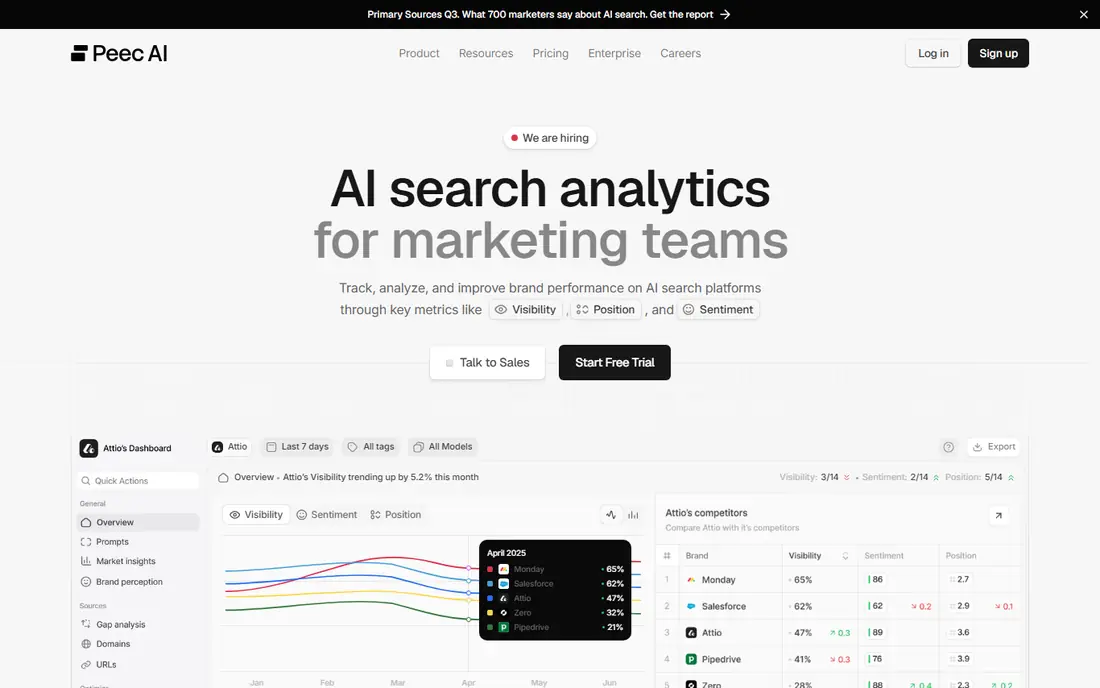
Peec AI tracks how a brand shows up in AI answers across selected engines and prompts, then shows competitors beside it. That side by side view helps a marketing team explain a drop in visibility, since it can show if a rival gained ground or if the whole answer changed. Agencies like the reporting structure, because clients can see prompts, citations, and trends without a custom dashboard build.
The limit is scope. Peec AI is mainly a tracker, so the work of improving pages, facts, and third party mentions still falls to your team. Prompt allowances also shape the real cost, so count the prompts you need before judging the entry price. Recent coverage lists entry pricing around $95 per month, with earlier euro pricing near 89 euros, so confirm the currency at checkout.
- Prompt level analytics
- Competitor comparisons
- Agency friendly reporting
- Price rises with prompt volume
- Monitoring focus means fixes stay with your team
- Euro pricing can confuse US buyers
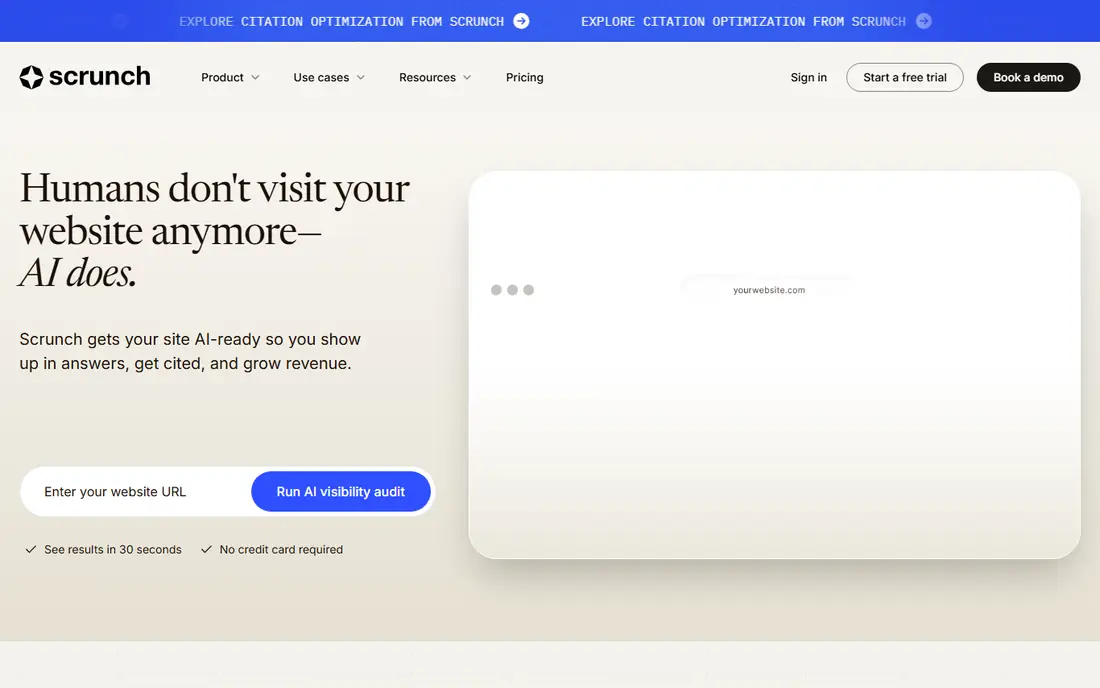
Scrunch AI goes a step further than simple tracking by adding analytics on AI crawlers and tools to serve optimised content to AI agents. For a team that already knows it is absent from answers, that extra layer matters. It helps answer a practical question: are AI crawlers even reaching the pages that should represent the brand.
The trade-off is cost and effort. At around $250 per month for a starter plan in recent coverage, Scrunch is a mid-market buy, not a casual test. The content work still needs a human owner, because agent ready pages need accurate facts, clear structure, and regular updates. Small teams should trial the prompt set first and check crawler data before committing.
- AI visibility monitoring
- Crawler analytics
- Pages shaped for AI agents
- Entry price is high for small teams
- Prompt limits apply
- Setup needs content work
Otterly.AI is the most accessible alternative here for a small business that wants to know if ChatGPT, Google AI Overviews, Perplexity, or Copilot mention it. The entry plan, listed at $29 per month in recent coverage, covers a modest prompt set, which suits a local or niche brand with a focused set of questions. Setup is quick, and alerts help a team spot changes without checking a dashboard daily.
Depth is the compromise. Larger brands with many products, regions, and competitors will outgrow the entry prompt limit fast. Reporting and integrations are also lighter than enterprise tools. For a first step into AI visibility, though, Otterly gives a clear, low cost way to learn what the data looks like before spending more.
- Low entry price
- Simple tracking setup
- Alerts on citations and mentions
- Smaller prompt allowance
- Fewer enterprise features
- Limited depth at entry tier
AthenaHQ covers many answer engines and offers a free Essential plan with a small credit, which makes it one of the easier tools to test with real data. Paid plans expand engine coverage and add analytics on prompts, sources, and responses. Teams that want to link AI visibility to revenue or pipeline will find the attribution angle useful, since most trackers stop at mentions.
The paid starter, listed at $295 per month in recent coverage, puts AthenaHQ in the mid-market bracket despite the free entry point. Free users should check how far the credit goes across their prompt set, because a broad test can use it quickly. For a team ready to pay, the breadth of engines is the main reason to choose it over cheaper single focus trackers.
- Free Essential plan with credit
- Broad engine coverage on paid plans
- Attribution features
- Paid starter is expensive
- Credit limits shape the free test
- Learning curve for full analytics
Goodie AI pairs AI visibility tracking with optimisation actions, so the dashboard does not only report a problem. It suggests fixes and tracks a set number of optimisations each month, which helps teams that lack a separate content plan. Multi-engine coverage includes ChatGPT, Google AI Overviews, Perplexity, and Copilot in recent coverage, giving a broad view of where a brand appears.
Price is the main barrier. At $399 per month for an Explorer plan in recent coverage, Goodie suits brands with a clear budget for AI search work. Teams should check how many prompts and optimisations the plan includes, since both shape value. If your team already has strong content resources, a cheaper tracker may be enough.
- Visibility tracking plus optimisation tasks
- Revenue attribution angle
- Multi-engine coverage
- High entry price
- Optimisation limits apply
- Smaller vendor than large SEO suites
Brandlight positions itself for large organisations that want a partner as well as a tool. That matters when AI visibility spans many brands, regions, and stakeholders, and when reporting must fit executive and compliance needs. The service angle can help a large team move from measurement to action without hiring a separate agency for every step.
The downside is access. Pricing is quote based, and small teams will find the sales process slow compared with self-serve tools. Public detail on prompt limits and engine coverage is also thinner than for self-serve rivals. Choose Brandlight when scale and support matter more than a quick, low cost trial.
- Enterprise focused reporting
- Execution support angle
- Suited to large brand portfolios
- Quote only pricing
- No self-serve trial for most buyers
- Overkill for small teams
SE Ranking suits teams that already run SEO and want AI visibility in the same workspace. Instead of buying a separate tracker, you can check AI Overviews and chatbot mentions beside keyword rankings, backlinks, and site health. That shared context helps a team see if a traffic change came from classic search, AI answers, or both.
Dedicated AI tools may offer deeper prompt analytics, competitor views, or agent content features. SE Ranking is a practical compromise, not a specialist replacement. Entry pricing for the core suite is listed at $52 per month billed annually in recent coverage, with AI features varying by plan, so confirm the AI prompt allowance before buying.
- AI tracking inside a full SEO suite
- Rank tracking and site audits
- Familiar SEO workflow
- AI features are an add-on to SEO work
- Prompt limits vary by plan
- Less deep than dedicated AI tools
Ahrefs Brand Radar adds AI mention data to a well known SEO platform, which helps teams research not only their own brand but any brand. That research angle is useful for agencies and analysts who need to compare many brands quickly. The underlying web data gives context on sources and mentions that pure prompt trackers may not show.
Cost and cadence need care. Recent coverage puts Brand Radar from $199 per month, with higher all-in costs depending on the Ahrefs bundle, and notes monthly chatbot refreshes in some comparisons. Teams that need daily prompt tracking may prefer a dedicated tracker. Teams that need broad brand research may find the Ahrefs view more useful.
- Strong brand mention data
- Ability to research competitors
- Large web index behind it
- High all-in cost in some bundles
- Monthly refresh limits in coverage
- Less focused on prompt tracking
Rankscale appeals to startups and small teams that want multi-engine tracking without a mid-market budget. Recent coverage lists an Essentials plan at $17 per month on yearly billing, with a trial on higher plans. That price point makes it easy to track a core set of prompts and learn how AI answers treat the brand.
The trade-off is depth. Rankscale does not offer the same optimisation, attribution, or enterprise reporting as larger tools. Support and roadmap detail are also thinner. For a small team, that may not matter, since the core job is simple: track mentions, spot changes, and act on the clearest gaps.
- Low entry price
- Multi-engine tracking
- Pay per check flexibility in coverage
- Yearly billing for lowest price
- Smaller vendor
- Fewer action features
How we picked these
We compared official pricing pages and recent October 2026 pricing coverage for tools that track brand visibility in AI answers and that exist as working products today. We kept tools with clear prompt tracking, engine coverage, and pricing that a buyer can verify. We removed tools that were only press releases, that had closed, or that offered only a one-off checker without ongoing tracking.
We also kept a mix of prices and buyer types. A list of only enterprise tools would not help a small business, and a list of only cheap trackers would not help a large brand. Each pick above states who it fits, so readers can shortlist two or three rather than trialling all nine.
How to choose a Profound alternative
Start by listing the prompts that matter. Those are the questions a buyer actually asks, such as best tools for a task, top brands in a category, or comparisons between named products. A tool is only useful if it tracks those prompts across the engines your buyers use. Count prompts, competitors, and regions before comparing prices, since allowances drive the real bill.
Check prompt limits and refresh rates
Entry plans often limit daily prompts or refresh data weekly or monthly. A weekly refresh may be fine for a stable brand, but a fast moving category needs more frequent checks. Ask how often prompts run, how many prompts the plan includes, and what happens when you exceed the limit.
Decide if you need fixes or only measurement
Most tools measure well and leave fixes to you. If your team has content and SEO resources, a tracker is enough. If you need suggested actions, agent ready pages, or attribution, pay for those features only if you will use them. A dashboard that no one acts on is a cost, not a strategy.
Trial with your real brand and competitors
Use a trial to track your brand, two competitors, and your top ten prompts. Look for clear citations, source pages, and trends you can explain. If the data feels vague or the sources look wrong, try another tool before signing an annual plan.
FAQ
What is Profound AI?
Profound is an AI search visibility platform that tracks how brands appear in answers from tools such as ChatGPT, Gemini, and Google AI Overviews. It offers prompt tracking, competitor views, and enterprise reporting. In recent coverage, Profound moved toward custom enterprise pricing, which is why many teams look for self-serve alternatives.
What is the best Profound alternative for a small business?
Otterly.AI and Rankscale are strong low cost starting points, because they track core prompts across major engines without a large monthly fee. AthenaHQ also offers a free Essential plan for a first test. Start with a small prompt set, check the data quality, and only move up when you need more prompts or competitors.
What is the best Profound alternative for agencies?
Peec AI suits agencies that track many clients, thanks to prompt level analytics and reporting built for client work. Scrunch AI suits agencies that also need crawler data and agent ready content. Compare prompt allowances per client, since agency costs rise fast when each client needs a large prompt set.
Do these tools improve AI visibility or only measure it?
Most tools mainly measure visibility, showing where a brand appears, which sources are cited, and how competitors compare. Improvement still depends on clear product pages, accurate facts, strong third party mentions, and structured content. Goodie and Scrunch add more action features, but the content work still needs a human owner.
How many prompts should I track?
Start with 20 to 50 prompts that cover your core category, your main products, and direct comparisons with competitors. Add location or audience variants only after the core set is stable. Tracking hundreds of prompts too early creates noise and cost without clearer decisions.
Can I track AI visibility for free?
Yes, for a limited test. AthenaHQ offers a free Essential plan with a credit, and several tools offer free trials or free checkers. Free options limit prompts, engines, or history, so they suit a first check rather than ongoing reporting. For regular tracking, budget for at least a low cost paid plan.