Best Akamai Alternatives in 2026: 9 CDNs Compared
akamai alternatives compared for delivery speed, security, edge compute and cost, from free plans to enterprise CDNs for video and global sites for teams.
- Editor's choice
 Cloudflare
All-round value and security
Starts atFreeVisit cloudflare.comFull review - Great alternative
 Fastly
Programmable edge delivery
Starts atSee websiteVisit fastly.comFull review - Also consider
 Amazon CloudFront
AWS-native delivery
Starts atSee websiteVisit aws.amazon.comFull review
TL;DR:
- Cloudflare is the easiest starting point for most sites, with a free plan and a broad security bundle.
- Fastly and AWS CloudFront suit teams that want programmable edge logic or deep cloud integration.
- Bunny.net and KeyCDN offer lower pay-as-you-go costs for smaller sites and static delivery.
- Enterprise buyers should compare contract terms and cache performance, not headline per-gigabyte prices alone.
Quick comparison
| Tool | Best for | Starts at | Free plan? | |
|---|---|---|---|---|
| Cloudflare | All-round value and security | Free | Yes | Visit |
| Fastly | Programmable edge delivery | See website | Free trial | Visit |
| Amazon CloudFront | AWS-native delivery | See website | Free trial | Visit |
 Google Cloud CDN | Google Cloud workloads | See website | No | Visit |
 Azure Front Door | Microsoft Azure workloads | See website | No | Visit |
 Edgio | Media and app delivery | See website | No | Visit |
 Bunny.net | Low-cost delivery | See website | Free trial (14 days) | Visit |
 KeyCDN | Simple static delivery | See website | No | Visit |
 Imperva | Security-first delivery | See website | No | Visit |
The best Akamai alternatives
Akamai remains a major enterprise CDN, but its contract-led model does not fit every team. Some sites need a free start, some need edge code, and some need simple pay-as-you-go billing. These nine options cover that range, from self-serve plans to enterprise platforms.

Cloudflare is the most practical Akamai alternative for most readers. The free plan covers basic CDN and security for a small site, and the Pro plan adds stronger optimisation and security controls for a modest monthly fee. Its network spans many cities, and the security bundle is a genuine advantage, since DDoS protection and a web application firewall are included rather than sold as separate add-ons.
The catch is that the most advanced routing and performance tuning sit on Business or Enterprise plans. Teams with strict performance targets should test real pages, not just marketing claims, and compare cache hit rates. For a typical business site, blog or store, Cloudflare gives the best mix of cost, security and ease of use.
- Free plan for small sites
- Broad security bundle including WAF and DDoS protection
- Workers for edge code
- Advanced performance features sit on higher plans
- Enterprise pricing is quote-based

Fastly suits publishers, streaming services and engineering-led teams that want control at the edge. Instant purging means content updates reach users quickly, and Compute lets teams run code close to visitors for personalisation or API handling. Real-time logging helps engineers spot delivery problems without waiting for delayed reports.
Pricing is usage-based and needs careful modelling, since bandwidth, requests and add-ons such as WAF features affect the bill. Smaller teams may also find the configuration model more technical than Cloudflare. For teams that treat the edge as part of the product, Fastly is a strong Akamai alternative.
- Fast cache purging
- Strong edge compute with Compute
- Detailed real-time logs and metrics
- Usage pricing can rise quickly at scale
- Smaller teams may find setup technical
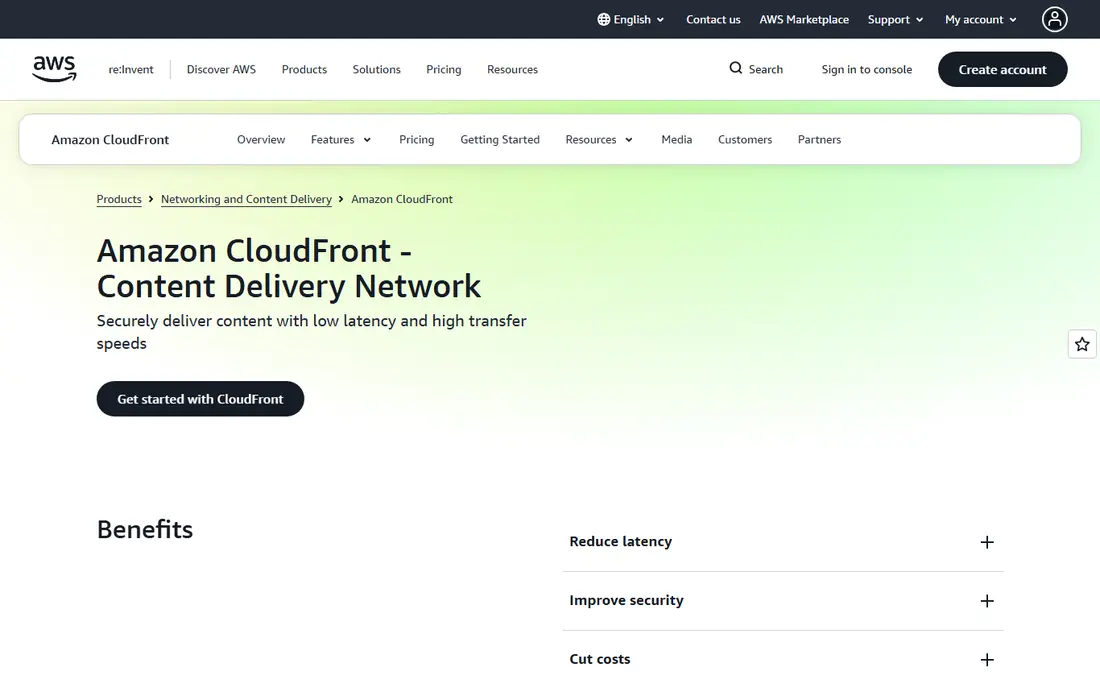
CloudFront is the natural choice for teams already running on AWS. It integrates with S3, Elastic Load Balancing and other AWS services, and billing sits inside the same AWS account. Lambda at the edge allows custom headers, redirects and authentication checks without running extra servers. The network is large, and origin shield features can cut origin load.
The pricing model takes care, because bandwidth, requests, invalidations and origin fetch fees all contribute. Teams outside AWS may find less reason to choose it over a standalone CDN. For AWS shops, though, the integration and single bill often outweigh that complexity.
- Deep integration with AWS services
- Global network with many edge locations
- Lambda at the edge for custom logic
- Pricing has several parts, including requests and origin fetch
- The console can feel complex
Google Cloud CDN fits teams that already host on Google Cloud. It works with Cloud Load Balancing, uses Google's global network, and supports signed URLs, cache keys and origin controls that app teams need. For Kubernetes and cloud-native workloads, the setup feels natural and the billing stays inside Google Cloud.
Outside Google Cloud, the case is weaker, and pricing varies by region, cache fill and egress. Teams should model total delivery cost, not just the headline egress rate. For Google Cloud users, it is a clean Akamai alternative with less extra tooling to manage.
- Tight integration with Google Cloud load balancing
- Global anycast network
- Cache and origin controls for app teams
- Best value inside Google Cloud
- Pricing varies by region and cache fill
Azure Front Door is Microsoft's global, scalable entry point for web apps, APIs and content. It combines routing, load balancing and security, with a web application firewall for protection. For teams already using Azure Active Directory, Azure App Service or Azure storage, the integration and single billing account are practical benefits.
It is not a like-for-like CDN for every use case, since it is designed as a front door for applications as well as content delivery. Pricing includes base fees plus usage, so small static sites may find a pay-as-you-go CDN cheaper. For Azure-first teams, Front Door is the sensible Akamai alternative.
- Global entry point for Azure apps
- Built-in WAF and routing rules
- Integration with Azure services
- Pricing includes base fees plus egress
- The feature set differs from a pure CDN
Edgio, formerly Limelight Networks, focuses on large sites, media and streaming delivery. It offers edge JavaScript for application logic, performance optimisation and security features aimed at high-traffic properties. Teams with video, large files or complex app delivery will find a feature set built for scale.
The sales model leans enterprise, so small sites may struggle to get a simple self-serve price. Setup and migration also take planning for large properties. For media-heavy and enterprise workloads, Edgio is a credible Akamai alternative with deep delivery experience.
- Strong media and streaming delivery
- Edge JavaScript for app logic
- Performance tooling for large sites
- Enterprise-leaning sales model
- Less suited to a quick self-serve start
Bunny.net is popular with independent developers, small stores and creators because pricing is pay-as-you-go and the dashboard is simple. It covers standard CDN delivery plus edge storage and a video streaming product, which helps sites that host files and video without a separate platform. Published rates start from around $0.01 per gigabyte in some regions, with volume pricing lower.
The security bundle is narrower than the enterprise options here, so teams facing serious bot or DDoS risk should check WAF and shielding options carefully. Support depth also varies by plan. For cost-sensitive delivery where simplicity matters, Bunny.net is an excellent Akamai alternative.
- Low pay-as-you-go rates
- Simple dashboard
- Edge storage and video streaming options
- Security bundle is narrower than Cloudflare or Imperva
- Support depth varies by plan
KeyCDN keeps the model simple, with pay-as-you-go pricing from around $0.04 per gigabyte and tiered reductions at higher volumes. Setup is quick for static sites, WordPress sites and file downloads, and the dashboard gives clear usage and reporting. Teams that want predictable, low-friction delivery without a contract will like the approach.
It does not match Fastly or Cloudflare on edge compute depth, and its network is smaller than the largest providers. For most small and mid-size sites, that gap rarely matters. For simple, affordable delivery, KeyCDN is a dependable Akamai alternative.
- Simple pay-as-you-go pricing
- Easy setup for static sites
- Real-time reporting
- Fewer edge compute options
- Smaller network than the largest providers
Imperva suits organisations where security leads the buying decision. Its CDN sits inside a wider application security platform, with a web application firewall, DDoS protection and bot management. That combination helps regulated firms, large stores and sites under frequent attack, since security rules and delivery are managed together.
Pricing is quote-based, and onboarding takes more effort than a self-serve CDN. Smaller sites may find the cost and process hard to justify. For security-first teams that need Akamai-level protection with a different vendor, Imperva is a strong alternative.
- Strong WAF and DDoS protection
- Bot management
- CDN delivery inside a security platform
- Quote-based pricing
- Setup is heavier than self-serve CDNs
How we picked these
We compared official product and pricing pages, recent CDN pricing comparisons and vendor documentation, and kept only providers that still sell CDN or edge delivery in October 2026. We weighed network reach, security, edge compute, ease of setup and pricing model, and we favoured providers with a free plan or trial where one exists. Where pricing is contract-based, we marked it as See website rather than guessing a figure.
What to check before you switch
Start with your traffic profile, including total bandwidth, request count, cache hit rate and the regions that matter most. A low per-gigabyte rate means little if cache hit rates are poor and origin costs rise. Test with real pages from your main regions, and compare time to first byte and full page load, not just a single benchmark.
Check security and edge needs next. If you rely on WAF rules, bot controls or edge code, confirm those features exist on the plan you can actually buy, not just on the enterprise tier. Plan a staged migration with DNS weighting or a second CDN, keep the old provider as a fallback, and monitor errors closely for the first two weeks.
A note on contracts
Enterprise CDN pricing is often negotiated, and headline rates can hide minimum commits, overage fees and charges for requests, invalidations and security add-ons. Ask for a total cost model based on your last three months of traffic before signing. A shorter initial term gives room to test performance and support before a long commitment.
FAQ
What is the cheapest Akamai alternative?
For small sites, Cloudflare's free plan is the cheapest start, and Bunny.net offers low pay-as-you-go rates for larger static delivery. The cheapest option depends on bandwidth, regions and security needs, so model your own traffic rather than trusting a single per-gigabyte figure. A free plan that lacks needed security may cost more later.
Is Cloudflare a full replacement for Akamai?
For most business sites, yes, since Cloudflare covers CDN, security and edge code in one platform. Very large media properties with complex delivery contracts may still prefer Akamai, Fastly or Edgio for specific performance or support reasons. Test your heaviest pages and check cache behaviour before a full switch.
Do I need a CDN for a small website?
A CDN helps when visitors are spread across regions, when pages include many static files, or when you want extra DDoS protection. A small local site with modest traffic may run fine without one. Cloudflare's free plan makes it easy to test, since you can measure speed before and after with no upfront cost.
How long does a CDN migration take?
A simple site can migrate in a day, while a large property with WAF rules, edge code and many origins may take weeks. Staged DNS changes, rule testing and monitoring add time but reduce risk. Keep the old CDN active until the new setup has run cleanly for at least a full traffic cycle.
Which Akamai alternative is best for video?
Fastly, Edgio and Bunny.net all handle video well, with streaming and storage options that suit different budgets. Edgio and Fastly suit large streaming properties, while Bunny.net suits creators and smaller services. Check support for your video format, adaptive bitrate needs and regional audience before choosing.
Can I use two CDNs at once?
Yes, multi-CDN setups are common for large sites, using DNS routing to split traffic by region or performance. This adds resilience and lets teams compare providers in production. It also adds complexity in cache purging and WAF rule syncing, so smaller sites usually do better with one well-chosen provider.
Sources
- https://www.cloudflare.com/plans
- https://www.fastly.com/pricing
- https://aws.amazon.com/cloudfront/pricing
- https://cloud.google.com/cdn/pricing
- https://azure.microsoft.com/en-us/pricing/details/front-door
- https://edg.io/pricing
- https://bunny.net/pricing
- https://www.keycdn.com/pricing
- https://www.imperva.com/products