Best Agriculture Software in 2026: 9 Tools Compared
We compared the best agriculture software for crops, livestock and farm finances, with pricing, offline use, and picks for small farms and large operations.

- Editor's choice
 AgriWebb
Livestock management
Starts at$50 per monthVisit agriwebb.comFull review - Great alternative
 Farmbrite
Small mixed farms
Starts at$29 per monthVisit farmbrite.comFull review - Also consider
 Climate FieldView
US row crop analytics
Starts atFreeVisit climate.comFull review
TL;DR:
- AgriWebb is our pick for livestock operations, with individual animal records, movements, treatments, and compliance in one place.
- Climate FieldView and Granular Insights lead for US row crops, and both offer free tiers worth trying first.
- Farmbrite suits small and mid-size mixed farms, with crop and livestock plans from $29 per month.
- Confirm offline use, data ownership, and export terms before you commit, since rural connectivity and years of records matter more than a demo.
Quick comparison
| Tool | Best for | Starts at | Free plan? | |
|---|---|---|---|---|
| AgriWebb | Livestock management | $50 per month | Yes | Visit |
| Farmbrite | Small mixed farms | $29 per month | Free trial | Visit |
| Climate FieldView | US row crop analytics | Free | Yes | Visit |
 Granular Insights | Satellite yield tracking | Free | Yes | Visit |
 Agrivi | Mixed crop and livestock farms | See website | No | Visit |
 Conservis | Large complex operations | See website | No | Visit |
 PTx Trimble | Precision agriculture and GPS mapping | Free | Yes | Visit |
 Bushel Farm | Simple small farm records | See website | Yes | Visit |
 Croptracker | Fruit and vegetable growers | See website | No | Visit |
The best agriculture software
No single tool fits every farm, because livestock, row crops, and specialty crops need different daily workflows. The tools below cover those workflows, plus finances, equipment, and compliance, and we compared official feature pages, pricing pages, app listings, and public reviews to match each tool to a farm type.
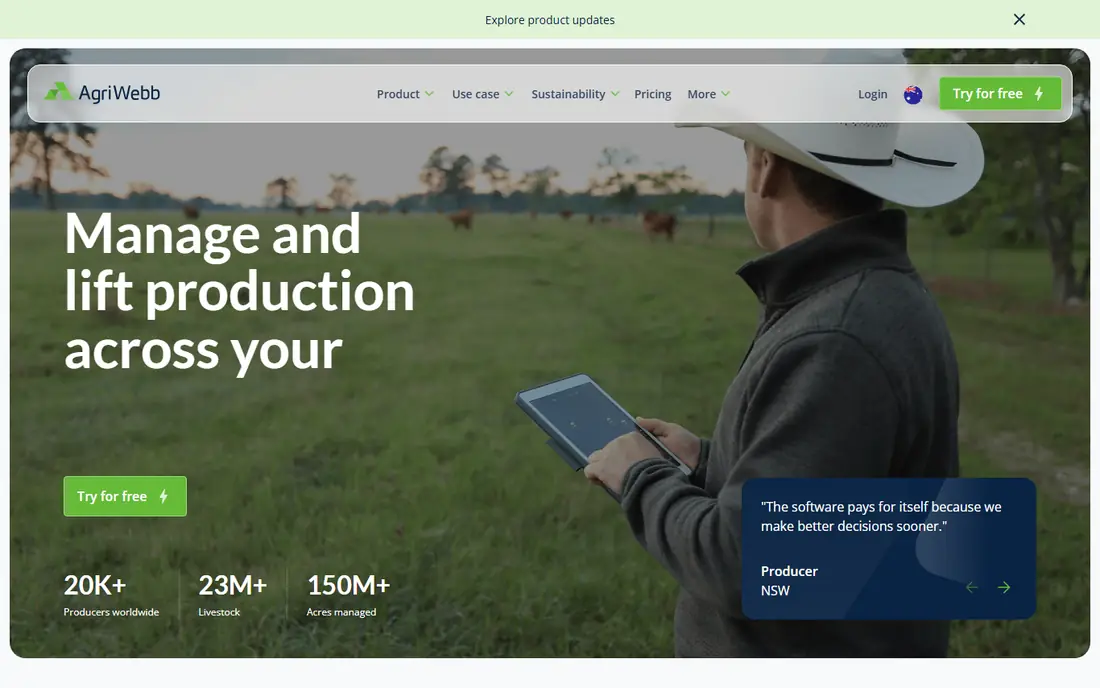
AgriWebb is built for livestock first. It tracks individual animals, movements between paddocks, treatments, weights, and breeding, and it turns those records into compliance reports that auditors and buyers accept. That depth is why it leads for cattle, sheep, and mixed livestock operations, and why it is used across 18 countries.
Crop-only farms will find AgriWebb thinner on field planning and spray records than FieldView or Agrivi, and mixed farms may pair it with a crop tool. For a livestock operation that needs clean, auditable animal records from the paddock, AgriWebb is the clearest pick in this list.
- Individual animal records and movements
- Treatment and compliance tracking
- Works across 18 countries
- Less crop depth than row-crop tools
- Paid plans start around $50 per month

Farmbrite suits the small farm that does a bit of everything: some crops, some animals, some direct sales, and a need to know what actually made money. It covers crop planning, livestock records, inventory, equipment, and financial tracking, with field mapping and a mobile app for field use. Plans start at $29 per month for livestock or crop essentials, and $59 per month for the complete suite.
The catch is that the complete suite, which most mixed farms want, costs twice the entry plan. Still, for a small farm replacing spreadsheets and notebooks, Farmbrite is one of the easiest tools to adopt, and its discounted program for new farmers helps startups get going.
- Crops and livestock in one tool
- Field mapping and financial tracking
- 14-day free trial
- Full crop plus livestock suite costs more
- No free plan, only a trial
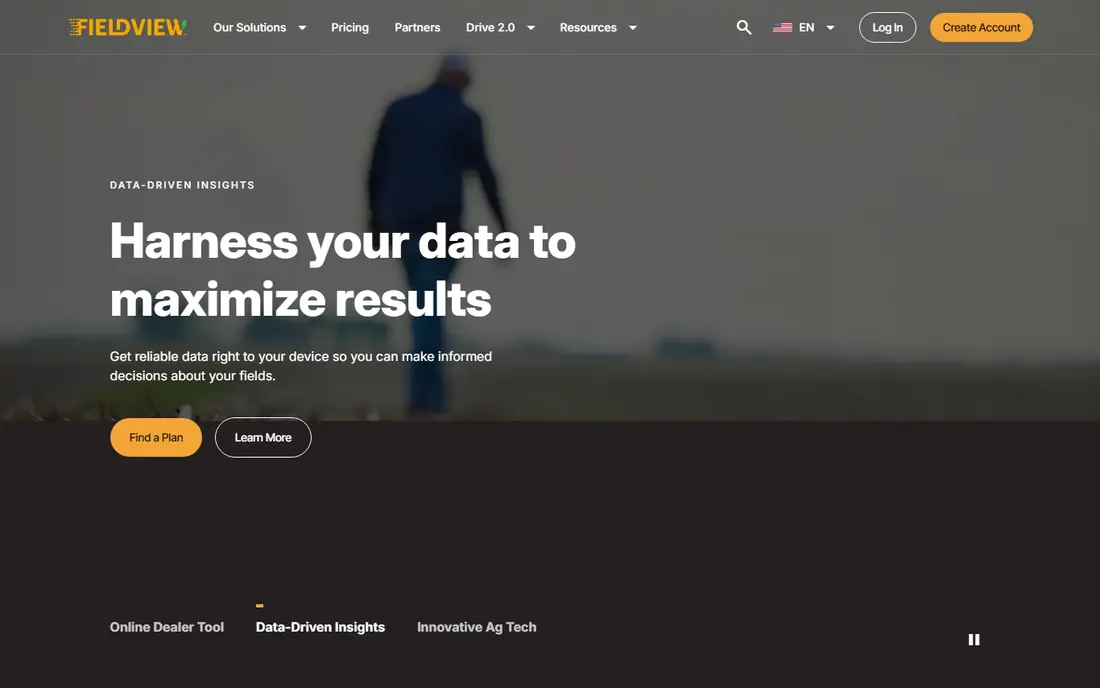
Climate FieldView, from Bayer, turns field data into decisions: planting maps, imagery, yield analysis, and field health views that help a grower spot problems early. It connects with a wide range of equipment and monitors, so data flows from the cab to the phone without retyping. A free tier lets growers start with basic field views before paying for deeper analytics.
It is most at home in US row crops such as corn and soybeans, and specialty growers may find Croptracker or Agrivi a better fit. For a row-crop operation that wants data-driven field decisions without a large upfront software bill, FieldView is a strong first trial.
- Strong field imagery and yield analysis
- Wide equipment compatibility
- Free tier to start
- Best for US row crops
- Advanced features and hardware add cost
Granular Insights, from Corteva, gives growers satellite imagery, field health, and yield tracking at no software cost, which makes it an easy second tool beside a record-keeping system. Its field-level views help a grower compare fields, track growth, and plan harvest order without new hardware.
Buyers should note a recent split: profit and cost tracking features that once sat with Granular now sit with Traction Ag, a separate product. Granular Insights remains strong for imagery and agronomy, but growers who need full profit tracking should check Traction Ag or Bushel Farm as well. As a free agronomy layer, Insights is hard to beat.
- Free satellite imagery and field insights
- Simple field-level views
- From Corteva
- Profit and cost tracking now sits with a separate product
- Less livestock depth
Agrivi is a strong pick for farms outside the US, and for mixed operations that need crop planning plus livestock records in one system. It covers crop planning, pest and disease management, input inventory, weather alerts, and farm analytics, with a depth on agronomy that suits professional growers. Its international footprint makes it a natural choice where US-centric tools fit less well.
Pricing is not published and no free trial is listed, so buyers must contact the vendor for a quote and a demo. That friction is the main downside. For a mid-size farm that wants one system for crops and livestock, and that can run a proper demo, Agrivi deserves a close look.
- Detailed crop planning and pest management
- Input inventory and weather alerts
- International coverage
- Pricing not published
- No free trial listed
Conservis is built for large, complex farms with multiple entities, contracts, and inventories to track. It handles grain contracts, inventory movements, work orders, and financial reporting at a scale where spreadsheets break, and it suits operations that need controls and audit trails across teams. That enterprise depth is its main strength.
Small farms should skip it. Conservis is priced by quote, needs implementation, and will feel heavy for a single-family operation. For a large farm group that needs one system of record across entities, it is one of the few tools built for that job from the start.
- Built for large multi-entity operations
- Strong inventory and contract tracking
- Enterprise workflows
- Quote-based pricing
- More system than a small farm needs
PTx Trimble, formerly Trimble Ag Software, is the precision agriculture pick in this list. It maps fields with GPS accuracy, tracks inputs and yields by location, and syncs with Trimble displays and equipment in the cab. A free Farmer Starter plan lets growers try core mapping and records, with Farmer Core listed at $199 per year for deeper features.
The catch is hardware. The full value arrives when the farm already runs Trimble displays, and display connections add cost, listed in past pricing at $99 per display per year. For a precision-focused farm already in the Trimble world, PTx is the natural system. For others, FieldView or Granular Insights may be cheaper to start.
- GPS field mapping and equipment integration
- Free Farmer Starter plan
- Strong precision depth
- Most value needs Trimble displays
- Display connection adds cost per display
Bushel Farm, formerly FarmLogs, is built for small farms that want simple profit tracking without a steep learning curve. It records field activities, inputs, and costs, and turns them into per-field profit views that help a grower see which fields actually pay. A free tier makes it easy to start, and its simplicity is the point.
Larger or more complex operations will outgrow it and need Conservis, Agrivi, or Granular plus Traction Ag. Buyers should also confirm current features, since the product has changed names and owners in recent years. For a small farm that wants clear profit answers fast, Bushel Farm is a good first system.
- Simple profit and cost tracking
- Grew from FarmLogs
- Free tier for small farms
- Less depth than enterprise tools
- Ownership changes mean checking current features matters
Croptracker is the specialty crop pick, built for fruit and vegetable growers who need harvest records, packing, labor, and traceability, not just broadacre field maps. It tracks a crop from field to packhouse, which matters for food safety audits and buyer requirements in fresh produce. Its mobile app is designed for field use with offline sync.
Row-crop growers will find FieldView or Granular Insights simpler for their needs, and pricing is not published, so a quote is needed. For a produce operation that needs traceability and packhouse records, Croptracker fits the daily workflow better than any general farm tool here.
- Built for specialty crops
- Harvest, packing, and traceability workflows
- Offline mobile use
- Pricing not published
- Less suited to broadacre row crops
How we picked these
We compared official feature pages, pricing pages, app listings, and public reviews, and we kept only tools that exist and work today and that truly fit agriculture, meaning farm management, crop planning, livestock records, or precision agriculture. Generic accounting software and generic mapping tools did not make the cut. Where pricing was not published, we wrote See website rather than guessing.
We also weighed farm type over brand fame. A tool that leads for livestock does not lead for row crops, and a tool that suits a 10,000-acre operation will overwhelm a 100-acre farm. That is why the notes match each tool to a farm type, and why offline use and data ownership get as much weight as features.
What to check before you pay
Test offline use in your own fields, not just in a demo. Record a treatment, a planting, and a harvest entry with no signal, then sync when you are back in range, and check that nothing is lost or duplicated. Rural connectivity is uneven, and a tool that needs constant signal will fail on the days you need it most.
Next, read the data policy before you sign. Confirm that you own your farm data, that you can export it in standard formats, and what happens on cancellation. Years of per-field profit history are an asset, and a tool that locks that history behind an export fee is a bad long-term deal. Finally, trial with one real field or one real mob for a full season cycle before rolling a tool out to the whole farm.
FAQ
What is the best agriculture software for small farms?
Farmbrite and Bushel Farm are the strongest small-farm picks. Farmbrite covers crops and livestock from $29 per month with a 14-day trial, while Bushel Farm offers a free tier for simple profit tracking. Small farms should start with a free tier where possible and upgrade only when records outgrow it.
What are the best agriculture apps for livestock?
AgriWebb leads for livestock, with individual animal records, movements, treatments, and compliance across 18 countries. Farmbrite is a good mixed option when a farm also grows crops. Both offer mobile apps for paddock use, so check offline sync before choosing.
What is the best farm management software for row crops?
Climate FieldView and Granular Insights lead for US row crops. FieldView offers strong imagery and equipment links, while Granular Insights offers free satellite yield tracking. PTx Trimble leads when GPS precision and Trimble equipment integration matter most.
Can farm management software work offline?
Most leading apps, including AgriWebb, FieldView, and Croptracker, offer mobile apps designed for field use with offline capability that syncs when connectivity returns. Confirm offline behavior for your exact workflows before buying, since sync rules differ by feature.
Who owns my farm data?
It depends on the vendor's terms. Most platforms state that the grower owns the data, but export formats and cancellation terms vary. Read the data policy before signing, and prefer vendors that guarantee full export in standard formats.