Roxhill Alternatives in 2026: 6 Options Vetted
Looking for Roxhill alternatives in 2026? I compare six media database and journalist contact tools from vendor documentation and public sources.
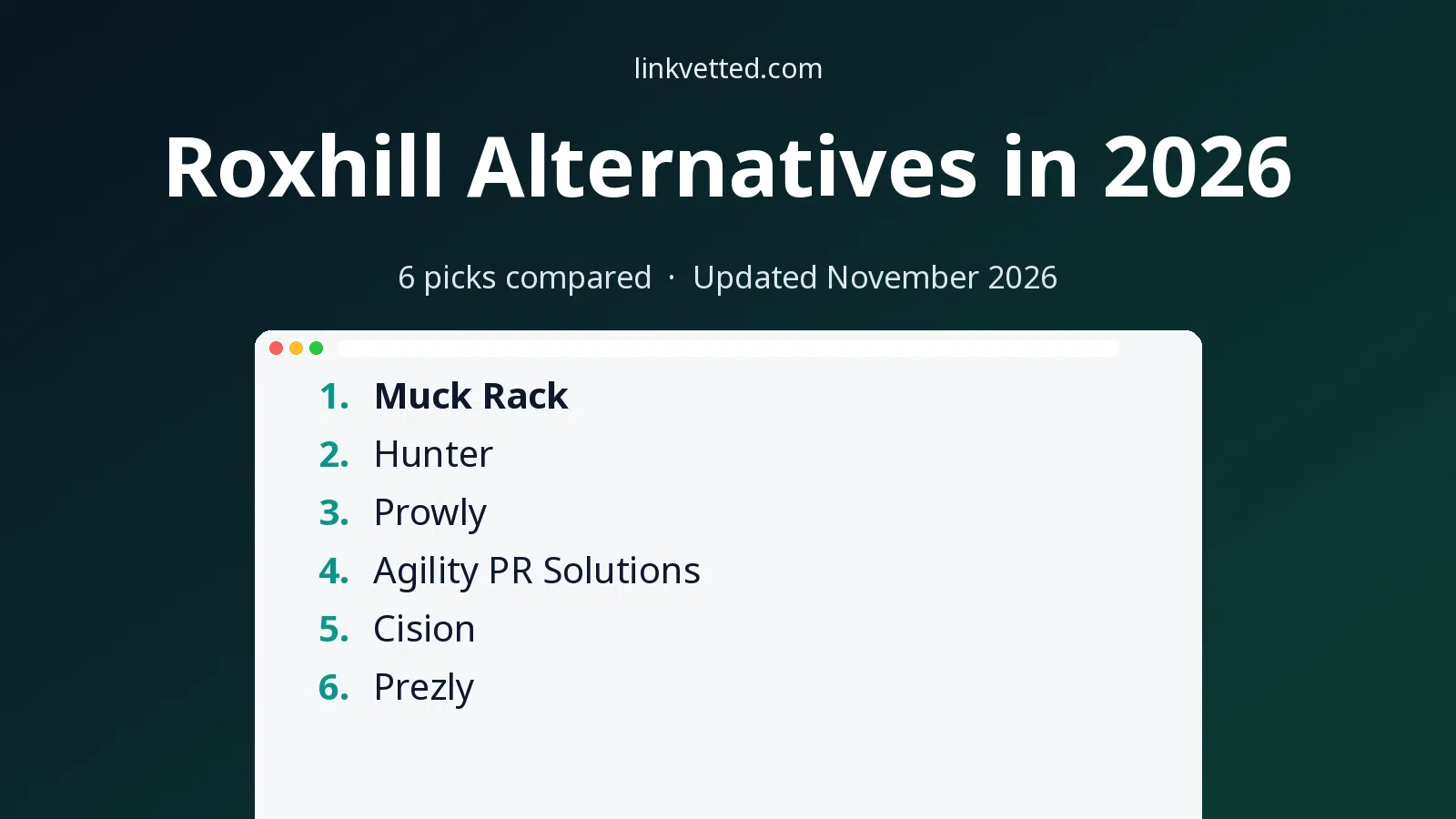
- Editor's choice
 Muck Rack
Database, monitoring and reporting in one
Starts atSee websiteVisit muckrack.comFull review - Great alternative
 Hunter
Finding and verifying email addresses
Starts atSee websiteVisit hunter.ioFull review - Also consider
 Prowly
Small PR teams wanting one workspace
Starts atSee websiteVisit prowly.comFull review
Direct answer
My first pick for most teams is Muck Rack, because it combines a journalist database with monitoring and reporting in one place. If you mainly need contact data at a lower commitment, Hunter is a practical second choice. For teams that want an all-in-one PR platform with media relations built in, Prowly is the third option. People look for Roxhill alternatives because they want different pricing structures, broader databases, extra features like monitoring, or a tool that fits a smaller team's workflow.
TL;DR:
- Roxhill alternatives fall into two groups: dedicated media databases and broader PR platforms that include contact data.
- Muck Rack suits teams that want database, monitoring and reporting under one login.
- Hunter is a contact-finding tool first, so it fits outreach workflows better than full PR campaigns.
- Prowly and Agility PR Solutions bundle media relations with other PR functions such as monitoring and pitching.
- Check how each vendor sources and updates journalist records before you commit, since coverage varies by country and beat.
Last checked November 2026. Plan prices are not quoted in this guide because they change often; see each vendor's own pricing page for current figures before you buy.
Quick comparison
| Tool | Best for | Starts at | Free plan? | |
|---|---|---|---|---|
| Muck Rack | Database, monitoring and reporting in one | See website | Not stated | Visit |
| Hunter | Finding and verifying email addresses | See website | Free plan | Visit |
| Prowly | Small PR teams wanting one workspace | See website | Free trial | Visit |
 Agility PR Solutions | Monitoring and measurement for mid-size teams | See website | Not stated | Visit |
 Cision | Large teams with complex PR workflows | See website | Not stated | Visit |
 Prezly | Newsroom publishing plus pitching | See website | Free trial | Visit |
The best Roxhill alternatives compared
I put this comparison together from vendor documentation and public sources, not from hands-on testing. I looked at what each product says it does, which workflows it supports, and where its limits are, then matched those to common PR and outreach needs. Treat it as a starting map, not a lab result.
Muck Rack is a PR platform built around a searchable journalist database, with monitoring and reporting layered on top. It fits in-house PR teams and agencies that run regular outreach and need to show coverage results. If your main job is finding the right reporter and tracking what happens after you pitch, this is the closest like-for-like replacement for a media database.
In practice, you search by beat, outlet or location, build media lists, and send pitches from the platform. Coverage monitoring then feeds into reports, which saves you from stitching together a database tool and a separate monitoring service. For teams comparing Roxhill alternatives, that combination is the main draw.
The limit is commitment. Pricing is quote-based, and the platform has more surface area than a small team may need. Solo consultants who only want contact records should look at lighter tools first.
- Large journalist database
- Media monitoring included
- Reporting and coverage tracking
- Pricing requires a quote
- Heavier than a simple contact tool
Hunter is an email discovery and verification tool. You give it a domain and it returns public email addresses associated with it, which is useful when you already know which publications you want to pitch. It fits link builders and PR people who do their own research rather than relying on a curated journalist database.
For Roxhill alternatives, Hunter plays a different role. Instead of browsing a media database, you find the outlet's domain, pull candidate addresses, and verify them before sending. That workflow is fast for small, targeted campaigns and works well alongside a spreadsheet or a lightweight CRM.
One limit is that Hunter does not tell you which journalist covers which beat, and it does not monitor coverage. If your outreach depends on beat-level targeting and reporting, you will still need a media database.
- Email finding and verification
- Domain search for outlet contacts
- Works with common outreach tools
- No media monitoring
- Not built as a PR database
Prowly is a PR platform that combines a media database, pitching tools, a hosted newsroom and coverage monitoring. It is aimed at small and mid-size PR teams that want one workspace instead of several subscriptions. Agencies that handle several clients from one account tend to like the structure.
As a Roxhill alternative, Prowly covers the contact side but adds publishing and campaign tracking. You can build lists, send pitches, publish releases to a branded newsroom, and check coverage in the same place. That reduces the number of tools a small team has to manage.
Its media database is not as large as the biggest vendors', so niche beats in some markets may be thin. Teams with very broad global media lists should check coverage in their target countries before committing.
- Media database plus newsroom
- Pitch and campaign tools
- Coverage monitoring
- Database is smaller than the largest vendors
- Best value at team level
Agility PR Solutions is a PR software suite with a media database, monitoring, measurement and outreach tools. It suits mid-size PR and communications teams that need to prove results to stakeholders, not just send pitches. The measurement side is the part that stands out.
For this list, Agility works as a Roxhill alternative when you want contact data plus ongoing coverage tracking. You can build media lists, distribute releases and then measure pickup across outlets. That loop is useful for teams that report monthly.
The trade-off is complexity. The platform has many modules, and solo users may find it heavier than they need. Expect a sales conversation before you see pricing.
- Media database and monitoring
- Measurement and reporting
- Media outreach tools
- Interface can feel heavy
- Pricing needs a sales conversation
Cision is one of the longest-running names in PR software, with a media database, monitoring, analytics and distribution tools. It fits enterprise and large agency teams that need broad coverage across markets and a formal reporting setup. If your organisation already uses Cision elsewhere, staying in the same ecosystem can simplify procurement.
As a Roxhill alternative, Cision covers the database need and adds monitoring and analytics. You can search for journalists, build lists, distribute releases and track coverage. The breadth is the point: one vendor covers most of the PR workflow.
The drawback is weight. Smaller teams may find the interface and contract process more than they need, and pricing is not published. Check whether your target markets are well covered before you commit.
- Large media database
- Monitoring and analytics
- Established PR workflow tools
- Large platform with a learning curve
- Pricing is quote-based
Prezly is a PR platform centred on publishing. It gives you a branded newsroom, contact management and pitching tools in one place. It fits teams that publish releases regularly and want the newsroom and the outreach to live together, rather than bolting a newsroom onto a separate database.
For Roxhill alternatives, Prezly is the pick when publishing matters as much as contact data. You can keep media lists, send pitches and host releases on your own newsroom, which helps with consistency and with giving journalists a single link.
It is not a pure media database, so if your main need is deep journalist search across many markets, a dedicated vendor will fit better. Treat Prezly as a publishing-led alternative rather than a direct database swap.
- Branded newsroom
- Contact and pitch tools
- Clean publishing workflow
- Not primarily a contact database
- Smaller database than dedicated vendors
How I chose
I built this list from vendor documentation and public sources. I read each product's own pages on features, workflows and coverage, then compared them against the jobs people usually want a media database to do: find journalists, build lists, send pitches and track coverage. I did not run hands-on tests, so I am describing what each vendor says it offers rather than my own trial results.
The second filter was fit and limits. I looked at whether a tool is a dedicated media database or a broader PR platform, because that changes what you get for your effort. I also noted where pricing is quote-based and where a product is clearly aimed at larger teams. The aim is to help you shortlist, not to declare a winner for every situation.
What to check before you buy
- Confirm how many journalists in your target countries and beats are covered, and ask for a sample search.
- Ask how often records are updated and how the vendor sources contact details.
- Check whether monitoring and reporting are included or sold as separate modules.
- Confirm the contract length and whether you can export your media lists if you leave.
- Ask whether the tool supports the outreach channels you use, such as email pitching or newsroom publishing.
- Request a walkthrough of the workflow you will actually run, not just a feature list.
FAQ
Why do people look for Roxhill alternatives?
People look for alternatives when they want a different pricing model, a larger database in certain markets, or extra features such as media monitoring and reporting. Some teams also want a tool that fits a smaller workflow or one that bundles publishing with outreach. The right choice depends on whether you mainly need contact data or a full PR platform.
Is Muck Rack a good replacement for a media database?
Muck Rack combines a journalist database with monitoring and reporting, so it covers the core media database job and adds coverage tracking. It suits teams that run regular outreach and need to report results. Pricing is quote-based, so ask for a walkthrough and a sample search in your target markets before deciding.
Can I use Hunter instead of a media database?
Hunter finds and verifies email addresses by domain, which helps when you already know which outlets to target. It does not tell you which journalist covers which beat, and it does not monitor coverage. It works best as a companion to a media database or for small, targeted campaigns where you do your own research.
Are these tools only for large PR teams?
No. Prowly and Prezly are aimed at smaller teams and solo practitioners, while Cision and Agility PR Solutions tend to fit larger organisations. Muck Rack and Hunter sit in between depending on the plan. Match the tool to your workflow and the markets you cover rather than to company size alone.
What should I ask before switching tools?
Ask for a sample search in your target countries and beats, confirm how records are updated, and check whether monitoring and reporting are included. Also confirm contract length, data export options and whether onboarding support is provided. A short trial or walkthrough of your actual workflow will tell you more than a feature list.
Sources
- https://muckrack.com
- https://hunter.io
- https://prowly.com
- https://www.agilitypr.com
- https://www.cision.com
- https://www.prezly.com